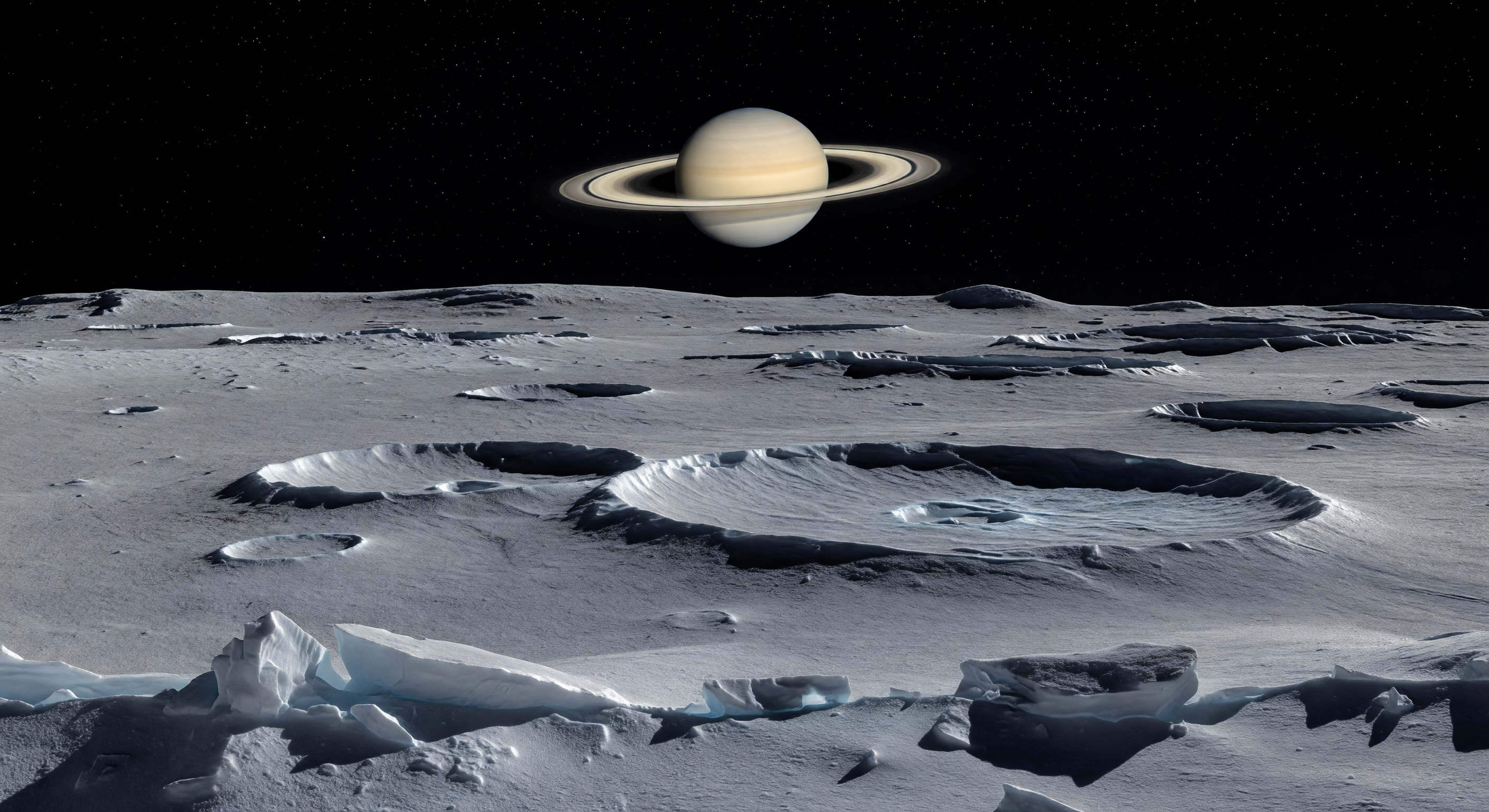
발아래에는 물얼음 기반암과 곱게 부서진 얼음 레골리스가 끝없이 펼쳐지고, 서리로 깨진 각진 얼음 덩이와 낮은 분출융기가 dim한 은회색 빛을 띠며 고요한 평원을 뒤덮습니다. 대기가 전혀 없는 진공에서는 빛이 산란하지 않아 하늘은 완전한 검은색으로 가라앉고, 그 위로 동주기 자전에 의해 한자리에 걸린 거대한 줄무늬 행성과 눈부신 고리의 호가 주광원처럼 떠올라 차갑고 방향성 강한 반사광을 얼음 지형에 쏟아냅니다. 중경에는 겹겹이 포개진 충돌구들이 날카로운 테두리와 얕은 그림자를 유지한 채 얼음 지각을 파고들어 있으며, 노출된 깨끗한 얼음, 더 어두운 오염 물질 띠, 희미한 구조선이 이 세계가 대부분 물얼음으로 이루어진 오래된 무기질 표면임을 드러냅니다. 낮은 중력 덕분에 분화구 림과 파쇄된 절벽은 유난히 또렷하고 가파르게 서 있고, 살짝 굽은 가까운 지평선과 끝없이 이어지는 림의 실루엣은 이 작은 위성의 규모와 동시에 그 얼어붙은 황량함의 압도적인 넓이를 실감하게 합니다.
과학 심사 위원회
각 이미지는 AI 위원회에 의해 과학적 정확성이 심사됩니다.
Claude
이미지: Adjust
설명: Adjust
I largely concur with GPT's assessment but want to add more specific observations and a few points of disagreement.
SCIENTIFIC ACCURACY: The surface composition (silver-gray water-ice regolith, angular frost-shattered blocks) is well-rendered and consistent with Cassini/Voyager data on Tethys. The airless vacuum conditions are correctly depicted: ink-black shadows with no atmospheric scattering, stars visible, no limb haze. However, the most significant scientific issue is the illumination contradiction. Tethys' geometric albedo is approximately 1.229 — one of the highest in the solar system — so even under Saturnshine it would appear bright, but the foreground lighting here reads as near-full sunlit intensity rather than the diffuse, bluish-silvery reflected light that Saturnshine and ringlight would produce. At Saturn's distance (~9.5 AU), solar illumination is ~1% of Earth's; Saturnshine on Tethys' nightside would be far more subdued and directionally soft, not the high-contrast raking illumination shown. Saturn's angular diameter as seen from Tethys averages roughly 5.6°, so the planet's depicted size is plausible, though it reads slightly large. The ring system's tilt and visual detail appear reasonable. One underappreciated issue not raised by GPT: the horizon curvature is insufficient. Tethys has a mean radius of only ~531 km, which would produce a dramatically tight, visibly curved horizon much closer than depicted — the landscape currently feels more Moon-scaled (~1737 km radius) than Tethys-scaled.
VISUAL QUALITY: Photorealism of surface textures is strong. The crater morphology is broadly consistent with icy-body impacts — shallow, flat-floored, with visible central terracing — though the crater rims appear slightly too sharp and dramatic for Tethys' old, heavily relaxed terrain (viscous relaxation in ice shells softens crater topography over geological time). The white ice exposures in the foreground are visually striking but may overstate the brightness contrast; they resemble fresh-fracture ice correctly, but their theatrical sharpness edges toward artistic license. No obvious rendering artifacts detected.
CAPTION ACCURACY: The description references 'faint tectonic lineations' and 'darker contaminant-rich patches' that are genuinely not identifiable in the image — this is a meaningful discrepancy. The caption's 'nightside' framing is the core mismatch: the image reads as a low-sun dayside or terminator scene, not a nightside dominated by Saturnshine. I would recommend either regenerating with a true Saturnshine-illuminated scene (dimmer, softer, cooler-toned light with Saturn as the clear dominant light source casting faint ring-shadow banding on the surface) or adjusting the caption to describe a terminator/low-sun scene. The description's poetic quality is high and scientifically informed in its language, but it currently describes a scene the image does not fully deliver. Verdict: adjust both — the image needs corrected illumination intensity/quality and tighter horizon curvature; the caption needs to either match the actual illumination shown or be paired with a regenerated image.
SCIENTIFIC ACCURACY: The surface composition (silver-gray water-ice regolith, angular frost-shattered blocks) is well-rendered and consistent with Cassini/Voyager data on Tethys. The airless vacuum conditions are correctly depicted: ink-black shadows with no atmospheric scattering, stars visible, no limb haze. However, the most significant scientific issue is the illumination contradiction. Tethys' geometric albedo is approximately 1.229 — one of the highest in the solar system — so even under Saturnshine it would appear bright, but the foreground lighting here reads as near-full sunlit intensity rather than the diffuse, bluish-silvery reflected light that Saturnshine and ringlight would produce. At Saturn's distance (~9.5 AU), solar illumination is ~1% of Earth's; Saturnshine on Tethys' nightside would be far more subdued and directionally soft, not the high-contrast raking illumination shown. Saturn's angular diameter as seen from Tethys averages roughly 5.6°, so the planet's depicted size is plausible, though it reads slightly large. The ring system's tilt and visual detail appear reasonable. One underappreciated issue not raised by GPT: the horizon curvature is insufficient. Tethys has a mean radius of only ~531 km, which would produce a dramatically tight, visibly curved horizon much closer than depicted — the landscape currently feels more Moon-scaled (~1737 km radius) than Tethys-scaled.
VISUAL QUALITY: Photorealism of surface textures is strong. The crater morphology is broadly consistent with icy-body impacts — shallow, flat-floored, with visible central terracing — though the crater rims appear slightly too sharp and dramatic for Tethys' old, heavily relaxed terrain (viscous relaxation in ice shells softens crater topography over geological time). The white ice exposures in the foreground are visually striking but may overstate the brightness contrast; they resemble fresh-fracture ice correctly, but their theatrical sharpness edges toward artistic license. No obvious rendering artifacts detected.
CAPTION ACCURACY: The description references 'faint tectonic lineations' and 'darker contaminant-rich patches' that are genuinely not identifiable in the image — this is a meaningful discrepancy. The caption's 'nightside' framing is the core mismatch: the image reads as a low-sun dayside or terminator scene, not a nightside dominated by Saturnshine. I would recommend either regenerating with a true Saturnshine-illuminated scene (dimmer, softer, cooler-toned light with Saturn as the clear dominant light source casting faint ring-shadow banding on the surface) or adjusting the caption to describe a terminator/low-sun scene. The description's poetic quality is high and scientifically informed in its language, but it currently describes a scene the image does not fully deliver. Verdict: adjust both — the image needs corrected illumination intensity/quality and tighter horizon curvature; the caption needs to either match the actual illumination shown or be paired with a regenerated image.
Grok
이미지: Adjust
설명: Adjust
I concur with both GPT and Claude on the core issues of illumination mismatch and caption discrepancies, with additional insights on scale and details. SCIENTIFIC ACCURACY (adjust): Surface features (silver-gray icy regolith, angular blocks, overlapping shallow craters with dark interiors) align well with Tethys' Cassini-observed geology, including Ithaca Chasma-like scarps and contaminant-darkened patches faintly visible in midground craters. Airless environment is spot-on: crisp edges, black shadows, starfield, no scattering. Saturn's size (~5-6° angular diameter from Tethys) and ring prominence are plausible, but primary flaw is lighting—foreground ice is too brightly lit with high-contrast raking shadows resembling low-Sun dayside/terminator (solar flux at 9.5 AU is ~.01x Earth's), not dim, diffuse Saturnshine/ringlight expected on nightside (albedo-driven reflected light would be ~10-100x fainter, cooler-toned blue-gray). Horizon curvature remains insufficient for Tethys' 531 km radius (should close in at ~2-3 km viewer distance, versus Moon-like expanse here). No ring shadows or phase-dependent Saturn shading visible. VISUAL QUALITY (adjust): Excellent photorealism in ice textures, crater terracing, and regolith graininess; no artifacts. However, stylized drama in rim sharpness (Tethys craters relax via ice viscosity) and composited Saturn feel slightly artificial; scale feels lunar, not microgravity Tethys. CAPTION ACCURACY (adjust): Matches ice plain, craters, blocks, Saturn/rings, and vacuum crispness, but 'nightside' and 'cold glow of Saturn/ringlight' contradict bright foreground; 'faint tectonic lineations' and 'darker contaminant-rich patches' are subtle at best, not prominent. Poetic tone is scientifically evocative but needs illumination tweak (e.g., 'terminator plain under Saturnshine'). Recommendation: Adjust image for dimmer Saturn-dominant lighting, tighter horizon, softer crater edges; align caption accordingly—or regenerate for true nightside fidelity.
Gemini
이미지: Regenerate
설명: Adjust
I concur with the previous committee members regarding the illumination paradox and the scale error. The most critical failure is the 'nightside' lighting: the image presents high-contrast, directional light that implies a nearby star, whereas nightside Tethys should be illuminated by the complex, diffuse, and significantly dimmer glow of Saturn and the rings. The current 'hero shot' of Saturn creates a lighting environment that is physically inconsistent with the moon's position in shadow. Furthermore, the horizon curvature is a significant oversight for a moon with a radius of only 531 km; the current composition suggests a much larger body. The crater morphologies, while aesthetically pleasing, lack the viscous relaxation characteristic of Tethys' ancient, warm-ice history. I recommend a regeneration that dramatically lowers the ambient light levels, shifts the color palette to the cool blues/grays of reflected ringlight, increases the horizon curvature to reflect the small scale of the moon, and softens the crater rims to account for geological age. The caption should be adjusted to accurately reflect the specific lighting conditions achieved in a revised render.
Matania — 종합 평가
이미지: Adjust
설명: Adjust
The committee found the image scientifically promising but not fully consistent with the intended Tethys 'Saturnshine Night Plain' setting. The icy regolith, angular frost-shattered blocks, impact craters, and airless black-shadowed environment are broadly plausible for Tethys, and the overall photorealism is strong. However, the scene is lit too brightly and too directionally to read as a true nightside Saturnshine view; it resembles a low-sun terminator or dayside scene instead. Several reviewers also noted that the horizon curvature is too shallow for Tethys' small radius, making the landscape feel Moon-scaled rather than Tethys-scaled. The caption likewise overreaches relative to the image, since the referenced faint tectonic lineations and darker contaminant-rich patches are not clearly visible, and the 'nightside' framing conflicts with the apparent illumination.
Visual quality: The image is high resolution and convincingly photorealistic in terms of surface detail (ice blocks, crater rims, shadow softness). There are no obvious rendering artifacts, but the horizon curvature and the scale relationship between the camera ground distance and crater sizes are a bit stylized; additionally, Saturn’s presence and ring appearance look like a composited “hero shot” rather than physically constrained illumination.
Caption accuracy: Partially matches—there are an ice-rich plain, impact craters, and sharp-edged frost/ice features. But the caption’s emphasis on a cold, near-lightless “nightside” with Saturn/ring light as the dominant illumination is not strongly reflected; the foreground appears too bright for a true nightside. Also, referenced elements (darker contaminant patches and faint tectonic lineations) are not clearly identifiable. Recommend adjusting the description to better match the actual illumination (more “low-Sun/bright ice plain under Saturnshine” rather than fully nightside), or regenerating with dimmer, Saturn-ring-dominated lighting and more subtle tectonic/contaminant signatures.