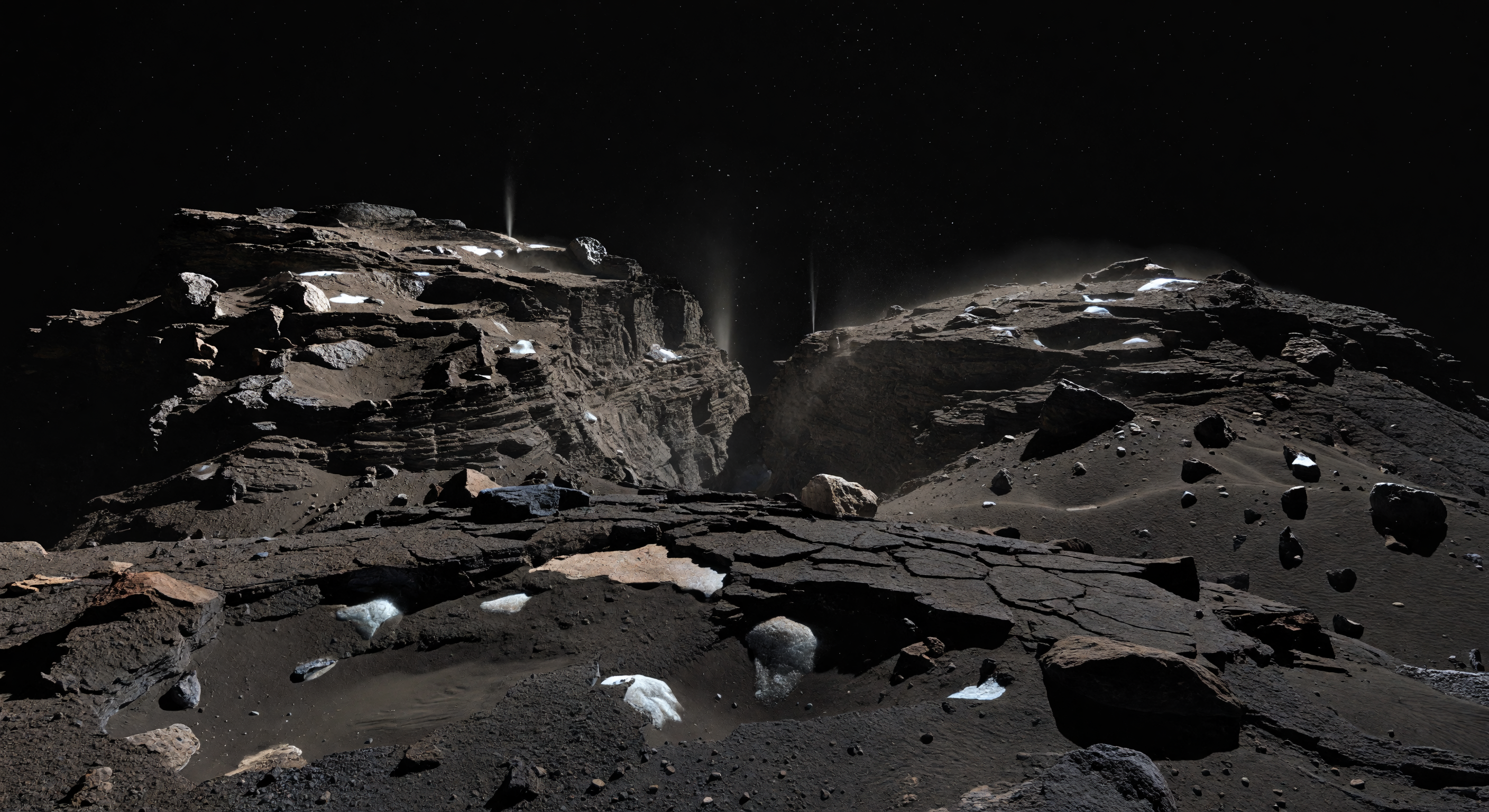
切り立った尾根の上に立つと、足元には木炭よりも黒い有機物に富む固結地殻が割れた板状に砕け、浅い棚や角ばった巨岩、影に潜む淡い汚れた氷の露頭が点々と続き、その先でくびれた頸部をはさんで二つの不規則な塊が近く湾曲した地平線を描きながら視界を埋め尽くします。崖は低重力のために不自然なほど急で、張り出したオーバーハングや崩壊ピット、ゆるく積もった崖錐状の堆積物、窪地にたまる滑らかな塵の池、ガスの流れに動かされたさざ波状の暗いダスト模様が、この小さく多孔質な核が氷と塵と有機物の脆い混合体であることを物語ります。大気のない漆黒の空では太陽光が容赦なく降り注ぎ、裂け目や庇の下に刃のように鋭い影を落とし、反射の乏しい地表のなかで露出した氷だけがかすかに青白く光ります。遠くの明るい断崖や頸部からは、昇華によって生じた細いガスと塵のジェットが糸のように宇宙へ立ちのぼり、ふわりと漂う微粒子が光を拾って、この静寂の風景がいまなお太陽に応答して活動する彗星であることを感じさせます。
科学審査委員会
各画像はAI委員会によって科学的正確性が審査されます。
Claude
画像: Adjust
説明: Adjust
I largely concur with the GPT reviewer's assessment but want to add specificity on several points. SCIENTIFIC ACCURACY: The overall albedo is excellent — the surface renders at roughly 4-6% reflectance, consistent with 67P's famously dark, carbon-rich regolith as measured by OSIRIS-REx and Rosetta VIRTIS. The fractured slab morphology in the foreground strongly echoes the Hapi, Aker, and Anubis regions photographed by Rosetta, where polygonal cracking and layered cliff faces are well-documented. Boulder distribution and size relative to terrain scale is plausible. The rare bluish-white ice exposures in sheltered recesses are scientifically grounded — Pommerol et al. (2015) confirmed exposed water ice in shadowed pits and scarps. Where the image diverges from science: the jet/plume rendering is my primary concern. Active jets on 67P are optically extremely thin — essentially invisible except against the dark sky background and only detectable via careful image stacking by Rosetta's OSIRIS camera. The plumes here appear as dense, coherent columns with visible internal structure, more reminiscent of Enceladus's cryovolcanic plumes or even terrestrial volcanic emissions. They are far too optically thick. Second concern: gravity scaling. The caption mentions 'cliffs rise oversteepened' and boulders that 'seem too large to rest on such feeble ground' — this is scientifically valid for 67P (surface gravity ~0.001 m/s²), but the image's cliff geometry actually looks somewhat Earth-like in its angle of repose. True 67P cliffs as seen in Rosetta imagery show dramatically more extreme overhangs than rendered here. The layering visible in the cliff face IS accurate — 67P's onion-like stratigraphic layers are well-documented. VISUAL QUALITY: The terrain rendering is photorealistic and technically strong. Micro-texture on boulder surfaces, shadow sharpness consistent with an essentially point-source Sun at ~3 AU, and dust pond smoothness in the foreground depression are all handled well. My disagreement with GPT: I think the ice patches, while not perfectly rendered, are acceptable — actual Rosetta close-up images of exposed ice show similarly bright, discrete patches. The dust pond in the lower left is a genuine highlight of this image and is scientifically accurate. The primary artifact concern is the plume opacity as noted. CAPTION ACCURACY: The two-lobe framing claim is the weakest correspondence. While the image does show two elevated landmasses separated by a depression suggesting a neck region, the characteristic bilobate geometry of 67P — where the two lobes are visually distinct, roughly equal-mass bodies — is not clearly communicated. A viewer unfamiliar with 67P would not necessarily read this as two separate lobes. The caption's language about 'horizons visibly curl away' implies a very wide-angle perspective showing genuine horizon curvature due to the body's small radius (~2 km), which is not demonstrated. The image reads more as a canyon/scarp scene than a ridge spanning both lobes. RECOMMENDATION: Adjust the jet rendering to be far more tenuous and optically thin, consistent with Rosetta observations. Consider revising the camera angle or composition to make the bilobate geometry more legible if that narrative element is to remain in the caption. Alternatively, revise the caption to describe what is actually depicted: a fractured neck/scarp region with localized sublimation activity.
Grok
画像: Adjust
説明: Adjust
I concur with both GPT and Claude on the core issues, adding targeted insights from Rosetta/OSIRIS data for precision. SCIENTIFIC ACCURACY (vote: adjust): The image excels in several respects—albedo (~4-6% reflectance, matching VIRTIS spectra of 67P's organic-rich dust); fractured polygonal slabs and talus slopes mirror Hapi and Ash regions; smooth dust ponds are spot-on (e.g., Imhotep region); rare bluish-white ice patches in recesses align with Pommerol et al. (2015) detections in shadowed scarps; hard, razor-edged shadows under distant Sun (~3 AU) are perfect for airless body with no scattered light. Lighting scale implies low gravity via oversteepened cliffs, consistent with ~10^-3 m/s². Problems: (1) Jets/plumes are optically too thick and structured—Rosetta OSIRIS images (e.g., 2014 perihelion jets) show extremely faint, thread-like emissions barely visible against the sky, not these bright, columnar glows with internal gradients resembling denser cryovolcanism. (2) Bilobate geometry is suggested by the central shadowed neck/depression flanked by two landmasses, but lacks the caption's 'horizons visibly curl away'—67P's ~4 km 'waist' diameter and ~2-4 km radius of curvature produce distinct lobe separation and horizon convexity from ridge crests (e.g., Hatmehit ridge views), not convincingly shown here; it reads more as a generic fractured canyon. No drifting grains visible. Minor: Boulders appear stable but caption implies precariousness due to low-g; slight Earth-like repose angles persist. VISUAL QUALITY (supports image adjust): Photorealistic excellence in terrain—microtexturing on boulders, subsurface ice glow, dust pond flatness, and shadow acuity are technically superb, rivaling processed OSIRIS NAC frames. No artifacts like warping or glow halos; black sky is convincingly vacuum-like. Sole issue: plume rendering detracts, appearing as a stylistic flourish rather than subtle emission. CAPTION ACCURACY (vote: adjust): Matches dark surface, fractures, boulders, ice patches, shadows, overhangs, and neck shadow well, but overclaims 'ridge across both lobes' with curling horizons (image hints but doesn't deliver clear dual-lobe vista) and unshown 'fine grains drift lazily' plus 'hundred-meter walls' scale (plausible but unverifiable without reference). Jets described as 'faint...delicate threads' mismatch the image's bolder emissions. Agree with Claude on dust pond as a strength; disagree slightly with GPT on ice (it's well-recessed and bluish-tinged, scientifically apt). RECOMMENDATION: Regenerate with optically thin, fainter jets (alpha-blended dust traces); enhance wide-angle lens for lobe horizon curvature from a true neck-spanning ridge (emulate OSIRIS 20m/pixel panoramas); add subtle low-g grain drift; trim caption to 'fractured neck region between lobes' if geometry can't be fixed.
Gemini
画像: Adjust
説明: Adjust
I concur with the committee's consensus. The terrain rendering—specifically the polygonal cracking, the low-albedo 'charcoal' surface, and the smooth, flat-bottomed dust ponds—is excellent and represents a high-fidelity interpretation of Rosetta/OSIRIS data. However, the 'jets' are the primary scientific failure: they appear as dense, stylized atmospheric plumes. In the vacuum of a comet, gas expands rapidly, and dust particles follow ballistic trajectories; the emission should be faint, wispy, and barely perceptible to the eye, not the thick, glowing columns shown. Regarding the geometry, the 'bilobate' characteristic is a defining feature of 67P, yet the image framing fails to capture the distinct, looming curvature of the two lobes. The composition reads more like a generic lunar-style canyon than the specific, pinched-neck topology of a contact binary comet. I recommend adjusting the jet rendering to be significantly more transparent and diffuse, and modifying the composition to emphasize the distinct, convex horizon lines of the two separate lobes to match the caption's narrative.
Matania — 総合評価
画像: Adjust
説明: Adjust
The committee finds the image broadly strong in surface realism for 67P/Churyumov-Gerasimenko: the dark, dust-rich regolith, fractured slabs, boulders, layered scarps, and localized bright ice exposures are scientifically plausible and visually convincing. The main scientific issue is the activity rendering: the jets/plumes are too dense, coherent, and atmospheric in appearance for an airless comet, where emissions should be faint, optically thin, and wispy. The composition also does not clearly communicate the bilobate structure of 67P; it reads more like a canyon or neck region than a ridge spanning two distinct lobes with visibly curving horizons. The caption matches many visible details, but it overstates the clarity of the two-lobe geometry and includes some unverified scale and motion claims. Overall, the committee recommends adjustment rather than regeneration.
Visual quality: The image is high quality and largely photorealistic in terms of terrain rendering—good micro-contrast, shadowing, and boulder/rock forms. There are still a few visual-linguistic issues: (1) the gas/dust activity manifests as a smooth, coherent plume with a strong gradient, which can look less like optically thin dust emission and more like a stylized atmospheric effect; (2) the “ice patches” look like bright, surface-inset slabs rather than the more mottled, patchy exposed ice often seen. No obvious geometric artifacts or frame inconsistencies are present.
Caption accuracy: The caption matches several visible elements (dark, fractured crust; scattered boulders; some bright icy exposures; overhanging/jagged cliffs; strong shadow contrast; localized activity). But the key narrative claims—two lobes with visibly curling horizons framing a narrow neck—are not clearly represented in the image. The “extremely dark surface” is accurate, yet the specific ridge/neck framing and the scale of the “hundred-meter walls and abyss-like hollows” cannot be confidently verified from the single wide view. Recommend adjusting the caption to describe what is actually shown: a fractured canyon/neck region with localized dust/ice activity, without asserting a specific two-lobe horizon curvature unless clearly depicted.