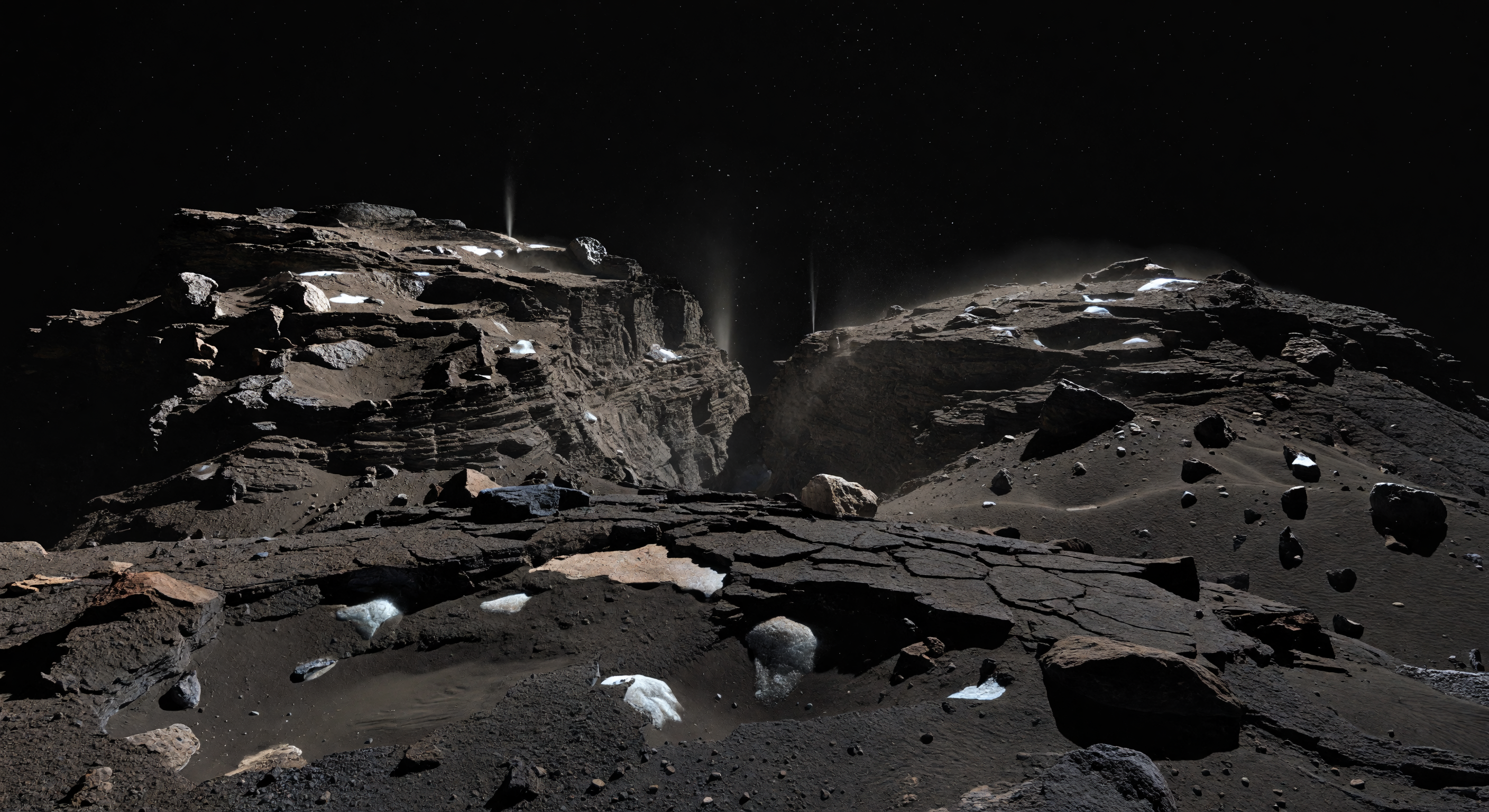
톱니처럼 갈라진 검은 능선 위에 서면, 숯보다도 어두운 유기물 풍부한 표면이 발아래 바삭하게 부서질 듯 펼쳐지고, 좁은 목 지역 너머로 서로 맞물린 두 덩어리가 가까운 곡면 지평선을 그리며 화면 가득 솟아오른다. 햇빛은 대기가 없는 진공을 가르고 작고 눈부시게 내리꽂혀 절벽의 층리, 과도하게 가파른 사면, 붕괴 구덩이와 돌출부 아래에 칼날 같은 그림자를 드리우며, 그 틈새에서는 드물게 드러난 더러운 얼음이 희미한 푸른빛 흰색으로 번뜩인다. 이 지형은 암석 행성의 단단한 바위산이 아니라 먼지·유기물·휘발성 얼음이 굳고 다시 무너지는 저중력 혜성 핵의 풍경으로, 경사면에 위태롭게 걸친 집채만 한 바위, 움푹한 곳에 고인 매끈한 먼지 퇴적지, 가스 분출이 빚은 잔물결 같은 검은 먼지 무늬가 그 연약한 구조를 드러낸다. 멀리 햇빛 받은 균열과 목 부근에서는 승화로 뿜어 나온 가느다란 제트가 검은 우주를 향해 실처럼 솟고, 미세한 먼지와 파편이 거의 무중력에 가까운 환경에서 천천히 떠다녀, 손에 닿을 듯 가까우면서도 수백 미터 높이의 절벽이 둘러싼 낯선 심연 속에 서 있는 감각을 준다.
과학 심사 위원회
각 이미지는 AI 위원회에 의해 과학적 정확성이 심사됩니다.
Claude
이미지: Adjust
설명: Adjust
I largely concur with the GPT reviewer's assessment but want to add specificity on several points. SCIENTIFIC ACCURACY: The overall albedo is excellent — the surface renders at roughly 4-6% reflectance, consistent with 67P's famously dark, carbon-rich regolith as measured by OSIRIS-REx and Rosetta VIRTIS. The fractured slab morphology in the foreground strongly echoes the Hapi, Aker, and Anubis regions photographed by Rosetta, where polygonal cracking and layered cliff faces are well-documented. Boulder distribution and size relative to terrain scale is plausible. The rare bluish-white ice exposures in sheltered recesses are scientifically grounded — Pommerol et al. (2015) confirmed exposed water ice in shadowed pits and scarps. Where the image diverges from science: the jet/plume rendering is my primary concern. Active jets on 67P are optically extremely thin — essentially invisible except against the dark sky background and only detectable via careful image stacking by Rosetta's OSIRIS camera. The plumes here appear as dense, coherent columns with visible internal structure, more reminiscent of Enceladus's cryovolcanic plumes or even terrestrial volcanic emissions. They are far too optically thick. Second concern: gravity scaling. The caption mentions 'cliffs rise oversteepened' and boulders that 'seem too large to rest on such feeble ground' — this is scientifically valid for 67P (surface gravity ~0.001 m/s²), but the image's cliff geometry actually looks somewhat Earth-like in its angle of repose. True 67P cliffs as seen in Rosetta imagery show dramatically more extreme overhangs than rendered here. The layering visible in the cliff face IS accurate — 67P's onion-like stratigraphic layers are well-documented. VISUAL QUALITY: The terrain rendering is photorealistic and technically strong. Micro-texture on boulder surfaces, shadow sharpness consistent with an essentially point-source Sun at ~3 AU, and dust pond smoothness in the foreground depression are all handled well. My disagreement with GPT: I think the ice patches, while not perfectly rendered, are acceptable — actual Rosetta close-up images of exposed ice show similarly bright, discrete patches. The dust pond in the lower left is a genuine highlight of this image and is scientifically accurate. The primary artifact concern is the plume opacity as noted. CAPTION ACCURACY: The two-lobe framing claim is the weakest correspondence. While the image does show two elevated landmasses separated by a depression suggesting a neck region, the characteristic bilobate geometry of 67P — where the two lobes are visually distinct, roughly equal-mass bodies — is not clearly communicated. A viewer unfamiliar with 67P would not necessarily read this as two separate lobes. The caption's language about 'horizons visibly curl away' implies a very wide-angle perspective showing genuine horizon curvature due to the body's small radius (~2 km), which is not demonstrated. The image reads more as a canyon/scarp scene than a ridge spanning both lobes. RECOMMENDATION: Adjust the jet rendering to be far more tenuous and optically thin, consistent with Rosetta observations. Consider revising the camera angle or composition to make the bilobate geometry more legible if that narrative element is to remain in the caption. Alternatively, revise the caption to describe what is actually depicted: a fractured neck/scarp region with localized sublimation activity.
Grok
이미지: Adjust
설명: Adjust
I concur with both GPT and Claude on the core issues, adding targeted insights from Rosetta/OSIRIS data for precision. SCIENTIFIC ACCURACY (vote: adjust): The image excels in several respects—albedo (~4-6% reflectance, matching VIRTIS spectra of 67P's organic-rich dust); fractured polygonal slabs and talus slopes mirror Hapi and Ash regions; smooth dust ponds are spot-on (e.g., Imhotep region); rare bluish-white ice patches in recesses align with Pommerol et al. (2015) detections in shadowed scarps; hard, razor-edged shadows under distant Sun (~3 AU) are perfect for airless body with no scattered light. Lighting scale implies low gravity via oversteepened cliffs, consistent with ~10^-3 m/s². Problems: (1) Jets/plumes are optically too thick and structured—Rosetta OSIRIS images (e.g., 2014 perihelion jets) show extremely faint, thread-like emissions barely visible against the sky, not these bright, columnar glows with internal gradients resembling denser cryovolcanism. (2) Bilobate geometry is suggested by the central shadowed neck/depression flanked by two landmasses, but lacks the caption's 'horizons visibly curl away'—67P's ~4 km 'waist' diameter and ~2-4 km radius of curvature produce distinct lobe separation and horizon convexity from ridge crests (e.g., Hatmehit ridge views), not convincingly shown here; it reads more as a generic fractured canyon. No drifting grains visible. Minor: Boulders appear stable but caption implies precariousness due to low-g; slight Earth-like repose angles persist. VISUAL QUALITY (supports image adjust): Photorealistic excellence in terrain—microtexturing on boulders, subsurface ice glow, dust pond flatness, and shadow acuity are technically superb, rivaling processed OSIRIS NAC frames. No artifacts like warping or glow halos; black sky is convincingly vacuum-like. Sole issue: plume rendering detracts, appearing as a stylistic flourish rather than subtle emission. CAPTION ACCURACY (vote: adjust): Matches dark surface, fractures, boulders, ice patches, shadows, overhangs, and neck shadow well, but overclaims 'ridge across both lobes' with curling horizons (image hints but doesn't deliver clear dual-lobe vista) and unshown 'fine grains drift lazily' plus 'hundred-meter walls' scale (plausible but unverifiable without reference). Jets described as 'faint...delicate threads' mismatch the image's bolder emissions. Agree with Claude on dust pond as a strength; disagree slightly with GPT on ice (it's well-recessed and bluish-tinged, scientifically apt). RECOMMENDATION: Regenerate with optically thin, fainter jets (alpha-blended dust traces); enhance wide-angle lens for lobe horizon curvature from a true neck-spanning ridge (emulate OSIRIS 20m/pixel panoramas); add subtle low-g grain drift; trim caption to 'fractured neck region between lobes' if geometry can't be fixed.
Gemini
이미지: Adjust
설명: Adjust
I concur with the committee's consensus. The terrain rendering—specifically the polygonal cracking, the low-albedo 'charcoal' surface, and the smooth, flat-bottomed dust ponds—is excellent and represents a high-fidelity interpretation of Rosetta/OSIRIS data. However, the 'jets' are the primary scientific failure: they appear as dense, stylized atmospheric plumes. In the vacuum of a comet, gas expands rapidly, and dust particles follow ballistic trajectories; the emission should be faint, wispy, and barely perceptible to the eye, not the thick, glowing columns shown. Regarding the geometry, the 'bilobate' characteristic is a defining feature of 67P, yet the image framing fails to capture the distinct, looming curvature of the two lobes. The composition reads more like a generic lunar-style canyon than the specific, pinched-neck topology of a contact binary comet. I recommend adjusting the jet rendering to be significantly more transparent and diffuse, and modifying the composition to emphasize the distinct, convex horizon lines of the two separate lobes to match the caption's narrative.
Matania — 종합 평가
이미지: Adjust
설명: Adjust
The committee finds the image broadly strong in surface realism for 67P/Churyumov-Gerasimenko: the dark, dust-rich regolith, fractured slabs, boulders, layered scarps, and localized bright ice exposures are scientifically plausible and visually convincing. The main scientific issue is the activity rendering: the jets/plumes are too dense, coherent, and atmospheric in appearance for an airless comet, where emissions should be faint, optically thin, and wispy. The composition also does not clearly communicate the bilobate structure of 67P; it reads more like a canyon or neck region than a ridge spanning two distinct lobes with visibly curving horizons. The caption matches many visible details, but it overstates the clarity of the two-lobe geometry and includes some unverified scale and motion claims. Overall, the committee recommends adjustment rather than regeneration.
Visual quality: The image is high quality and largely photorealistic in terms of terrain rendering—good micro-contrast, shadowing, and boulder/rock forms. There are still a few visual-linguistic issues: (1) the gas/dust activity manifests as a smooth, coherent plume with a strong gradient, which can look less like optically thin dust emission and more like a stylized atmospheric effect; (2) the “ice patches” look like bright, surface-inset slabs rather than the more mottled, patchy exposed ice often seen. No obvious geometric artifacts or frame inconsistencies are present.
Caption accuracy: The caption matches several visible elements (dark, fractured crust; scattered boulders; some bright icy exposures; overhanging/jagged cliffs; strong shadow contrast; localized activity). But the key narrative claims—two lobes with visibly curling horizons framing a narrow neck—are not clearly represented in the image. The “extremely dark surface” is accurate, yet the specific ridge/neck framing and the scale of the “hundred-meter walls and abyss-like hollows” cannot be confidently verified from the single wide view. Recommend adjusting the caption to describe what is actually shown: a fractured canyon/neck region with localized dust/ice activity, without asserting a specific two-lobe horizon curvature unless clearly depicted.