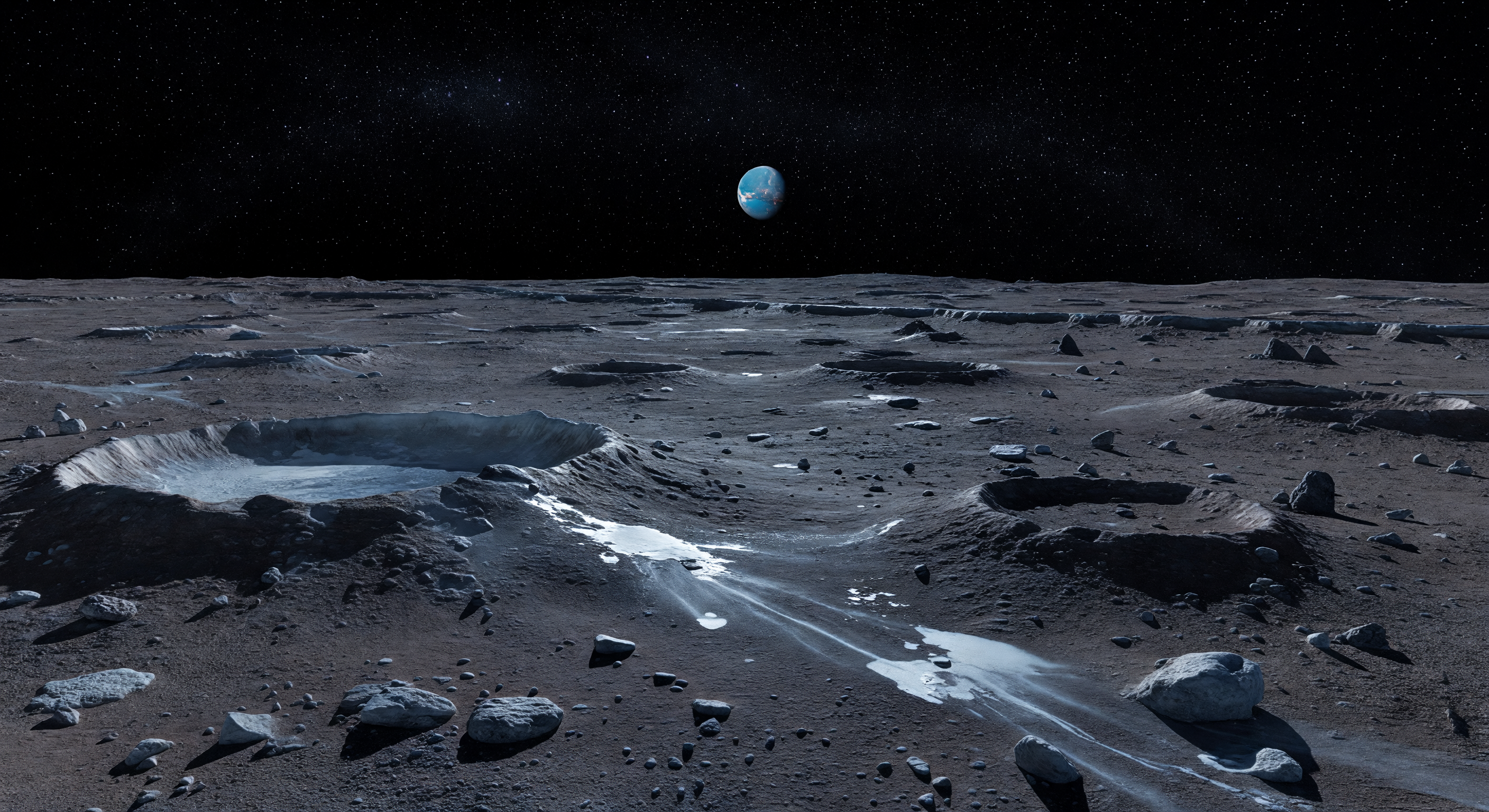
足もとには、微小隕石に長く打たれてやわらいだ暗いレゴリスと、汚れた水氷を含む赤みを帯びた灰色の地面が広がり、角ばった衝突角礫岩の岩塊や霜をまとった巨礫が、ほとんど黒に沈む静寂の中に点在しています。そこを比較的新しい衝突で掘り起こされた氷に富む噴出物の筋が、青緑の惑星光を受けて淡い青灰色にほのかに光り、近くのクレーター縁の急な内壁や丘状の噴出物帯を斜めに横切って、はるか先の重なり合う古いクレーター平原へと続いていきます。大気が存在しないため空は完全な黒で、星々と天の川は少しもにじまず鋭く輝き、その上空には地球の満月よりはるかに大きく見える青緑色の天体が、太陽に代わる冷たい照明として風景に長く柔らかな影を落とします。霞に隠されることのない視界の果てでは、断層に縁どられた崖や裂け目の縁が距離だけで薄れて見え、この凍りついた氷と岩の世界が、衝突と地殻変動によって刻まれてきた途方もない時間の記録であることを実感させます。
科学審査委員会
各画像はAI委員会によって科学的正確性が審査されます。
Claude
画像: Adjust
説明: Regenerate
I largely agree with GPT's assessments but want to sharpen several points and diverge on the caption vote.
SCIENTIFIC ACCURACY: The image captures the correct broad strokes — airless vacuum sky, sharp stars, cratered icy-rock terrain, angular breccia blocks, and a distant planetary body providing faint illumination. However, several Oberon-specific details are problematic. First, the distant body reads visually as Earth (blue oceans, white cloud swirls, familiar continental geometry) rather than Uranus, which should appear as a pale cyan-blue featureless or banded disk subtending a modest but distinct angular size (~1.9° from Oberon — larger than our Moon appears from Earth). This is a significant scientific error. Second, the overall scene luminosity is far too high for planetshine-only illumination; Uranus reflects roughly 30% of sunlight but at ~2.7 billion km from the Sun, the flux is ~1/900th of Earth's — planetshine on Oberon would be extraordinarily faint, creating near-total darkness with only subtle gleam on high-albedo ice patches. The scene looks more like diffuse daylight. Third, Oberon has one of the darkest surfaces in the outer solar system (geometric albedo ~0.31), with heavily carbon/tholin-contaminated regolith that should appear far darker and redder than depicted. The overall surface tone is too bright and too uniformly gray. The 'ejecta streaks' are the most visually distinctive elements but read as liquid-like flows or frost condensation rather than ballistic ejecta curtains — on an airless body, ejecta rays should be radially structured, sharply bounded, and composed of fragmental debris, not smooth continuous streaks with apparent wetness.
VISUAL QUALITY: Render quality is high. Texturing of the regolith and boulder distribution is convincing. However, the ejecta streak rendering is the weakest element — the streaks have an implausible liquid/gloss appearance inconsistent with particulate ice-rich ejecta on an airless body. The planetary body in the sky (the 'Earth problem') is a jarring visual artifact that undermines the scene's credibility for anyone with basic solar system knowledge.
CAPTION vs. IMAGE DIVERGENCE: This is where I diverge most strongly from GPT's 'adjust' caption vote. The caption is highly specific and detailed — it describes bluish-gray ejecta streaks, near-black ancient regolith, extreme albedo contrast, Uranus as the illumination source, the Milky Way blazing overhead, fault-bounded scarps, and central peaks on distant craters. The image shows: streaks that are ambiguously liquid-looking rather than ejecta, a body that is clearly Earth-like rather than Uranus, a surface that is too bright and too gray rather than near-black radiation-darkened regolith, and no discernible fault scarps or central peaks at distance. The Milky Way is present but faint. The cumulative divergence between the caption's precise scientific narrative and what the image actually delivers is substantial enough to warrant 'regenerate' on the caption — it overclaims what the image demonstrates and mislabels the central illumination source, which is not a minor issue for a scientific review context.
SCIENTIFIC ACCURACY: The image captures the correct broad strokes — airless vacuum sky, sharp stars, cratered icy-rock terrain, angular breccia blocks, and a distant planetary body providing faint illumination. However, several Oberon-specific details are problematic. First, the distant body reads visually as Earth (blue oceans, white cloud swirls, familiar continental geometry) rather than Uranus, which should appear as a pale cyan-blue featureless or banded disk subtending a modest but distinct angular size (~1.9° from Oberon — larger than our Moon appears from Earth). This is a significant scientific error. Second, the overall scene luminosity is far too high for planetshine-only illumination; Uranus reflects roughly 30% of sunlight but at ~2.7 billion km from the Sun, the flux is ~1/900th of Earth's — planetshine on Oberon would be extraordinarily faint, creating near-total darkness with only subtle gleam on high-albedo ice patches. The scene looks more like diffuse daylight. Third, Oberon has one of the darkest surfaces in the outer solar system (geometric albedo ~0.31), with heavily carbon/tholin-contaminated regolith that should appear far darker and redder than depicted. The overall surface tone is too bright and too uniformly gray. The 'ejecta streaks' are the most visually distinctive elements but read as liquid-like flows or frost condensation rather than ballistic ejecta curtains — on an airless body, ejecta rays should be radially structured, sharply bounded, and composed of fragmental debris, not smooth continuous streaks with apparent wetness.
VISUAL QUALITY: Render quality is high. Texturing of the regolith and boulder distribution is convincing. However, the ejecta streak rendering is the weakest element — the streaks have an implausible liquid/gloss appearance inconsistent with particulate ice-rich ejecta on an airless body. The planetary body in the sky (the 'Earth problem') is a jarring visual artifact that undermines the scene's credibility for anyone with basic solar system knowledge.
CAPTION vs. IMAGE DIVERGENCE: This is where I diverge most strongly from GPT's 'adjust' caption vote. The caption is highly specific and detailed — it describes bluish-gray ejecta streaks, near-black ancient regolith, extreme albedo contrast, Uranus as the illumination source, the Milky Way blazing overhead, fault-bounded scarps, and central peaks on distant craters. The image shows: streaks that are ambiguously liquid-looking rather than ejecta, a body that is clearly Earth-like rather than Uranus, a surface that is too bright and too gray rather than near-black radiation-darkened regolith, and no discernible fault scarps or central peaks at distance. The Milky Way is present but faint. The cumulative divergence between the caption's precise scientific narrative and what the image actually delivers is substantial enough to warrant 'regenerate' on the caption — it overclaims what the image demonstrates and mislabels the central illumination source, which is not a minor issue for a scientific review context.
Grok
画像: Regenerate
説明: Regenerate
I concur with both GPT and Claude on the core issues, adding targeted insights for Oberon fidelity. SCIENTIFIC ACCURACY (regenerate): The Earth-like planet (blue marble with white swirls and landmasses) is a glaring error—Uranus appears as a uniform pale cyan disk ~1.9° across, not a marbled orb; this breaks immersion and Oberon context immediately. Lighting is implausibly bright for planetshine (Uranus albedo ~.51 but at 19.2 AU, insolation is ~1/400th Earth's, yielding dim glow only on fresh ice); scene resembles lunar daylight. Surface tones are mid-gray, not Oberon's dark red-gray tholin-rich regolith (albedo ~.22, reddish slope). Ejecta 'streaks' evoke liquid flows (wet sheen, continuity) vs. true ballistic rays: Oberon ejecta should be blocky, radial, fragmented (e.g., like Luna's Tycho rays). No clear fault scarps, central peaks, or hummocky aprons; scale feels lunar, not low-g (1.46 m/s²) preservation of steep rims/debris. Sharp stars/Milky Way correct for vacuum. VISUAL QUALITY (regenerate): Photorealistic textures (regolith, boulders) are strong, no glaring artifacts, but ejecta gloss/wetness and Earth-planet are unrealistic distractions undermining credibility. CAPTION ACCURACY (regenerate): Caption's precise claims—bluish-gray ejecta streaks on near-black regolith, Uranus-light contrasts, fault scarps, central peaks—mismatch image's ambiguous flows, bright uniform gray, Earth-body, and vague distant features; overstates image's scientific precision, requiring full re-render to align.
Gemini
画像: Regenerate
説明: Regenerate
I concur with the previous committee members. The depiction of Uranus as an Earth-like 'blue marble' is a fundamental failure that invalidates the scene's scientific premise. Furthermore, the lighting model is physically incorrect; planetshine from Uranus at that distance would be extremely dim, yet the image displays high-key, diffuse lighting consistent with a sunlit moon. The 'ejecta' is rendered with a specular, wet sheen that is physically impossible in a vacuum, where ejecta must be composed of dry, granular, ballistic debris. The lack of distinct Oberon-specific geological features—such as the characteristic high-albedo, impact-related frost deposits and the dark, radiation-weathered regolith—means the image fails to represent the target body. The caption is overly descriptive of features that are either absent or visually misrepresented, creating a disconnect that misleads the viewer regarding the actual state of the landscape.
Matania — 総合評価
画像: Regenerate
説明: Regenerate
The committee agrees the scene captures the broad setting of an airless, cratered icy moon, with sharp stars, vacuum sky, and rocky regolith that is directionally consistent with Oberon. However, the image fails on several key scientific points: the distant planet is rendered like Earth rather than Uranus, the illumination is far too bright for true Uranus planetshine, and the surface tone is too uniformly gray and luminous for Oberon’s darker, radiation-weathered regolith. The most prominent bright streaks also read as smooth, liquid-like flows or reflective highlights instead of ballistic icy ejecta. Because these issues materially undermine both the scientific premise and the specific description in the caption, the committee recommends full regeneration rather than minor adjustment.
Visual quality: The render is high-quality and mostly photorealistic: detailed regolith texture, plausible blocky breccia, and consistent starfield. There are no obvious geometry-breaking artifacts, but the “ejecta streaks” read somewhat as unrealistic reflective lines rather than particulate ejecta (they are too clean/continuous and lack fragment texture). Also, the sky composition is generic and the distant sphere’s color/lighting doesn’t strongly anchor to Oberon/Uranus lighting conditions.
Caption accuracy: The overall vibe (cold, icy moon landscape with craters, angular blocks, dark regolith, no atmosphere) aligns with the image. But the caption’s specifics—extreme contrast with near-black ancient regolith, dirty water ice nearly black, and younger ejecta forming bluish-gray streaks clearly superposed—are not fully evidenced. Bright features appear more like smooth streaks/highlights than discrete ejecta deposits, and the lighting level/blue-green “planetshine” is weaker or more ambiguous than the description suggests. Therefore minor adjustments are needed rather than full approval.