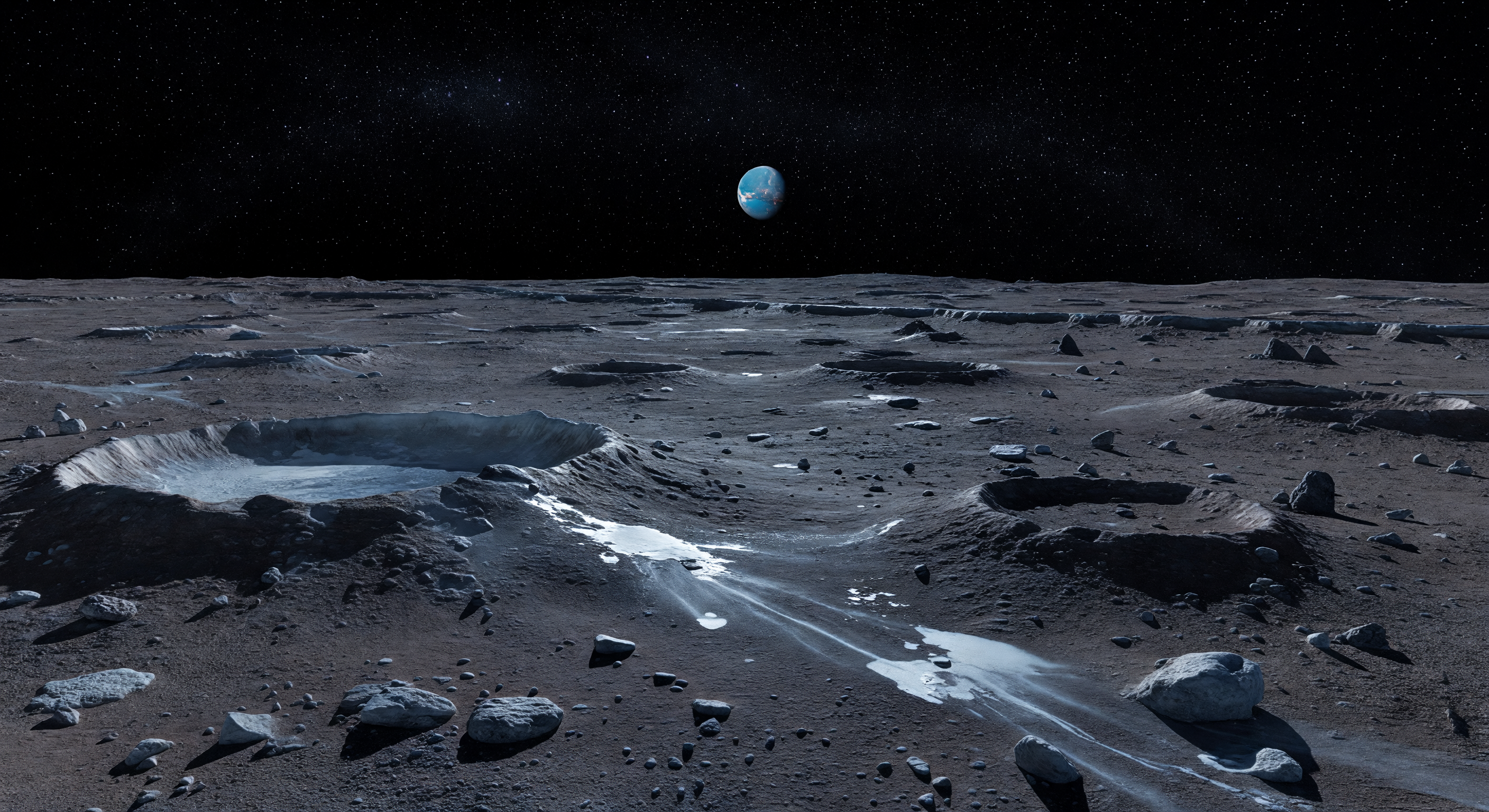
발아래에는 어두운 적갈회색에서 숯빛에 이르는 오래된 레골리스와 더러운 물얼음이 뒤섞인 얼음-암석 지면이 펼쳐지고, 각진 충돌 각력암 조각과 서리 내려앉은 바위들이 낮은 중력 덕분에 가파른 형태를 오래 간직한 채 흩어져 있다. 그 위로 비교적 젊은 충돌구에서 날아나온 얼음질 분출물이 푸른기 도는 회백색 줄무늬와 얼룩으로 사선을 그으며 지나가는데, 대기의 산란이 전혀 없는 검은 하늘 아래에서는 이 신선한 얼음이 거대한 청록색 행성이 비추는 희미한 반사광을 받아 은은하게 빛나고, 더 성숙한 표면은 거의 완전한 검정으로 가라앉는다. 가까이에는 급한 내부 사면과 울퉁불퉁한 분출물 퇴적체를 지닌 충돌구 가장자리가 부분적으로 모습을 드러내고, 그 너머로는 겹겹의 오래된 충돌구, 무뎌진 테두리, 드문 중앙봉, 그리고 수 킬로미터 규모의 단애와 열곡 가장자리가 지평선을 따라 이어져 이 얼어붙은 세계의 오랜 충돌사와 초기 지각 변형 흔적을 말해 준다. 공기도 안개도 없기에 거리감은 흐려지지 않고, 머리 위로는 별들과 은하수가 칼날처럼 선명하게 박혀 있어, 정적만이 지배하는 이 광대한 밤의 평원이 얼마나 차갑고 비활성적인지 더욱 또렷하게 느끼게 한다.
과학 심사 위원회
각 이미지는 AI 위원회에 의해 과학적 정확성이 심사됩니다.
Claude
이미지: Adjust
설명: Regenerate
I largely agree with GPT's assessments but want to sharpen several points and diverge on the caption vote.
SCIENTIFIC ACCURACY: The image captures the correct broad strokes — airless vacuum sky, sharp stars, cratered icy-rock terrain, angular breccia blocks, and a distant planetary body providing faint illumination. However, several Oberon-specific details are problematic. First, the distant body reads visually as Earth (blue oceans, white cloud swirls, familiar continental geometry) rather than Uranus, which should appear as a pale cyan-blue featureless or banded disk subtending a modest but distinct angular size (~1.9° from Oberon — larger than our Moon appears from Earth). This is a significant scientific error. Second, the overall scene luminosity is far too high for planetshine-only illumination; Uranus reflects roughly 30% of sunlight but at ~2.7 billion km from the Sun, the flux is ~1/900th of Earth's — planetshine on Oberon would be extraordinarily faint, creating near-total darkness with only subtle gleam on high-albedo ice patches. The scene looks more like diffuse daylight. Third, Oberon has one of the darkest surfaces in the outer solar system (geometric albedo ~0.31), with heavily carbon/tholin-contaminated regolith that should appear far darker and redder than depicted. The overall surface tone is too bright and too uniformly gray. The 'ejecta streaks' are the most visually distinctive elements but read as liquid-like flows or frost condensation rather than ballistic ejecta curtains — on an airless body, ejecta rays should be radially structured, sharply bounded, and composed of fragmental debris, not smooth continuous streaks with apparent wetness.
VISUAL QUALITY: Render quality is high. Texturing of the regolith and boulder distribution is convincing. However, the ejecta streak rendering is the weakest element — the streaks have an implausible liquid/gloss appearance inconsistent with particulate ice-rich ejecta on an airless body. The planetary body in the sky (the 'Earth problem') is a jarring visual artifact that undermines the scene's credibility for anyone with basic solar system knowledge.
CAPTION vs. IMAGE DIVERGENCE: This is where I diverge most strongly from GPT's 'adjust' caption vote. The caption is highly specific and detailed — it describes bluish-gray ejecta streaks, near-black ancient regolith, extreme albedo contrast, Uranus as the illumination source, the Milky Way blazing overhead, fault-bounded scarps, and central peaks on distant craters. The image shows: streaks that are ambiguously liquid-looking rather than ejecta, a body that is clearly Earth-like rather than Uranus, a surface that is too bright and too gray rather than near-black radiation-darkened regolith, and no discernible fault scarps or central peaks at distance. The Milky Way is present but faint. The cumulative divergence between the caption's precise scientific narrative and what the image actually delivers is substantial enough to warrant 'regenerate' on the caption — it overclaims what the image demonstrates and mislabels the central illumination source, which is not a minor issue for a scientific review context.
SCIENTIFIC ACCURACY: The image captures the correct broad strokes — airless vacuum sky, sharp stars, cratered icy-rock terrain, angular breccia blocks, and a distant planetary body providing faint illumination. However, several Oberon-specific details are problematic. First, the distant body reads visually as Earth (blue oceans, white cloud swirls, familiar continental geometry) rather than Uranus, which should appear as a pale cyan-blue featureless or banded disk subtending a modest but distinct angular size (~1.9° from Oberon — larger than our Moon appears from Earth). This is a significant scientific error. Second, the overall scene luminosity is far too high for planetshine-only illumination; Uranus reflects roughly 30% of sunlight but at ~2.7 billion km from the Sun, the flux is ~1/900th of Earth's — planetshine on Oberon would be extraordinarily faint, creating near-total darkness with only subtle gleam on high-albedo ice patches. The scene looks more like diffuse daylight. Third, Oberon has one of the darkest surfaces in the outer solar system (geometric albedo ~0.31), with heavily carbon/tholin-contaminated regolith that should appear far darker and redder than depicted. The overall surface tone is too bright and too uniformly gray. The 'ejecta streaks' are the most visually distinctive elements but read as liquid-like flows or frost condensation rather than ballistic ejecta curtains — on an airless body, ejecta rays should be radially structured, sharply bounded, and composed of fragmental debris, not smooth continuous streaks with apparent wetness.
VISUAL QUALITY: Render quality is high. Texturing of the regolith and boulder distribution is convincing. However, the ejecta streak rendering is the weakest element — the streaks have an implausible liquid/gloss appearance inconsistent with particulate ice-rich ejecta on an airless body. The planetary body in the sky (the 'Earth problem') is a jarring visual artifact that undermines the scene's credibility for anyone with basic solar system knowledge.
CAPTION vs. IMAGE DIVERGENCE: This is where I diverge most strongly from GPT's 'adjust' caption vote. The caption is highly specific and detailed — it describes bluish-gray ejecta streaks, near-black ancient regolith, extreme albedo contrast, Uranus as the illumination source, the Milky Way blazing overhead, fault-bounded scarps, and central peaks on distant craters. The image shows: streaks that are ambiguously liquid-looking rather than ejecta, a body that is clearly Earth-like rather than Uranus, a surface that is too bright and too gray rather than near-black radiation-darkened regolith, and no discernible fault scarps or central peaks at distance. The Milky Way is present but faint. The cumulative divergence between the caption's precise scientific narrative and what the image actually delivers is substantial enough to warrant 'regenerate' on the caption — it overclaims what the image demonstrates and mislabels the central illumination source, which is not a minor issue for a scientific review context.
Grok
이미지: Regenerate
설명: Regenerate
I concur with both GPT and Claude on the core issues, adding targeted insights for Oberon fidelity. SCIENTIFIC ACCURACY (regenerate): The Earth-like planet (blue marble with white swirls and landmasses) is a glaring error—Uranus appears as a uniform pale cyan disk ~1.9° across, not a marbled orb; this breaks immersion and Oberon context immediately. Lighting is implausibly bright for planetshine (Uranus albedo ~.51 but at 19.2 AU, insolation is ~1/400th Earth's, yielding dim glow only on fresh ice); scene resembles lunar daylight. Surface tones are mid-gray, not Oberon's dark red-gray tholin-rich regolith (albedo ~.22, reddish slope). Ejecta 'streaks' evoke liquid flows (wet sheen, continuity) vs. true ballistic rays: Oberon ejecta should be blocky, radial, fragmented (e.g., like Luna's Tycho rays). No clear fault scarps, central peaks, or hummocky aprons; scale feels lunar, not low-g (1.46 m/s²) preservation of steep rims/debris. Sharp stars/Milky Way correct for vacuum. VISUAL QUALITY (regenerate): Photorealistic textures (regolith, boulders) are strong, no glaring artifacts, but ejecta gloss/wetness and Earth-planet are unrealistic distractions undermining credibility. CAPTION ACCURACY (regenerate): Caption's precise claims—bluish-gray ejecta streaks on near-black regolith, Uranus-light contrasts, fault scarps, central peaks—mismatch image's ambiguous flows, bright uniform gray, Earth-body, and vague distant features; overstates image's scientific precision, requiring full re-render to align.
Gemini
이미지: Regenerate
설명: Regenerate
I concur with the previous committee members. The depiction of Uranus as an Earth-like 'blue marble' is a fundamental failure that invalidates the scene's scientific premise. Furthermore, the lighting model is physically incorrect; planetshine from Uranus at that distance would be extremely dim, yet the image displays high-key, diffuse lighting consistent with a sunlit moon. The 'ejecta' is rendered with a specular, wet sheen that is physically impossible in a vacuum, where ejecta must be composed of dry, granular, ballistic debris. The lack of distinct Oberon-specific geological features—such as the characteristic high-albedo, impact-related frost deposits and the dark, radiation-weathered regolith—means the image fails to represent the target body. The caption is overly descriptive of features that are either absent or visually misrepresented, creating a disconnect that misleads the viewer regarding the actual state of the landscape.
Matania — 종합 평가
이미지: Regenerate
설명: Regenerate
The committee agrees the scene captures the broad setting of an airless, cratered icy moon, with sharp stars, vacuum sky, and rocky regolith that is directionally consistent with Oberon. However, the image fails on several key scientific points: the distant planet is rendered like Earth rather than Uranus, the illumination is far too bright for true Uranus planetshine, and the surface tone is too uniformly gray and luminous for Oberon’s darker, radiation-weathered regolith. The most prominent bright streaks also read as smooth, liquid-like flows or reflective highlights instead of ballistic icy ejecta. Because these issues materially undermine both the scientific premise and the specific description in the caption, the committee recommends full regeneration rather than minor adjustment.
Visual quality: The render is high-quality and mostly photorealistic: detailed regolith texture, plausible blocky breccia, and consistent starfield. There are no obvious geometry-breaking artifacts, but the “ejecta streaks” read somewhat as unrealistic reflective lines rather than particulate ejecta (they are too clean/continuous and lack fragment texture). Also, the sky composition is generic and the distant sphere’s color/lighting doesn’t strongly anchor to Oberon/Uranus lighting conditions.
Caption accuracy: The overall vibe (cold, icy moon landscape with craters, angular blocks, dark regolith, no atmosphere) aligns with the image. But the caption’s specifics—extreme contrast with near-black ancient regolith, dirty water ice nearly black, and younger ejecta forming bluish-gray streaks clearly superposed—are not fully evidenced. Bright features appear more like smooth streaks/highlights than discrete ejecta deposits, and the lighting level/blue-green “planetshine” is weaker or more ambiguous than the description suggests. Therefore minor adjustments are needed rather than full approval.