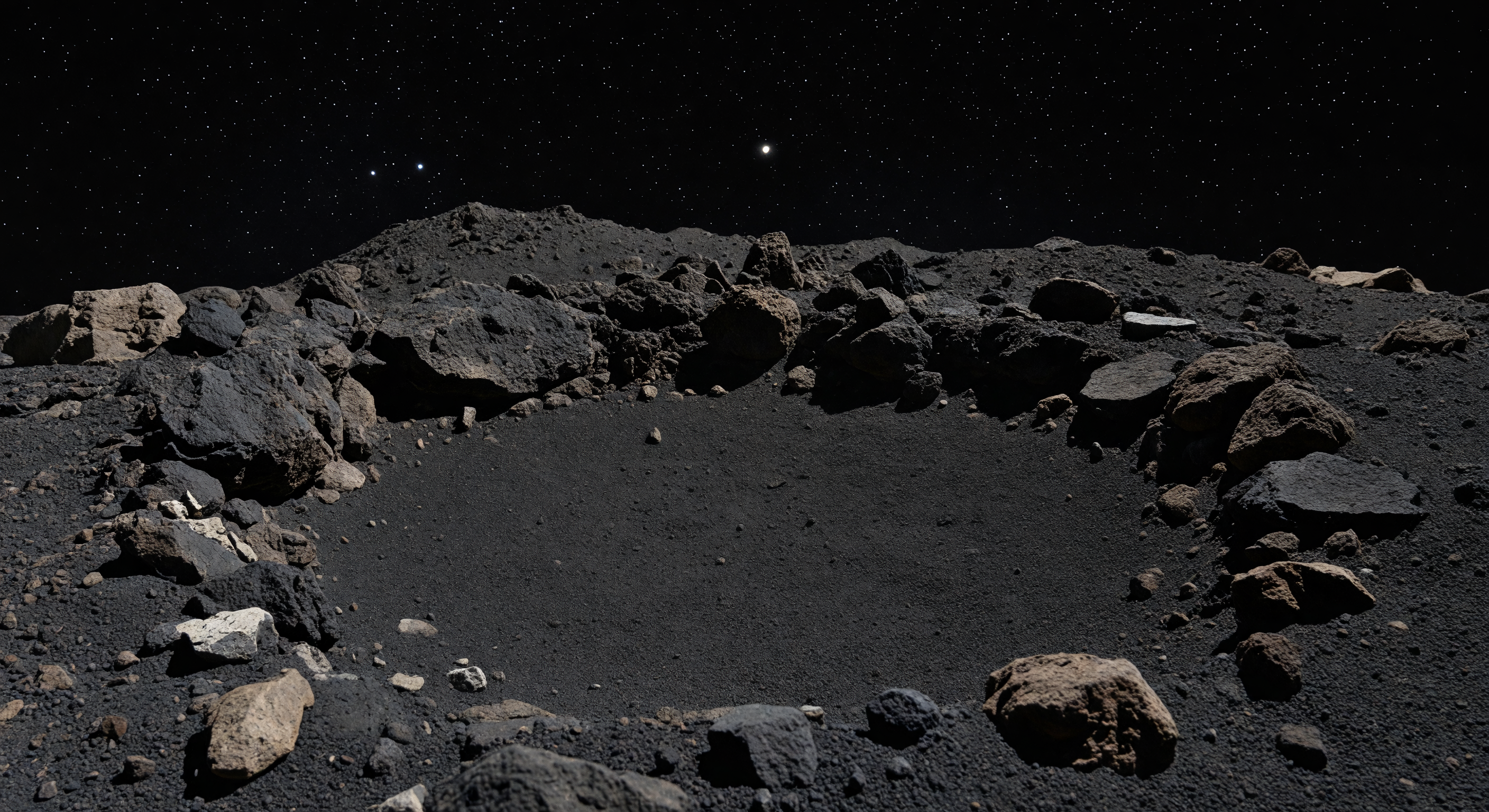
浅い窪地の底には、煤のように暗い微粒のレゴリスが静かにたまり、周囲を縁取る埋もれた小礫や低い岩塊のリムとの対比で、そのなめらかな面がいっそう際立って見えます。ここを覆う物質は、炭素に富む原始的なコンドライト質の破片と細粒物からなる非常に暗い表層で、水を含んだ鉱物や有機物を宿す始原的な太陽系物質の名残であり、風のない真空中では砂紋ではなく微小衝突で舞い上がって落ちた粒子の沈積が、かすかな起伏を刻みます。空は昼でも完全な黒で、太陽光は大気に散乱されず、ひとつひとつの小石から刃物のように鋭い真っ黒な影を落とし、数メートル先で急に曲がって消える近い地平線が、この天体の小ささと極端に弱い重力を生々しく感じさせます。見渡せば露出した岩盤、孔だらけの岩、危うい姿勢で止まった瓦礫が折り重なり、巨大な岩の寄せ集めにすぎないラブルパイル天体の表面に、いま自分がそっと立っているかのような、張りつめた異世界の静けさが満ちています。
科学審査委員会
各画像はAI委員会によって科学的正確性が審査されます。
Claude
画像: Adjust
説明: Adjust
I largely concur with the previous reviewer's assessment but want to add several specific observations.
SCIENTIFIC ACCURACY: The image succeeds in several important respects — the airless black sky, hard star points, absence of atmospheric scattering, and the general carbon-dark coloration of the regolith are all consistent with Hyabusa2 mission data showing Ryugu's albedo of roughly 0.045, one of the darkest known Solar System bodies. The presence of both fine regolith and larger embedded boulders is also faithful to Ryugu's rubble-pile nature. However, I flag two specific concerns the previous reviewer did not fully address: (1) The two bright point sources in the sky deserve scrutiny — one likely represents the Sun, but the second prominent bright object is problematic. At Ryugu's orbital distance (~1 AU), no companion body would appear this prominent. This is a notable scientific error. (2) The boulder colors include warm tan-brown tones that are somewhat acceptable given hydrated mineral content, but some boulders appear slightly too high-contrast and variegated compared to Hyabusa2 close-approach imagery, where surface material shows more uniform darkness with subtler color variation.
VISUAL QUALITY: The CG origin is detectable primarily in the overly uniform dust grain texture of the hollow floor — real regolith at this scale would show more stochastic variation. The lighting direction is consistent across the scene, which is correct for solar illumination, but shadow gradients on boulder undersides look slightly too soft for the vacuum environment where there is zero atmospheric diffusion. That said, the overall composition and resolution are impressive.
CAPTION ACCURACY: The 'startlingly close curved horizon' is the caption's most significant unmet claim — the image shows no perceptible curvature, which is actually the most diagnostically Ryugu-specific visual element given its 450m radius. This omission is consequential. The 'velvety soot-dark' regolith description is partially supported but overstated. The dual bright sky objects require either caption clarification or image correction.
SCIENTIFIC ACCURACY: The image succeeds in several important respects — the airless black sky, hard star points, absence of atmospheric scattering, and the general carbon-dark coloration of the regolith are all consistent with Hyabusa2 mission data showing Ryugu's albedo of roughly 0.045, one of the darkest known Solar System bodies. The presence of both fine regolith and larger embedded boulders is also faithful to Ryugu's rubble-pile nature. However, I flag two specific concerns the previous reviewer did not fully address: (1) The two bright point sources in the sky deserve scrutiny — one likely represents the Sun, but the second prominent bright object is problematic. At Ryugu's orbital distance (~1 AU), no companion body would appear this prominent. This is a notable scientific error. (2) The boulder colors include warm tan-brown tones that are somewhat acceptable given hydrated mineral content, but some boulders appear slightly too high-contrast and variegated compared to Hyabusa2 close-approach imagery, where surface material shows more uniform darkness with subtler color variation.
VISUAL QUALITY: The CG origin is detectable primarily in the overly uniform dust grain texture of the hollow floor — real regolith at this scale would show more stochastic variation. The lighting direction is consistent across the scene, which is correct for solar illumination, but shadow gradients on boulder undersides look slightly too soft for the vacuum environment where there is zero atmospheric diffusion. That said, the overall composition and resolution are impressive.
CAPTION ACCURACY: The 'startlingly close curved horizon' is the caption's most significant unmet claim — the image shows no perceptible curvature, which is actually the most diagnostically Ryugu-specific visual element given its 450m radius. This omission is consequential. The 'velvety soot-dark' regolith description is partially supported but overstated. The dual bright sky objects require either caption clarification or image correction.
Grok
画像: Adjust
説明: Adjust
I concur with both previous reviewers on the 'adjust' votes for image and caption, as the core composition captures Ryugu's rubble-pile aesthetic effectively but falls short on key specifics. SCIENTIFIC ACCURACY (adjust): Strong matches include the airless black sky with hard stars, dark low-albedo regolith (albedo ~.045 per Hayabusa2 data), and mix of fine grains with embedded boulders/cobbles, consistent with Ryugu's primitive C-type chondrite composition and porous, fractured surface from impacts. Subtle brown-gray tones align with hydrated minerals like phyllosilicates detected via spectral analysis. However, two issues persist: (1) The two prominent bright sky points—one likely the Sun (white, uncompromising as described), the other unexplained and too bright for Ryugu's ~1 AU orbit (no nearby companions; could be an artifact or erroneous star)—violates orbital context. (2) No visible curved horizon despite Ryugu's ~450m radius implying a horizon ~1-2 km away at eye level, with noticeable curvature over tens of meters; the background flattens unrealistically, weakening scale and low-gravity cues. Shadows are sharp (good for no atmosphere), but some boulder undersides show implausibly soft gradients. Colors are mostly accurate but include occasional tan tones slightly warmer than Hayabusa2's muted blues/blacks. VISUAL QUALITY (adjust): Photorealistic overall with high resolution, coherent solar lighting from upper right, and no haze—evoking weightlessness well. The hollow's dark regolith pool reads as smooth/velvety at a glance. Artifacts include CG-like uniformity in grain texture (real regolith shows more micro-roughness/chaos per rover images) and stylized star points; the second bright sky object disrupts immersion. CAPTION ACCURACY (adjust): Matches sheltered hollow with smooth soot-dark regolith, rough boulder rims, razor-sharp shadows, carbon-rich porous rock, black starry sky, white Sun, and stark silence. However, 'startlingly close, curved horizon' and 'low rises tens of meters high falling away' are absent (flat background); 'delicately resting fine grains' and 'velvety' texture are approximated but not razor-sharp/detailed enough; second sky bright spot unmentioned. Constructive: Regenerate with explicit horizon curvature (e.g., via wide-angle lens), single Sun point, stochastically varied regolith texture, and tighter scale cues like meter-scale boulders for approval.
Gemini
画像: Regenerate
説明: Adjust
I concur with the previous committee members regarding the failure to depict Ryugu’s most diagnostic feature: its extreme, compact curvature. Ryugu is a 'rubble-pile' asteroid with a diameter of only ~900 meters; a viewer standing on the surface would perceive a horizon that curves sharply and is remarkably close. The current image presents a flat, terrestrial-style horizon, which undermines the scientific value of the depiction entirely. Furthermore, the inclusion of a second 'bright object' in the sky is a significant error, as Ryugu has no such companion. The regolith texture lacks the stochastic, chaotic distribution seen in the Hayabusa2 MASCOT lander images, appearing too processed and uniform. To achieve approval, the next iteration must prioritize a wide-angle perspective that emphasizes the 'falling away' of the horizon, remove the erroneous secondary light source, and introduce greater clast-size heterogeneity in the regolith to match the messy, unsorted nature of carbonaceous chondrite rubble.
Matania — 総合評価
画像: Adjust
説明: Adjust
The committee found the image broadly credible as an airless, dark, rubble-pile asteroid scene, with appropriate hard starlight, no atmospheric haze, and a mix of fine regolith and embedded boulders consistent with Ryugu. However, it falls short on Ryugu-specific diagnostics: the horizon reads too flat and terrestrial, the regolith texture is somewhat uniform/CG-like, and the sky contains an extra bright object that should not be present. The caption is thematically close and captures the sheltered hollow, dark regolith, and stark vacuum conditions, but it overstates the visual evidence in key places, especially the close curved horizon and the degree of velvety, razor-sharp shadowing.
Other languages
- English: Sheltered Regolith Hollow
- Français: Creux de régolithe abrité
- Español: Hondonada de regolito abrigada
- Português: Depressão de regolito abrigada
- Deutsch: Geschützte Regolithmulde
- العربية: منخفض الثرى المحمي
- हिन्दी: आश्रित रेगोलिथ गर्त
- 한국어: 보호된 레골리스 움푹지
- Italiano: Conca di regolite riparata
- Nederlands: Beschutte regolietkom
2) VISUAL QUALITY (adjust): The image is high-resolution and convincing as a barren, airless landscape: no atmospheric haze, consistent star field, and coherent illumination across the rock/rim. Nonetheless, there are some realism concerns: the lighting is somewhat uniform/CG-like, and the sky/stars appear somewhat stylized. Also, the “hollow” reads more as a compositional depression than a well-resolved shallow regolith trap with the delicate fine-grain behavior described.
3) CAPTION ACCURACY (adjust): The caption’s core elements—regolith pooled in a sheltered hollow, surrounded by rough rims of embedded cobbles and jagged boulders, black sky, airless conditions—partly match what is visible. But key specifics are not well supported: the claimed “velvety soot-dark” smooth patch is only moderately represented, the emphasis on extremely fine grains casting razor-sharp black shadows is overstated, and the “startlingly close curved horizon” is not shown. Overall, the caption is close in theme but not tightly aligned to the exact visual details.