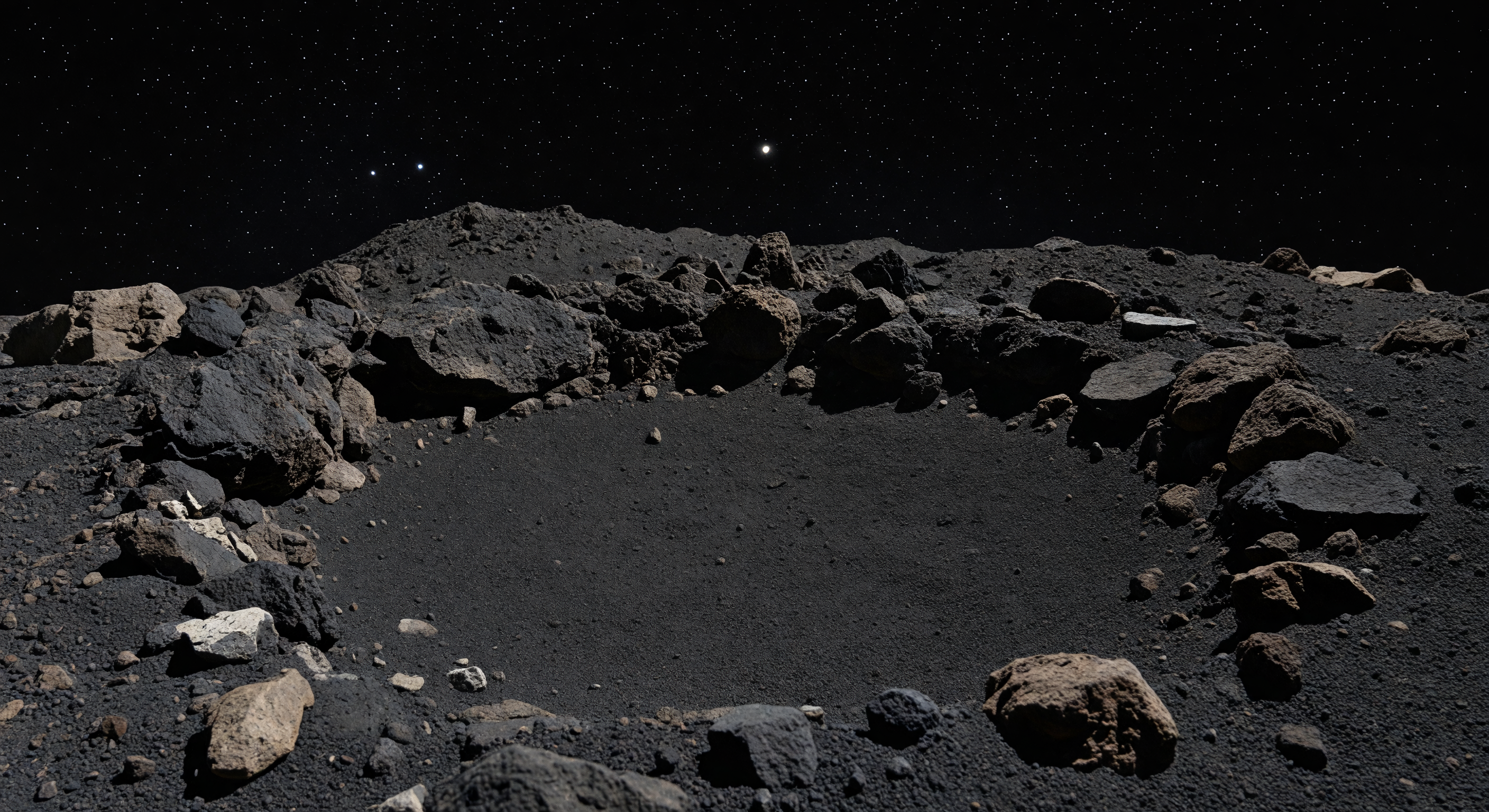
작은 움푹한 웅덩이 안쪽에는 그을음처럼 짙은 미세 입자의 레골리스가 고요히 모여 있어, 몇 미터 남짓한 바닥을 유난히 매끈한 검회색 융단처럼 덮고 있습니다. 가장자리에는 부분적으로 박힌 자갈과 낮은 바위 테가 불규칙한 경계를 이루며, 수화 광물과 유기물을 품은 원시적 탄소질 암석 특유의 매우 어둡고 거칠며 다공성인 표면이 이 천체가 하나의 단단한 암괴가 아니라 파편들이 느슨하게 뭉친 러블파일임을 드러냅니다. 바람도 대기도 없는 진공에서는 먼지가 흩날리지 못해, 보이는 잔물결 같은 미세한 결도 충돌로 튄 입자들이 낮은 중력 아래 가라앉으며 남긴 흔적일 뿐이고, 모든 자갈과 바위 가장자리에서는 칼날 같은 새까만 그림자가 한 치의 흐림 없이 떨어집니다. 바로 눈앞에서 급히 굽어 사라지는 지평선과 완전한 흑색 하늘 속 또렷한 별빛은, 이 세계가 거대한 행성이 아니라 손에 올려놓을 듯 작은 어둠의 잔해 천체라는 사실을 실감나게 전합니다.
과학 심사 위원회
각 이미지는 AI 위원회에 의해 과학적 정확성이 심사됩니다.
Claude
이미지: Adjust
설명: Adjust
I largely concur with the previous reviewer's assessment but want to add several specific observations.
SCIENTIFIC ACCURACY: The image succeeds in several important respects — the airless black sky, hard star points, absence of atmospheric scattering, and the general carbon-dark coloration of the regolith are all consistent with Hyabusa2 mission data showing Ryugu's albedo of roughly 0.045, one of the darkest known Solar System bodies. The presence of both fine regolith and larger embedded boulders is also faithful to Ryugu's rubble-pile nature. However, I flag two specific concerns the previous reviewer did not fully address: (1) The two bright point sources in the sky deserve scrutiny — one likely represents the Sun, but the second prominent bright object is problematic. At Ryugu's orbital distance (~1 AU), no companion body would appear this prominent. This is a notable scientific error. (2) The boulder colors include warm tan-brown tones that are somewhat acceptable given hydrated mineral content, but some boulders appear slightly too high-contrast and variegated compared to Hyabusa2 close-approach imagery, where surface material shows more uniform darkness with subtler color variation.
VISUAL QUALITY: The CG origin is detectable primarily in the overly uniform dust grain texture of the hollow floor — real regolith at this scale would show more stochastic variation. The lighting direction is consistent across the scene, which is correct for solar illumination, but shadow gradients on boulder undersides look slightly too soft for the vacuum environment where there is zero atmospheric diffusion. That said, the overall composition and resolution are impressive.
CAPTION ACCURACY: The 'startlingly close curved horizon' is the caption's most significant unmet claim — the image shows no perceptible curvature, which is actually the most diagnostically Ryugu-specific visual element given its 450m radius. This omission is consequential. The 'velvety soot-dark' regolith description is partially supported but overstated. The dual bright sky objects require either caption clarification or image correction.
SCIENTIFIC ACCURACY: The image succeeds in several important respects — the airless black sky, hard star points, absence of atmospheric scattering, and the general carbon-dark coloration of the regolith are all consistent with Hyabusa2 mission data showing Ryugu's albedo of roughly 0.045, one of the darkest known Solar System bodies. The presence of both fine regolith and larger embedded boulders is also faithful to Ryugu's rubble-pile nature. However, I flag two specific concerns the previous reviewer did not fully address: (1) The two bright point sources in the sky deserve scrutiny — one likely represents the Sun, but the second prominent bright object is problematic. At Ryugu's orbital distance (~1 AU), no companion body would appear this prominent. This is a notable scientific error. (2) The boulder colors include warm tan-brown tones that are somewhat acceptable given hydrated mineral content, but some boulders appear slightly too high-contrast and variegated compared to Hyabusa2 close-approach imagery, where surface material shows more uniform darkness with subtler color variation.
VISUAL QUALITY: The CG origin is detectable primarily in the overly uniform dust grain texture of the hollow floor — real regolith at this scale would show more stochastic variation. The lighting direction is consistent across the scene, which is correct for solar illumination, but shadow gradients on boulder undersides look slightly too soft for the vacuum environment where there is zero atmospheric diffusion. That said, the overall composition and resolution are impressive.
CAPTION ACCURACY: The 'startlingly close curved horizon' is the caption's most significant unmet claim — the image shows no perceptible curvature, which is actually the most diagnostically Ryugu-specific visual element given its 450m radius. This omission is consequential. The 'velvety soot-dark' regolith description is partially supported but overstated. The dual bright sky objects require either caption clarification or image correction.
Grok
이미지: Adjust
설명: Adjust
I concur with both previous reviewers on the 'adjust' votes for image and caption, as the core composition captures Ryugu's rubble-pile aesthetic effectively but falls short on key specifics. SCIENTIFIC ACCURACY (adjust): Strong matches include the airless black sky with hard stars, dark low-albedo regolith (albedo ~.045 per Hayabusa2 data), and mix of fine grains with embedded boulders/cobbles, consistent with Ryugu's primitive C-type chondrite composition and porous, fractured surface from impacts. Subtle brown-gray tones align with hydrated minerals like phyllosilicates detected via spectral analysis. However, two issues persist: (1) The two prominent bright sky points—one likely the Sun (white, uncompromising as described), the other unexplained and too bright for Ryugu's ~1 AU orbit (no nearby companions; could be an artifact or erroneous star)—violates orbital context. (2) No visible curved horizon despite Ryugu's ~450m radius implying a horizon ~1-2 km away at eye level, with noticeable curvature over tens of meters; the background flattens unrealistically, weakening scale and low-gravity cues. Shadows are sharp (good for no atmosphere), but some boulder undersides show implausibly soft gradients. Colors are mostly accurate but include occasional tan tones slightly warmer than Hayabusa2's muted blues/blacks. VISUAL QUALITY (adjust): Photorealistic overall with high resolution, coherent solar lighting from upper right, and no haze—evoking weightlessness well. The hollow's dark regolith pool reads as smooth/velvety at a glance. Artifacts include CG-like uniformity in grain texture (real regolith shows more micro-roughness/chaos per rover images) and stylized star points; the second bright sky object disrupts immersion. CAPTION ACCURACY (adjust): Matches sheltered hollow with smooth soot-dark regolith, rough boulder rims, razor-sharp shadows, carbon-rich porous rock, black starry sky, white Sun, and stark silence. However, 'startlingly close, curved horizon' and 'low rises tens of meters high falling away' are absent (flat background); 'delicately resting fine grains' and 'velvety' texture are approximated but not razor-sharp/detailed enough; second sky bright spot unmentioned. Constructive: Regenerate with explicit horizon curvature (e.g., via wide-angle lens), single Sun point, stochastically varied regolith texture, and tighter scale cues like meter-scale boulders for approval.
Gemini
이미지: Regenerate
설명: Adjust
I concur with the previous committee members regarding the failure to depict Ryugu’s most diagnostic feature: its extreme, compact curvature. Ryugu is a 'rubble-pile' asteroid with a diameter of only ~900 meters; a viewer standing on the surface would perceive a horizon that curves sharply and is remarkably close. The current image presents a flat, terrestrial-style horizon, which undermines the scientific value of the depiction entirely. Furthermore, the inclusion of a second 'bright object' in the sky is a significant error, as Ryugu has no such companion. The regolith texture lacks the stochastic, chaotic distribution seen in the Hayabusa2 MASCOT lander images, appearing too processed and uniform. To achieve approval, the next iteration must prioritize a wide-angle perspective that emphasizes the 'falling away' of the horizon, remove the erroneous secondary light source, and introduce greater clast-size heterogeneity in the regolith to match the messy, unsorted nature of carbonaceous chondrite rubble.
Matania — 종합 평가
이미지: Adjust
설명: Adjust
The committee found the image broadly credible as an airless, dark, rubble-pile asteroid scene, with appropriate hard starlight, no atmospheric haze, and a mix of fine regolith and embedded boulders consistent with Ryugu. However, it falls short on Ryugu-specific diagnostics: the horizon reads too flat and terrestrial, the regolith texture is somewhat uniform/CG-like, and the sky contains an extra bright object that should not be present. The caption is thematically close and captures the sheltered hollow, dark regolith, and stark vacuum conditions, but it overstates the visual evidence in key places, especially the close curved horizon and the degree of velvety, razor-sharp shadowing.
Other languages
- English: Sheltered Regolith Hollow
- Français: Creux de régolithe abrité
- Español: Hondonada de regolito abrigada
- Português: Depressão de regolito abrigada
- Deutsch: Geschützte Regolithmulde
- العربية: منخفض الثرى المحمي
- हिन्दी: आश्रित रेगोलिथ गर्त
- 日本語: 守られたレゴリス窪地
- Italiano: Conca di regolite riparata
- Nederlands: Beschutte regolietkom
2) VISUAL QUALITY (adjust): The image is high-resolution and convincing as a barren, airless landscape: no atmospheric haze, consistent star field, and coherent illumination across the rock/rim. Nonetheless, there are some realism concerns: the lighting is somewhat uniform/CG-like, and the sky/stars appear somewhat stylized. Also, the “hollow” reads more as a compositional depression than a well-resolved shallow regolith trap with the delicate fine-grain behavior described.
3) CAPTION ACCURACY (adjust): The caption’s core elements—regolith pooled in a sheltered hollow, surrounded by rough rims of embedded cobbles and jagged boulders, black sky, airless conditions—partly match what is visible. But key specifics are not well supported: the claimed “velvety soot-dark” smooth patch is only moderately represented, the emphasis on extremely fine grains casting razor-sharp black shadows is overstated, and the “startlingly close curved horizon” is not shown. Overall, the caption is close in theme but not tightly aligned to the exact visual details.