Scientific confidence: Medium

You hover above no ground at all, but over an immense plain of upper ammonia-ice clouds, its alabaster and cream billows folding into scalloped ridges, shear lanes, and hummocky swells that run all the way to a gently curved horizon. From this bright deck, colossal convective towers erupt upward in brilliant white columns, their cauliflower tops spreading into flattened anvils and fibrous veils as rising gases from deeper, warmer layers loft ammonia ice and aerosols into the high atmosphere. The small, distant Sun hangs high as a softened white disk in a pale gold haze, and because sunlight here is weak and strongly scattered by suspended crystals and photochemical mist, the whole scene is washed in near-shadowless light. Standing in this floating world of cloud and storm, you would feel the scale immediately: thousands of kilometers of luminous atmosphere, no solid surface anywhere, and everywhere the visible signature of violent convection shaping the giant planet’s restless equatorial skies.
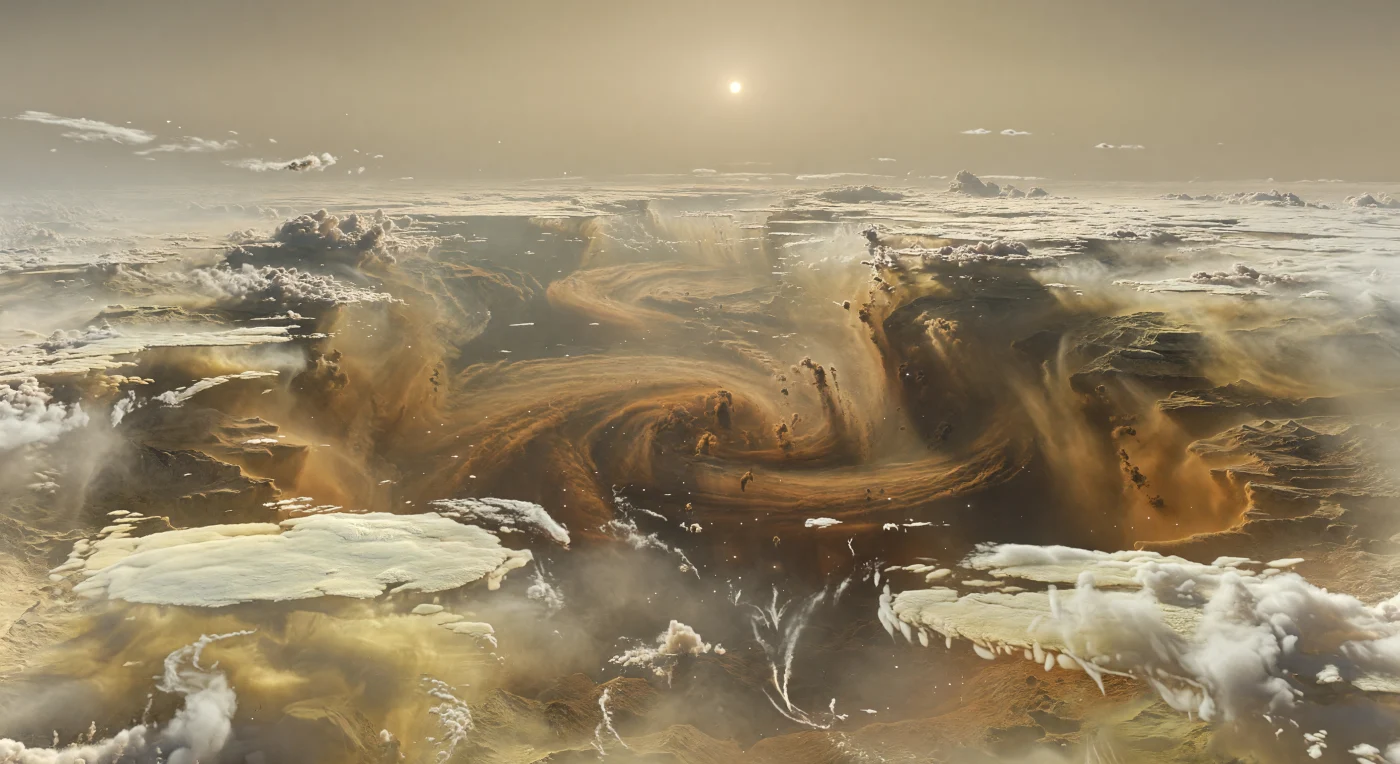
From the edge of the clearing, pale ammonia-ice cloud shelves rise and curl like immense luminous cliffs, their scalloped ledges and torn streamers suspended above a vast opening where the atmosphere drops away into smoky umber, ochre, and muted reddish-brown depths. This is not a surface but a layered hydrogen-helium sky shaped into topography by chemistry and motion: bright upper clouds of ammonia ice over darker ammonium hydrosulfide and deeper water-cloud haze, all sculpted by fierce jet streams, vortices, and sinking dry air within an equatorial hot spot. A tiny probe light or instrument mast is almost absurd against the scale, dwarfed by cloud walls tens of kilometers high and a chasm stretching hundreds of kilometers until it dissolves into amber-gray haze with no true horizon. Under a dirty beige sky, the distant Sun is only a weak, blurred disk, casting soft filtered light that leaves the cream cloud rims faintly glowing while the hot spot interior sinks into cinnamon shadow, making the whole scene feel less like weather than a descending glimpse into a planet-sized ocean of gas.

From just inside the upper ammonia cloud deck, the view resembles an immense frozen plain, yet every ridge, trough, and scalloped roll is made not of ground but of dense cloud matter suspended in a hydrogen-helium atmosphere. Cream-white and pale beige hummocks, brighter puffs of ammonia ice condensate, and faint tan lanes revealing deeper layers stretch toward a subtly curved horizon, where broad cloud walls and low convective domes rise through amber-tinted haze. Overhead, a small but fiercely bright Sun glows through the aerosol-rich sky, its light scattered by ammonia particles and photochemical smog into soft, low-contrast illumination with only muted shadows. Standing here would feel profoundly disorienting: a landscape with the scale and texture of terrain, but no solid surface at all—only stratified weather sculpted by powerful winds and convection on a world vast enough to bend the horizon beneath your gaze.

You are hovering above no ground at all, only a colossal boundary between bright, braided ammonia-ice cloud banks and darker belts of tan, ochre, and cinnamon haze, each side stretched into long, parallel filaments by jet streams racing at roughly 100 to 180 meters per second. The low dawn Sun, tiny at this great distance, skims the horizon and casts warm golden light across folded cloud walls, scalloped bands, and curling vortices, while coppery shadows sink into gaps that fade downward into amber murk. These contrasting colors mark different atmospheric materials and depths—paler upper ammonia clouds beside deeper ammonium-hydrosulfide aerosols—revealing the chemistry of a giant planet whose rapid rotation drives immense banding and shear on scales of thousands of kilometers. With no mountains, no sea, and no solid surface anywhere below, the view feels like standing inside a living atmosphere, where every horizon-spanning ribbon and mist-lit trough is part of a turbulent world made entirely of cloud and wind.
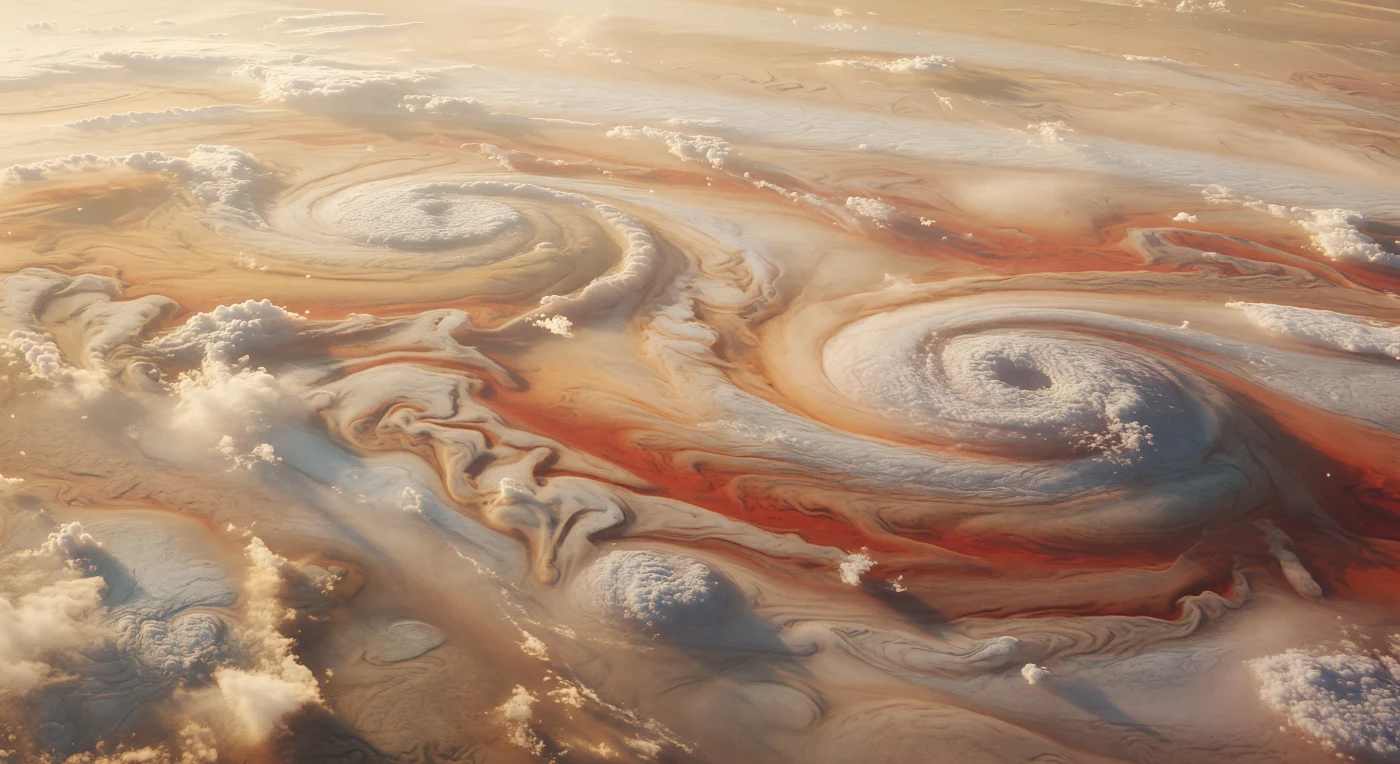
You are hovering above no land at all, only a vast undulating deck of ammonia-ice and ammonium-hydrosulfide clouds where the outer wall of the giant storm rises in sweeping anticyclonic arcs of pale cream, salmon, rust, and muted brick red. Kilometer-high cloud ramparts curl away over the horizon, their scalloped edges, filamentary streamers, and shadow-filled vortical hollows shaped by powerful shear winds in an atmosphere of mostly hydrogen and helium, with color supplied by deeper chemical hazes and descending material. Overhead, the sky is a dense luminous vault of beige-gold and faint reddish tan, where a tiny distant Sun glows through aerosol haze and casts warm peach light across the crests while troughs sink into cool bluish-gray shadow. Fine ice crystals and drifting veils of condensate soften the scene, but the scale remains immense: continent-sized storm structure alive with turbulence, motion, and the charged, restless energy of a world with no solid surface anywhere beneath you.

You are suspended above no solid ground at all, only an immense atmospheric landscape where ammonia-ice storm towers surge tens of kilometers above a flatter sea of cream and pale tan clouds, their cauliflower-bright anvils glowing softly beneath a dim, distant Sun. Gray flanks, amber-lit recesses, and darker chasms between the citadels reveal the planet’s layered chemistry: brilliant upper ammonia clouds over deeper, more subdued ammonium hydrosulfide hazes, all sculpted by violent convection rising from warmer depths and torn sideways by powerful jet-stream shear. Fine aerosols and drifting mist soften the horizon, where storm columns merge into banded cloud plains that stretch for hundreds of kilometers, emphasizing that this “terrain” is entirely weather in a hydrogen-helium world with no surface to stand on. The result is both majestic and unsettling—a sky turned into architecture, luminous and colossal, hanging in perpetual motion under gravity more than twice that of Earth.

There is no ground here—only an immense cavern of atmosphere, where black-brown water-cloud towers rise like city-sized walls through bronze haze and rainlike curtains plunge into darkness. Blue-white lightning flickers inside the convective columns, briefly exposing scalloped cloud faces, rotating hollows, and stacked storm terraces before the view collapses again into a dim sepia gloom. This is the deep water-cloud region of a hydrogen-helium giant, where water vapor can drive powerful thunderstorm updrafts beneath higher ammonia-bearing layers, and where increasing pressure, heat, and dense aerosols make the air thick, opaque, and light-starved. Suspended in that pressure-heavy murk, you would feel surrounded by weather on a scale beyond any terrestrial storm system—an endless, electrically charged sky with no surface below and no true horizon ahead.

Beneath a black polar sky, you hover above a boundless, heaving plain of ammonia-ice cloud tops where steel-gray, pale cream, and bluish haze are sculpted into towering anvils, spiral eddies, and deep shadowed troughs by winds that can race through the upper atmosphere at tremendous speed. Overhead, immense auroral curtains ripple in violet, crimson, and faint green, produced when charged particles guided by the giant planet’s extraordinarily powerful magnetic field plunge into the upper atmosphere and excite hydrogen and trace species, casting a cold spectral glow across hundreds of kilometers of vapor. There is no ground here at all—only layered cloud decks above deeper, darker levels stained muted ochre by lower atmospheric chemistry, a reminder that this landscape is entirely fluid and perpetually in motion. In rare clear gaps, a few stars and a sharp bright moon glint beyond the haze, making the scene feel vast beyond measure, as if you are standing at the edge of an endless storm lit by living light.
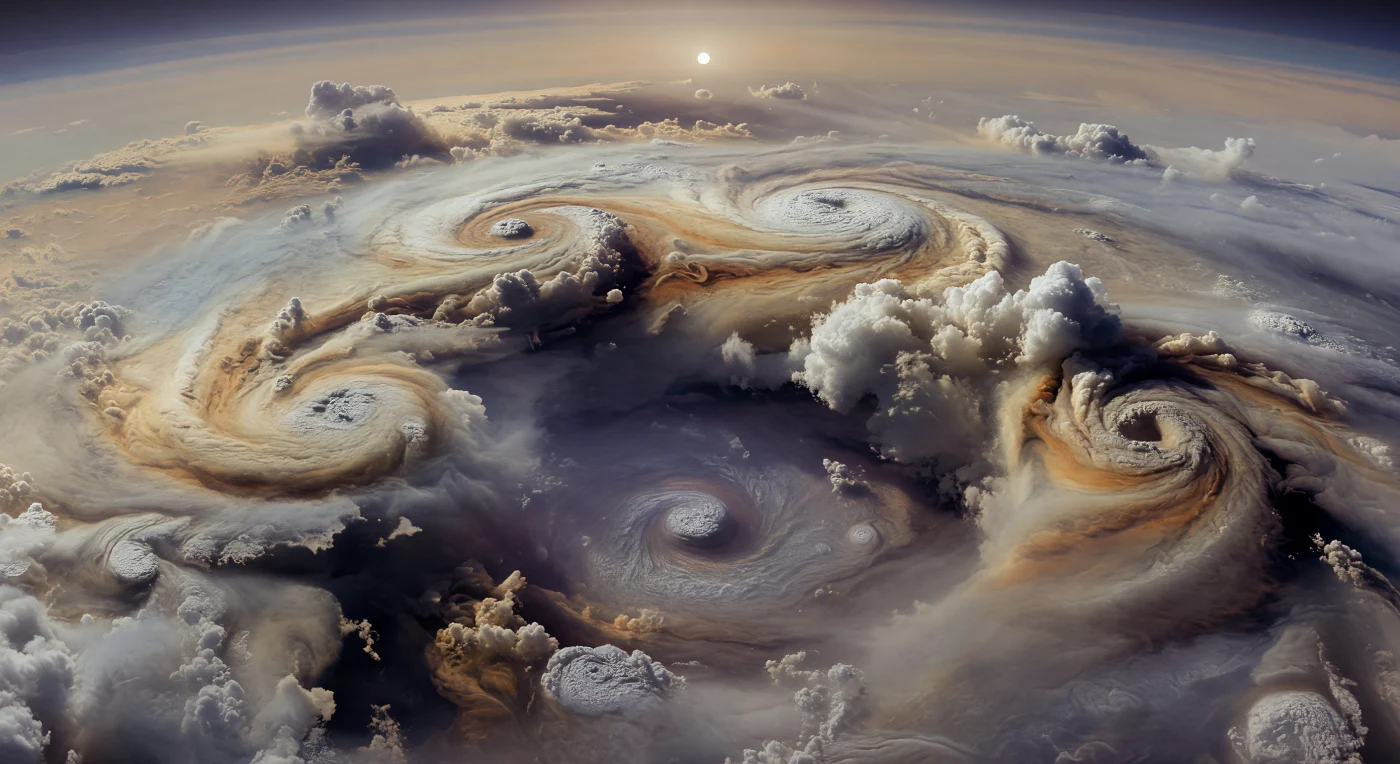
You are suspended above a polar abyss with no ground beneath you, only colossal spiral walls of cloud—cream-white ammonia ice, blue-gray haze, ochre ammonium hydrosulfide bands, and near-black violet storm shadows—curling downward into a seemingly bottomless cyclone eye. The tiny distant Sun, more than five times farther away than on Earth, filters through pale beige and amber-lilac haze, casting weak, oblique light that reveals shredded streamers, scalloped vortex rims, collapsing eddies, and rolling fogbanks in astonishing relief. These are not landforms but atmospheric structures, hundreds of kilometers tall, sculpted by rapid rotation, fierce jet-driven shear, and deep convection in a hydrogen-helium world with no solid surface at all. The effect is both beautiful and unnerving: a vast, dimly glowing storm basin where depth fades into opacity and the scale of the atmosphere feels almost planetary in itself.
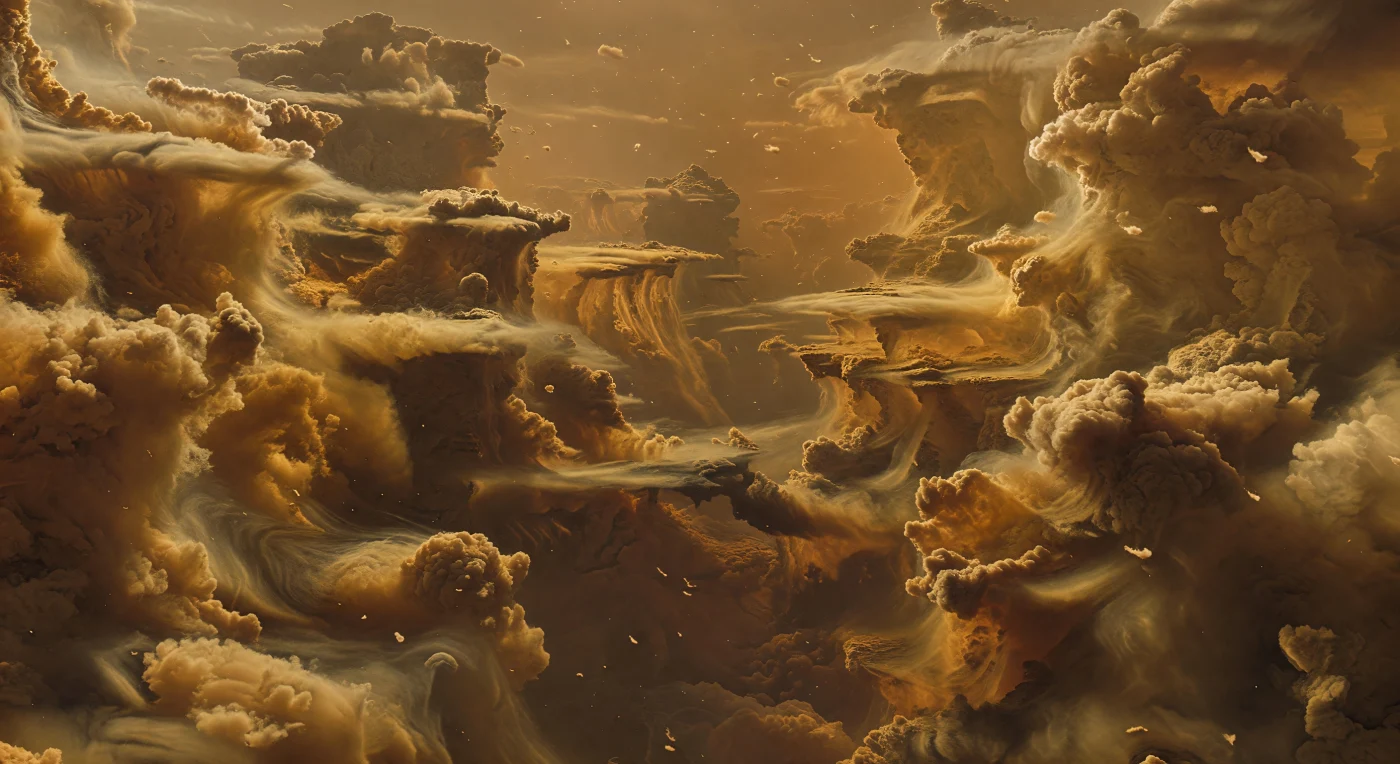
You drift through a colossal atmospheric corridor where no ground or horizon exists, only immense cloud walls rising and folding away into bronze obscurity like cliffs carved from storm itself. In this 1–3 bar realm, ammonium hydrosulfide-rich aerosols build towering escarpments, scalloped recesses, and collapsing plume curtains, while deeper, darker pockets hint at vigorous water-cloud convection below. Sunlight cannot penetrate here as a clear beam, so the entire scene glows with a dim, diffuse amber radiance—ochre, tobacco-gold, muted rust, and smoky brown suspended in layered haze that softens every edge and erases distance. The scale feels overwhelming: tiny wisps are swallowed by vertical ramparts stretching for kilometers through a dense hydrogen-helium atmosphere, where pressure exceeds Earth’s sea level and the landscape is not land at all, but weather made monumental.
