Scientific confidence: Medium

From this hovering vantage just above the upper cloud deck, the world below is an immense, unbroken plain of matte cream and pale-gold ammonia-ice clouds, gently folded into low swells, shallow troughs, and delicate cellular patterns that mimic a landscape despite there being no ground anywhere beneath you. Farther out, the cloud field grades into butterscotch and beige bands, with occasional darker openings hinting at deeper ammonium hydrosulfide layers sinking into the planet’s vast fluid atmosphere. Weak sunlight from a tiny, brilliant Sun filters through hydrocarbon haze, casting soft amber highlights and low-contrast shadows across the cloud ridges while the strongly curved horizon fades into luminous golden smog, revealing the enormous scale of this rapidly rotating gas giant. In the thin calm of the .5–2 bar region, the scene feels eerily serene and impossibly deep: a quiet ocean of cloud suspended above an interior that never becomes solid at all.

There is no ground here—only immense, gently curving plains of cloud, where parallel ribbons of butterscotch, ivory, pale tan, and muted gray-gold sweep unbroken to the horizon under a warm cream sky dimmed by hydrocarbon haze. These bands are the visible tops of ammonia-ice clouds near the 1-bar level, stretched into feathered streaks, braided filaments, scalloped waves, and subtle vortices by powerful east-west jet streams that race around the planet at extraordinary speeds; in the darker lanes between them, deeper cloud layers tinted by ammonium hydrosulfide show through in smoky bronze and ochre. Far off, isolated convective towers rise like low vapor mesas before their summits are sheared flat by the winds, making even active storm cells seem tiny against the vast, continent-scale banding. The sunlight is faint at this great distance, reduced to a small pale disk blurred by smog, and the whole atmosphere glows with a cold, muted warmth that makes the scene feel both serene and colossal—as if you are suspended inside a living ocean of gas.

You appear to be hovering above an endless, softly lit ocean of cloud, where broad beige and pale butterscotch bands curve toward a vast horizon and a cluster of brilliant white ovals swirls like luminous islands in the sky. These are long-lived anticyclonic storms in the ammonia-ice cloud region near the 1-bar level, their raised silver-cream rims and spiral interiors shaped by powerful zonal winds that stretch streamers and filaments into darker tan layers of deeper haze, likely rich in ammonium hydrosulfide and photochemical smog. The sunlight here is weak and cold, arriving as a tiny dim point through the pale gold haze, so the storms gleam with only faint pearly highlights while the surrounding atmosphere fades into soft aerosol mist. In the far distance, a delicate arc of rings briefly emerges through a thinner patch of haze, reinforcing the immense scale of this world of nothing but stacked cloud decks, turbulence, and weather systems hundreds to thousands of kilometers across.

You appear to be hovering within a vast storm-built landscape of cloud alone: colossal convective towers surge upward from a lower plain of flattened haze banks and rolling fog, their brilliant white ammonia-ice anvils glowing faintly above layered cream, pale yellow, and golden-ochre walls that plunge into blue-gray shadow and bronze mist. There is no ground anywhere—only stratified gas and aerosols at the boundary between upper ammonia clouds and deeper ammonium-hydrosulfide haze, where deep convection, shear, and powerful jet streams sculpt scalloped ridges, spiral eddies, torn vapor filaments, and canyon-like voids between the towering cells. Far above, the Sun is only a small, muted disk in a butterscotch sky thick with photochemical haze, casting weak directional light that warms the tower tops while leaving the cloud valleys dim and cold. In the distance, whole ramparts of storm clouds fade into creamy amber veils, making the atmosphere feel planetary in scale, while faint glows deep inside some shadowed cores hint at lightning flickering within this immense, ever-rising architecture of ice and gas.
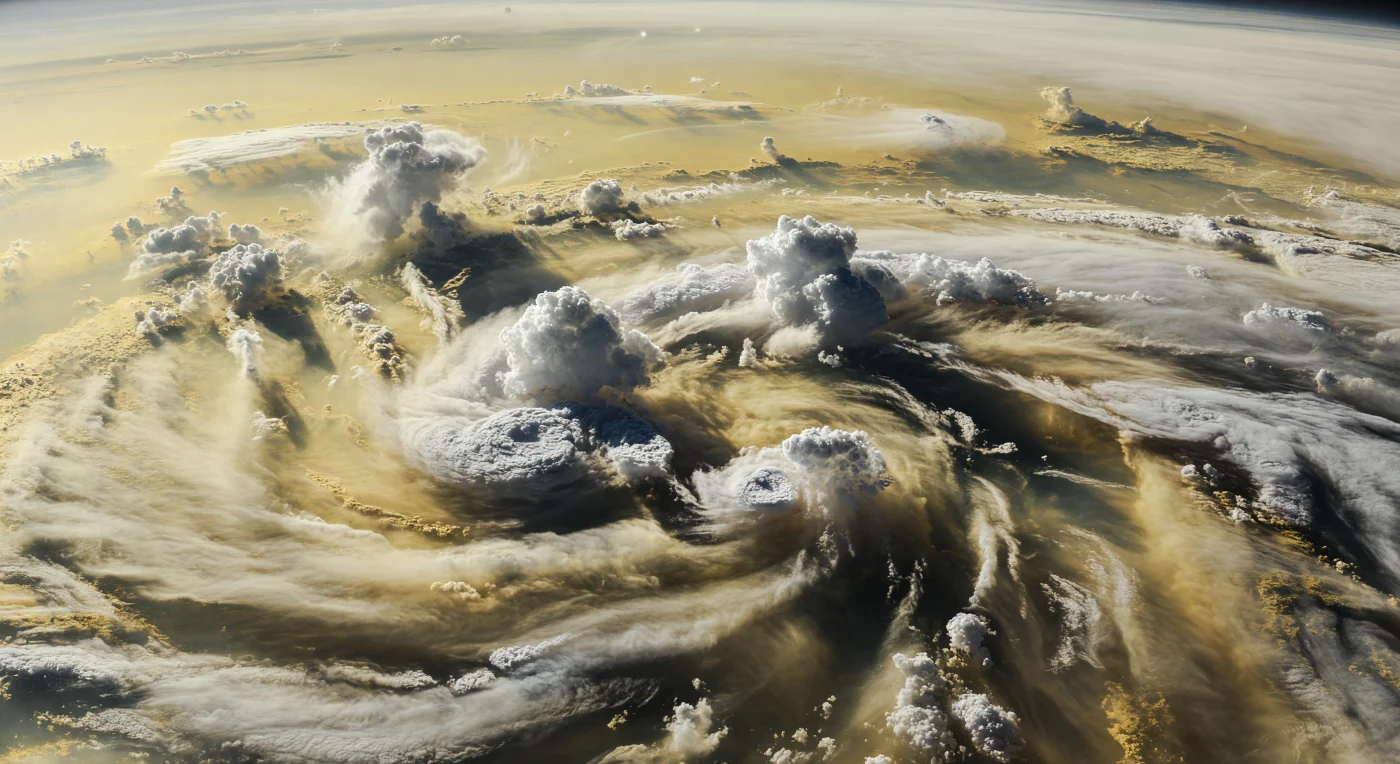
You appear to be hovering within an endless storm front where no ground exists at all—only colossal white ammonia-ice plumes bursting upward through bands of cream, pale yellow, and beige, then trailing into a vast tan and ochre wake that wraps around an entire latitude of the planet. Towering convective clouds rise like vapor mountain ranges, their cauliflower tops torn into streamers by ferocious jet-stream shear, while darker bronze and gray-brown trenches reveal material dredged up from deeper ammonium hydrosulfide layers below. In this frigid upper atmosphere, near 95 kelvin, sunlight arrives as a faint, distant glow, diffused by photochemical haze into soft illumination that makes the brightest fresh cloud crests gleam cold white and leaves the storm chasms in blue-gray shadow. The scale is almost impossible to grasp: scalloped cloud walls hundreds of kilometers high, wave fronts and vortex chains stretching beyond the horizon, and the whole turbulent panorama slowly curving with the immense atmosphere of a world with no solid surface anywhere beneath you.

You are suspended in a vast storm labyrinth with no ground, no horizon, and no open sky—only colossal walls of bronze and sepia cloud plunging into charcoal depths while amber haze chokes the view in every direction. A sudden blue-white lightning flash exposes the true structure of this place: immense convective towers of water cloud, curtains of condensed droplets, slanting precipitation, and collapsing downdraft chasms sculpted by violent winds into forms like atmospheric canyons hundreds of kilometers across. These are not landforms but deep layers of a hydrogen-helium giant, where ammonium hydrosulfide-stained hazes merge into darker, warmer water-cloud regions and rapid convection continuously builds, shears, and shreds the storm architecture. Under the faintest diffuse sunlight from far beyond, the scene feels both crushingly enclosed and immeasurably vast, an alien weather world where the planet’s “landscape” is nothing but fluid, darkness, and lightning.

From this floating vantage above the polar cloud tops, there is no land at all—only an immense, softly undulating sea of ammonia-ice clouds and photochemical haze, tinted cream, pale gold, beige, and gray-white, with darker olive and bronze troughs opening into deeper atmospheric layers below. Over the curved horizon of the giant planet, a dim butterscotch haze glows faintly beneath a nearly black sky, while delicate green auroral arcs edged with violet trace the polar oval high overhead, produced as charged particles spiral along the magnetic field into the upper atmosphere. A razor-thin, ghostly line of rings cuts the darkness at a shallow angle, reflecting only the weakest distant sunlight and emphasizing the vast scale of the scene. In air near 95 kelvin, with no solid surface anywhere beneath you and convective cloud domes rising hundreds of kilometers across, the polar night feels less like weather and more like standing inside a colossal, living atmosphere.
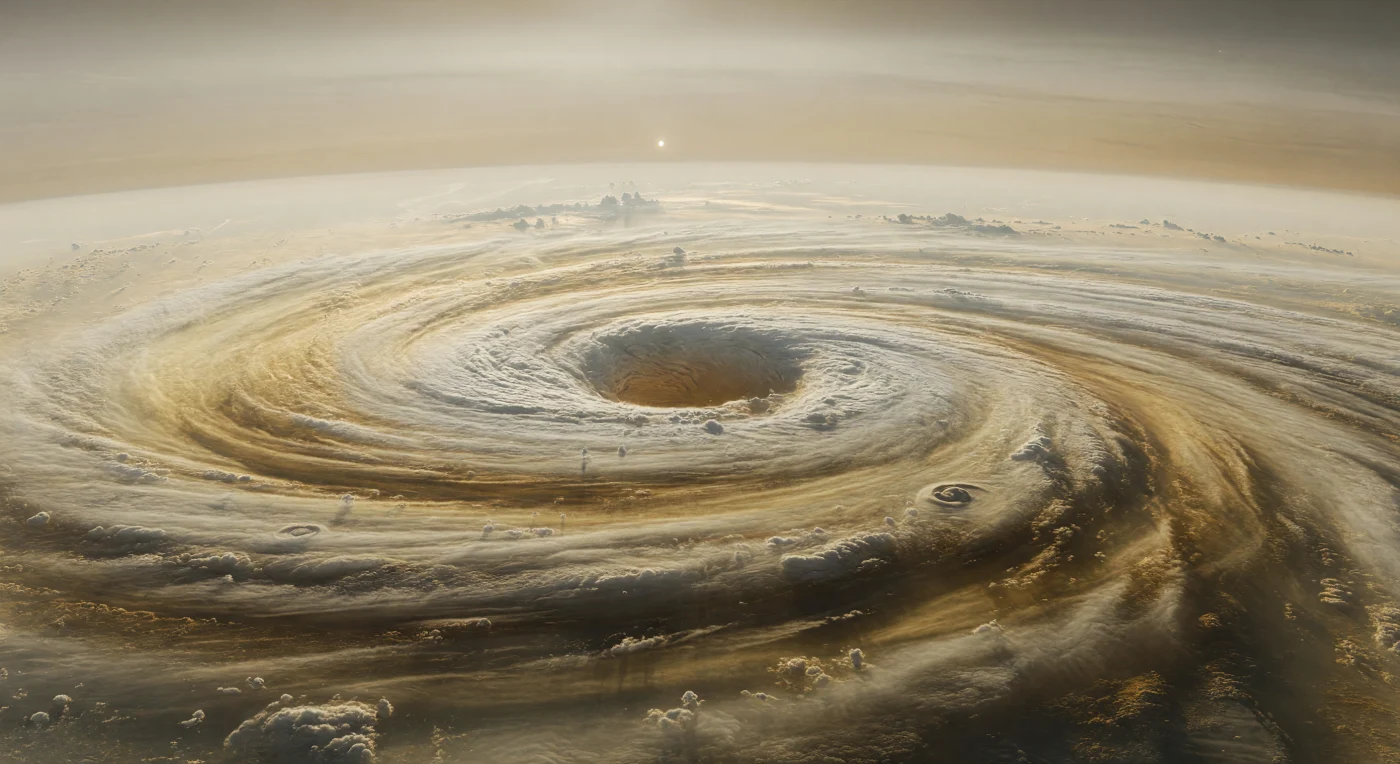
You seem to be hovering above a vast descending amphitheater of cloud, where pale cream, muted yellow, and tan spiral bands curl inward in tight, elegant terraces toward a darker amber center that drops away like an atmospheric well. The ridges are built from ammonia-ice clouds and veiled in hydrogen-helium haze, while deeper gray-brown troughs and bronze-ochre shear lanes likely mark lower, darker condensates and photochemical smog churned by ferocious winds. Under the weak, low sunlight of the distant outer Solar System, the cyclone’s scalloped walls, fibrous streaks, and embedded secondary vortices reveal a storm of planetary scale, sculpted by rapid rotation and powerful polar circulation rather than any solid terrain. With no ground anywhere beneath you—only layered cloud architecture fading into a softly glowing tan horizon—the scene feels like standing at the rim of a colossal, living abyss in a world of cold light and endless atmosphere.

You seem to hover above an endless plain of softly undulating cloud tops, where luminous cream, pale butterscotch, and beige bands stretch to a curved horizon under a glowing canopy of gold-white haze. Across this vast atmospheric “surface” lie immense cool-gray stripes—the shadows of the rings—feathered at the edges by suspended aerosols, while high overhead the ring plane itself sweeps across the sky as a thin, brilliant ivory arc of almost absurd scale. These clouds are not ground at all but upper decks of ammonia ice near the 1-bar level, sculpted into waves, streaks, and distant storm anvils by powerful jet streams in air colder than −170 °C, with darker hollows hinting at deeper ammonium-hydrosulfide haze below. The dim, far-off Sun filters through photochemical smog as a muted point of light, casting a cold, gentle illumination that makes the scene feel both serene and profoundly alien—an endless sky-world with no land, only weather, depth, and shadow.
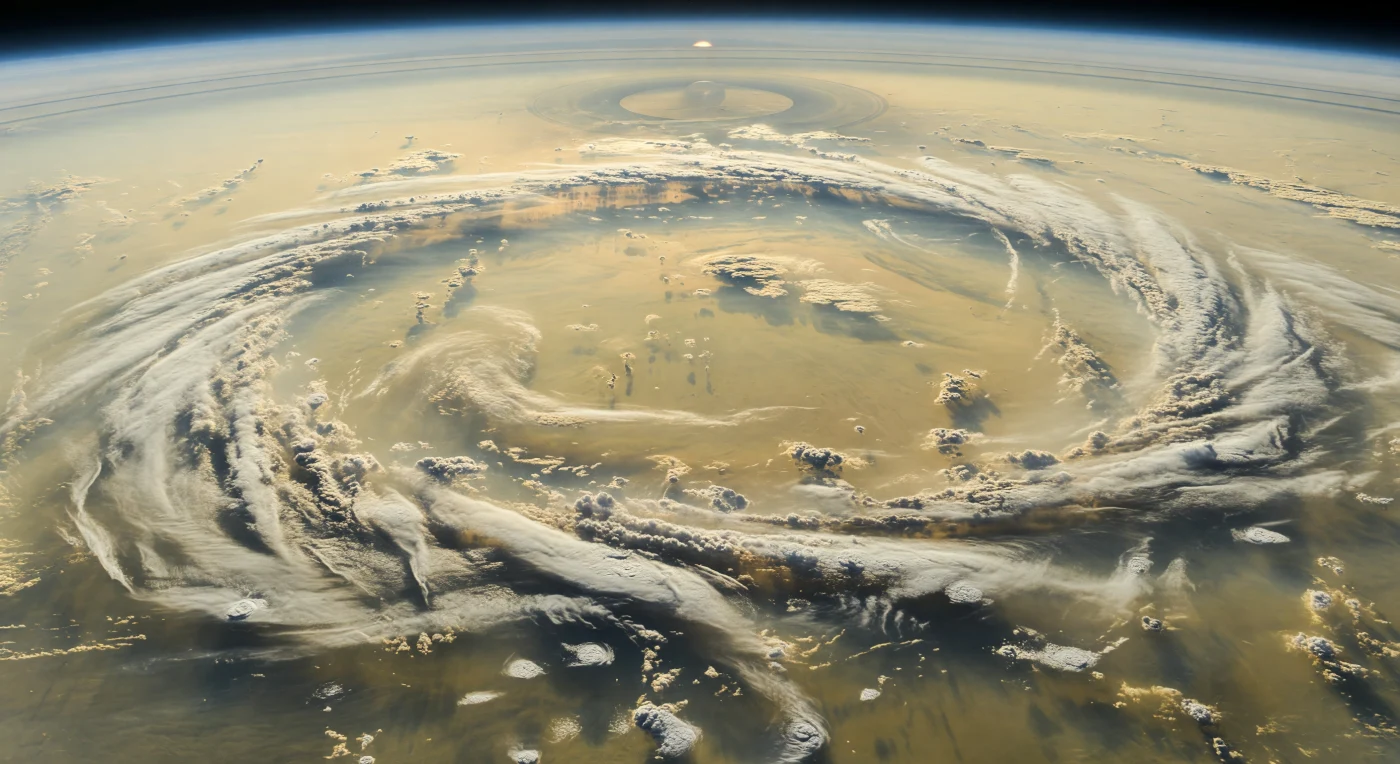
You appear to be drifting beside a colossal atmospheric escarpment: a ruler-straight wall in the clouds where pale cream and butterscotch ammonia-ice tops meet muted olive-beige and dirty ochre hazes, all bending away in the immense six-sided curve of the polar jet stream. There is no ground at all—only layered gas and condensate, with wind-shorn terraces, scalloped vortex hollows, braided streamers, and darker blue-gray recesses sinking into deeper storm layers far below, while tiny bright eddies reveal that these cloud structures rise for many kilometers and extend across thousands. In this frigid realm, near 95 K, low seasonal sunlight filters through photochemical smog as a dim, distant disk, casting soft golden highlights and long diffuse shading across a landscape made entirely of motion, chemistry, and pressure. The effect is both geometric and alien: a vast passage carved not in rock but in ammonia clouds and high-altitude haze, where the atmosphere itself becomes architecture.
