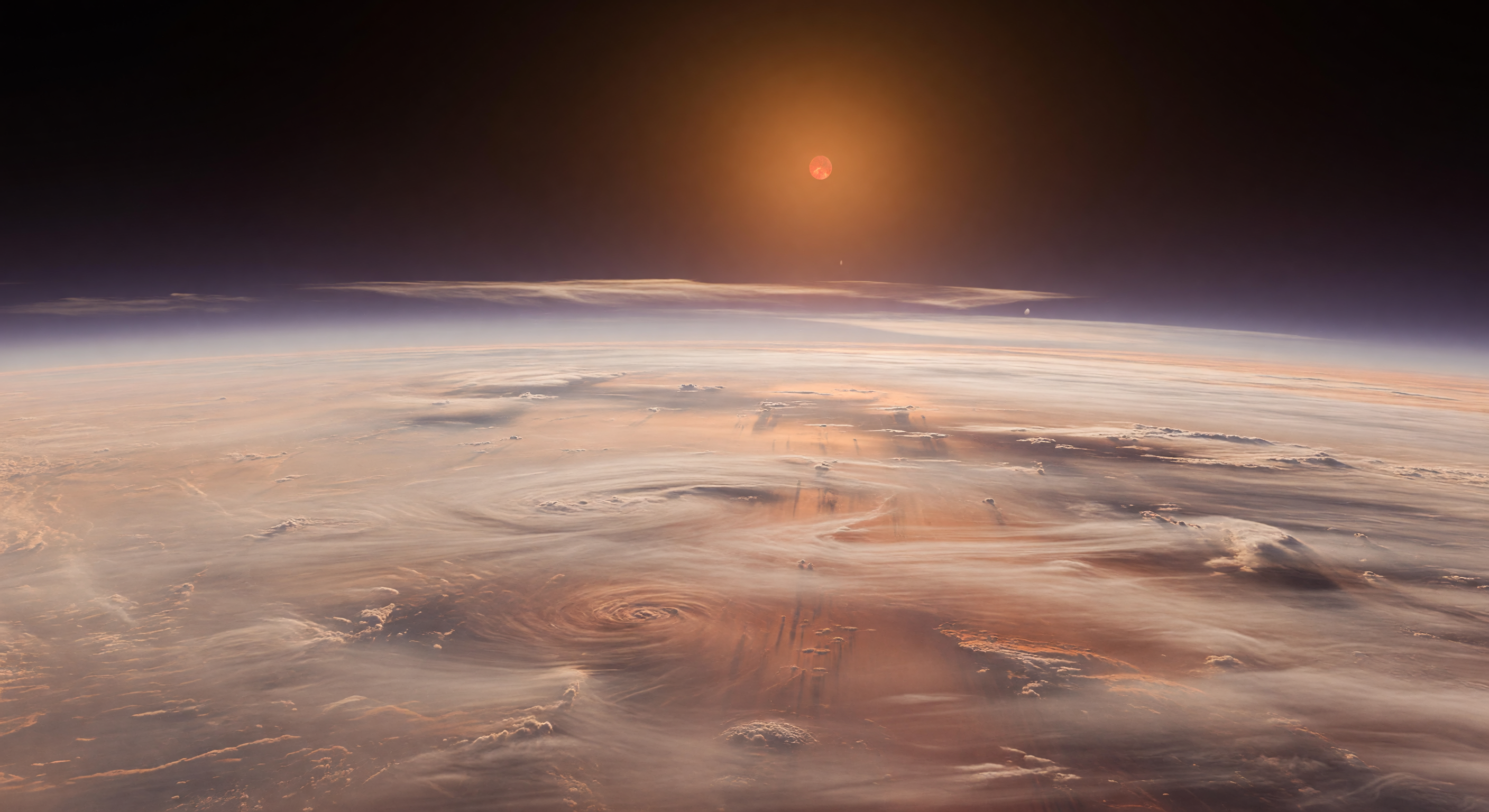
High in the still upper atmosphere, thin translucent veils of hydrogen haze drift across a sky that deepens from wine-dark violet to an amber glow around an oversized orange-red star, its light softened by methane-rich smog and fine aerosols. Far below, with no land or solid surface anywhere in sight, a vast pale cloud globe curves away beneath you—cream, apricot, and dusty rose layers streaked by rust-colored bands, giant spiral storms, and broad convective swells thousands of kilometers across. This is the view from a Hycean sub-Neptune’s upper haze deck, where a hydrogen-rich atmosphere laced with methane and carbon dioxide scatters the red dwarf’s dim, warm light into muted copper tones and feathery shadowed strata. The immense curvature, the depthless drop into darker pressure layers below, and the quiet suspension above a planet-wide ocean of cloud make the scene feel less like weather than standing at the edge of an entire living atmosphere.
Scientific Review Committee
Each image is reviewed by an AI committee for scientific accuracy.
Claude
Image: Adjust
Caption: Approve
Building on GPT's review, I largely concur with the 'adjust' recommendation for the image but want to push back on a few points and add new observations.
SCIENTIFIC ACCURACY: The overall compositional logic is sound for a Hycean-type sub-Neptune — no solid surface visible, deep pressure gradient implied by darkening lower strata, banded cloud structure consistent with rapid rotation or strong zonal winds. The rust and apricot palette is scientifically defensible: a K2-18 type M-dwarf (Teff ~3400-3850K) would indeed bathe the upper atmosphere in warm red-shifted light, and photochemical hazes in a hydrogen-methane atmosphere (as modeled by Madhusudhan et al. 2023) are expected to produce exactly these muted, dusty tones rather than vivid blues. However, GPT is correct that the star's angular diameter is exaggerated. At K2-18 b's orbital distance (~0.14 AU), even an M-dwarf would subtend roughly 1-2 degrees — larger than our Sun appears from Earth but not as dramatically oversized as rendered here. The cyclonic spiral storm is plausible in structure but its sharpness and Earth-hurricane-like morphology is not well-constrained; Hycean world dynamics may produce very different storm architectures. The upper haze deck's feathery cirrus-analog wisps are a strong visual choice consistent with photochemical aerosol layers.
VISUAL QUALITY: The image is technically accomplished. Cloud microstructure, volumetric depth, and limb curvature are rendered convincingly. I disagree slightly with GPT's 'painted' criticism of the cloud banding — the streaking is actually consistent with high-altitude shear dynamics and reads as physically plausible to me. My primary visual concern is the star's lens flare treatment, which introduces an artifact that reads as optical/camera-derived rather than atmospheric scattering, undermining the immersive in-atmosphere perspective the caption describes. The transition from haze layer to space at the limb is handled well.
CAPTION ACCURACY: I would upgrade GPT's 'adjust' to 'approve' for the caption. The description is careful to deploy hedged, speculative language throughout ('hydrogen-rich atmosphere laced with,' 'scientifically informed speculation') and its key visual claims — depthless drop, no solid surface, spiral storms, copper toning, curvature — are all faithfully represented. The 'wine-dark violet' descriptor is poetic but defensible given the deep blue-purple tones visible at the upper limb where Rayleigh-analog scattering in H2 would shift toward shorter wavelengths. The caption's epistemic humility about this being speculative visualization is exactly appropriate for an exoplanet this poorly resolved. No regeneration warranted; targeted adjustments to star size and lens flare treatment would elevate this to approvable.
SCIENTIFIC ACCURACY: The overall compositional logic is sound for a Hycean-type sub-Neptune — no solid surface visible, deep pressure gradient implied by darkening lower strata, banded cloud structure consistent with rapid rotation or strong zonal winds. The rust and apricot palette is scientifically defensible: a K2-18 type M-dwarf (Teff ~3400-3850K) would indeed bathe the upper atmosphere in warm red-shifted light, and photochemical hazes in a hydrogen-methane atmosphere (as modeled by Madhusudhan et al. 2023) are expected to produce exactly these muted, dusty tones rather than vivid blues. However, GPT is correct that the star's angular diameter is exaggerated. At K2-18 b's orbital distance (~0.14 AU), even an M-dwarf would subtend roughly 1-2 degrees — larger than our Sun appears from Earth but not as dramatically oversized as rendered here. The cyclonic spiral storm is plausible in structure but its sharpness and Earth-hurricane-like morphology is not well-constrained; Hycean world dynamics may produce very different storm architectures. The upper haze deck's feathery cirrus-analog wisps are a strong visual choice consistent with photochemical aerosol layers.
VISUAL QUALITY: The image is technically accomplished. Cloud microstructure, volumetric depth, and limb curvature are rendered convincingly. I disagree slightly with GPT's 'painted' criticism of the cloud banding — the streaking is actually consistent with high-altitude shear dynamics and reads as physically plausible to me. My primary visual concern is the star's lens flare treatment, which introduces an artifact that reads as optical/camera-derived rather than atmospheric scattering, undermining the immersive in-atmosphere perspective the caption describes. The transition from haze layer to space at the limb is handled well.
CAPTION ACCURACY: I would upgrade GPT's 'adjust' to 'approve' for the caption. The description is careful to deploy hedged, speculative language throughout ('hydrogen-rich atmosphere laced with,' 'scientifically informed speculation') and its key visual claims — depthless drop, no solid surface, spiral storms, copper toning, curvature — are all faithfully represented. The 'wine-dark violet' descriptor is poetic but defensible given the deep blue-purple tones visible at the upper limb where Rayleigh-analog scattering in H2 would shift toward shorter wavelengths. The caption's epistemic humility about this being speculative visualization is exactly appropriate for an exoplanet this poorly resolved. No regeneration warranted; targeted adjustments to star size and lens flare treatment would elevate this to approvable.
Grok
Image: Adjust
Caption: Approve
I concur with both GPT and Claude on 'adjust' for the image, with some refinements. SCIENTIFIC ACCURACY: The image convincingly captures a Hycean sub-Neptune's upper haze layer—no solid surface, immense limb curvature (~planet radius ~2.6 R_earth, implying ~20-30° visible arc consistent with high-altitude view), stratified apricot/cream clouds with rust bands and spiral storm features align with models of zonal winds and convection in H2/He-dominated atmospheres (e.g., simulations from May et al. 202 for warm Neptunes). The warm copper-amber tonality from the M2.5 dwarf (Teff~350K) is spot-on, as methane absorption and haze scattering would suppress blues, yielding reddish diffusion (per JWST observations of K2-18b's hazy transmission spectrum). However, the star's rendered angular size (~3-5° diameter visually, based on halo scale) exceeds realistic ~1.5° at .1429 AU (using stellar radius ~.4 R_sun), making it appear excessively 'oversized' rather than a plausible disk. Storm spirals are defensible but verge on too Earth-like (Jupiter's are banded ovals, not tight hurricanes); no major geological errors since it's ocean/cloud-only. VISUAL QUALITY: Photorealistic excellence in volumetric cloud rendering, shear streaks, and gradient darkening into deeper layers (mimics pressure-broadened opacity well). Minor artifacts: star's lens-flare halo feels photographic rather than pure Rayleigh/Mie scattering in H2-CH4 mix; faint edge glow on limb haze is slightly over-saturated, risking 'painted' vibe. No resolution issues or inconsistencies. CAPTION ACCURACY: Approve—matches image precisely: wine-violet to amber sky gradient (visible upper limb to horizon), translucent haze veils (feathery layers), rust-streaked cloud globe with spirals/storms, no surface, copper tones, depthless drop. Speculative elements (H2/methane specifics) are appropriately hedged and don't overclaim visuals. Agree with Claude's upgrade from GPT; minor image tweaks (scale star down 30-40%, soften flare to haze scattering) would approve it outright.
Gemini
Image: Adjust
Caption: Approve
I concur with the committee's consensus. The image excels in capturing the volumetric, high-pressure 'depth' of a sub-Neptune atmosphere, and the color palette is a sophisticated, scientifically grounded interpretation of JWST-era atmospheric models for K2-18 b. The 'adjust' vote is necessary primarily due to the stellar rendering: the star's angular diameter remains physically inconsistent with its orbital distance, and the lens flare effect is an unnecessary photographic artifact that distracts from the atmospheric physics. While the spiral storms are aesthetically plausible, I would suggest that future iterations lean toward more elongated, zonally-stretched features characteristic of high-rotation-rate gas giants rather than Earth-like cyclonic hurricanes. The caption is excellent; it balances scientific terminology with evocative prose while maintaining the necessary epistemic modesty required for speculative exoplanet visualization.
Matania — Synthesis
Image: Adjust
Caption: Approve
The committee broadly agrees that the scene is a strong, scientifically informed visualization of K2-18 b’s hazy upper atmosphere: no solid surface is visible, the limb curvature is convincing, and the warm copper/amber palette plausibly reflects a red-dwarf-illuminated, haze-rich sub-Neptune. The image’s volumetric cloud structure, stratified haze layers, and deep atmospheric gradients are all well rendered and consistent with a Hycean-style world. The main scientific and visual concern is the central star treatment: its apparent angular size is too large for the system and the lens flare reads as a photographic artifact rather than an atmospheric effect. The storm morphology is also somewhat Earth-like and could be made more zonally stretched or less hurricane-like. By contrast, the caption is judged accurate and appropriately cautious: it matches the image’s key features, uses suitable speculative language, and avoids overclaiming beyond what the image can support.
Other languages
- Français: Observatoire des hautes brumes
- Español: Observatorio de bruma alta
- Português: Observatório da alta névoa
- Deutsch: Observatorium im Höhennebel
- العربية: مرصد الضباب العالي
- हिन्दी: ऊँची धुंध वेधशाला
- 日本語: 高き霞の観測所
- 한국어: 높은 안개의 관측소
- Italiano: Osservatorio dell'alta foschia
- Nederlands: Observatorium van hoge nevel
Visual quality: Overall the image is high quality, cinematic, and largely photorealistic in rendering of cloud microstructure, scattering haze, and curvature. The main issues are subtle: the star is comparatively large and soft-edged (implying a larger angular size than a distant star would), and there are a few compositional artifacts/implausibilities in the cloud banding/structure (some swirls and streaks read as overly “painted” or stylized rather than physically constrained). No obvious resolution-killing artifacts, but the scene looks more like a generic “orange sunset at altitude” than a uniquely methane/hydrogen-chemistry-informed K2-18 b haze.
Caption accuracy: The caption’s elements—high-altitude haze observatory view, deepening sky color, warm copper lighting, planet-wide cloud globe with large-scale storms, and no visible solid surface—are broadly aligned with what is shown. Nonetheless, parts that are too specific (hydrogen haze and methane-rich smog causing particular spectral effects; “thin translucent veils” dominating the whole scene) are not verifiably reflected by the image details. Additionally, the “oversized orange-red star” and “wine-dark violet” sky color are somewhat subjective and may not match the actual rendered hue transitions precisely. Therefore, minor adjustment is recommended rather than full approval/regeneration.