Scientific confidence: Speculative

Hovering above the upper atmosphere, you would see no land at all—only an immense ocean of ammonia-rich clouds, its cream, pale gold, and ivory bands rolling away in smooth wind-shaped swells until they curve with the planet itself at the horizon. The brighter of the two suns, a modest warm orange disk, lifts first into a sky that fades from luminous haze near the cloud tops to indigo and near-black overhead, while a smaller, dimmer deep red companion hangs nearby and paints the scene with a second, subtler light. Across the cloud deck, powerful zonal winds sculpt ridges, scalloped eddies, and faint cellular textures, and occasional gaps hint at colder, bluish-gray layers plunging far below into the depths of a hydrogen-helium atmosphere with no solid surface anywhere. The result is both beautiful and unsettling: a colossal weather world lit by twin dawns, where amber highlights and faint crimson shadows slide together over the cloud waves in a truly alien sunrise.
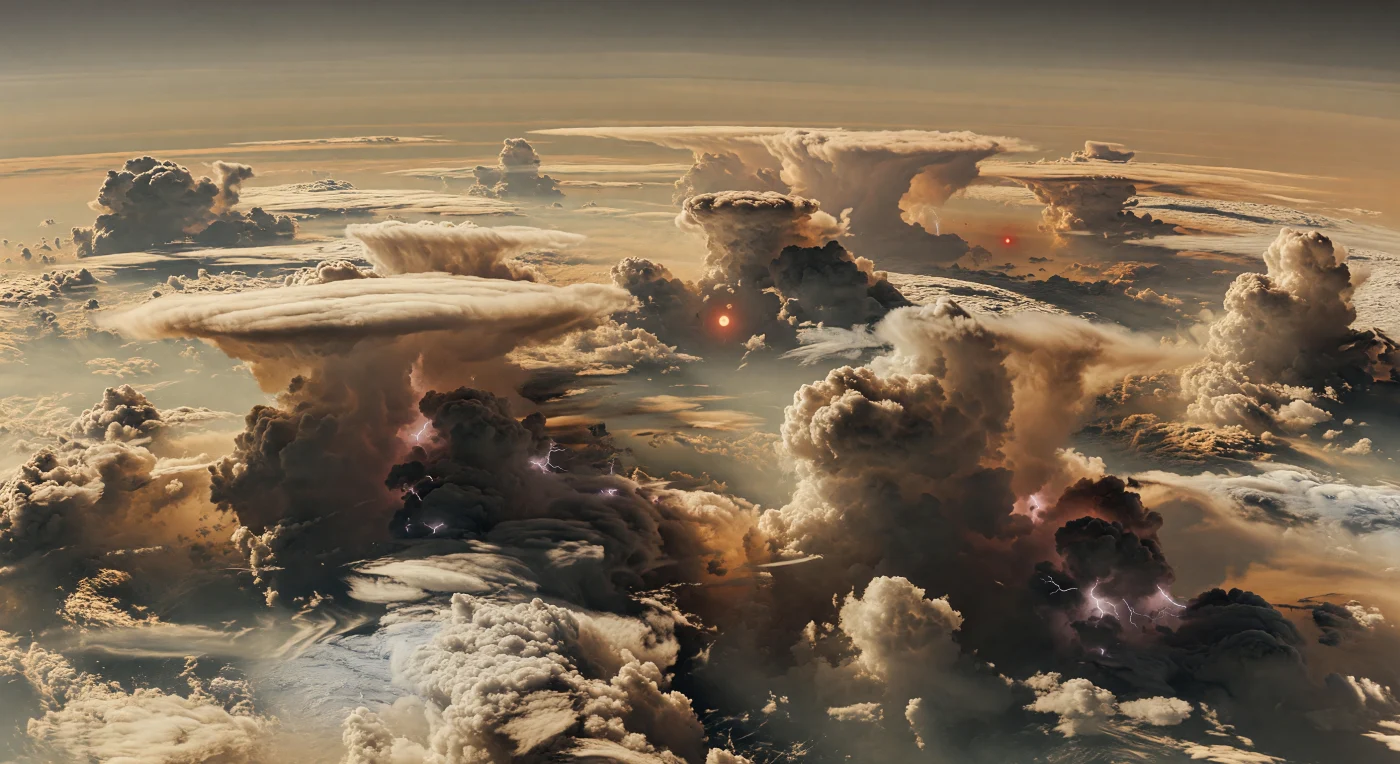
You seem to hover above an endless hydrogen-helium cloud deck where no ground, sea, or ice ever breaks through—only towering storm columns rising like atmospheric mountain ranges, their brown-gray walls and pale cream anvils thrusting tens of kilometers into a cold, hazy sky. The brighter orange star paints the convective towers in warm sidelight while its dimmer red companion adds a faint crimson rim, creating subtly doubled shadows across turbulent vapor, shredded wisps, and distant zonal bands that curve away into the planet’s immense horizon. In the dark troughs between these colossal upwellings, bluish-white lightning flickers through layers of ammonia- and water-bearing cloud, briefly revealing the depth of a violently churning atmosphere shaped by powerful convection in a world chilled to roughly 180 K. The result is an eerily beautiful skyscape: not a surface to stand on, but a suspended wilderness of storm and haze under two suns, vast enough to make even the tallest cloud buttresses feel planetary in scale.

You seem to be suspended inside a colossal atmospheric frontier, looking down the length of an equatorial jetstream corridor where a broad cream-beige haze band meets a deeper tawny belt carved by silver-gray shear lines and rust-colored aerosol streamers. There is no ground anywhere—only stacked cloud terraces, rolling fog banks, translucent canyons of vapor, and immense convective walls sinking into amber-brown depths, all shaped by powerful zonal winds in a cold hydrogen-helium atmosphere near 180 K where ammonia, water ice, and other condensates can form layered clouds. The light is uncanny: a subdued orange glow from the brighter star and a faint red wash from its smaller companion lay delicate double highlights across the wind-combed haze, while the thick honey-amber sky hides the stars and softens every edge. Tiny ripples in the nearby mist contrast with storm filaments that arc away over the planetary curvature, making the whole scene feel like standing within a living weather system on a scale larger than continents.

An endless, mirror-smooth cloud plain stretches to a gently curved horizon, its pearl-white ammonia and water-ice haze broken only by low rolls of cream and silver-gray mist and the faint suggestion of deeper ochre cloud bands far below. Overhead, two tiny suns hang in a luminous amber sky: the brighter orange disk partially grazed by a smaller, redder companion, their mutual eclipse washing the atmosphere in an uncanny copper noon and briefly dimming the reflective deck beneath. Soft double shadows and reddish penumbras drift across the cloud tops, sharpening for a moment near the overlap before dissolving back into the dense, aerosol-rich haze. In this cold hydrogen-helium atmosphere, where no solid surface exists and the weather itself forms the landscape, the scale feels colossal—nearby ripples gleam with crisp reflections while distant cloud swells fade into apricot fog, as if you were suspended above an infinite sea made entirely of light and vapor.
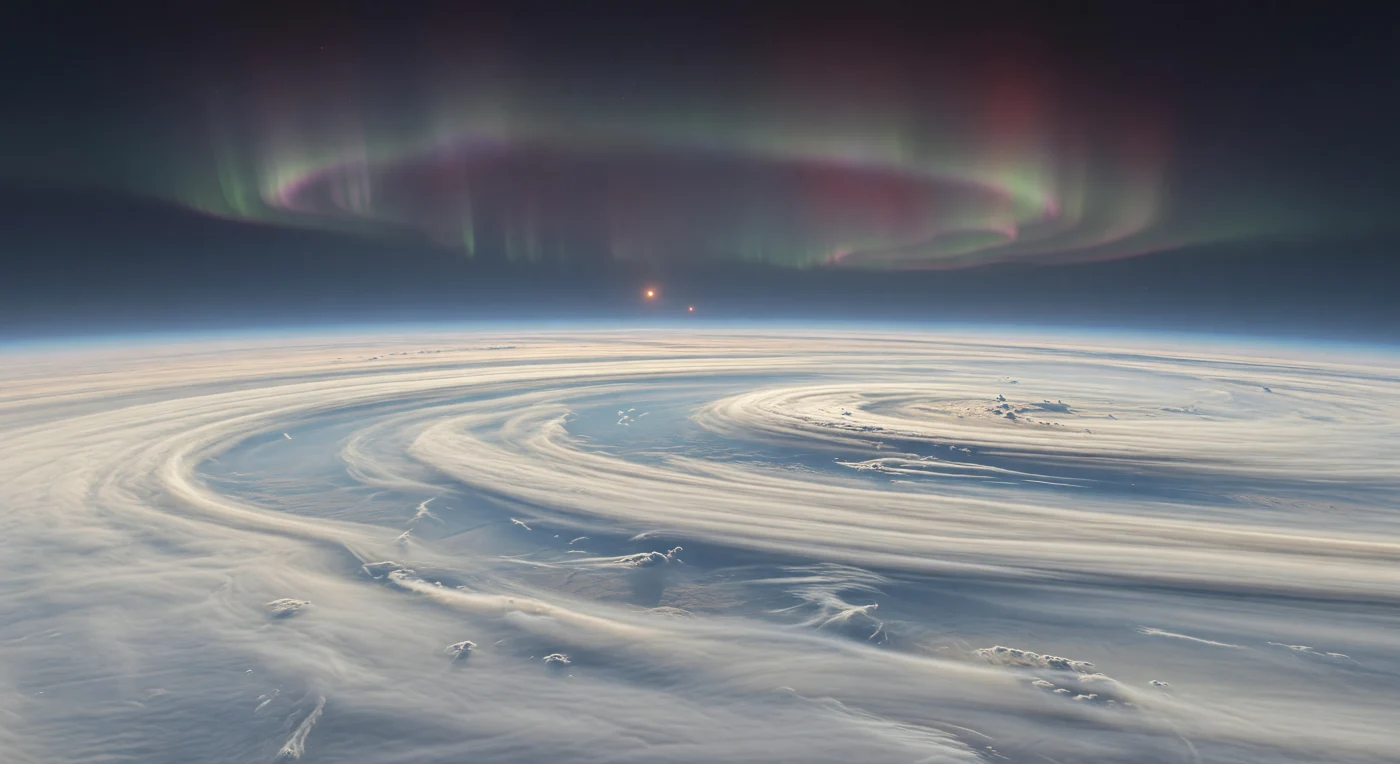
At these polar heights, there is no ground at all—only immense terraces of ammonia-water cloud and thin bluish haze, curving away like frozen surf beneath a darkening sky. The pale ivory and blue-gray decks are sculpted by high-altitude winds into streamers, shallow vortices, and softly swollen convective domes, revealing the restless dynamics of a cold hydrogen-helium giant whose upper atmosphere sits near roughly 180 K. Across the far horizon, broad auroral veils in faint green, violet, and subdued crimson ripple through the near-black sky, likely tracing charged particles guided by a planetary magnetic field into the upper atmosphere. With the two suns reduced to a weak twilight glow low beyond the cloud arcs, the aurora paints only the slightest color onto the cold haze, and the vast curved horizon makes the scale feel planetary in the most literal sense.

Suspended in a lightless storm layer, you would see a vast basin of atmosphere rather than land: towering umber and bronze cloud escarpments rise like canyon walls, while fog-choked troughs, scalloped shelves, and swollen convective towers disappear upward into charcoal darkness. These structures are made of hydrogen-helium gas laden with deeper cloud decks of ammonia, water, and ammonium hydrosulfide condensates, shaped by rapid rotation, powerful zonal flows, and intense vertical convection into a three-dimensional weather landscape with no surface and no true horizon. In the long black intervals between flashes, the haze feels crushing and nearly opaque; then sheet lightning blooms within the storm banks, backlighting vapor cliffs and revealing smoky orange, copper, and burnt-sienna interiors inside the turbulent cloud masses. The effect is immense and profoundly alien, as if you were floating inside a planet-sized canyon system carved not from rock, but from pressure, chemistry, and perpetual storm.

At the edge of day and night, an endless cloud ocean of muted cream, pale ochre, and lavender-taupe ripples away beneath you, its softly banded tops sculpted by winds into dune-like waves of vapor with no trace of rock or shore. Far below the nearly black upper sky, thin layers of ammonium hydrosulfide haze and higher blue-gray and amber mists glow faintly, while isolated ammonia-water convective towers rise tens of kilometers like mountain ranges made entirely of cloud. The brighter orange star has already slipped beneath the horizon, leaving only the dim red companion to cast a weak ruby light across the atmosphere, drawing single elongated shadows over shallow cellular textures and dark storm lanes. In the cold hydrogen-helium air, where water, ammonia, and sulfur-bearing clouds stack in vast stratified layers, the scene feels both intimate and planetary in scale—an immense twilight world of vapor, silence, and shifting double-star dusk.

You appear to be suspended above the towering rim of a storm so vast it curves beyond the horizon, where scalloped walls of cream, beige, and ochre cloud tops fold inward like a spiral canyon made entirely of vapor. Beneath the bright, cold upper condensate layers, darker smoky-brown bands and ammonium hydrosulfide hazes sink toward a murky central eye, while convective plumes, filamentary eddies, and faint lightning deep in the eyewall reveal the violent circulation of a frigid hydrogen-helium atmosphere with no solid surface anywhere below. The larger orange sun paints the cloud escarpments in warm oblique light, and the dimmer red companion adds a subtle backglow that splits the shadows into two soft, offset directions, giving the whole vortex an uncanny double-lit depth. Standing here, you would feel the scale most of all: cloud buttresses rising like mountain ranges, spiral terraces descending into brown atmospheric abyss, and an amber sky thick with aerosols that turns this giant cyclone into a living, planet-sized machine of weather.
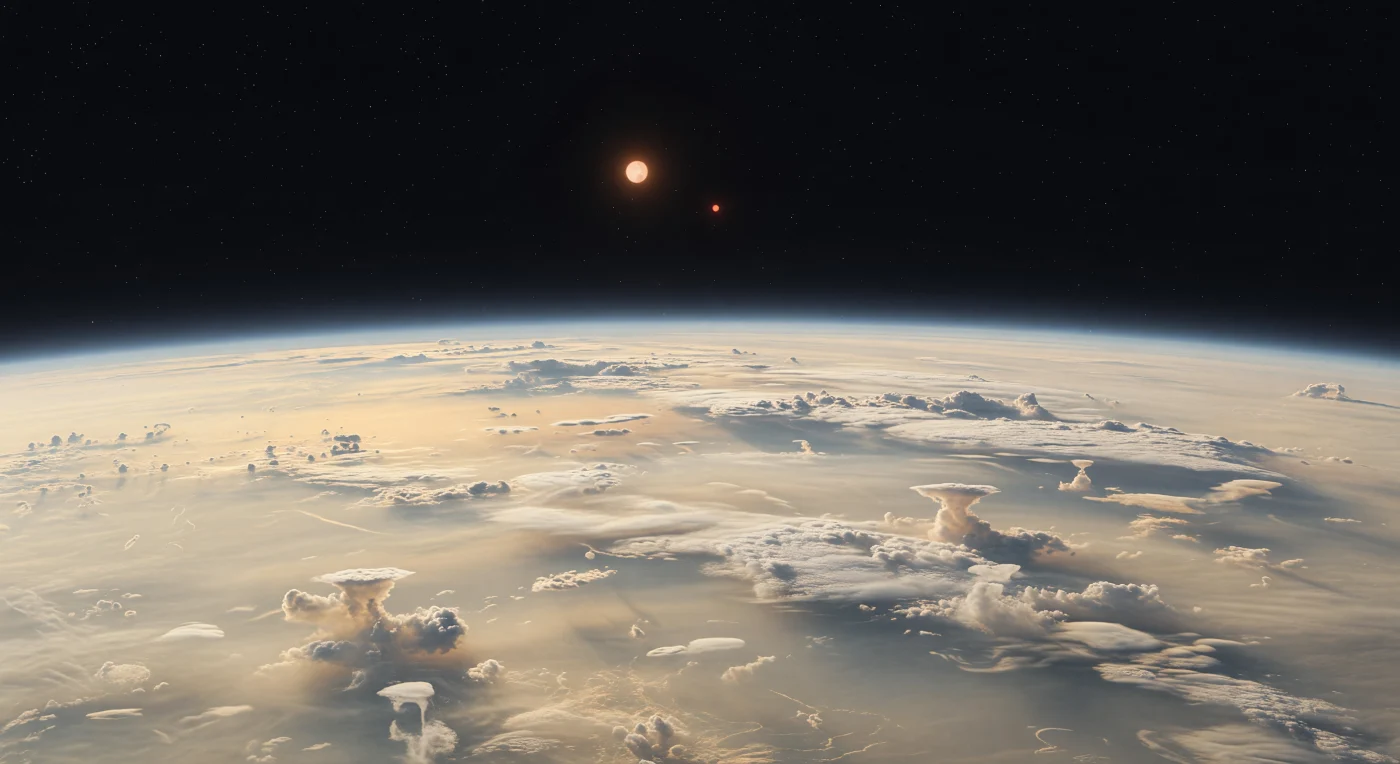
From this lofty perch above the main cloud decks, you look out over a vast cream-colored ocean of atmosphere, its softly banded ammonia and water-ice hazes curving away so strongly that the planet’s immensity is impossible to miss. Towering storm anvils and faint spiral eddies rise from the smoother layers thousands of kilometers below, while a razor-thin silver-blue limb traces the horizon beneath a sky already faded to near-black. Suspended there are two distinct suns: a warm orange primary casting amber light across the pale clouds, and nearby a far smaller ember-red companion adding a delicate secondary glow that splits highlights and shadows across the storm tops. With no land, no sea, and no solid surface anywhere beneath you—only cold hydrogen-helium depths and stratified cloud worlds descending into darkness—the scene feels less like weather above a planet than the exposed upper skin of a giant, alien atmosphere.

From a high opening between colossal cloud banks, you look out across an endless plain of pale-gold and cream cloud tops, their smooth ammonia-ice and water-ice layers broken by scalloped ridges, dark troughs, spiral eddies, and towering storm plumes that rise like frozen thunderheads into a dim violet-gray sky. Along the far-curving horizon, the brighter orange star has already slipped from view, leaving only a faint apricot afterglow, while its smaller red companion hangs alone above the haze, casting a weak copper-red sheen across the highest crests and letting the lower bands sink into mauve and crimson-gray shadow. The atmosphere here is deep, cold, and hydrogen-helium rich, with aerosols and layered vapor decks sculpted by powerful zonal winds and convection on a world with no solid surface anywhere below. In the prolonged circumbinary twilight, every banded terrace and isolated storm tower feels immense beyond human scale, as though you are hovering above a planet-sized ocean of cloud slowly darkening under two suns that do not set together.
