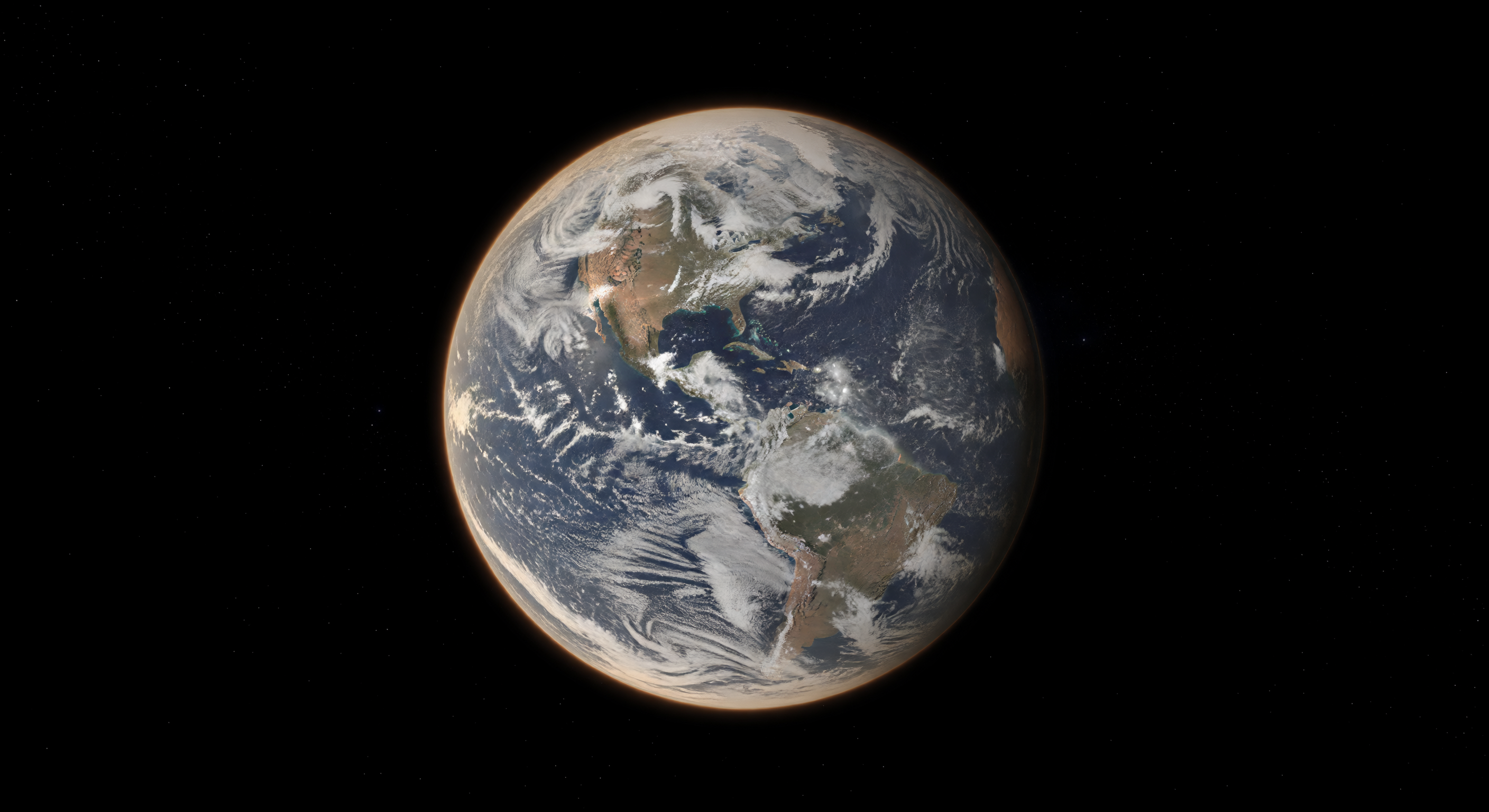
Scientific confidence: Speculative
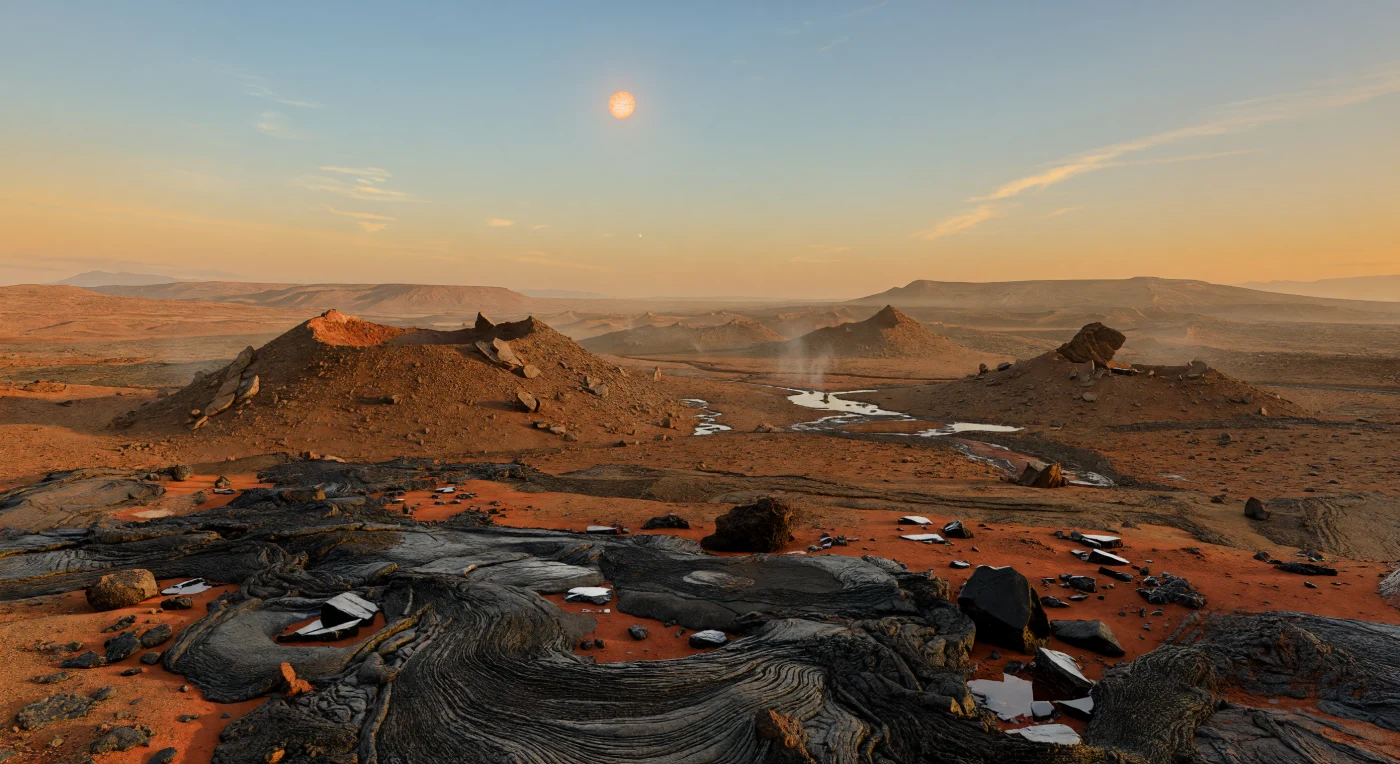
From the ground, the landscape spreads out as an immense volcanic plain of black and charcoal pahoehoe, its ropy crust gleaming in places where smoother basalt catches the warm light, while pressure ridges, broken lava toes, vesicular fragments, and scattered glassy clasts create a razor-sharp texture underfoot. Low cinder cones and spatter ramparts rise from the plain in rusty red-brown tones, their oxidized scoria contrasting with the darker lava, while thin fumarole plumes trail sideways through denser air, hinting at lingering geothermal heat beneath a cooling basaltic surface. Overhead, a pale cyan sky fades to amber at the horizon through haze and volcanic aerosols, and the slightly smaller orange-white disk of the system’s K-type star casts subdued golden shadows softer than those on Earth. The broad stepped lava fields and distant shield-like uplands make the terrain feel immense and heavy, the kind of dry, volcanic super-Earth surface where stronger gravity, abundant iron-rich rock, and an atmosphere thick enough to hold haze combine into a scene both habitable in principle and starkly alien in practice.
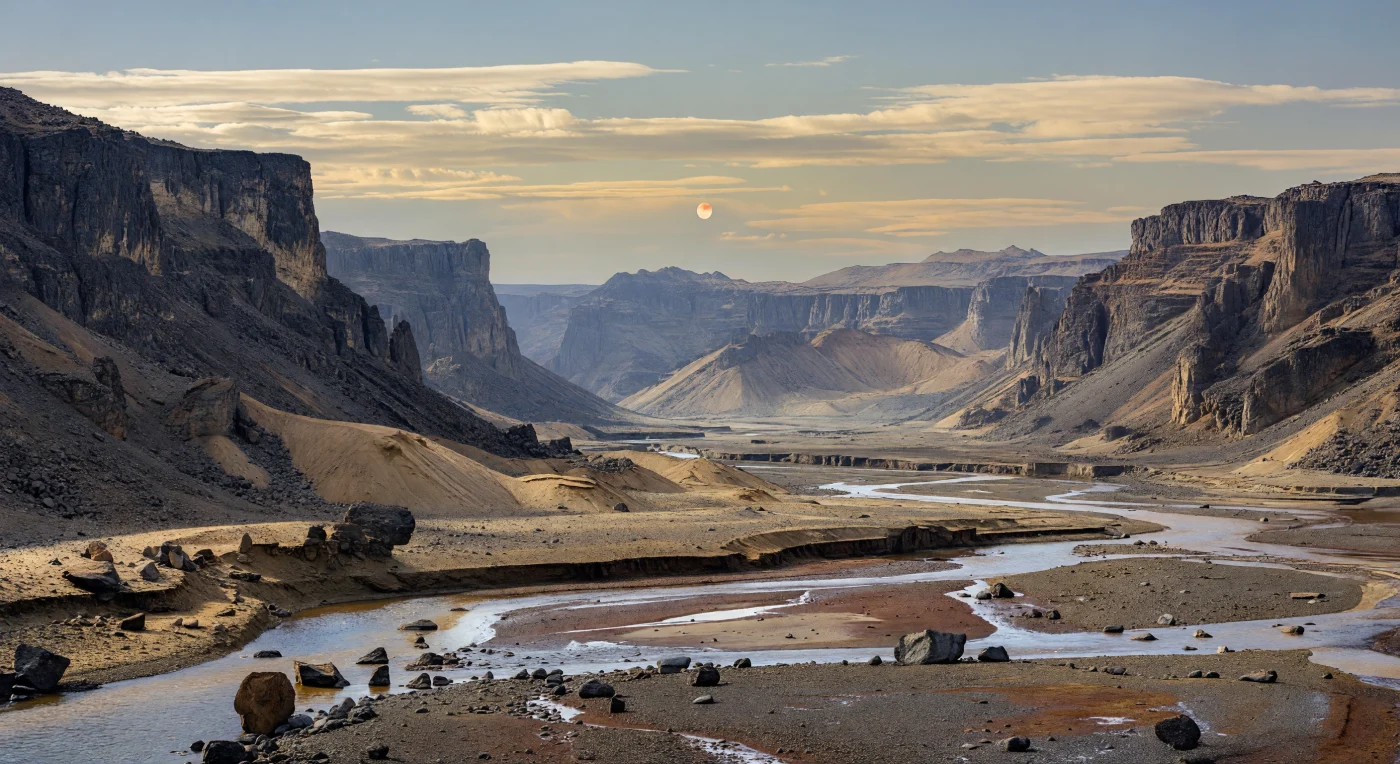
From a gravelly terrace near the valley floor, you look into an immense rift where dark walls of basaltic and metamorphic rock rise for kilometers, broken by fresh fault scarps, talus chutes, and broad tan landslide fans that spill out like frozen cascades from the cliffs. Across the subsiding basin, braided river channels thread through pale silt bars, damp sandbanks, rounded cobbles, and iron-stained sediments, recording the work of flowing water in a tectonic landscape still being pulled apart. The slightly stronger gravity expected on a rocky super-Earth would favor these heavy, stable landforms, while the dense, Earthlike-to-somewhat-thicker atmosphere softens the scene into bluish distance haze and carries layered cream-white clouds beneath a compact orange star. Its dimmer, warmer light throws the escarpments into crisp relief without harsh glare, making the valley feel both temperate and profoundly alien—vast, silent, and continental in scale.
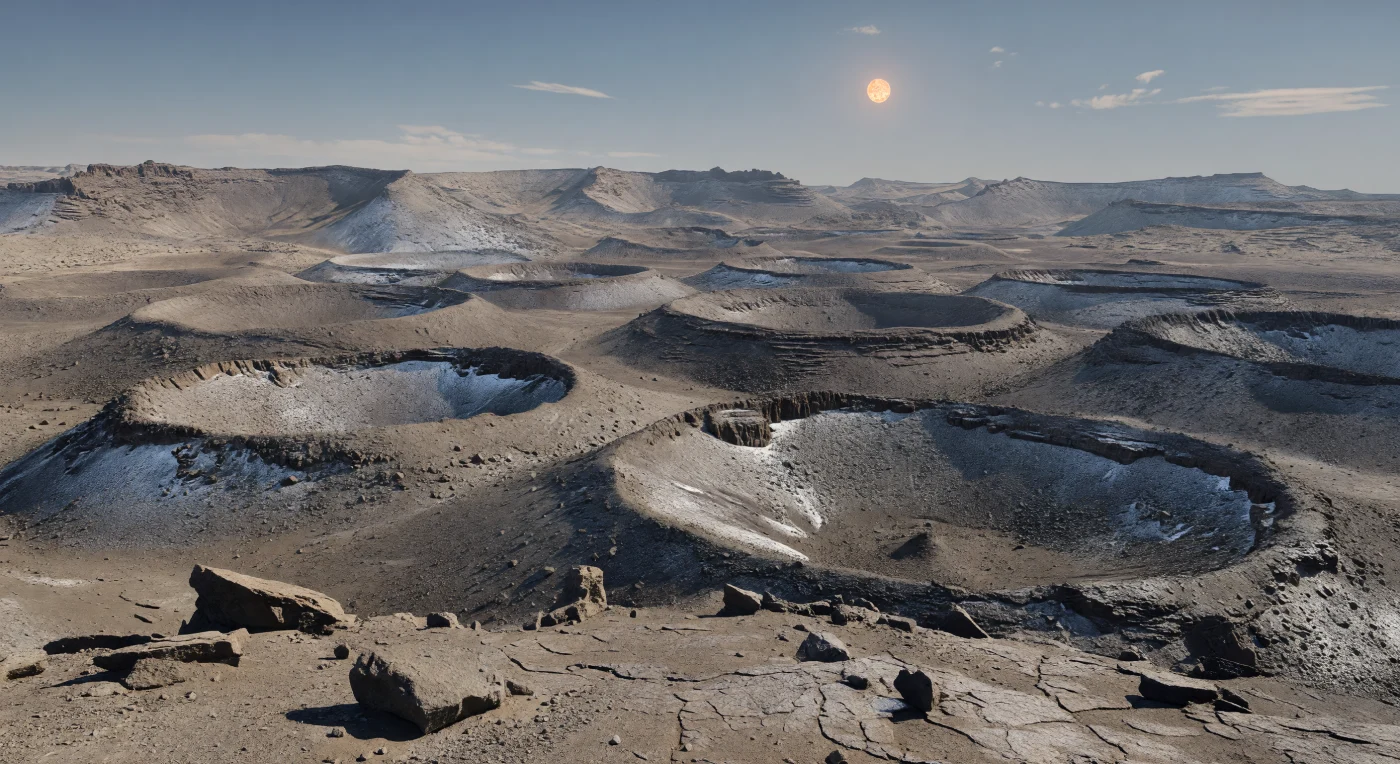
From this ground-level vantage, ancient brown-gray uplands stretch outward in a maze of terraced impact craters, their immense rims and steep inner steps still crisply etched beneath exceptionally clear air. Fractured basaltic and metamorphic bedrock breaks through a thin, wind-stripped regolith in the foreground, where angular boulders, pebble lag, and faint frost-heaved polygons hint at a cold, dry surface shaped by impacts, slow weathering, and seasonal freeze-thaw near the ground. In the deeper hollows and along shadowed crater walls, pale frost and bright rime linger where sunlight rarely reaches, while darker central peaks rise from several basins as the exposed uplift of ancient crust. Over it all, a small amber star glows in a soft blue sky, casting warm light across a landscape whose sharp horizons and vast cratered scale make the highlands feel both eerily still and almost impossibly immense.

From ground level, the basin stretches away in bands of ochre and rust, where fine dunes merge with streamlined yardangs—ridges of sedimentary rock and compacted duststone sculpted by long, relentless winds—while cream-colored salt pans crack into polygonal plates around the ghosts of vanished brines. Dry channels braid across the flats, their margins dark with pebble lag and scattered boulders, hinting at episodic flows that once swept sediment into low alluvial ridges before evaporating under arid skies. The slightly stronger gravity expected on a rocky super-Earth gives the terrain a subtly compact, grounded look, yet the scale feels immense as dune trains, distant mesas, and hazy escarpments fade into a dense atmosphere beneath a pale turquoise sky warmed to whitish orange near the horizon. Overhead, a small bright orange-white sun casts soft amber light through dust and haze, so that dust devils rise like twisting smoke from the heated basin floor and every salt crust, shadowed slip face, and iron-stained layer glows with a dry, mineral otherness.
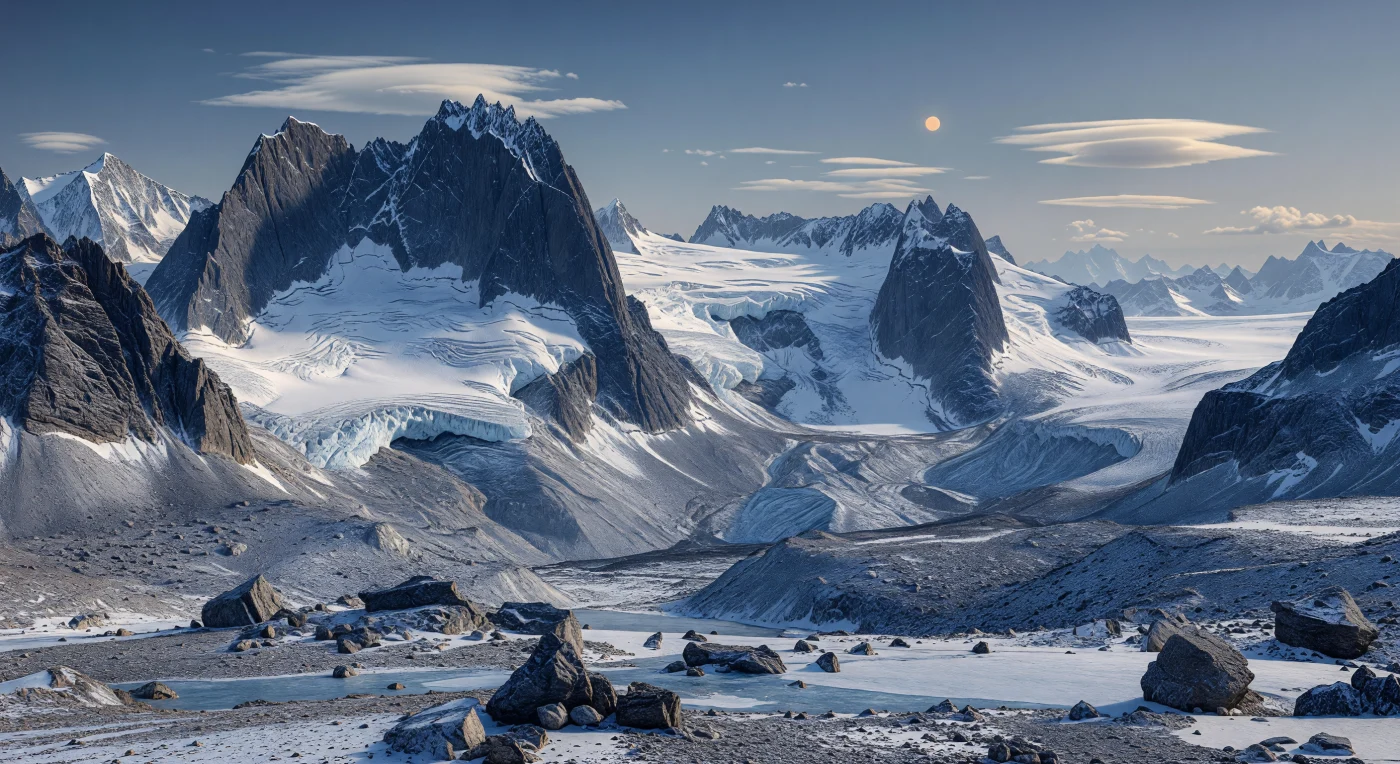
From the valley floor, you would look up at immense, load-bearing mountain walls of dark slate and basaltic-gray metamorphic rock, their broad ridges and fractured buttresses packed with thick snowfields, pale blue crevasses, and hanging glaciers poised above deep U-shaped troughs carved by long-moving ice. The foreground is a harsh mosaic of frost-shattered boulders, fine mineral grit, wind-hardened snow, and bands of polished bluish ice, while moraines, talus fans, avalanche chutes, and ice-scoured bedrock reveal a landscape shaped by repeated freezing, flow, and collapse under somewhat stronger gravity than Earth’s. Overhead, a cold blue-gray sky is veiled by thin haze and stretched lenticular clouds, and a small orange star casts cream-gold light that warms the snow and ice with muted amber highlights while cool shadows pool in the crevasses below. The result is an austere alpine world of unusual weight and scale, where layered glacial basins fade into the distance and every ridge seems built not to soar delicately, but to endure.

From the wet pebble shore, you look up at towering black basalt cliffs whose columnar fractures, volcanic dikes, and fresh rockfall fans reveal a crust shaped by ancient lava flows and relentless marine erosion. A steel-blue ocean drives dense white surf into narrow terraces and tide pools, while thin sheets of water glaze the charcoal and iron-brown stones, and sea mist drifts low along the cliff base in the chilly, salt-heavy air. Under the warm apricot light of a slightly smaller orange star, the muted blue sky softens to peach near the horizon beneath broad decks of marine cloud, giving the scene a subdued, almost twilight warmth despite the cold sea. The immense headlands fading into haze suggest a rocky super-Earth with stronger gravity than our own—one where waves break in compact, weighty arcs and the coast feels at once familiar, austere, and profoundly alien.

At ground level, the basin spreads out as a raw volcanic plain of slick black basalt, its vesicular lava and shallow runoff channels gleaming with condensed mineral water beneath a warm apricot sun. Across the darker rock, white silica sinter has built delicate stepped terraces around turquoise hot pools, while yellow sulfur crusts and ochre staining mark active vents where steam escapes into the dense, humid air. These mineral aprons are the kind of deposits hydrothermal systems create when hot, silica-rich water cools and precipitates layer by layer, a sign of persistent geothermal heat in a tectonically active crust that may be shaped by stronger-than-Earth gravity. Under broken clouds and the soft amber light of a cooler orange star, the vapor takes on a faint golden glow, and the distant basaltic ridges fade into haze, making the whole landscape feel immense, hot, and startlingly alive despite its complete barrenness.
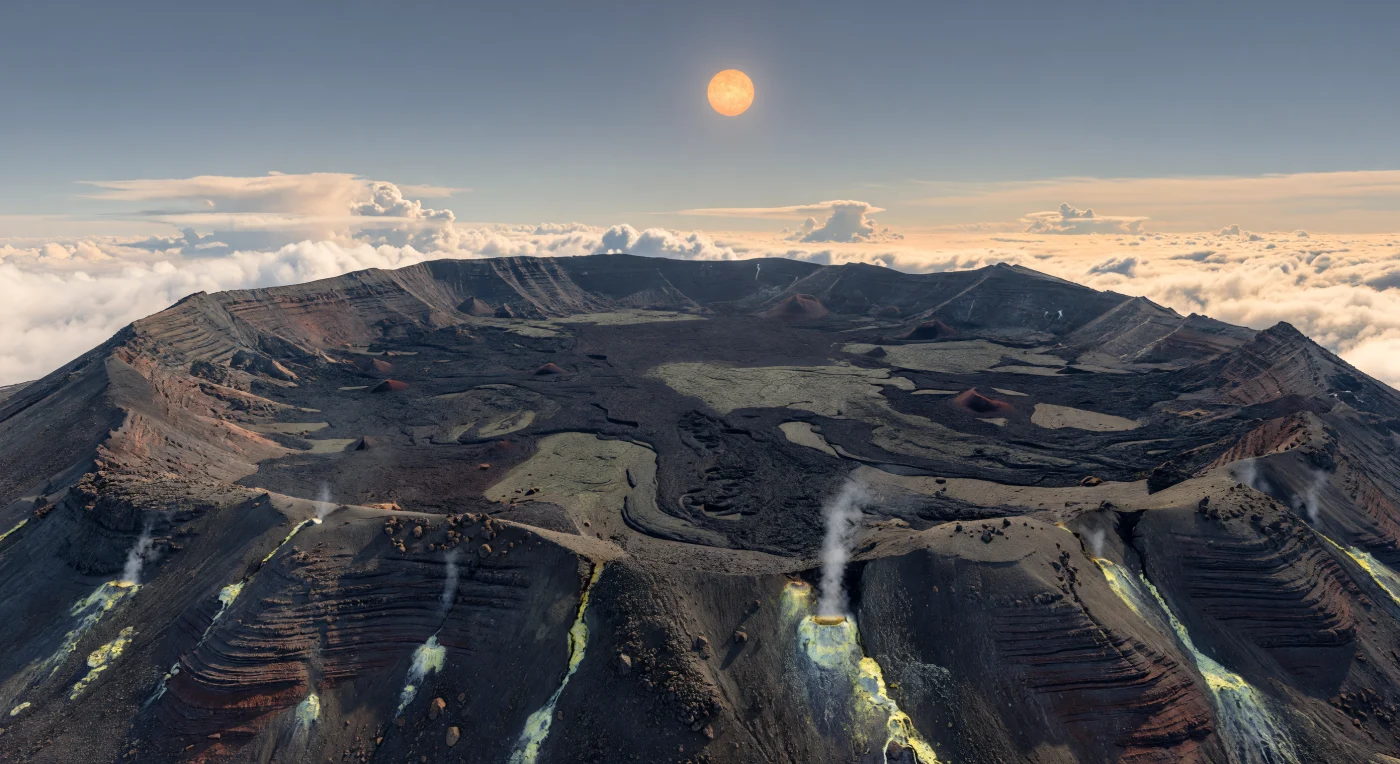
From the summit of an immense shield volcano, the ground falls away into a colossal collapsed caldera tens of kilometers wide, its floor a dark mosaic of fresh basaltic lava, ropy pahoehoe, shattered clinker, and red-brown scoria cones scattered across fractured slabs like embers frozen in stone. Along the terraced rim, narrow fissures exhale faint white steam from sulfur-rich fumaroles, where yellow and pale green mineral crusts stain the black rock, hinting at lingering volcanic heat and gases rising through a still-active crust. Far below, a bright ocean of cloud buries the lowlands, making the high summit air seem unusually clear; under the somewhat stronger gravity expected on a rocky super-Earth, the volcanic landforms feel broad, heavy, and monumental rather than spired or delicate. Overhead, a slightly smaller orange-white star shines through the muted blue-gray sky, casting warm, crisp shadows and gilding lava, ash, and drifting vapor with a gentle amber light that makes the entire scene feel at once starkly barren and profoundly alive.

From the slick dark mud at your feet, a drowned lowland opens outward into an immense maze of shallow channels, brackish lagoons, and smooth tidal flats, their tea-brown waters flashing metallic silver under a sky of dense cream-gray cloud. Fine drying cracks in the clay are half-erased by fresh flooding, rounded pebbles and isolated basaltic and iron-stained sandstone boulders rise from the saturated silicate sediment, and low blackish microbial mats cling to the wet ground where dim amber daylight can still be harvested. The broad, nearly level plain suggests a super-Earth surface shaped by slow sediment transport, standing water, and repeated inundation, with slightly stronger gravity helping keep the horizon low and the marsh pressed into a vast, heavy stillness. Above, the hidden orange star filters through fog and stratus as a muted warm glow, washing the landscape in cool, subdued light while distant waterways dissolve into pale haze, making the flooded continent feel both scientifically plausible and profoundly alien.
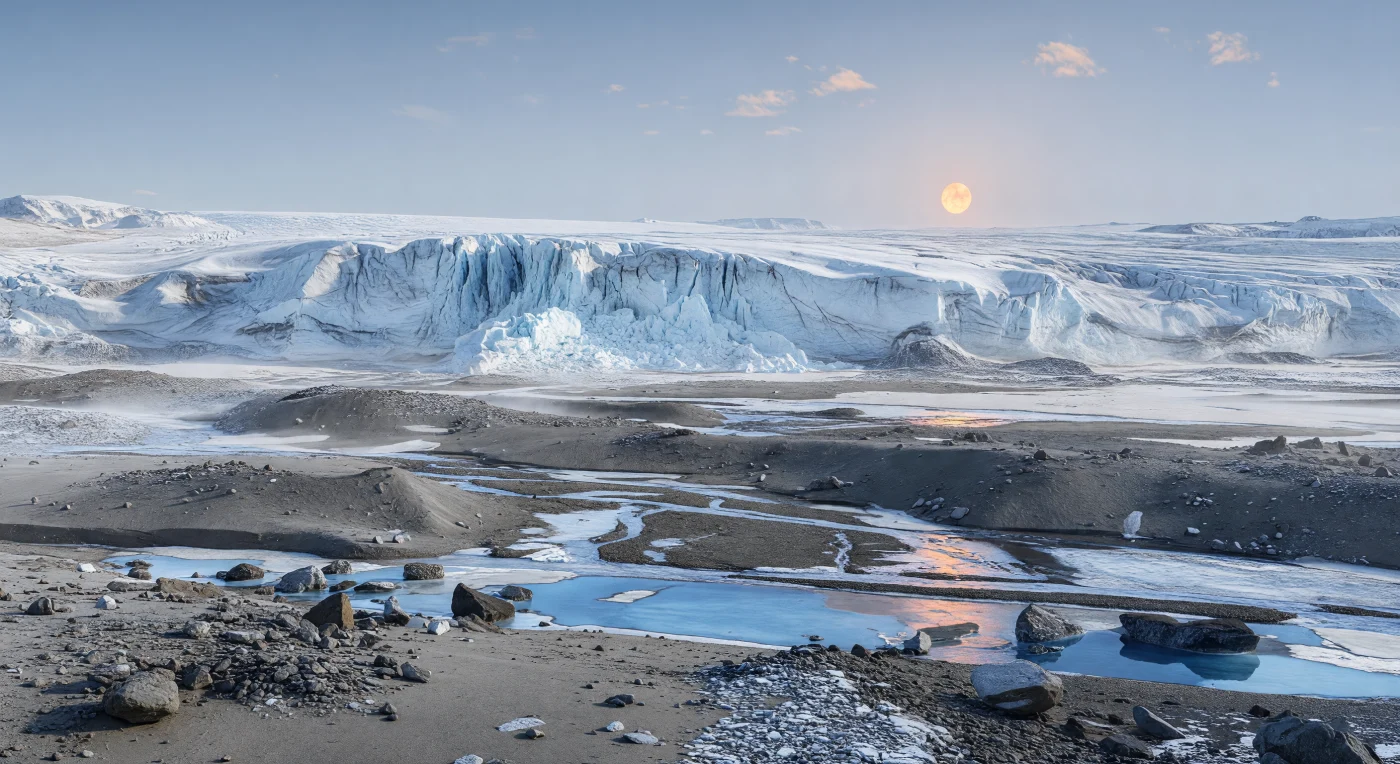
At the edge of a colossal ice sheet, a fractured rampart of blue-white glacier ice towers over dusty gray moraines, its face striped with ancient dust bands, split by crevasses, and undercut by translucent melt channels where katabatic winds tear streamers of spindrift into the air. Under the stronger gravity expected on a rocky super-Earth, house-sized basaltic and granitic boulders sit embedded in hummocky till and outwash, while braided melt streams thread across gravel bars into intensely blue ponds whose color reveals clear water absorbing red light and reflecting the warm, low orange disk of the system’s K-type star. The dry polar air leaves the sky pale and unusually clear, yet thin ice fog and blowing snow soften the long shadows and glaze the scene with amber light, as if cold and warmth coexist on the same horizon. Standing here, you would feel the immense scale of active glaciation on a larger world: a frozen continent in motion, grinding rock to silt, sculpting moraines and escarpments, and retreating only briefly beneath a dimmer, copper-toned sun.
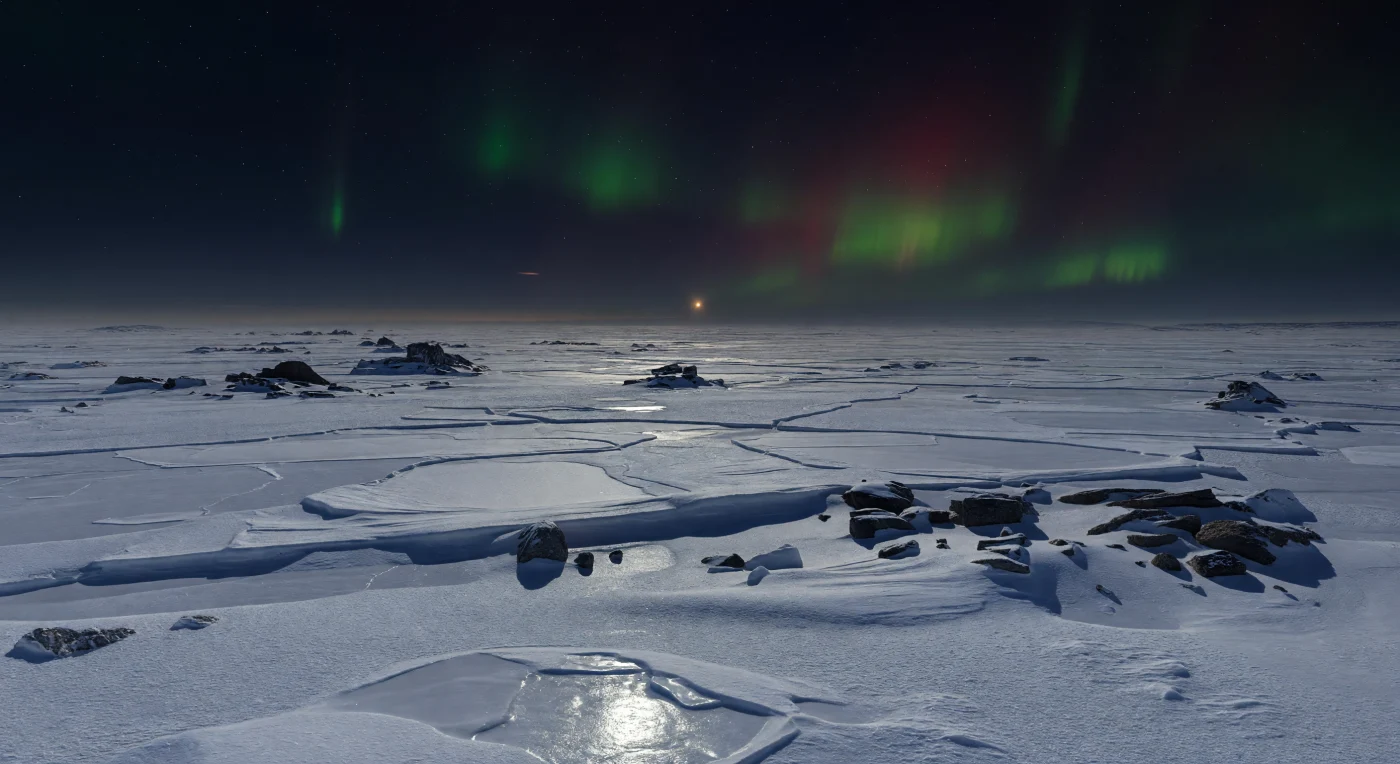
Under a deep blue-black polar sky, an immense frozen plain stretches away in near darkness, its surface sculpted into sharp sastrugi, hard granular snow, and broad plates of fractured ice stitched with polygonal cracks and low pressure ridges. In the foreground, wind-polished glaze ice, frost crystals, and half-buried basaltic and silicate boulders catch the faintest light, while the stronger gravity implied for a rocky super-Earth seems to press the landscape into compact, subdued forms rather than lofty pinnacles. Near the horizon, a thin amber twilight band hints at a small, dimmer orange star, but the scene is ruled by vast green and crimson auroral curtains whose glow washes the snow with subtle color and shimmers across smooth ice. The cold, clear air and slight surface haze sharpen the sense of continental scale, making the plain feel both geologically familiar—ice, rock, wind, fracture, frost—and profoundly alien in its silent, light-starved expanse.

Under a sky locked between day and night, a broad plain of dark basalt and weathered volcanic rock stretches outward in coppery twilight, broken by thin frost caught in hollows, scattered angular boulders, and low flat-topped mesas whose eroded scarps cast long, soft shadows. The orange star hangs low and nearly fixed on the horizon, its grazing light turning dust and stone to bronze while the sky above deepens through cobalt into blue-black, where the first faint stars emerge over the nightside. Shallow polygonal cracks and talus-strewn slopes hint at repeated thermal stress, freezing, and contraction in a cold, dry environment, while the compact landforms suggest a rocky super-Earth with somewhat stronger gravity than Earth’s. Standing here, the landscape feels immense and motionless—an austere boundary world where warmth never fully arrives and darkness never entirely wins.
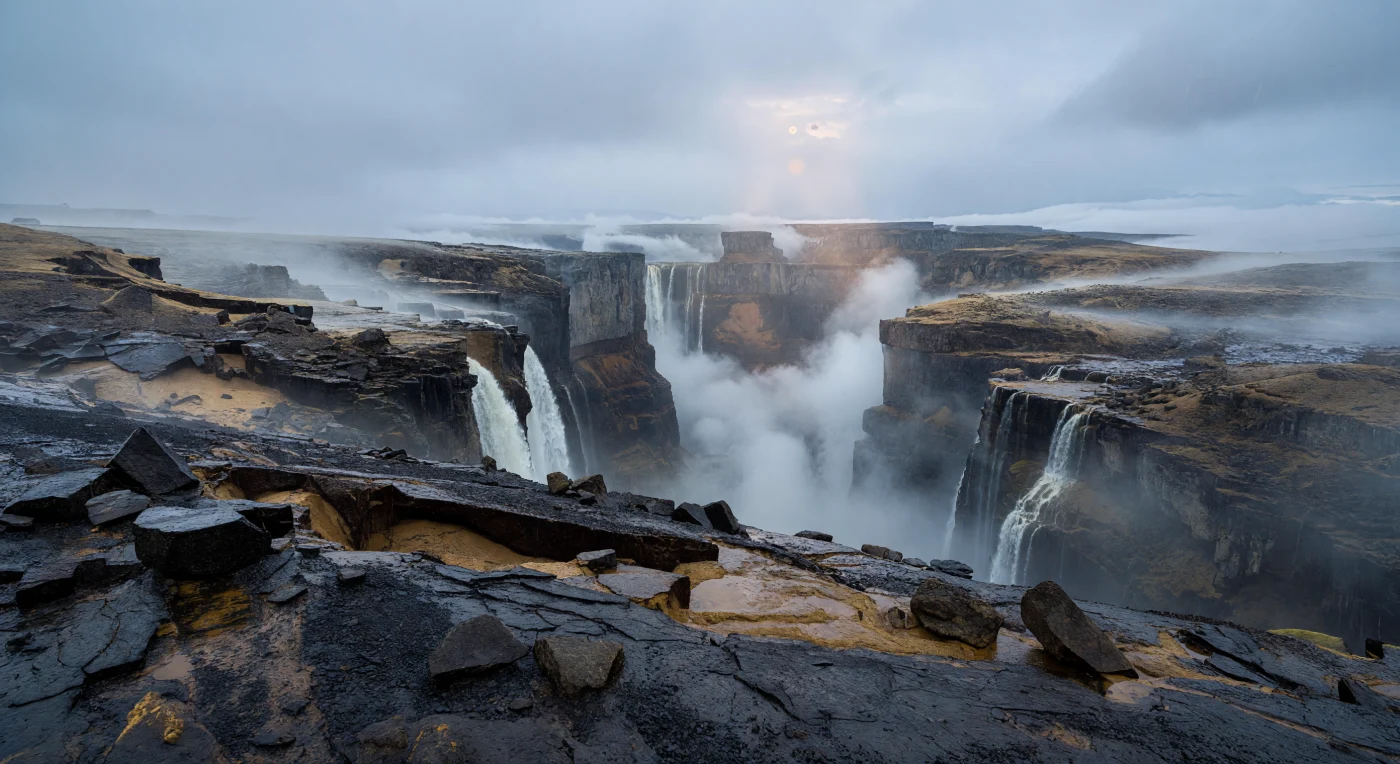
From this rain-slick highland edge, dark basaltic and metamorphic bedrock breaks into fractured ledges, angular boulders, and black gravel, while thin ochre mud and narrow runoff channels show how persistent precipitation has carved the slope. The land falls away abruptly into immense ravines choked with silver fog, where tall waterfalls plunge from stepped escarpments and vanish into cloud, and distant ridgelines fade layer by layer into the wet haze. Under a dense, moisture-rich atmosphere, the light is mostly cool and diffuse, but breaks in the overcast reveal the small warm disk of the orange dwarf, sending apricot beams across water-darkened cliffs and bright spray. The broad, heavy relief suggests a rocky super-Earth with somewhat stronger gravity than Earth’s, where erosion, fractured crust, and abundant surface water combine to shape a landscape that feels both geologically familiar and profoundly alien.
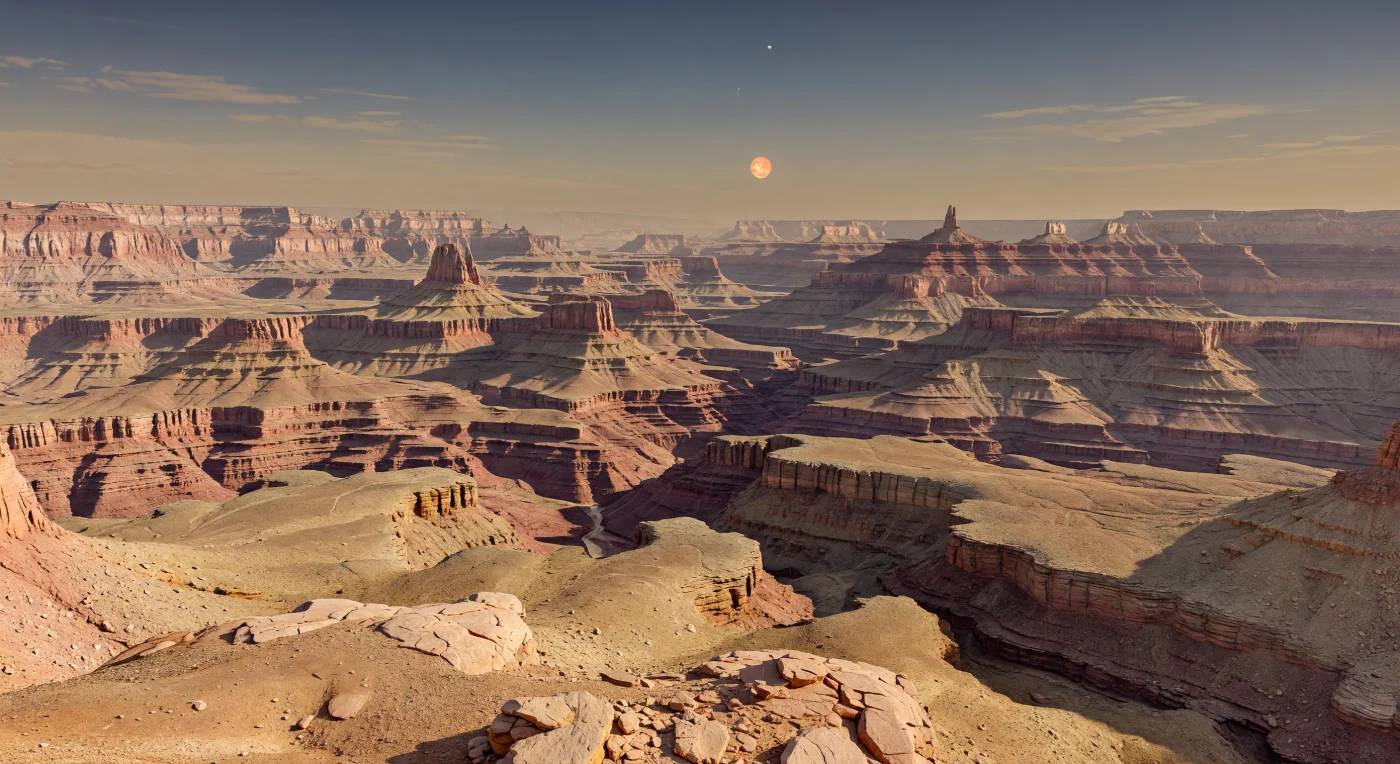
From ground level, the landscape unfolds as a maze of immense canyons cut through stacked sedimentary rock, where tan, salmon, ochre, rust, and deep umber layers stand exposed in sheer cliffs, terraced escarpments, and isolated buttes. Fractured slabs, wind-scoured gravel, talus, and broad alluvial fans spread across the basin floors, recording a long history of erosion, slope collapse, and uplift on a rocky world likely burdened by somewhat stronger gravity than Earth’s. Low amber light from the orange dwarf star skims the canyon rims, casting mauve shadows deep into slot chasms and beneath natural arches, while a muted blue sky fades to a dusty beige horizon through a dry, substantial atmosphere. The result is both familiar and profoundly alien: a silent, ancient desert of stone whose scale feels crushingly vast, as if you are standing at the edge of a planetary wound carved over eons.
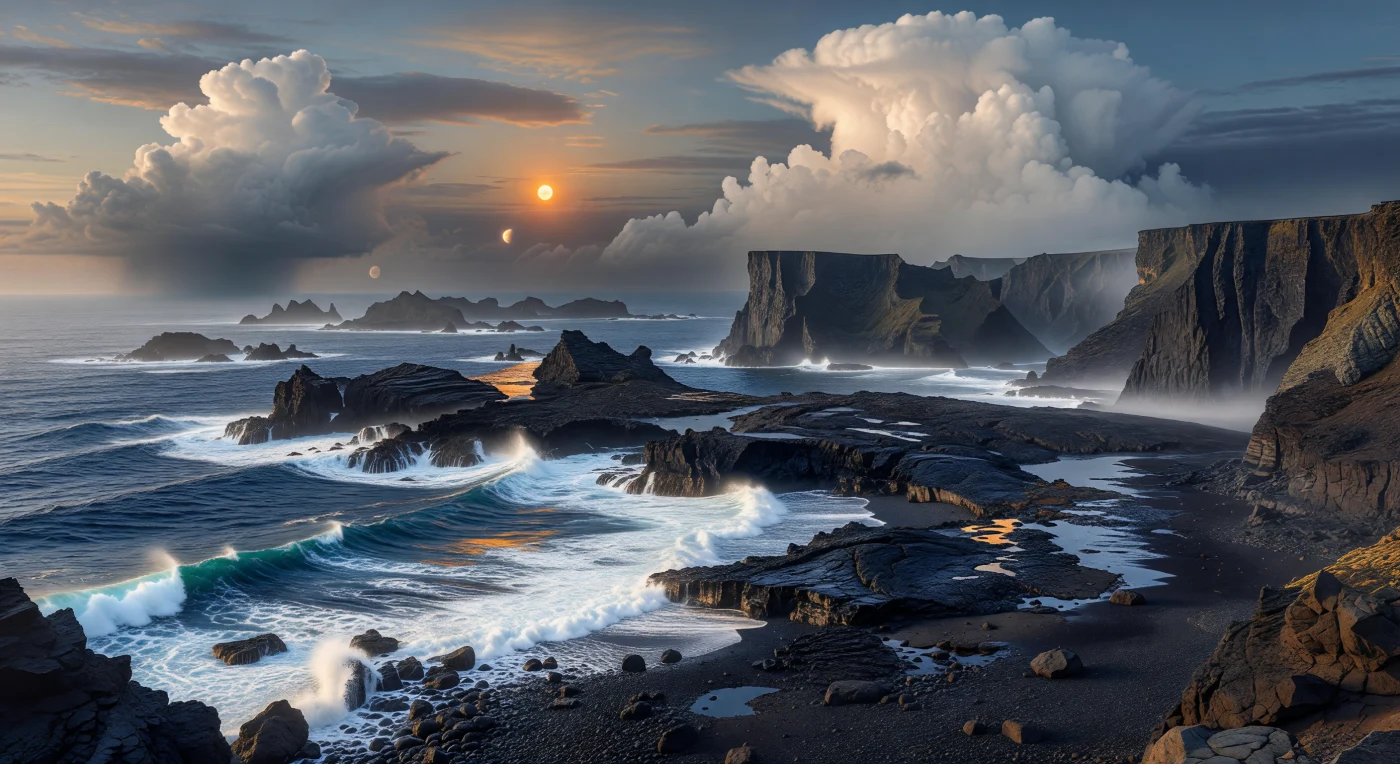
From this shoreline, the coast rises in dark, broken tiers of volcanic basalt—wave-cut terraces, columnar cliff faces, sea stacks, and boulder fields polished to an obsidian sheen by relentless surf. A deep cobalt ocean drives whitecapped swells through narrow inlets and surge channels, scattering foam across black sand and rounded cobbles, while distant island chains fade into humid haze beneath immense anvil-topped storm clouds and slanting rain shafts. The warm, golden light of a small orange star glows through gaps in the weather, reflecting softly from wet rock and mist in an atmosphere dense enough to mute shadows and deepen the blue of sea and sky. On a larger, likely rock-rich world with somewhat stronger gravity than Earth’s, such coastlines would record the work of both volcanism and marine erosion, making the scene feel at once habitable, violent, and unmistakably alien as a bright companion world glimmers low on the horizon.