Scientific confidence: Speculative

From this storm-lashed basalt shore, the foreground is a study in volcanic rock and water: black glassy boulders, fractured lava shelves, vesicular stone, and tide pools gleaming under a dim peach glow, while beyond them a dark iron-blue ocean rolls in heavy swells streaked with copper and gray reflections. High overhead, the star hangs almost motionless as a reddish-orange disk larger than our Sun appears from Earth, its light softened by a dense, humid atmosphere and by the immense cream-white convective cloud shield that rises in towering columns and anvils tens of kilometers into the sky. The coastline’s columnar basalts, wave-cut platforms, and broad, compact volcanic headlands suggest a rocky world shaped by mafic volcanism, relentless surf, and slightly stronger gravity than Earth’s, while the permanent day side drives powerful evaporation, rain haze, and towering storms near the point of constant illumination. Standing here, you would feel the scale immediately: tiny pools at your feet, an ocean stretching into salmon-gray haze, and above it all a nearly fixed ceiling of planet-wide weather glowing in the warm, muted light of a quiet red dwarf.
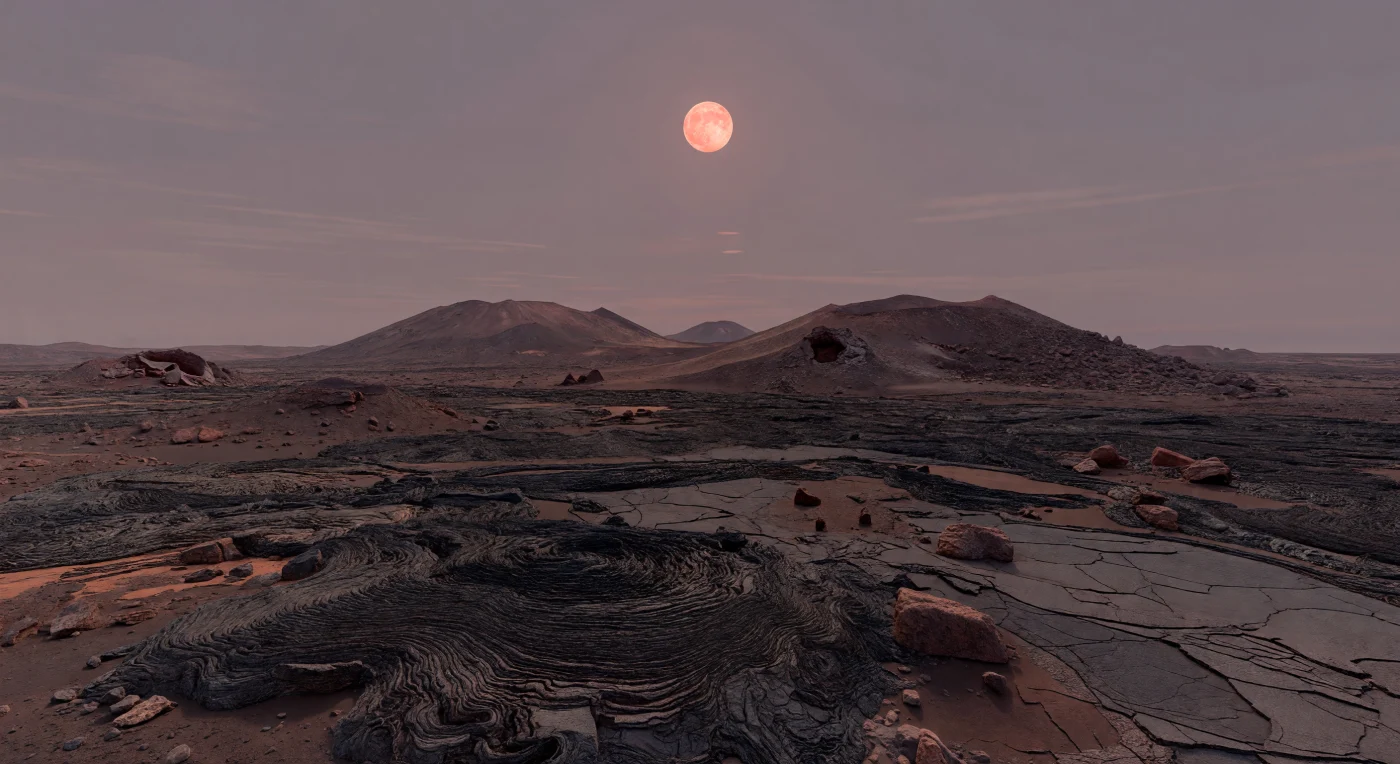
At ground level, the dayside opens into an immense basalt plain where charcoal-black pahoehoe has cooled into glossy ropy swells, broken ash-dark slabs, pressure ridges, and shallow contraction cracks dusted with iron-brown powder. Scattered boulders and lava channels several meters wide lead the eye toward low shield volcanoes on the horizon, their broad gentle flanks built by repeated fluid eruptions, with collapsed lava tubes and dark cinder patches marking old volcanic vents. Overhead, a broad red-orange dwarf hangs high in a muted lavender-gray sky, its light filtered through thin mineral haze that softens the scene into maroon-gray shadows and faint layered veils in the distance. The result is a landscape that feels both dry and immense: a wind-worked volcanic world with no water or life in sight, yet one whose thin to moderate atmosphere still turns stark basalt into a strangely warm, habitable-zone noon.

At the foot of the escarpment, you would see immense slate-gray cliffs climbing in dark, stepped walls, their rain-polished basaltic and metamorphic faces streaked with threadlike waterfalls that vanish into sheets of milk-white fog. Across the broad foreplain, braided rivers wind between angular boulders, talus cones, gravel bars, and reddish-brown sediment, clear signs of intense fluvial erosion driven by persistent rainfall and a dense, humid atmosphere. Overhead, a planet-wide cloud shield glows in muted copper and rust tones under the hidden light of a quiet red dwarf, softening shadows and turning every wet rock surface into a dim, warm mirror. The result is a landscape that feels both storm-bound and habitable: vast, water-carved, and eerily still except for the constant motion of falling water, drifting mist, and rivers disappearing into the haze.

At the endless twilight boundary, a 200-meter-high wall of blue-white glacier ice rises like a frozen cliff, its compressed turquoise bands and soot-dark moraine layers recording long cycles of snowfall, flow, and rock entrainment as overhanging seracs shed fresh debris onto the basalt plain below. Braided meltwater threads through black volcanic gravel, vesicular lava slabs, frost-split boulders, and rust-toned dust, reflecting the dim ember light of a red dwarf that hangs permanently just above the horizon, swollen and soft through copper-lit haze. The sky grades from orange and dusty rose near the star into mauve, violet, and finally star-speckled black toward the nightside, a plausible terminator atmosphere for a tidally locked rocky world where heat, ice, and volatile transport may keep water trapped and seasonless at the boundary between permanent day and night. In the distance, subdued mountains and ancient worn highlands fade into shadow, making the glacier front feel immense and the landscape both geologically active and profoundly still.

At the edge of eternal day, a broad plain of dark basaltic gravel and compacted regolith stretches away under a low red-orange star that never rises or sets, its light skimming the surface and pulling long shadows from angular boulders, mesas, and worn escarpments. Frost traces the polygonal cracks in fractured volcanic bedrock and clings to sheltered hollows, hinting at persistent cold where heat from the day side is weak and the nearby night side can lock volatiles onto the ground. Strong crosswinds sweep thin veils of dust across the steppe, slowly abrading the flat-topped outcrops and subdued volcanic uplands into broad, compact landforms shaped by a dense enough atmosphere to scatter the light into crimson near the horizon and indigo overhead. Standing here, you would feel caught between two worlds at once: a wind-carved, frozen frontier beneath a dim ember sky, with the first stars already shining above the endless sunset.

You stand on a storm-carved shore of black vesicular basalt, where fractured lava shelves, iron-stained sand, and tide pools gleam under a heavy red-shifted sky, while white surf detonates against cliffs that soar hundreds of meters above the dark ocean. Across the archipelago, jagged volcanic islands and sea stacks expose columnar basalt, talus slopes, and wave-cut caves—landforms shaped by repeated eruptions, relentless erosion, and powerful tides in a moisture-rich atmosphere. Pale steam slips from shoreline vents, hinting at lingering geothermal heat beneath the crust, and through breaks in immense cream and salmon cloud decks, broad shafts of copper light from the cool red dwarf sweep across mist, water, and stone. The result is both harsh and habitable-looking: a raw coastal world with no sign of life at the surface, suspended beneath permanent weather and lit in colors that make even foam and fog feel alien.

You stand on a permanent nightside plain of water ice so vast it seems to swallow the horizon, its steel-blue surface combed into long, parallel sastrugi and low pressure ridges by relentless downslope winds flowing out of colder interior highlands. Black crevasses split the plateau into branching fracture systems, their lightless depths bordered by shattered ice blocks and scattered dark basaltic stones exposed where frost and stress have broken through the frozen crust. Above, the sky is extraordinarily clear and star-crowded, while along one far horizon a narrow muted red-orange band marks the distant day side, its faint glow softened by thin high ice haze and reflected dimly from wind-polished translucent ice. The scene suggests a rocky, tidally locked world with an atmosphere still capable of moving heat, lofting ice crystals, and sculpting exposed water ice into immense, austere landforms under cold, crushing stillness.
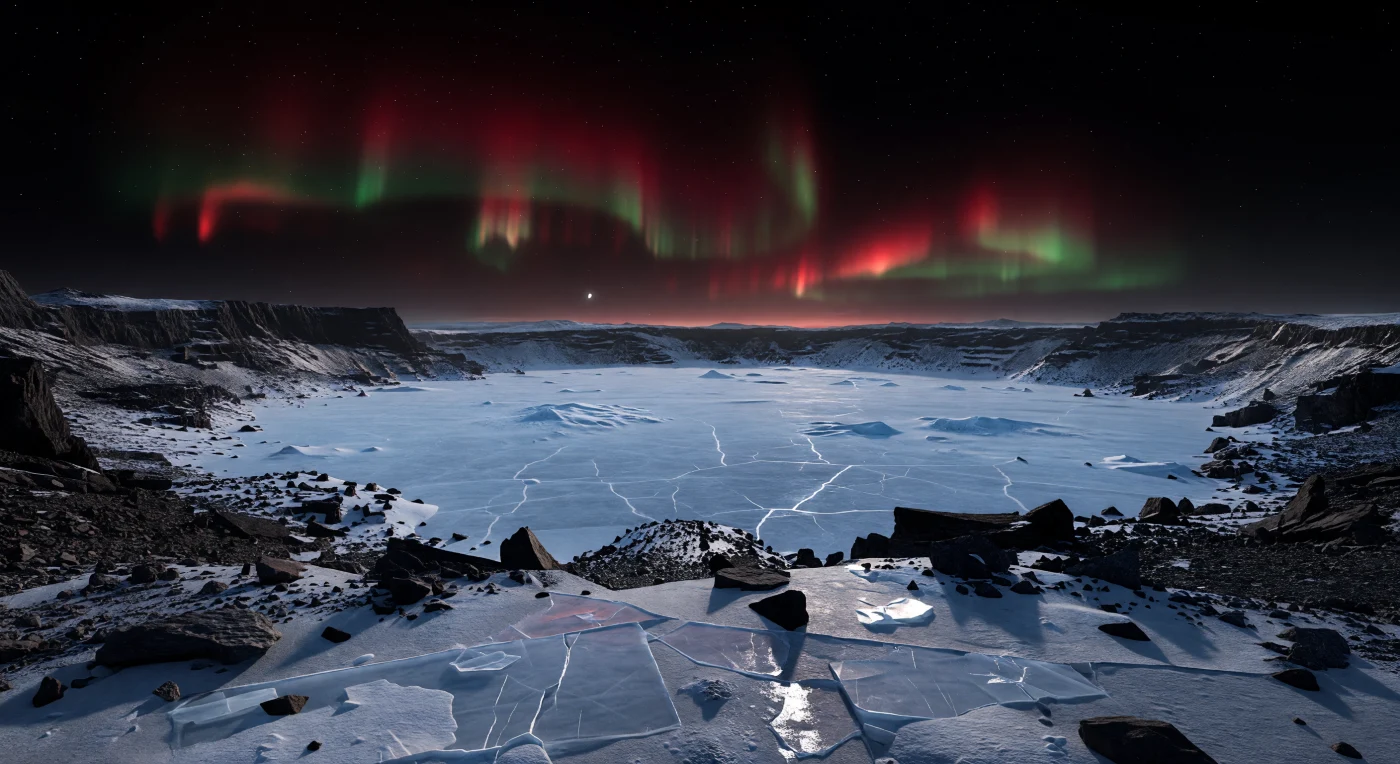
You stand on the frozen floor of an immense ancient impact basin where pale blue water ice stretches flat to the horizon, broken into polygonal fractures, pressure ridges, and brittle frost seams that hint at slow glacial creep under unrelenting cold. Around the basin, jagged rings of nearly black basaltic rock and shattered impact breccia rise as broken cliffs and boulder fields, their dark volcanic and collision-forged materials absorbing what little light reaches this permanent night side. Along the far rim, a faint ruby glow marks the distant fringe of the tidally locked dayside, while overhead red and green auroral curtains ripple through the black sky, suggesting charged particles interacting with a thin atmosphere and perhaps a magnetic field. In the auroral wash, the ice gleams softly and the basin’s enormous curvature becomes palpable, making the scene feel both geologically ancient and profoundly otherworldly.

You stand at the bottom of a colossal canyon on the world’s permanent night side, where nearly black basaltic and ultramafic cliffs rise in fractured ledges, columnar faces, and ancient landslide scars above slopes of frost-whitened rubble. Across the valley floor, dense freezing fog pools like a buried inland sea, glowing a ghostly white only through faint atmospheric scattering and weak thermal reflection, while hoarfrost, rime, and thin glassy ice plates cling to every broken stone and shattered block. Far beyond one rim, a dim reddish smear marks the distant terminator, the only hint of the quiet red dwarf whose energy never reaches this chasm directly, leaving the rest of the sky almost black and the stars sharp. The scene suggests a tidally locked rocky planet where silicate bedrock, intense cold, and slow atmospheric transport allow cryofog and frost to accumulate in shadowed lowlands, creating a landscape that feels both geologically familiar and profoundly alien in its frozen stillness.

You stand at the edge of permanent twilight, where kilometer-long trains of black basaltic dunes flow across the landscape like a frozen sea, their crests and ripples carved by relentless winds streaming from the hotter day side toward the frozen night. On the shaded faces, a delicate silver frost has condensed in thin films and sheltered troughs, catching the low reddish light while vesicular lava boulders, ash-rich regolith, and cracked crusts record repeated cycles of freezing and sublimation. Near the horizon, a dim, enlarged red-orange star hangs almost motionless above a band of fiery haze, casting impossibly long shadows and painting the dune tops in copper and maroon while the upper sky fades into near-black. Beyond, broad shield-like rises and low ridgelines suggest volcanic plains shaped under slightly stronger gravity, giving the whole scene an immense, heavy stillness that feels both starkly alien and geologically familiar.

From the rocky shore, you look across a chain of ink-dark lakes pooled along a vast rift where basaltic crust has split and dropped between towering fault escarpments, their broken strata and talus slopes fading into a cool haze. The lake margins are ringed with hydrothermal minerals—gleaming white silica terraces, iron-rich crusts stained rusty orange and deep maroon, subtle yellow sulfur patches, and salt-cracked mud—while fumaroles breathe pale steam through fractured lava and shallow hot springs thread thin wet channels into the still water. Everything is lit by a low red-orange star fixed near the horizon, its oblique copper light reflecting off the lakes and wet sinter while matte black volcanic rock stays almost lightless, giving the valley a stark, cinematic contrast. On a tidally locked world where cool air from the twilight zone meets geothermal heat, this landscape records active faulting, volcanic resurfacing, and water-rock chemistry on a scale that feels immense, silent, and profoundly alien.

At this highland boundary near the eternal twilight line, slow tongues of fresh basaltic lava ooze down from low volcanic ridges into fractured sheets of blue-white ground ice, where the heat blasts up dense white steam and briefly frees narrow meltwater rivulets before they vanish into hissing fissures. Underfoot, glossy black pahoehoe, jagged ʻaʻā rubble, incandescent cracks, shattered translucent ice slabs, and ash-dark sediment record an active contest between volcanism and deep cold, a plausible outcome on a rocky, likely tidally locked world where heat from the interior meets a frozen margin near the terminator. The low, reddish disk of the host star hangs permanently near the dayward horizon, bathing the ice in pink-lilac highlights and the lava in a black-crimson sheen, while the sky darkens overhead into violet-black toward the nightside glacier plain, where a few stars and even small sibling planets glimmer through haze. Immense ice fractures, house-sized basalt blocks, and lava fronts stretching into the distance make the scene feel both habitable and hostile—an alien shoreline where fire, frost, and thin-lived water coexist for a moment at planetary scale.
