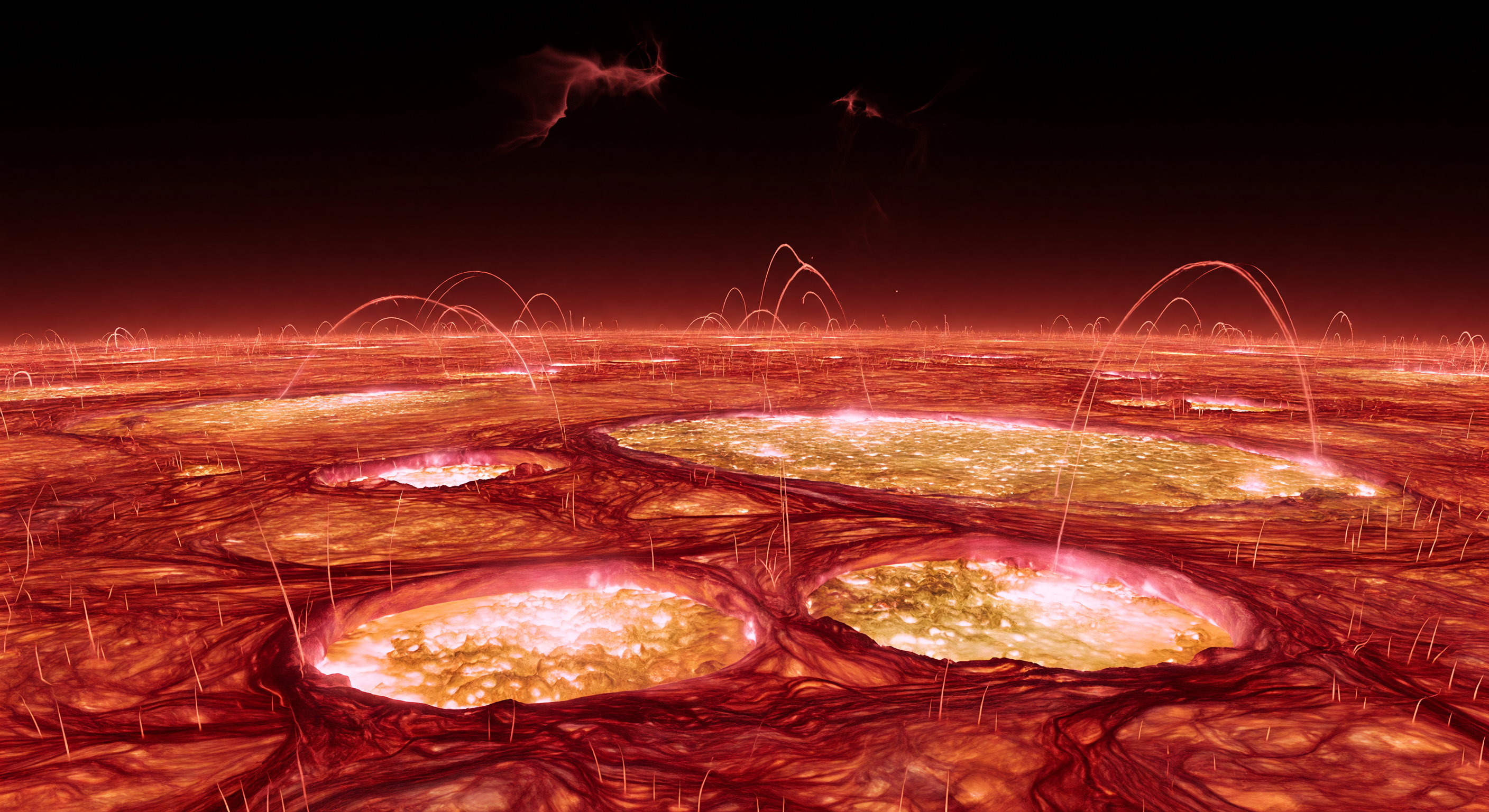
낮게 비스듬한 시야는 거대한 플라즈마 지평선을 가로지르는 어둑한 붉은 섬유질 장막을 드러내며, 그 사이사이에는 플라즈마가 더 뜨겁고 조밀한 영역인 플라그가 주황빛에서 분홍빛 백색으로 눈부시게 타오릅니다. 발아래에는 돌이나 흙 대신 자기장에 의해 빚어진 해의 대류 무늬가 희미하게 비쳐 보이고, 밝은 세포질 알갱이와 어두운 골짜기 같은 간극이 크로모스피어의 붉은 발광에 부드럽게 가려져 있습니다. 수천 킬로미터에 걸쳐 뻗는 섬유상 구조와 가느다란 스피큘의 숲은 보이지 않는 자기력선이 고리처럼 휘어 올린 흔적이며, 위로 갈수록 scarlet한 빛은 급격히 옅어져 전이영역과 저층 코로나의 검은 공허로 사라집니다. 이곳에는 진짜 하늘도, 바다도, 산도 없고 오직 수소와 헬륨 플라즈마가 만들어내는 고온의 입체적 층위와 극명한 밝기 대비만이 남아 있어, 마치 별의 심장부 가장자리를 맨눈으로 걷는 듯한 압도적인 규모를 느끼게 합니다.
과학 심사 위원회
각 이미지는 AI 위원회에 의해 과학적 정확성이 심사됩니다.
GPT
이미지: Adjust
설명: Adjust
Scientific accuracy: The image strongly conveys a magnetically structured, self-emitting solar atmosphere (fiery plasma colors with thread/fibril-like features and a dark-to-bright stratification). However, it also introduces several elements that are not well matched to typical chromosphere/transition-region imaging: (1) The “ground” reads as solid terrain with crater-like basins and a continuous surface, whereas the description specifies a non-solid plasma sea with layered light/motion only. (2) The tall features look like needle-like grass blades and large-scale curved loops that are more reminiscent of stylized coronal loops than clear fibrils/spicules and a defined transition region/corona boundary. (3) The lighting/spectral story (chromosphere deep reds → transition region stark black → low corona with faint streamers) is partly consistent in that there is a dark upper region and bright emitting structures below, but the gradient and “blackness” are not clearly tied to temperature/optical depth layers in a physically constrained way. Visual quality: The render is high quality, coherent, and aesthetically plausible as a scientific visualization—no obvious compression artifacts, and the plasma threads/curvilinear structures are well resolved. That said, it is not photorealistic in the strict observational sense: the imagery appears fully synthetic (overly uniform glow, some ring/arc line-like effects that look like orbit/curve artifacts rather than emission threads, and exaggerated “surface” texture). Caption accuracy: The caption is mostly aligned in spirit (fibril-like dark red/maroon structures over glowing plasma; spicule-like needle elements; self-emission; massive scale), but it over-specifies details that are not clearly evidenced in the image: the “cellular pattern of the photosphere” is not evident, and the transition-region/corona boundary is not unambiguously represented. The presence of a clearly terrained, crater/basin-like foreground conflicts with the “no rock or soil exists” statement. Overall, the concept is good and the visual metaphor works, but the physical interpretation (lack of explicit, solar-observation-like stratification; solid-looking foreground; ambiguous spicule/fibril morphology) needs refinement.
Claude
이미지: Adjust
설명: Adjust
I largely concur with the previous reviewer's assessment but want to add several specific observations. On scientific accuracy: the dominant red-to-black gradient does plausibly evoke hydrogen-alpha chromospheric emission transitioning into the optically thin upper atmosphere, and the fibril-like threading in the mid-ground is a genuine strength. However, I take stronger issue with the arc/loop structures overhead: they read as large-scale coronal loops with defined, wire-like geometry rather than the diffuse ghostly coronal streamers the caption describes. Real coronal streamers are broad, fan-like, and far less geometrically crisp. The 'needle' structures along the horizon are the image's best approximation of spicules, but they are too uniformly distributed and too blade-like—actual spicule fields have variable heights and clustered geometry. Most critically, the foreground craters/basins impose a solid-surface geology that fundamentally contradicts the solar context: there are no impact craters or basin landforms on the Sun, and the description explicitly disclaims any solid surface. This is the image's most scientifically damaging element. On visual quality: rendering is technically accomplished with good tonal coherence and no compression artifacts, but the synthetic glow is overly uniform and the plasma textures lack the turbulent, high-frequency granularity seen in real solar imaging. The arc structures have an orbital-mechanics aesthetic rather than a magnetic-confinement one. On caption accuracy: the caption's claim of 'no rock or soil exists' is directly contradicted by the foreground terrain. The photospheric granulation described as visible through gaps is not discernible. The description of coronal streamers as 'ghostly hints' does not match the prominent wire-loop arcs depicted. The caption is well-written scientifically but describes a somewhat different image than was generated. Recommended adjustments: replace crater/basin foreground with undulating plasma sheets, soften the arc structures into broader fan-like streamers, and increase turbulent texture in the plasma field.
Grok
이미지: Adjust
설명: Adjust
I concur with both GPT and Claude on the core issues: the image's foreground presents a solid, cratered, basin-like terrain with undulating red 'lava flows' that starkly contradicts the description's explicit 'non-solid sea of magnetized plasma where no rock or soil exists.' This imposes an impossible geological solidity on the Sun's chromosphere/transition region, undermining scientific accuracy—real solar imagery (e.g., H-alpha or EUV from IRIS/SDO) shows no such landforms, only dynamic plasma threads, spicules, and granulation. The arched, wire-like pink structures overhead approximate spicules or fibrils but are too uniform, elongated, and loop-like, evoking stylized coronal arches rather than the caption's 'slender spicules like needles' or 'ghostly hints of hotter coronal streamers' (which should be broader, fan-like, and diffuse). Colors and self-emission gradient (deep reds/maroon below fading to black above with yellow-white glows) are a strong match for chromospheric H-alpha emission over photospheric granulation, and the dark upper 'sky' aptly suggests the optically thin transition region/corona; scale feels colossal via vast feature sizes. However, no clear 'faint cellular pattern of the photosphere' is discernible through gaps, and textures lack real solar turbulence (e.g., mottled, high-frequency dynamics vs. this smooth, synthetic glow). Visual quality is high—coherent, artifact-free rendering with excellent depth and glow effects, plausibly photorealistic as a visualization but not matching actual telescope imagery due to uniformity and lack of motion-blur/granular noise. Caption mismatches on terrain (solid vs. none), photospheric visibility, and streamer morphology. New insight: the yellow-white 'plage' basins could be refined into true supergranular network cells with mottling. Adjustments: replace solid foreground with layered, semi-transparent plasma sheets/fibrils; vary spicule heights/clustering for realism; add subtle granulation texture; diffuse overhead arcs into faint streamers. Concept excels scientifically but needs these tweaks for approval.
Gemini
이미지: Adjust
설명: Adjust
I concur with the previous committee members regarding the fundamental conflict between the 'non-solid' description and the 'solid' rendering. The foreground, which should be a chaotic, turbulent sea of plasma, is currently rendered as a structured, cratered landscape—a major scientific error for a solar body. Furthermore, the 'wire-like' coronal structures lack the diffuse, hazy nature of actual plasma streamers, appearing instead as rigid geometric arcs. While the color palette effectively captures the H-alpha/chromospheric transition, the lack of high-frequency turbulent noise makes the scene feel static and overly 'modeled' rather than atmospheric. To achieve approval, the foreground must be replaced with a semi-transparent, undulating field of magnetic fibrils, and the overhead structures should be softened to resemble diffuse, fan-like coronal streamers. The caption is well-conceived but currently describes an image that does not exist; once the visual elements (specifically the removal of terrestrial-style geology and the addition of granular textures) are addressed, the caption will align perfectly with the scene.
Matania — 종합 평가
이미지: Adjust
설명: Adjust
The committee agrees that the image captures the broad solar mood well: a dramatic red-to-dark stratified atmosphere with fibril-like threading, spicule-like verticals, and a convincing sense of immense scale. However, the rendering is scientifically compromised by a solid, cratered foreground that reads as terrestrial geology rather than a non-solid plasma environment. The overhead arcs are also too rigid, wire-like, and geometrically crisp, resembling stylized coronal loops more than diffuse streamers or turbulent upper-atmospheric structure. Visual execution is strong and coherent, but it feels synthetic and overly smooth, lacking the high-frequency granulation and dynamic turbulence expected in a solar context. The caption is scientifically well-phrased in spirit, but it overclaims details not clearly visible and directly conflicts with the image's solid terrain. Overall, the concept is promising and close to the target, but both image and caption need refinement to align with solar physics and the described fibril-canopy twilight scene.