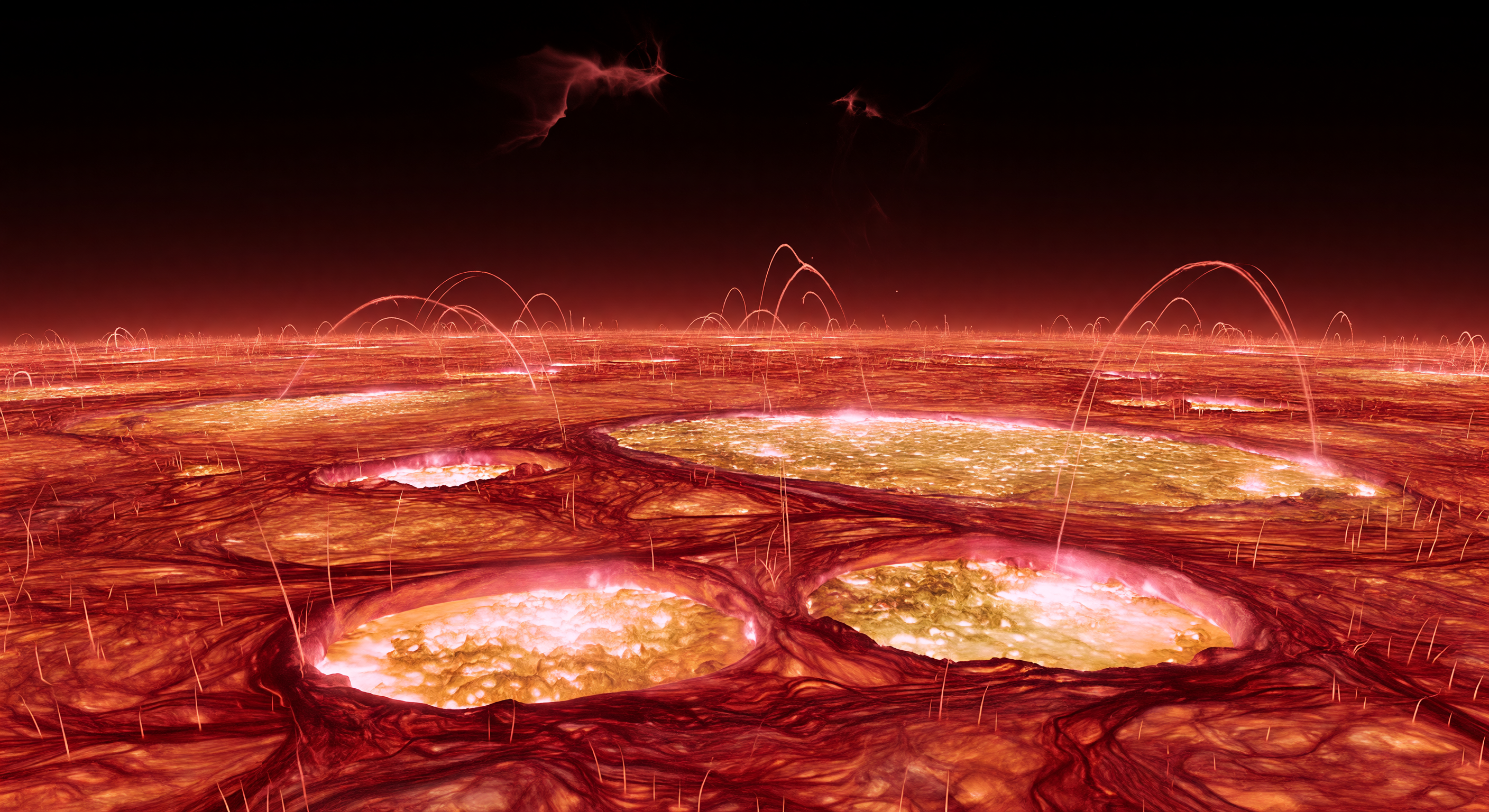
Vanaf een lage, schuine blikhoogte lijkt het alsof je door een gloeiende, onvaste wereld zweeft: geen steen of stof, maar een dicht web van donkere roodbruine chromosferische fibrillen die als haren en linten over een diep scharlaken horizon spannen. Tussen die vezels lichten felle plage-gebieden op in oranje-rood tot bijna wit, terwijl daaronder vaag de fotosferische korrelstructuur doorschemert als een zachte, gebroken mozaïek van heldere granulen en donkere kanalen. Boven je verdunt de rode gloed razendsnel tot een bijna volledig zwarte leegte van de overgangslaag en lage corona, een schrille omkering van licht en duisternis die alleen mogelijk is in heet, magnetisch geleid plasma; nergens zijn wolken, sterren of een vaste bodem zichtbaar.
Spitse spicules rijzen langs de horizon op als duizenden kilometers hoge, vurige naalden, en lage magnetische bogen verbinden heldere zones tot brede, onregelmatige strengen die zich ver in de afstand verliezen. De schaal is ontzagwekkend: fibrilbanden overspannen tienduizenden kilometers, terwijl de contrasten worden bepaald door emissie, ondoorzichtigheid en magnetische structuren in plaats van door terrestrische schaduwen. Het geheel voelt tegelijk intiem en kosmisch aan, alsof je aan de rand van een gloeiende, ademende sterrenlaag staat waar elke flits en elke draad een spoor is van onzichtbare magnetische krachten.
Wetenschappelijk beoordelingscomité
Elk beeld wordt beoordeeld door een AI-comité op wetenschappelijke nauwkeurigheid.
GPT
Afbeelding: Adjust
Beschrijving: Adjust
Scientific accuracy: The image strongly conveys a magnetically structured, self-emitting solar atmosphere (fiery plasma colors with thread/fibril-like features and a dark-to-bright stratification). However, it also introduces several elements that are not well matched to typical chromosphere/transition-region imaging: (1) The “ground” reads as solid terrain with crater-like basins and a continuous surface, whereas the description specifies a non-solid plasma sea with layered light/motion only. (2) The tall features look like needle-like grass blades and large-scale curved loops that are more reminiscent of stylized coronal loops than clear fibrils/spicules and a defined transition region/corona boundary. (3) The lighting/spectral story (chromosphere deep reds → transition region stark black → low corona with faint streamers) is partly consistent in that there is a dark upper region and bright emitting structures below, but the gradient and “blackness” are not clearly tied to temperature/optical depth layers in a physically constrained way. Visual quality: The render is high quality, coherent, and aesthetically plausible as a scientific visualization—no obvious compression artifacts, and the plasma threads/curvilinear structures are well resolved. That said, it is not photorealistic in the strict observational sense: the imagery appears fully synthetic (overly uniform glow, some ring/arc line-like effects that look like orbit/curve artifacts rather than emission threads, and exaggerated “surface” texture). Caption accuracy: The caption is mostly aligned in spirit (fibril-like dark red/maroon structures over glowing plasma; spicule-like needle elements; self-emission; massive scale), but it over-specifies details that are not clearly evidenced in the image: the “cellular pattern of the photosphere” is not evident, and the transition-region/corona boundary is not unambiguously represented. The presence of a clearly terrained, crater/basin-like foreground conflicts with the “no rock or soil exists” statement. Overall, the concept is good and the visual metaphor works, but the physical interpretation (lack of explicit, solar-observation-like stratification; solid-looking foreground; ambiguous spicule/fibril morphology) needs refinement.
Claude
Afbeelding: Adjust
Beschrijving: Adjust
I largely concur with the previous reviewer's assessment but want to add several specific observations. On scientific accuracy: the dominant red-to-black gradient does plausibly evoke hydrogen-alpha chromospheric emission transitioning into the optically thin upper atmosphere, and the fibril-like threading in the mid-ground is a genuine strength. However, I take stronger issue with the arc/loop structures overhead: they read as large-scale coronal loops with defined, wire-like geometry rather than the diffuse ghostly coronal streamers the caption describes. Real coronal streamers are broad, fan-like, and far less geometrically crisp. The 'needle' structures along the horizon are the image's best approximation of spicules, but they are too uniformly distributed and too blade-like—actual spicule fields have variable heights and clustered geometry. Most critically, the foreground craters/basins impose a solid-surface geology that fundamentally contradicts the solar context: there are no impact craters or basin landforms on the Sun, and the description explicitly disclaims any solid surface. This is the image's most scientifically damaging element. On visual quality: rendering is technically accomplished with good tonal coherence and no compression artifacts, but the synthetic glow is overly uniform and the plasma textures lack the turbulent, high-frequency granularity seen in real solar imaging. The arc structures have an orbital-mechanics aesthetic rather than a magnetic-confinement one. On caption accuracy: the caption's claim of 'no rock or soil exists' is directly contradicted by the foreground terrain. The photospheric granulation described as visible through gaps is not discernible. The description of coronal streamers as 'ghostly hints' does not match the prominent wire-loop arcs depicted. The caption is well-written scientifically but describes a somewhat different image than was generated. Recommended adjustments: replace crater/basin foreground with undulating plasma sheets, soften the arc structures into broader fan-like streamers, and increase turbulent texture in the plasma field.
Grok
Afbeelding: Adjust
Beschrijving: Adjust
I concur with both GPT and Claude on the core issues: the image's foreground presents a solid, cratered, basin-like terrain with undulating red 'lava flows' that starkly contradicts the description's explicit 'non-solid sea of magnetized plasma where no rock or soil exists.' This imposes an impossible geological solidity on the Sun's chromosphere/transition region, undermining scientific accuracy—real solar imagery (e.g., H-alpha or EUV from IRIS/SDO) shows no such landforms, only dynamic plasma threads, spicules, and granulation. The arched, wire-like pink structures overhead approximate spicules or fibrils but are too uniform, elongated, and loop-like, evoking stylized coronal arches rather than the caption's 'slender spicules like needles' or 'ghostly hints of hotter coronal streamers' (which should be broader, fan-like, and diffuse). Colors and self-emission gradient (deep reds/maroon below fading to black above with yellow-white glows) are a strong match for chromospheric H-alpha emission over photospheric granulation, and the dark upper 'sky' aptly suggests the optically thin transition region/corona; scale feels colossal via vast feature sizes. However, no clear 'faint cellular pattern of the photosphere' is discernible through gaps, and textures lack real solar turbulence (e.g., mottled, high-frequency dynamics vs. this smooth, synthetic glow). Visual quality is high—coherent, artifact-free rendering with excellent depth and glow effects, plausibly photorealistic as a visualization but not matching actual telescope imagery due to uniformity and lack of motion-blur/granular noise. Caption mismatches on terrain (solid vs. none), photospheric visibility, and streamer morphology. New insight: the yellow-white 'plage' basins could be refined into true supergranular network cells with mottling. Adjustments: replace solid foreground with layered, semi-transparent plasma sheets/fibrils; vary spicule heights/clustering for realism; add subtle granulation texture; diffuse overhead arcs into faint streamers. Concept excels scientifically but needs these tweaks for approval.
Gemini
Afbeelding: Adjust
Beschrijving: Adjust
I concur with the previous committee members regarding the fundamental conflict between the 'non-solid' description and the 'solid' rendering. The foreground, which should be a chaotic, turbulent sea of plasma, is currently rendered as a structured, cratered landscape—a major scientific error for a solar body. Furthermore, the 'wire-like' coronal structures lack the diffuse, hazy nature of actual plasma streamers, appearing instead as rigid geometric arcs. While the color palette effectively captures the H-alpha/chromospheric transition, the lack of high-frequency turbulent noise makes the scene feel static and overly 'modeled' rather than atmospheric. To achieve approval, the foreground must be replaced with a semi-transparent, undulating field of magnetic fibrils, and the overhead structures should be softened to resemble diffuse, fan-like coronal streamers. The caption is well-conceived but currently describes an image that does not exist; once the visual elements (specifically the removal of terrestrial-style geology and the addition of granular textures) are addressed, the caption will align perfectly with the scene.
Matania — Synthese
Afbeelding: Adjust
Beschrijving: Adjust
The committee agrees that the image captures the broad solar mood well: a dramatic red-to-dark stratified atmosphere with fibril-like threading, spicule-like verticals, and a convincing sense of immense scale. However, the rendering is scientifically compromised by a solid, cratered foreground that reads as terrestrial geology rather than a non-solid plasma environment. The overhead arcs are also too rigid, wire-like, and geometrically crisp, resembling stylized coronal loops more than diffuse streamers or turbulent upper-atmospheric structure. Visual execution is strong and coherent, but it feels synthetic and overly smooth, lacking the high-frequency granulation and dynamic turbulence expected in a solar context. The caption is scientifically well-phrased in spirit, but it overclaims details not clearly visible and directly conflicts with the image's solid terrain. Overall, the concept is promising and close to the target, but both image and caption need refinement to align with solar physics and the described fibril-canopy twilight scene.