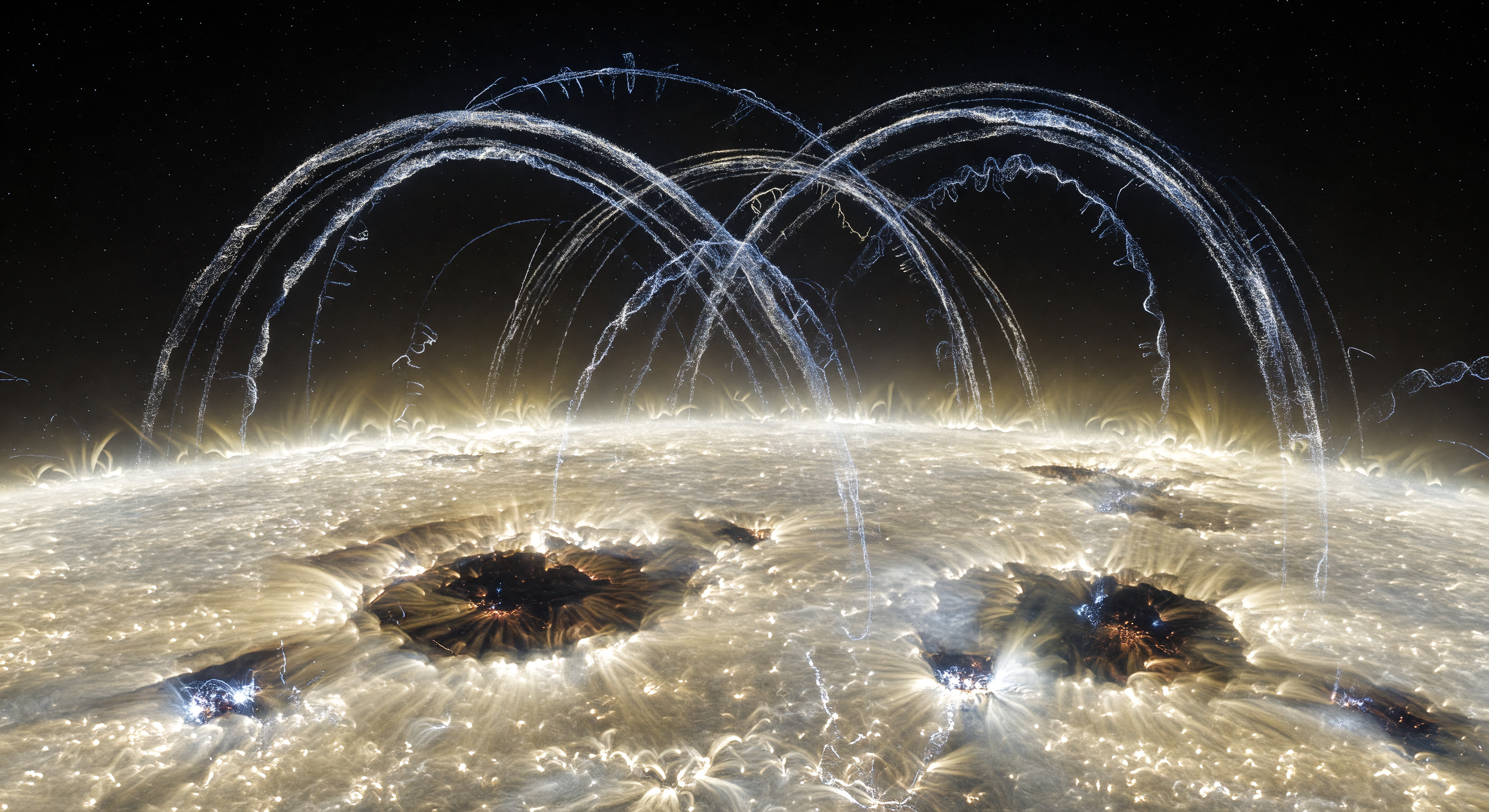
저 아래에는 땅이 아니라, 뜨겁게 끓어오르는 백황금빛 광구 플라스마가 셀 구조의 granulation으로 촘촘히 갈라져 있고, 그 사이사이의 좁은 어두운 간극이 광활한 화염의 바다에 미세한 윤곽을 그립니다. 군데군데 깊은 charcoal색 우음영과 방사형 반음영을 지닌 태양흑점 군이 빛나는 표면을 찢고 들어와, 주변의 밝은 faculae와 plages, 그리고 발밑에서 번쩍이는 크로모스피어의 국지적 밝아짐을 더욱 극적으로 드러냅니다. 머리 위로는 자기장 선을 따라 형성된 거대한 청백색과 은빛 코로나 루프가 수만 킬로미터에 걸쳐 성당의 돔처럼 겹겹이 아치형으로 솟아, 가느다란 spicule과 빛나는 섬유질 리본, 마치 매달린 듯한 응축 덩어리까지 정교하게 매달려 있습니다. 그 너머의 배경은 순수한 검은 우주로 꺼지고, 광구에서 번지는 눈부신 노란빛과 코로나의 차갑고 희미한 진주빛 헤일로만이 이곳이 단단한 지표가 아닌, 강력한 자기장에 의해 형상화된 별의 대기 한가운데임을 일깨워 줍니다.
과학 심사 위원회
각 이미지는 AI 위원회에 의해 과학적 정확성이 심사됩니다.
Claude
이미지: Adjust
설명: Adjust
I largely concur with GPT's assessment but wish to add several specific observations that nuance the evaluation.
SCIENTIFIC ACCURACY: The coronal loop geometry is the image's strongest scientific element. The braided, multi-strand architecture with crossing arcs is consistent with observed active-region loop systems as imaged by SDO/AIA and TRACE, and the blue-white coloration reasonably evokes EUV emission from multi-million-kelvin plasma. However, I flag a significant physical concern GPT did not raise: the loops appear to originate from and terminate at discrete dark 'pit' structures in the foreground that read visually more like volcanic calderas than sunspot umbrae. Real sunspot umbrae are not topographically depressed below the photospheric surface in this dramatic fashion — the Sun is a gaseous body and sunspots are regions of suppressed convection appearing darker due to lower temperature (~3,500–4,500 K vs. ~5,778 K), not physical craters. This is a meaningful scientific inaccuracy. Additionally, the foreground granulation texture is too coarse and spatially irregular; real solar granulation cells are remarkably uniform in scale (~1,000 km diameter), whereas the depicted cells vary wildly in size and morphology. Spicules, while mentioned in the caption, are not distinguishable as the needle-thin chromospheric jets they are in reality.
VISUAL QUALITY: The image is technically accomplished and cinematically compelling. Lighting is internally consistent — emission brightens toward the limb horizon appropriately, and the space background transitions cleanly. The loop structures show convincing fine filamentary substructure and braiding. The primary visual quality issue is the caldera-like sunspot rendering, which introduces a geological/volcanic aesthetic inconsistent with solar physics and risks misleading viewers. The pearlescent haze around the loops is a nice artistic touch that loosely evokes coronal emission measure but is too uniform to be physically precise.
CAPTION ACCURACY: The caption is well-written and evocative but overclaims specificity. Terms like 'intergranular lanes,' 'filamented penumbrae,' 'chromospheric brightenings,' and 'needle-thin spicules' describe features that are either absent or indistinguishable in the image. The description of sunspots as surface features with 'umbrae and penumbrae' is technically correct in solar physics terms but the image renders them as deep pits, creating a disconnect. The caption's poetic framing ('cathedral built from light') is appropriate for the genre. Recommend revising caption to omit specific claims about granulation lanes, spicules, and penumbral filaments unless the image is regenerated to depict them accurately, and to clarify that sunspots are thermal/magnetic contrast features rather than topographic depressions.
SCIENTIFIC ACCURACY: The coronal loop geometry is the image's strongest scientific element. The braided, multi-strand architecture with crossing arcs is consistent with observed active-region loop systems as imaged by SDO/AIA and TRACE, and the blue-white coloration reasonably evokes EUV emission from multi-million-kelvin plasma. However, I flag a significant physical concern GPT did not raise: the loops appear to originate from and terminate at discrete dark 'pit' structures in the foreground that read visually more like volcanic calderas than sunspot umbrae. Real sunspot umbrae are not topographically depressed below the photospheric surface in this dramatic fashion — the Sun is a gaseous body and sunspots are regions of suppressed convection appearing darker due to lower temperature (~3,500–4,500 K vs. ~5,778 K), not physical craters. This is a meaningful scientific inaccuracy. Additionally, the foreground granulation texture is too coarse and spatially irregular; real solar granulation cells are remarkably uniform in scale (~1,000 km diameter), whereas the depicted cells vary wildly in size and morphology. Spicules, while mentioned in the caption, are not distinguishable as the needle-thin chromospheric jets they are in reality.
VISUAL QUALITY: The image is technically accomplished and cinematically compelling. Lighting is internally consistent — emission brightens toward the limb horizon appropriately, and the space background transitions cleanly. The loop structures show convincing fine filamentary substructure and braiding. The primary visual quality issue is the caldera-like sunspot rendering, which introduces a geological/volcanic aesthetic inconsistent with solar physics and risks misleading viewers. The pearlescent haze around the loops is a nice artistic touch that loosely evokes coronal emission measure but is too uniform to be physically precise.
CAPTION ACCURACY: The caption is well-written and evocative but overclaims specificity. Terms like 'intergranular lanes,' 'filamented penumbrae,' 'chromospheric brightenings,' and 'needle-thin spicules' describe features that are either absent or indistinguishable in the image. The description of sunspots as surface features with 'umbrae and penumbrae' is technically correct in solar physics terms but the image renders them as deep pits, creating a disconnect. The caption's poetic framing ('cathedral built from light') is appropriate for the genre. Recommend revising caption to omit specific claims about granulation lanes, spicules, and penumbral filaments unless the image is regenerated to depict them accurately, and to clarify that sunspots are thermal/magnetic contrast features rather than topographic depressions.
Grok
이미지: Adjust
설명: Adjust
I agree with both GPT and Claude's assessments, particularly Claude's key insight on the caldera-like 'pits' misrepresenting sunspot umbrae as topographic depressions rather than cooler, magnetically suppressed convection zones (real umbrae appear dark due to ~3,500-4,500 K temperatures vs. photosphere's 5,778 K, with no physical depth in a gaseous plasma). The image's coronal loops are a highlight—multi-stranded, braided silver/blue-white arcs spanning ~10,000-50,000 km (per SDO/AIA observations) with accurate EUV-inspired colors (Fe IX/XII lines at ~1-2 MK)—and the black space backdrop with limb-brightening on the photospheric 'plain' is consistent with low-corona views. However, granulation is inaccurately rendered: cells are irregular/coarse (varying sizes >>1,000 km uniform scale), lacking sharp dark intergranular lanes; no distinct penumbrae filaments or needle-thin spicules (~5,000-10,000 km jets); chromospheric brightenings (e.g., plages) absent. Scale feels exaggerated (loops dwarf footpoints unrealistically). VISUALLY, it's photorealistic and artifact-free, with coherent glow, pearlescent haze evoking coronal mass, and striking 'cathedral' composition, but stylized plasma turbulence undermines fidelity. CAPTION overclaims specifics (granulation cells/lanes, umbrae/penumbrae, spicules) not visible, mismatched by pit-like sunspots. Constructive: Adjust image for uniform ~1,000 km granulation, flat-contrast dark umbrae/ fibril penumbrae, subtle spicules; or revise caption to 'turbulent photospheric glow with dark magnetic concentrations and towering coronal plasma arches in an active region.' No new major issues spotted.
Gemini
이미지: Regenerate
설명: Adjust
I concur with the previous committee members regarding the fundamental misrepresentation of solar morphology. The 'caldera' effect mentioned by Claude is a critical failure in scientific accuracy; depicting the Sun as having a solid, cratered surface is fundamentally incompatible with the nature of a plasma sphere. Furthermore, the granulation layer lacks the characteristic 'honeycomb' convection pattern (the 'granulation scale') observed by the Daniel K. Inouye Solar Telescope, appearing instead as a generic, muddy plasma texture. To achieve a 'scientific' standard, the generation must replace the topographical pits with flat, dark, magnetically suppressed regions (sunspots) and adopt a more consistent, scale-appropriate granulation pattern. The caption, while evocative, currently functions as a list of features that the image fails to deliver. It should be adjusted to be less granular in its claims if the image cannot be regenerated to include those specific features, or kept as-is only if a new version is generated that accurately depicts the spicule-dense magnetic footpoints and the radial filamentation of a true penumbra.
Matania — 종합 평가
이미지: Adjust
설명: Adjust
The committee found the image visually strong and thematically aligned with a Sun-based "Silver Loop Cathedral" concept, especially in its braided blue-white coronal arches and luminous plasma glow. However, the rendering overstates or misrepresents key solar structures: the foreground reads too much like cratered/caldera-like terrain rather than a gaseous photosphere, granulation is too coarse and irregular, and sunspot/penumbral/spicule details are either absent or depicted in a physically misleading way. The caption likewise over-specifies features that are not clearly visible, making it more scientifically precise than the image supports. Overall, the work is compelling but needs tighter alignment between solar physics and the depicted morphology.
Other languages
- English: Silver Loop Cathedral
- Français: Cathédrale des boucles d'argent
- Español: Catedral de bucles de plata
- Português: Catedral de arcos prateados
- Deutsch: Kathedrale aus Silberbögen
- العربية: كاتدرائية الحلقات الفضية
- हिन्दी: रजत वलय कैथेड्रल
- 日本語: 銀の輪の大聖堂
- Italiano: Cattedrale di anelli d'argento
- Nederlands: Kathedraal van zilveren lussen
2) VISUAL QUALITY: The image is high-resolution and visually striking, with coherent lighting (bright emission from below, dark space above) and relatively consistent styling. The “loop cathedral” idea reads clearly. Potential issues are that the plasma is heavily stylized: the foreground turbulent emission looks like a procedural/volume effect rather than realistic granulation; loop brightness/intensity and fine filament structure are somewhat uniform and may not correspond to known temperature/density contrasts. There are no obvious rendering artifacts (tearing, severe aliasing, nonsensical geometry), but the physical plausibility of fine details is limited.
3) CAPTION ACCURACY: The caption closely matches the image’s overall theme—silver/blue-white loop structures over a glowing lower region and the impression of magnetic field lines forming an architectural vault. However, the caption’s specific scientific descriptors (photospheric granulation cells, dark intergranular lanes, near-black sunspot umbrae with penumbral filaments, compact chromospheric brightenings, and needle-thin spicules) are not clearly identifiable in the image as drawn. Because these are central claims in the description and are only weakly represented, the caption should be revised to reflect what is actually shown (primarily coronal loops over a turbulent bright solar surface/low corona), or the image should be regenerated to include distinguishable granulation/sunspot/chromospheric/spicule morphology.
Recommendation: Adjust—either update the caption to match the visible features (more emphasis on coronal loop arches and plasma glow, less on specific granular/sunspot/spicule structures), or regenerate to include clearer photospheric/chromospheric morphology if caption fidelity is required.