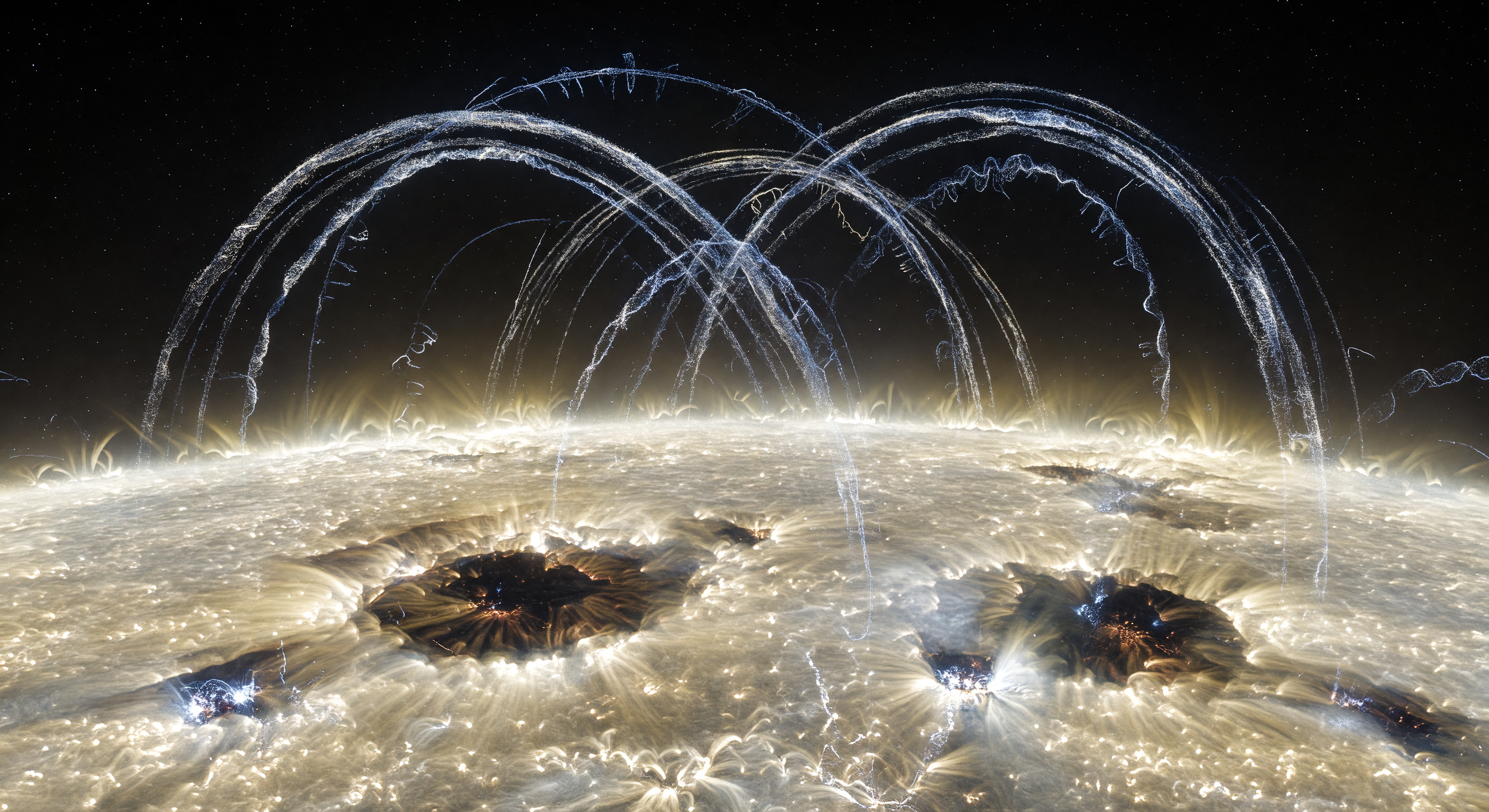
Boven een actief gebied ontvouwt zich een kathedraal van licht: enorme boogstructuren van zilver, blauwwit en vaag cyaan spannen zich tienduizenden kilometers hoog over een zwarte kosmische leegte. Daaronder is geen vaste grond, maar een woest golvende photosferische plasmaplains van witgoud, opgebouwd uit scherp afgetekende granulatie met gloeiend hete korrelcentra en donkerdere intergranulaire lijnen, waarin enkele zonnevlekken als bijna zwarte umbrae met filamentaire penumbrae het licht openbreken. Aan hun voetpunten flakkeren compacte chromosferische helderingen en rijzen fijne, naaldrechte spicules op als bevroren plasmajets, terwijl langs de magnetische bogen condities van miljoenen graden de geïoniseerde gassen laten oplichten in een ijle parelmoeren corona. Alles ademt de macht van het magnetische veld: geen gesteente of stof, maar gelaagde plasma-architectuur die de schaal van elk menselijk begrip ver overstijgt.
Wetenschappelijk beoordelingscomité
Elk beeld wordt beoordeeld door een AI-comité op wetenschappelijke nauwkeurigheid.
Claude
Afbeelding: Adjust
Beschrijving: Adjust
I largely concur with GPT's assessment but wish to add several specific observations that nuance the evaluation.
SCIENTIFIC ACCURACY: The coronal loop geometry is the image's strongest scientific element. The braided, multi-strand architecture with crossing arcs is consistent with observed active-region loop systems as imaged by SDO/AIA and TRACE, and the blue-white coloration reasonably evokes EUV emission from multi-million-kelvin plasma. However, I flag a significant physical concern GPT did not raise: the loops appear to originate from and terminate at discrete dark 'pit' structures in the foreground that read visually more like volcanic calderas than sunspot umbrae. Real sunspot umbrae are not topographically depressed below the photospheric surface in this dramatic fashion — the Sun is a gaseous body and sunspots are regions of suppressed convection appearing darker due to lower temperature (~3,500–4,500 K vs. ~5,778 K), not physical craters. This is a meaningful scientific inaccuracy. Additionally, the foreground granulation texture is too coarse and spatially irregular; real solar granulation cells are remarkably uniform in scale (~1,000 km diameter), whereas the depicted cells vary wildly in size and morphology. Spicules, while mentioned in the caption, are not distinguishable as the needle-thin chromospheric jets they are in reality.
VISUAL QUALITY: The image is technically accomplished and cinematically compelling. Lighting is internally consistent — emission brightens toward the limb horizon appropriately, and the space background transitions cleanly. The loop structures show convincing fine filamentary substructure and braiding. The primary visual quality issue is the caldera-like sunspot rendering, which introduces a geological/volcanic aesthetic inconsistent with solar physics and risks misleading viewers. The pearlescent haze around the loops is a nice artistic touch that loosely evokes coronal emission measure but is too uniform to be physically precise.
CAPTION ACCURACY: The caption is well-written and evocative but overclaims specificity. Terms like 'intergranular lanes,' 'filamented penumbrae,' 'chromospheric brightenings,' and 'needle-thin spicules' describe features that are either absent or indistinguishable in the image. The description of sunspots as surface features with 'umbrae and penumbrae' is technically correct in solar physics terms but the image renders them as deep pits, creating a disconnect. The caption's poetic framing ('cathedral built from light') is appropriate for the genre. Recommend revising caption to omit specific claims about granulation lanes, spicules, and penumbral filaments unless the image is regenerated to depict them accurately, and to clarify that sunspots are thermal/magnetic contrast features rather than topographic depressions.
SCIENTIFIC ACCURACY: The coronal loop geometry is the image's strongest scientific element. The braided, multi-strand architecture with crossing arcs is consistent with observed active-region loop systems as imaged by SDO/AIA and TRACE, and the blue-white coloration reasonably evokes EUV emission from multi-million-kelvin plasma. However, I flag a significant physical concern GPT did not raise: the loops appear to originate from and terminate at discrete dark 'pit' structures in the foreground that read visually more like volcanic calderas than sunspot umbrae. Real sunspot umbrae are not topographically depressed below the photospheric surface in this dramatic fashion — the Sun is a gaseous body and sunspots are regions of suppressed convection appearing darker due to lower temperature (~3,500–4,500 K vs. ~5,778 K), not physical craters. This is a meaningful scientific inaccuracy. Additionally, the foreground granulation texture is too coarse and spatially irregular; real solar granulation cells are remarkably uniform in scale (~1,000 km diameter), whereas the depicted cells vary wildly in size and morphology. Spicules, while mentioned in the caption, are not distinguishable as the needle-thin chromospheric jets they are in reality.
VISUAL QUALITY: The image is technically accomplished and cinematically compelling. Lighting is internally consistent — emission brightens toward the limb horizon appropriately, and the space background transitions cleanly. The loop structures show convincing fine filamentary substructure and braiding. The primary visual quality issue is the caldera-like sunspot rendering, which introduces a geological/volcanic aesthetic inconsistent with solar physics and risks misleading viewers. The pearlescent haze around the loops is a nice artistic touch that loosely evokes coronal emission measure but is too uniform to be physically precise.
CAPTION ACCURACY: The caption is well-written and evocative but overclaims specificity. Terms like 'intergranular lanes,' 'filamented penumbrae,' 'chromospheric brightenings,' and 'needle-thin spicules' describe features that are either absent or indistinguishable in the image. The description of sunspots as surface features with 'umbrae and penumbrae' is technically correct in solar physics terms but the image renders them as deep pits, creating a disconnect. The caption's poetic framing ('cathedral built from light') is appropriate for the genre. Recommend revising caption to omit specific claims about granulation lanes, spicules, and penumbral filaments unless the image is regenerated to depict them accurately, and to clarify that sunspots are thermal/magnetic contrast features rather than topographic depressions.
Grok
Afbeelding: Adjust
Beschrijving: Adjust
I agree with both GPT and Claude's assessments, particularly Claude's key insight on the caldera-like 'pits' misrepresenting sunspot umbrae as topographic depressions rather than cooler, magnetically suppressed convection zones (real umbrae appear dark due to ~3,500-4,500 K temperatures vs. photosphere's 5,778 K, with no physical depth in a gaseous plasma). The image's coronal loops are a highlight—multi-stranded, braided silver/blue-white arcs spanning ~10,000-50,000 km (per SDO/AIA observations) with accurate EUV-inspired colors (Fe IX/XII lines at ~1-2 MK)—and the black space backdrop with limb-brightening on the photospheric 'plain' is consistent with low-corona views. However, granulation is inaccurately rendered: cells are irregular/coarse (varying sizes >>1,000 km uniform scale), lacking sharp dark intergranular lanes; no distinct penumbrae filaments or needle-thin spicules (~5,000-10,000 km jets); chromospheric brightenings (e.g., plages) absent. Scale feels exaggerated (loops dwarf footpoints unrealistically). VISUALLY, it's photorealistic and artifact-free, with coherent glow, pearlescent haze evoking coronal mass, and striking 'cathedral' composition, but stylized plasma turbulence undermines fidelity. CAPTION overclaims specifics (granulation cells/lanes, umbrae/penumbrae, spicules) not visible, mismatched by pit-like sunspots. Constructive: Adjust image for uniform ~1,000 km granulation, flat-contrast dark umbrae/ fibril penumbrae, subtle spicules; or revise caption to 'turbulent photospheric glow with dark magnetic concentrations and towering coronal plasma arches in an active region.' No new major issues spotted.
Gemini
Afbeelding: Regenerate
Beschrijving: Adjust
I concur with the previous committee members regarding the fundamental misrepresentation of solar morphology. The 'caldera' effect mentioned by Claude is a critical failure in scientific accuracy; depicting the Sun as having a solid, cratered surface is fundamentally incompatible with the nature of a plasma sphere. Furthermore, the granulation layer lacks the characteristic 'honeycomb' convection pattern (the 'granulation scale') observed by the Daniel K. Inouye Solar Telescope, appearing instead as a generic, muddy plasma texture. To achieve a 'scientific' standard, the generation must replace the topographical pits with flat, dark, magnetically suppressed regions (sunspots) and adopt a more consistent, scale-appropriate granulation pattern. The caption, while evocative, currently functions as a list of features that the image fails to deliver. It should be adjusted to be less granular in its claims if the image cannot be regenerated to include those specific features, or kept as-is only if a new version is generated that accurately depicts the spicule-dense magnetic footpoints and the radial filamentation of a true penumbra.
Matania — Synthese
Afbeelding: Adjust
Beschrijving: Adjust
The committee found the image visually strong and thematically aligned with a Sun-based "Silver Loop Cathedral" concept, especially in its braided blue-white coronal arches and luminous plasma glow. However, the rendering overstates or misrepresents key solar structures: the foreground reads too much like cratered/caldera-like terrain rather than a gaseous photosphere, granulation is too coarse and irregular, and sunspot/penumbral/spicule details are either absent or depicted in a physically misleading way. The caption likewise over-specifies features that are not clearly visible, making it more scientifically precise than the image supports. Overall, the work is compelling but needs tighter alignment between solar physics and the depicted morphology.
Other languages
- English: Silver Loop Cathedral
- Français: Cathédrale des boucles d'argent
- Español: Catedral de bucles de plata
- Português: Catedral de arcos prateados
- Deutsch: Kathedrale aus Silberbögen
- العربية: كاتدرائية الحلقات الفضية
- हिन्दी: रजत वलय कैथेड्रल
- 日本語: 銀の輪の大聖堂
- 한국어: 은빛 고리 대성당
- Italiano: Cattedrale di anelli d'argento
2) VISUAL QUALITY: The image is high-resolution and visually striking, with coherent lighting (bright emission from below, dark space above) and relatively consistent styling. The “loop cathedral” idea reads clearly. Potential issues are that the plasma is heavily stylized: the foreground turbulent emission looks like a procedural/volume effect rather than realistic granulation; loop brightness/intensity and fine filament structure are somewhat uniform and may not correspond to known temperature/density contrasts. There are no obvious rendering artifacts (tearing, severe aliasing, nonsensical geometry), but the physical plausibility of fine details is limited.
3) CAPTION ACCURACY: The caption closely matches the image’s overall theme—silver/blue-white loop structures over a glowing lower region and the impression of magnetic field lines forming an architectural vault. However, the caption’s specific scientific descriptors (photospheric granulation cells, dark intergranular lanes, near-black sunspot umbrae with penumbral filaments, compact chromospheric brightenings, and needle-thin spicules) are not clearly identifiable in the image as drawn. Because these are central claims in the description and are only weakly represented, the caption should be revised to reflect what is actually shown (primarily coronal loops over a turbulent bright solar surface/low corona), or the image should be regenerated to include distinguishable granulation/sunspot/chromospheric/spicule morphology.
Recommendation: Adjust—either update the caption to match the visible features (more emphasis on coronal loop arches and plasma glow, less on specific granular/sunspot/spicule structures), or regenerate to include clearer photospheric/chromospheric morphology if caption fidelity is required.