Scientific confidence: High

From the rubble-strewn foothills of a colossal central peak, pale to medium-gray basaltic regolith and shattered blocks of pyroxene-rich rock and breccia climb into steep, faceted ridges, every splintered edge preserved with uncanny sharpness in the airless vacuum. Fresh-looking outcrops, talus aprons, and small impact craters record a violent history of crustal excavation, exposing material from an ancient differentiated body whose basaltic crust was broken, mixed, and redeposited by giant impacts, with faint darker carbonaceous patches hinting at foreign debris delivered from elsewhere in the asteroid belt. The low gravity leaves boulders seeming almost precariously perched, while beyond the ridges the basin floor drops away so quickly that the horizon appears startlingly close and visibly curved, making this world feel both miniature and immense at once. Overhead, a compact Sun burns in a pitch-black sky scattered with unwavering stars, casting razor-edged shadows so deep that cracks and crevices vanish into absolute darkness.

A vast plain of pale to medium gray regolith spreads across the floor of the giant south-polar basin, strewn with angular basaltic rubble, charcoal-dark boulders, and low hummocks that cast knife-edged shadows in the hard sunlight. The ground is the shattered surface of a differentiated world’s ancient basaltic crust—powdery dust, brecciated impact debris, and occasional slabs of coherent bedrock exposed where repeated collisions have churned and excavated the basin floor. In the extremely weak gravity, blocks perch precariously on subtle slopes and thin ejecta aprons lie almost undisturbed, while the airless vacuum leaves every pebble and fracture trace etched with startling clarity beneath a smaller but still brilliant Sun. The horizon curves away after only a short distance, making the immense basin feel both intimate and alien, as distant ring-wall escarpments rise in subdued steps under a pure black sky crowded with sharp, unwavering stars.
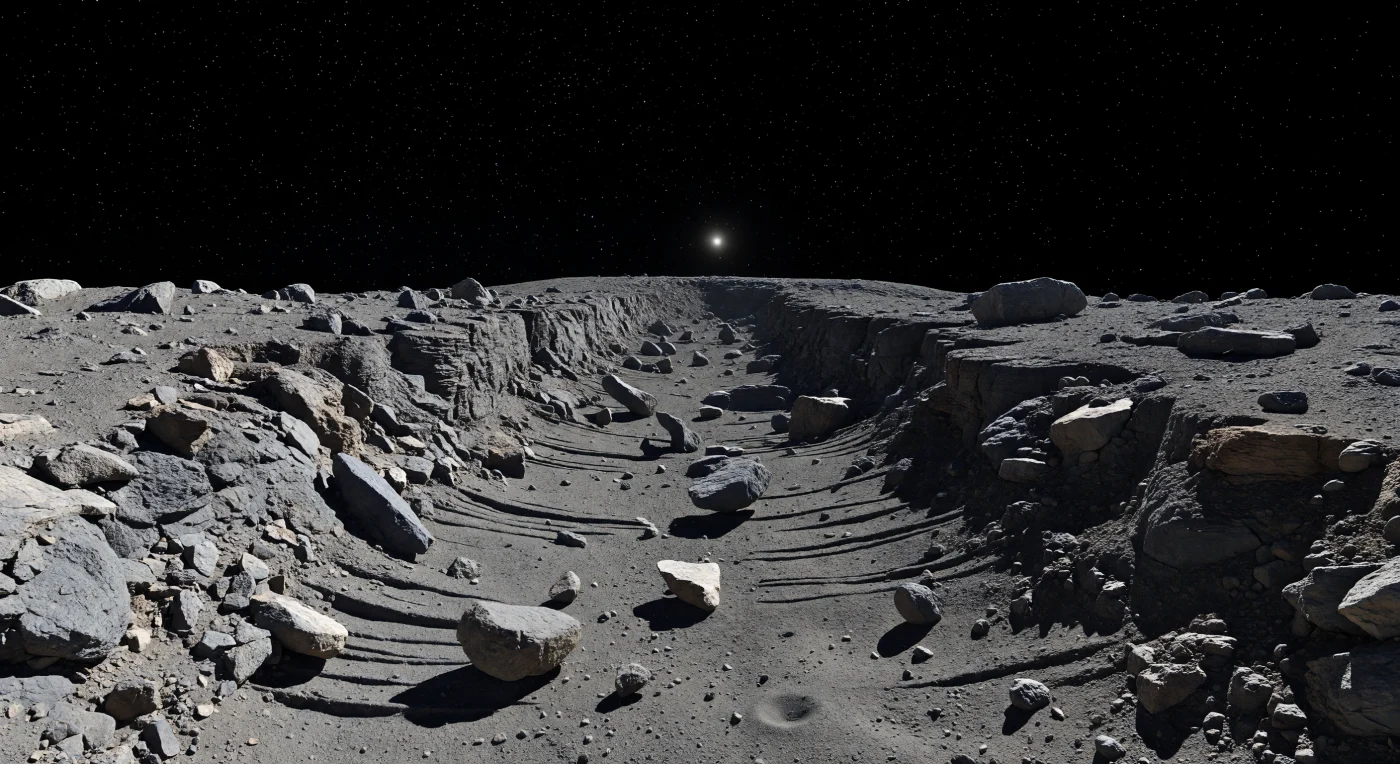
From the floor of this equatorial trough, steep, ruler-straight fault scarps of gray to charcoal basaltic crust rise on either side, their fractured ledges and blocky talus lit by harsh side sunlight that cuts every edge into stark relief. Underfoot lies a hummocky plain of fine regolith—crushed basalt, pyroxene-rich dust, sharp pebbles, and scattered boulders—scored by parallel grooves and dotted with small impact pits, where precariously perched slabs and loose ejecta blocks hint at the grip of gravity only a few percent as strong as Earth’s. These giant trenches were opened by global stresses after immense impacts shook and deformed the crust, exposing the layered remains of an ancient differentiated world whose surface once formed from molten rock. Above the scarps the sky is a pure black vacuum pricked with unwavering stars, while the horizon curves away so quickly that the trough seems to bend around the body itself, making the landscape feel at once intimate underfoot and planetary in scale.
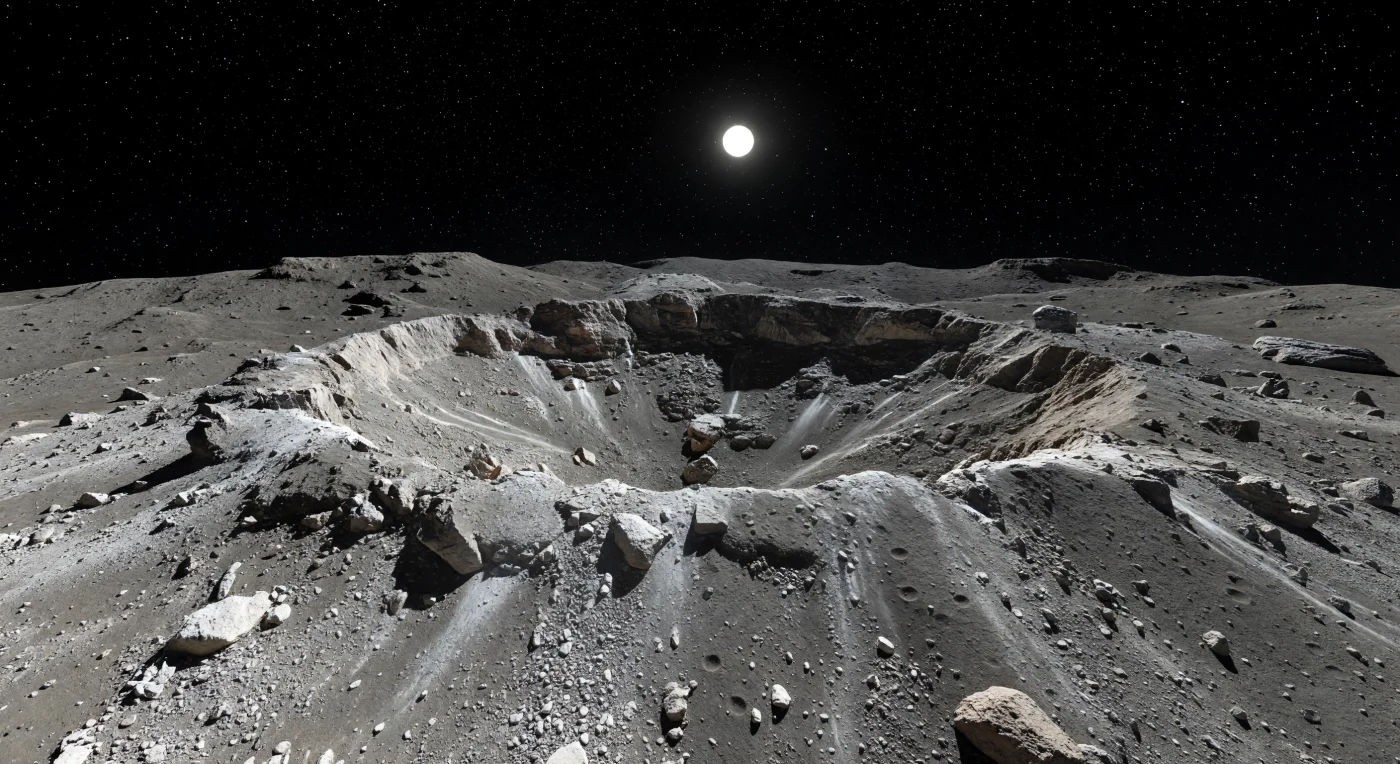
A young impact crater slices through older, darker basaltic ground here, its crisp rim rising only a few tens of meters yet looking startlingly dramatic against the strongly curved horizon of this small world. Under a pure black, airless sky, pale whitish-gray fresh ejecta—powdery dust, shattered slabs, angular boulders, and brecciated fragments—radiates outward across charcoal-toned mature regolith, while steep inner ledges expose fractured basalt lit by a smaller, hard white Sun. With no atmosphere to soften the light, sunlit faces blaze and every recess falls into absolute black shadow, making secondary pits, slump deposits, and perched blocks stand out with razor-edged clarity. You are looking at the exposed crust of a differentiated protoplanet, where recent impact excavation has unearthed fresher basaltic material from beneath space-weathered surface layers, preserving an intimate but profoundly alien record of early Solar System violence.

You stand in a jumbled maze of ancient impact scars where dusty beige-gray regolith, angular basaltic rocks, and brecciated ejecta smother nearly every surface, leaving almost no level ground between the shallow bowls and battered rims of countless overlapping craters. This is the exposed crust of a differentiated protoplanet, its basalt-rich surface shattered by billions of years of impacts into fractured slabs, loose gravel, and dark foreign patches delivered by later collisions, with fresh pinprick craters still punched into older, softened terrain. In the feeble gravity, boulders seem to rest too lightly on steep rubble slopes, and thin streaks of migrated dust cling to inclines as if the whole landscape could shift at a touch. The horizon curves away unnervingly close beneath a pitch-black, star-filled sky, while a small hard Sun casts razor-sharp black shadows into every crevice, making the highlands feel silent, airless, and astonishingly crisp from the nearest pebble to the miniature cratered rises beyond.
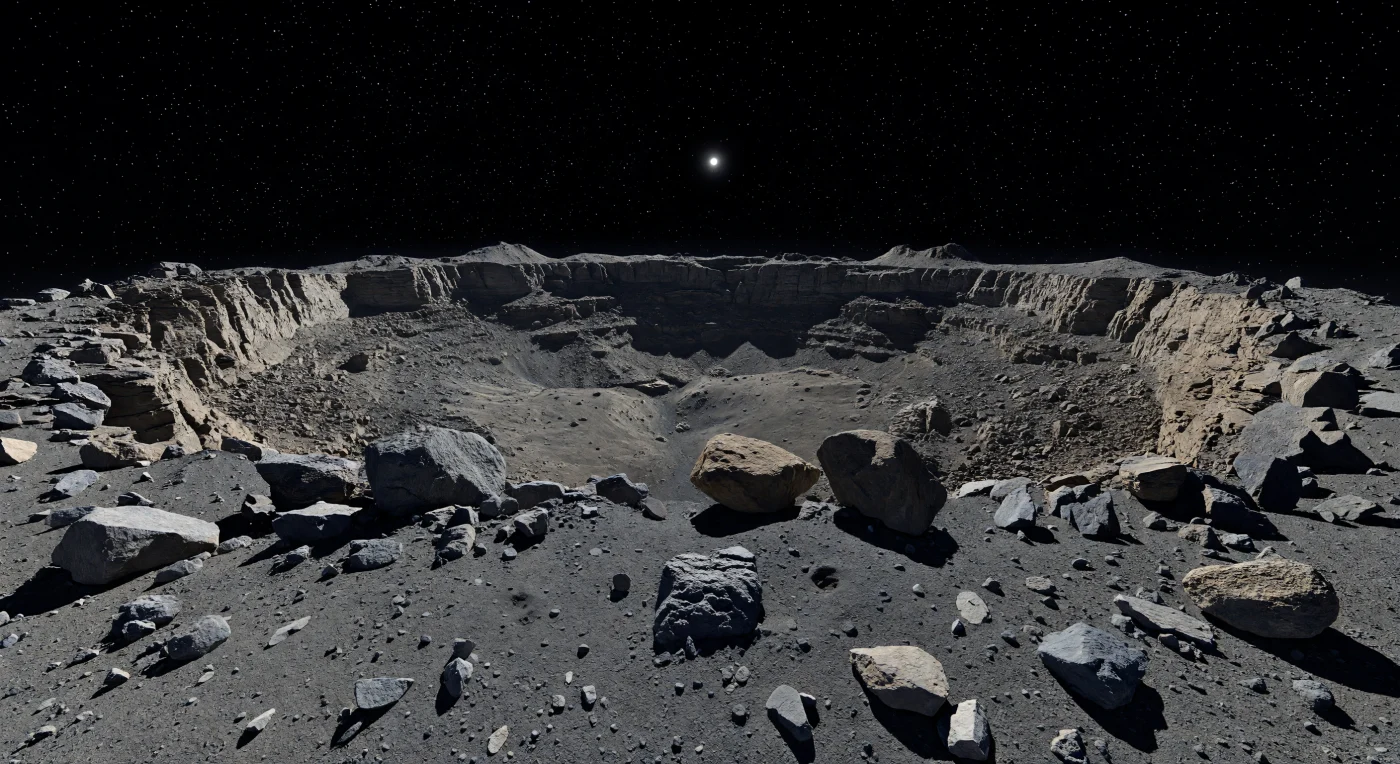
From this narrow rim, the ground drops away almost immediately into a colossal impact basin, the nearby horizon already curving downward to reveal the smallness of the world beneath your feet. Under harsh, undiffused sunlight, every grain of dark basaltic regolith, every shattered plate of crust, and every sharp-edged boulder stands out in neutral grays, brown-grays, and muted tan, while black shadows cut cleanly through terraced cliffs, slump benches, narrow chutes, and angular talus fans. These scarps expose the fractured basaltic crust of a differentiated protoplanet—ancient lava-derived rock later broken and rearranged by catastrophic impacts—while darker exogenic patches, scattered secondary craters, and precariously balanced megablocks record a long history of bombardment in gravity so weak that steep, unstable-looking slopes can persist. Beyond the rubble-strewn escarpment, hummocky plains and low ridges fade into the basin interior beneath a star-filled black sky, where the vacuum makes the scene feel impossibly crisp, silent, and starkly immense.

You stand within a crater whose interior wall appears caught in a silent landslide: broad stepped slump benches descend from fractured medium-gray basaltic crust, while overlapping fan-shaped talus aprons spread across the terrace in lobes of rubble, dust, and sharp-edged blocks. Fresh pale scarps and exposed bedrock mark where material has recently broken away, and detached megablocks—some the size of buildings—rest improbably on steep slopes, their precarious balance made possible by gravity only a few percent of Earth’s. The ground is a dry mosaic of charcoal-gray regolith, pebble-sized basalt fragments, scattered boulders, and small secondary impact pits, all lit by a smaller, fiercely bright Sun that casts razor-black shadows into narrow slots and under overhangs with no atmospheric softening at all. Above the close, subtly curved horizon, the sky is pure vacuum-black and crowded with hard, steady stars, making the crater feel both intimate and immense: a collapsed wound in the basaltic crust of an unfinished world.
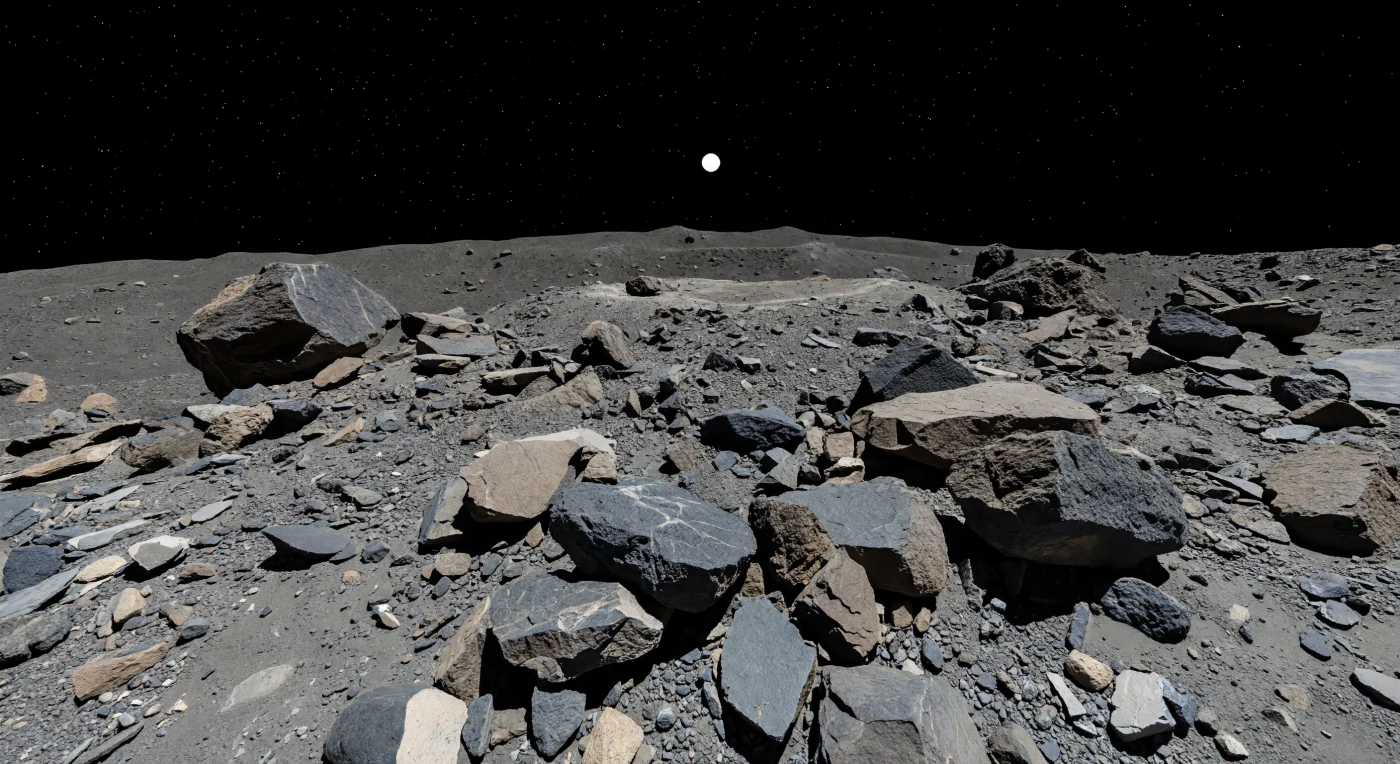
At ground level, the crater’s ejecta apron is a chaotic spill of angular basaltic blocks and shattered breccia, from knife-sharp gravel underfoot to fractured monoliths large enough to dwarf a house, all clinging to slopes that seem impossibly steep in such weak gravity. Between dark slabs of eucritic and diogenitic crust, pockets of pale regolith dust have collected in sheltered cracks, while fresh broken faces and occasional glassy, impact-sheared surfaces reveal the violence that excavated this rubble from deeper layers of an ancient differentiated body. The sunlight, weaker than at Earth’s distance yet unsoftened by any atmosphere, strikes every rock with brutal clarity, turning sunlit surfaces charcoal, ash gray, and muted brown while shadows fall as absolute black voids. Beyond the unstable-looking piles of perched boulders, the land drops quickly toward a startlingly near curved horizon, where low crater rims and ridges rise like miniature mountains beneath a star-filled black sky.

At your feet, pale basaltic dust and crushed volcanic rock are mottled with irregular splashes and pond-like smears of charcoal to brown-black material, impact-delivered carbon-rich debris darkening the brighter Vestan regolith like soot across broken stone. Sharp-edged basalt blocks, breccia boulders, glassy fragments, and tiny fresh craterlets crowd the surface, their forms frozen under very low gravity and lit by a small, fierce Sun that casts razor-black shadows through the airless vacuum. A low rise ahead, only tens of meters high, feels like a miniature mountain, its exposed basaltic layers and asymmetrical dark ejecta recording a crust built by ancient melting, differentiation, and relentless impacts. Beneath a perfectly black sky where stars remain visible even at noon, the horizon curves startlingly close, making this battered landscape feel both intimate and planetary—a fragment of an unfinished world suspended in silence.

A muted plain of ash-gray to beige basaltic regolith stretches between craters, its powdery surface studded with angular dark fragments, scattered breccia blocks, and countless tiny impact pits whose crisp rims cast razor-black shadows in the unfiltered sunlight. At your feet, the ground looks almost smooth, but that calm quickly gives way to subtle swales, low crater rims, and exposed patches of fractured basaltic bedrock—evidence that this small world once melted, differentiated, and built a true igneous crust before billions of impacts ground it into dust. In the feeble gravity, loose rubble clings to surprisingly steep slopes, and the horizon curves away startlingly close, making the landscape feel both intimate and precariously small. Above it all hangs a star-filled black sky and a hard, distant Sun, lending the scene a cold, airless stillness that feels less like a desert and more like the exposed skin of an unfinished planet.

At the edge of day, a small white Sun skims a sharply curved horizon, casting brutal, undiffused light across an airless plain of overlapping craters, fractured basalt ledges, and angular breccia blocks perched on steep rubble slopes. Pale silver-gray rims and slabby rock faces blaze against perfectly black, razor-edged shadows that stretch so far they merge directly into night, while pinpoint stars remain visible overhead because no atmosphere scatters or softens the light. The ground is a mix of basaltic dust, broken igneous crust, and darker charcoal patches likely delivered by foreign impactors, preserving the record of both volcanic differentiation and relentless bombardment on this ancient protoplanet. In the weak gravity, even “mountain-sized” rim crests rise only modestly above the terrain, yet the close, dropping horizon and precarious boulders make the landscape feel at once intimate and immense, as if you are standing on the broken skin of a miniature world.

You stand low among immense, subparallel ridges and troughs cut into a battered basaltic crust, the ground strewn with angular rubble, brecciated slabs, pale regolith, and occasional darker carbon-rich clasts perched improbably on steep slopes in feeble gravity. These grooves are thought to be giant fractures formed when colossal impacts stressed and deformed the crust of this differentiated protoplanet, exposing layered igneous rock and leaving narrow trenches drowned in absolute black shadow while ridge crests gleam with pulverized ejecta under the hard, distant Sun. Small fresh craterlets, overturned blocks, and faint downslope drifts of dust record a surface still being reworked by impacts and slow regolith migration, even in the absence of air, water, or weather. Above it all hangs a pitch-black sky scattered with sharp stars, and the nearby curved horizon makes these modest 10-to-50-meter walls feel like the ribs of a shattered miniature world.
