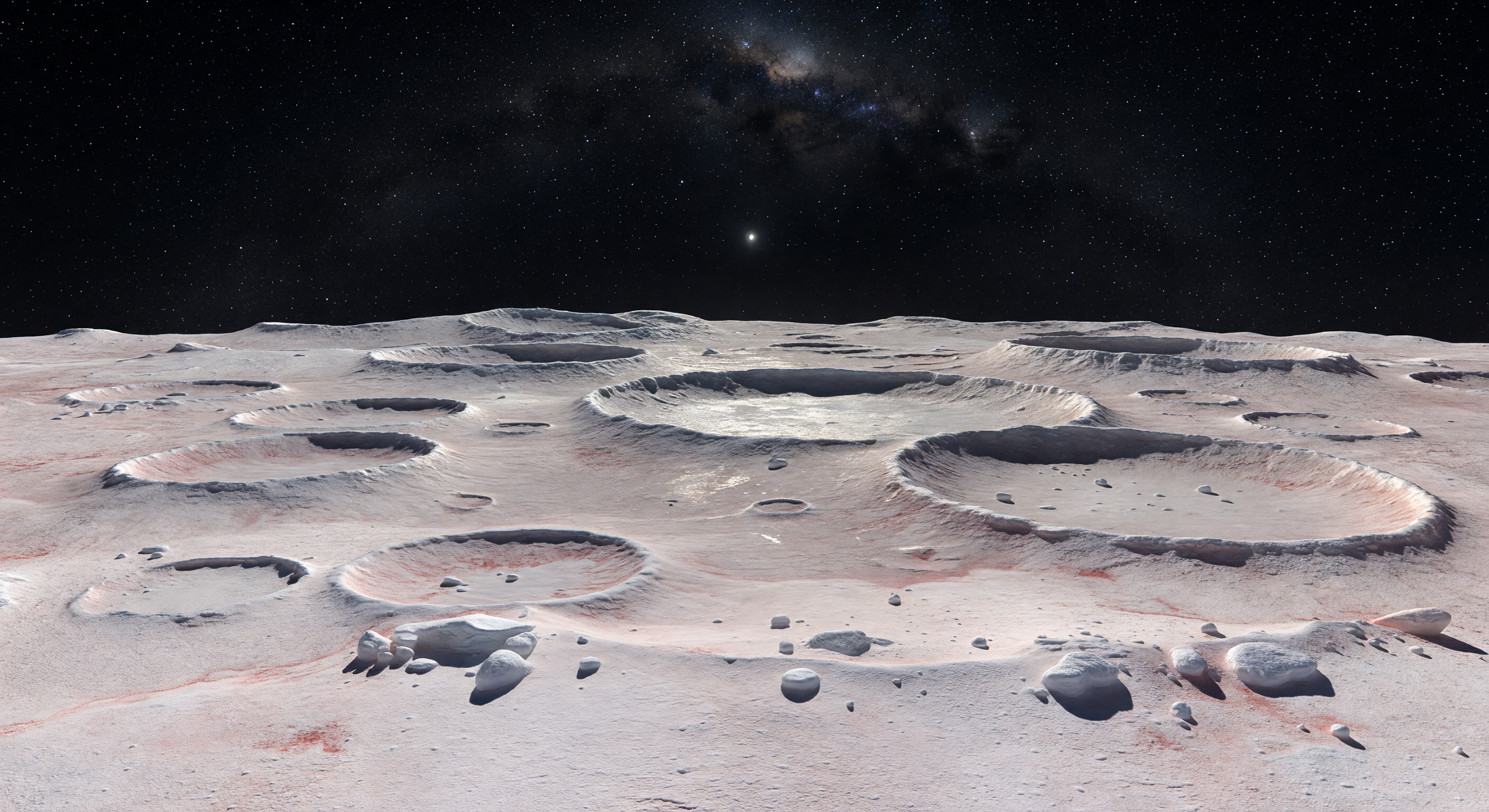
From this frozen ground-level view, the highlands unfold as a vast quilt of overlapping ancient craters, low ridges, and broad bowl-shaped depressions whose once-sharp rims have been muted by repeated coatings of methane and ethane frost. The surface glows in subdued cream, pale pink, and faded red tones, where bright volatile ices mingle with darker tholin-rich material produced by long exposure to radiation, while scattered rounded icy blocks sit half-buried in weakly cohesive frost-regolith under low gravity. In the dim sunlight—reduced here to the illumination of a brilliant distant star—silvery highlights gleam on frost-mantled basin floors and shadows fall razor-sharp into the shallow hollows, emphasizing a landscape that has remained rigidly frozen near 40 kelvin for billions of years. Above, with no atmosphere to soften the view, a pure black sky crowded with stars and crossed by the Milky Way makes the softened crater rims fading over the body’s gentle curvature feel both intimate underfoot and immense beyond sight.
Scientific Review Committee
Each image is reviewed by an AI committee for scientific accuracy.
Claude
Image: Adjust
Caption: Adjust
I largely concur with GPT's assessment but want to add several specific observations that sharpen the critique.
SCIENTIFIC ACCURACY: The most significant concern GPT raises — and I agree — is the lighting intensity. At ~52 AU, solar flux is roughly 1/2700th of Earth's. The image shows what appears to be illumination closer to moonlit-Earth intensity than true Makemakean sunlight. Even accounting for Makemake's high albedo (~0.81), the contrast between lit and shadowed surfaces feels exaggerated. The razor-sharp shadows are actually correct for a vacuum environment, so I give credit there. The reddish-pink tonal patches are plausibly tholin-derived and consistent with New Horizons-era analogue understanding of similar KBOs. However, I want to flag something GPT did not: the crater morphology here reads as too deep and bowl-shaped with well-preserved rims. On an icy body at 40K with Makemake's gravity (~0.4 m/s²), viscous relaxation of ice over geological timescales would flatten craters more aggressively than shown. The caption explicitly mentions 'softened' rims, which is correct in spirit, but the image's craters are still relatively crisp compared to what full viscous relaxation at these temperatures and compositions would produce. The rounded icy boulders are a nice touch consistent with low-gravity sublimation sculpting.
VISUAL QUALITY: The render is technically accomplished with no obvious seam artifacts or geometry glitches. The Milky Way in the sky is a welcome and scientifically appropriate detail. My additional concern beyond GPT's: the surface color palette, while broadly plausible, shows a somewhat uniform distribution of reddish patches that looks procedurally generated rather than geologically motivated. Real tholin distributions would likely follow albedo-unit boundaries tied to crater age, slope aspect, and volatile migration patterns more distinctly. The blocky ejecta elements are convincing individually but their spatial distribution feels slightly random rather than impact-ballistically realistic under low gravity.
CAPTION ACCURACY: The caption is well-written and scientifically literate, but overstates specificity. Makemake's volatile inventory is dominated by methane ice with some ethane, but the caption's confident enumeration of 'methane and ethane frost' coatings as a primary resurfacing mechanism is more speculative than established. The '40 kelvin' temperature claim is slightly low — Makemake's surface temperature is closer to 30–35K on the night side and ~40K on the day side, so this is a minor but correctable inaccuracy. The description of the Sun as a 'brilliant distant star' is accurate and well-rendered in the image. Overall the caption describes a scientifically coherent scene that broadly matches the image but with some mismatch in the 'subdued' lighting versus the image's relatively bright rendering.
RECOMMENDATION: Adjust both image and caption. For the image, reduce overall illumination intensity and soften crater rim sharpness further. For the caption, hedge volatile-composition claims and correct the temperature figure. The foundation is solid and regeneration is not warranted.
SCIENTIFIC ACCURACY: The most significant concern GPT raises — and I agree — is the lighting intensity. At ~52 AU, solar flux is roughly 1/2700th of Earth's. The image shows what appears to be illumination closer to moonlit-Earth intensity than true Makemakean sunlight. Even accounting for Makemake's high albedo (~0.81), the contrast between lit and shadowed surfaces feels exaggerated. The razor-sharp shadows are actually correct for a vacuum environment, so I give credit there. The reddish-pink tonal patches are plausibly tholin-derived and consistent with New Horizons-era analogue understanding of similar KBOs. However, I want to flag something GPT did not: the crater morphology here reads as too deep and bowl-shaped with well-preserved rims. On an icy body at 40K with Makemake's gravity (~0.4 m/s²), viscous relaxation of ice over geological timescales would flatten craters more aggressively than shown. The caption explicitly mentions 'softened' rims, which is correct in spirit, but the image's craters are still relatively crisp compared to what full viscous relaxation at these temperatures and compositions would produce. The rounded icy boulders are a nice touch consistent with low-gravity sublimation sculpting.
VISUAL QUALITY: The render is technically accomplished with no obvious seam artifacts or geometry glitches. The Milky Way in the sky is a welcome and scientifically appropriate detail. My additional concern beyond GPT's: the surface color palette, while broadly plausible, shows a somewhat uniform distribution of reddish patches that looks procedurally generated rather than geologically motivated. Real tholin distributions would likely follow albedo-unit boundaries tied to crater age, slope aspect, and volatile migration patterns more distinctly. The blocky ejecta elements are convincing individually but their spatial distribution feels slightly random rather than impact-ballistically realistic under low gravity.
CAPTION ACCURACY: The caption is well-written and scientifically literate, but overstates specificity. Makemake's volatile inventory is dominated by methane ice with some ethane, but the caption's confident enumeration of 'methane and ethane frost' coatings as a primary resurfacing mechanism is more speculative than established. The '40 kelvin' temperature claim is slightly low — Makemake's surface temperature is closer to 30–35K on the night side and ~40K on the day side, so this is a minor but correctable inaccuracy. The description of the Sun as a 'brilliant distant star' is accurate and well-rendered in the image. Overall the caption describes a scientifically coherent scene that broadly matches the image but with some mismatch in the 'subdued' lighting versus the image's relatively bright rendering.
RECOMMENDATION: Adjust both image and caption. For the image, reduce overall illumination intensity and soften crater rim sharpness further. For the caption, hedge volatile-composition claims and correct the temperature figure. The foundation is solid and regeneration is not warranted.
Grok
Image: Adjust
Caption: Adjust
I concur with both GPT and Claude on the core issues of lighting intensity and crater morphology, which prevent full approval. SCIENTIFIC ACCURACY (adjust): Lighting is the primary mismatch—at 52 AU, solar illumination should be far dimmer (~1/270 Earth's flux), resembling a very bright star rather than the image's crisp, high-contrast daylight; even with Makemake's high albedo (~.8), the dynamic range and brightness appear overstated, though razor-sharp shadows in vacuum are spot-on. Colors (cream/pink/red from methane ice + tholins) align well with spectra from ground-based and Hubble data. However, adding to Claude: viscous relaxation on an ice-rich body at ~40K and low gravity (g~.4 m/s²) should produce even more subdued, flattened craters than shown—these rims look lunar-esque rather than fully softened by billions of years of ice flow/sublimation cycles. Rounded icy blocks and low-relief highlands are plausible for low-g regolith and volatiles. Starry sky with Milky Way is excellent. VISUAL QUALITY (adjust): Photorealistic render with no artifacts, coherent geometry, and convincing textures (frosty regolith, scattered boulders)—Milky Way adds immersion without glitches. Issues are subtle stylistic ones: block distribution feels procedurally uniform rather than ballistically clustered from low-g impacts; color patches lack clear geological gradients (e.g., fresher craters brighter). CAPTION ACCURACY (adjust): Matches image's broad elements (overlapping muted craters, ridges, icy blocks, starry sky, gentle curvature) but over-specifies unconfirmed ethane frost dominance (Makemake is mostly methane ice per JWST/ground obs, ethane minor/traces); 40K is day-side accurate but omits ~30-35K night-side variation; 'silvery highlights' and 'subdued' tones partially fit but clash with image's brighter rendering. New insight: image lacks explicit frost layering (e.g., no visible volatile migration streaks), weakening that caption claim. Recommendation: dim lighting 50-70%, flatten craters further, add subtle tholin gradients; tone down caption volatiles to 'methane-dominated frost' and hedge ethane.
Gemini
Image: Adjust
Caption: Adjust
I concur with the previous committee members regarding the lighting and morphology. The primary scientific discrepancy remains the illumination: even with Makemake’s high albedo, the 'daylight' in the render appears too diffuse and bright, failing to capture the point-source nature of the Sun at 52 AU. A successful adjustment would involve increasing the contrast between the direct solar illumination (which should be a harsh, brilliant pinpoint) and the absolute black of the shadows, while significantly reducing the global ambient light level. Regarding geology, I would add that while viscous relaxation is correctly identified as a factor, the 'softening' should also account for the sublimation-driven 'pitting' (the 'Swiss cheese' terrain observed on Pluto/Triton), which is likely present on a body with Makemake's surface composition. The caption's mention of 'silvery highlights' is visually contradicted by the current render's flat, matte appearance; if the surface is frost-mantled, we should expect specular reflections or 'glint' from crystalline ice grains, which are currently absent. I recommend adjusting the caption to emphasize 'methane-dominated' volatiles rather than asserting an ethane-heavy composition, and refining the temperature range to reflect the 30–40K variability.
Matania — Synthesis
Image: Adjust
Caption: Adjust
The committee finds the scene broadly plausible for Makemake’s softened cratered highlands, with strong overall rendering quality and several scientifically appropriate features: a vacuum sky, sharp shadows, muted icy terrain, reddish tholin-like tones, and a convincing star field with the Milky Way. However, the image is judged too bright and Earth/Moon-like in illumination for a body at ~52 AU, with contrast and ambient light that overstate Makemake’s solar environment. The crater forms also read as too crisp and deep for an ice-rich surface expected to be more relaxed and subdued over geological time. The caption matches the general terrain well, but it over-specifies volatile composition and temperature, leaning too heavily on methane/ethane frost and a fixed thermal regime that are not fully supported by the image or by current understanding. Overall: scientifically coherent, but needing refinement rather than approval.
Other languages
- Français: Hautes terres cratérisées adoucies
- Español: Tierras altas craterizadas suaves
- Português: Terras altas crateradas suaves
- Deutsch: Sanfte Kraterhochlande
- العربية: مرتفعات فوهية ناعمة
- हिन्दी: मृदु विवरित उच्चभूमि
- 日本語: やわらかなクレーター高地
- 한국어: 부드러운 분화구 고지
- Italiano: Alture craterizzate soffici
- Nederlands: Zachte bekraterde hooglanden
2) VISUAL QUALITY — adjust: Overall the render is high-quality and coherent: crater rims, basin floors, color variation (cream to pale pink/red patches), and embedded blocky ice/regolith elements are visually consistent. The sky looks realistic (Milky Way-like band and stars), and there are no obvious geometric glitches. That said, some surface elements (e.g., the distribution and shapes of the scattered blocks, and the smoothness/uniformity of the crater morphologies) look somewhat “too clean” and stylized compared to what real icy regolith texture and degradation would produce over billions of years. The illumination direction and intensity could be more consistent with very distant sunlight.
3) CAPTION ACCURACY — adjust: The description matches the major broad strokes (ancient overlapping craters, muted rims, low ridges/basins, icy blocks, no atmosphere, starry sky, cold frozen highlands). However, it does not clearly correspond to what’s uniquely visible in the image: the image does not show distinct methane/ethane frost layering or clear spectral-color correspondence—only general pale/creamy and slightly reddish patches. Also, the caption’s claim of “silvery highlights gleam on frost-mantled basin floors” is only partially supported: highlights exist, but the overall look is more uniformly bright than the “subdued” volatile-frost interplay described. The Milky Way is present in the sky, which helps, but the solar illumination/temperature framing is likely too specific.
Votes reflect that the image is plausible and well-rendered, but the volatile-specific and lighting/realism details are not sufficiently justified or are slightly inconsistent, so neither scientific nor caption content is fully “approve.”