Scientific confidence: High

Across the floor of the immense impact basin, smooth volcanic plains spread outward like a frozen sea of gray-brown basalt, broken by darker craters that have punched through the lava and exposed charcoal-toned material from below. Low wrinkle ridges and fractures run across the plain in sweeping geometric lines, evidence that this once-molten surface later cooled, contracted, and was compressed as the planet’s interior shrank. On the horizon, rugged mountain rings rise more than two kilometers high, their silhouettes cut with knife-edge precision by an airless sky so black and clear that the Sun blazes overhead undimmed, casting stark shadows with no haze to soften them. Standing here, you would feel the strange intimacy of a small world and the severity of its environment at once: a silent volcanic basin forged by colossal impact, reshaped by lava flooding, and baked under some of the most extreme temperature swings in the solar system.

At local noon, the ground stretches away as a vast wilderness of grey-brown regolith and overlapping impact craters, every rim, terrace, and scattered boulder etched with extraordinary clarity beneath a sky that remains perfectly black even in full daylight. With essentially no atmosphere to scatter light or soften distance, the Sun hangs directly overhead as an intense white disk nearly three times the apparent size seen from Earth, driving surface temperatures to about 430°C and casting razor-edged shadows that look like cuts into the terrain. The rocks underfoot are ancient, iron-poor silicate debris—pulverized by billions of years of impacts, darkened in places by carbon-rich material excavated from depth, and fractured by relentless heating, cooling, micrometeorite bombardment, and solar-wind exposure. In the middle distance, subtle cliff-like scarps hint at the world’s long contraction as its interior cooled, giving the whole scene the uncanny feeling of standing inside a silent furnace where every detail, from bright crater rays to pools of absolute darkness, appears brutally close and impossibly sharp.

At the knife-edge of the terminator, a crater rim rises in blazing silvery-grey light while its interior drops instantly into absolute blackness, a contrast made brutally sharp by the lack of any atmosphere to soften the scene. Hidden within that permanent polar shadow—preserved by the world’s near-zero axial tilt—thermal imaging reveals thick deposits of water ice, glowing pale beneath a thin cover of dark, reddish-brown, carbon- and iron-rich regolith that appears nearly black to the eye. The sunlit slopes show impact-shattered boulders, fine powdery soil, and fresh bright ejecta etched with long, hard shadows, while subtle ridges in the surrounding plains record global crustal contraction as the planet’s enormous metal core slowly cooled. Standing here would feel like occupying two worlds at once: one side scorched to more than 430°C, the other locked below -170°C, with no wind, no haze, and no twilight—only stone, ice, and silence under a black sky.

Ahead of you, a dusty, crater-pocked plain runs unbroken to the foot of an immense cliff, where the ground suddenly heaves upward into a fault scarp towering roughly 1.5 to 2 kilometers high, its grey rock face etched with horizontal layers and fractured into stark, striped ledges by merciless sunlight. This escarpment is the surface expression of planetary contraction: as the interior cooled and shrank, the crust was thrust over itself along great thrust faults, raising long scarps like this one across the ancient volcanic plains and impact-scarred crust. With essentially no atmosphere to soften the light, every boulder, crater rim, and rock rib throws a pitch-black shadow, while sunlit surfaces blaze pale against a sky so black that stars remain visible even in daytime. From the base of the scarp, the scale feels overwhelming—the plateau above seems like a lifted fragment of world, suspended at the edge of space beyond a frozen, silent landscape of dust, broken stone, and deep time.
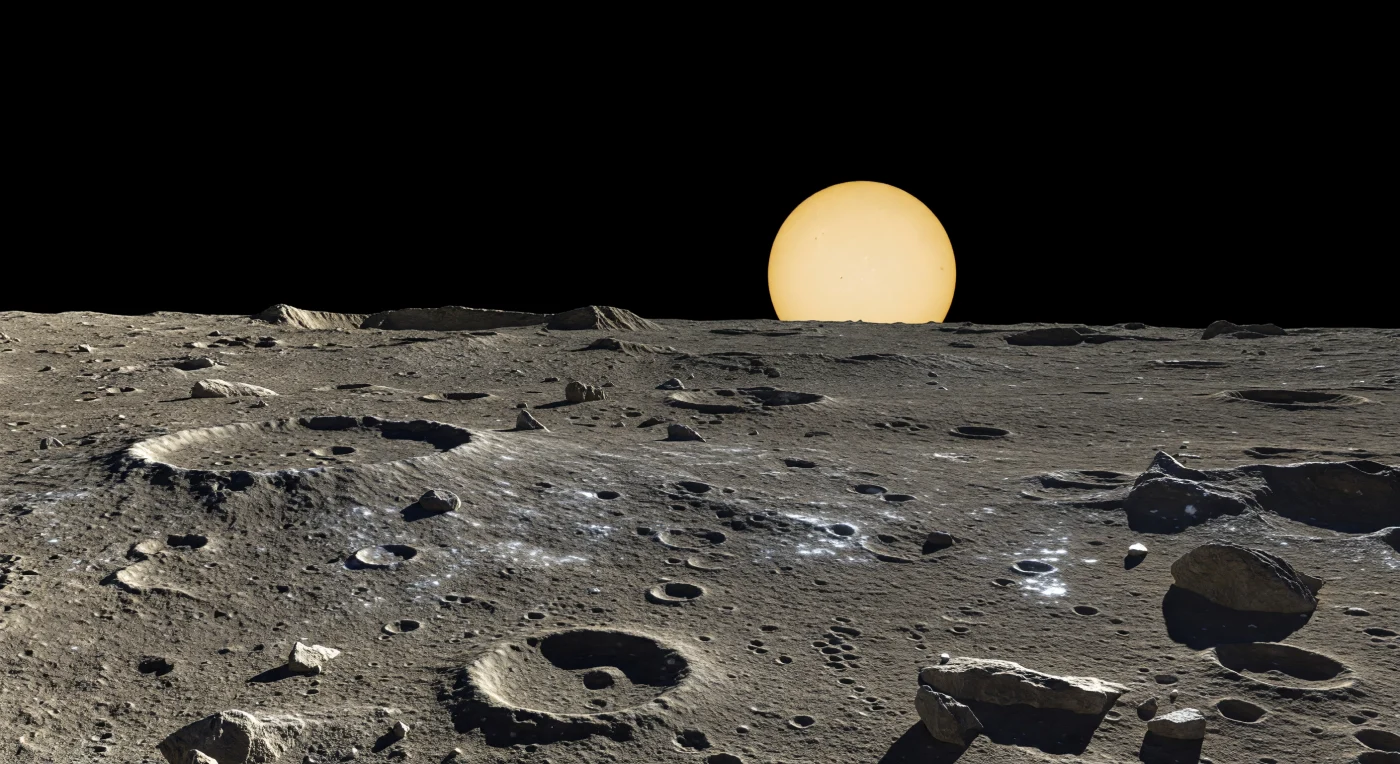
At your feet lies a battered plain of gray-brown regolith, its fine, heat-hardened dust broken by angular boulders, overlapping impact craters, and bright streaks of fresh ejecta, while distant lobate scarps rise like immense frozen waves from a world that has slowly contracted as its oversized iron core cooled. Above this ancient volcanic and impact-shaped landscape, the Sun looms unnaturally large in a perfectly black sky, flattened slightly at the horizon and seeming to hesitate there—an eerie effect caused by the 3:2 spin-orbit resonance that can make sunset briefly reverse before the disk finally drops from view a second time. With almost no atmosphere to scatter light, the horizon glows only faintly pale orange while shadows remain razor-sharp and nearly absolute black, dividing blistering ground hot enough to melt lead from nearby terrain already plunging toward deep cryogenic cold. The result is a scene of uncanny stillness and enormous scale, where space begins at the horizon and even the motion of the Sun feels slowed to a near standstill.

You stand on a vast expanse of ancient inter-crater plains, where low, muted hills and shallow depressions are draped in fine grey-brown regolith ground to powder by billions of years of impacts. Craters crowd every view: some are crisp and deep, with steep walls and central peaks excavated from the crust, while older ones have softened into broad rings and gentle rises, recording an immense span of surface history in a single landscape. Cutting across the middle distance, a lobate scarp rises like a frozen wave of rock—a thrust fault formed as the planet’s interior cooled and contracted—its shadow falling with knife-edge sharpness in the airless, unsoftened sunlight. Under a perfectly black sky and the fierce glare of the oversized Sun, the terrain feels at once monotonous and endlessly intricate, a silent world where extreme temperatures, vacuum, and relentless bombardment have preserved an ancient face almost unchanged for eons.

At your feet, jagged grey-brown boulders lie scattered across a blanket of fine regolith, each rock outlined with astonishing precision as brilliant sunlight carves razor-sharp edges and drops their far sides into absolute black shadow. In this airless environment, there is no wind, no water, and essentially no atmosphere to soften or erode the terrain, so impact-shattered stones remain angular and fresh while dust-sized mineral grains accumulate as a uniform, powdery layer between them. The surface materials are dark and relatively low in reflectance, consistent with ancient, carbon-rich crustal debris pulverized by billions of years of meteoroid impacts, and beyond the boulder field the cratered plains roll away to a stark horizon under a sky black as space itself. Standing here would feel like occupying a frozen moment of geologic violence and silence, where the nearby Sun blazes with unnatural intensity and every rock, shadow, and grain appears etched into the vacuum with unforgiving clarity.
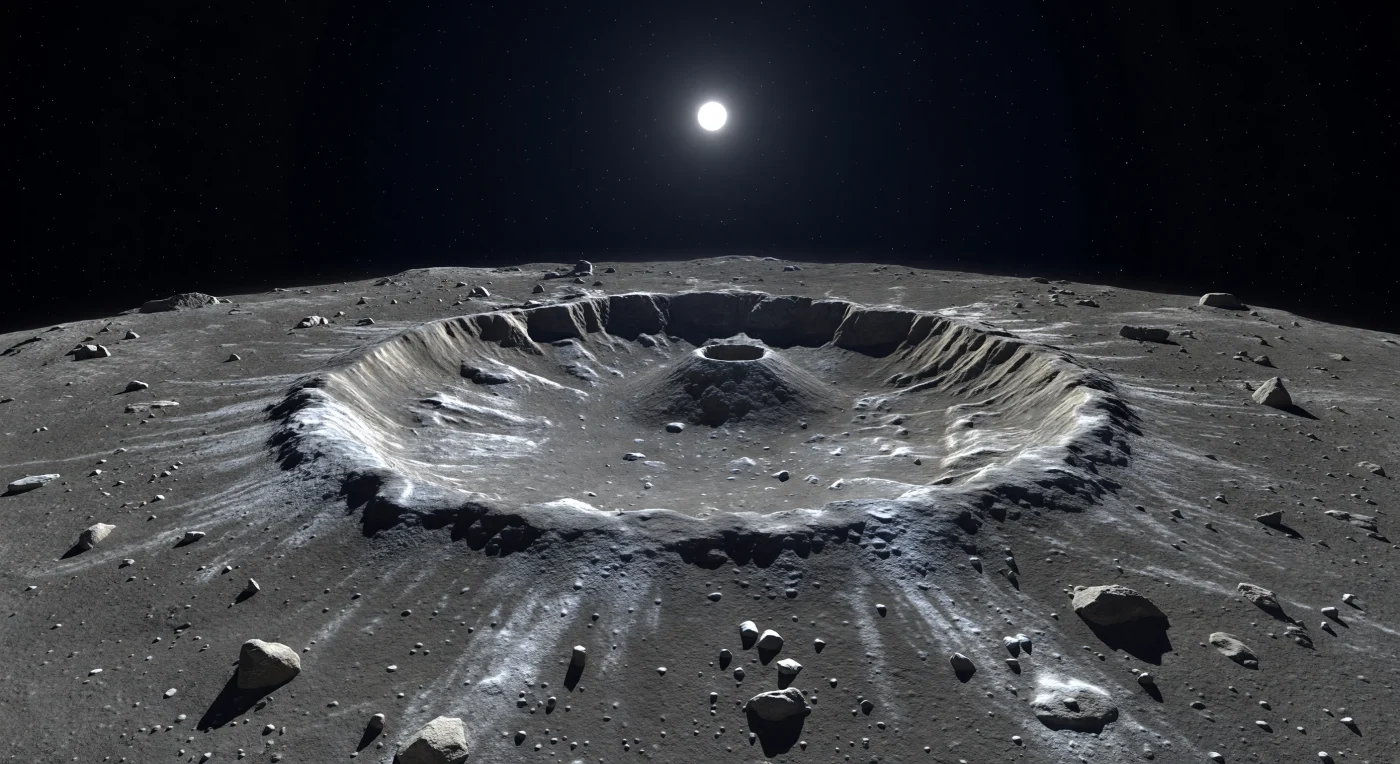
From this low vantage on the ancient plains, a sharp-rimmed crater towers ahead, its bright ejecta blanket splashed across the darker ground in striking radial streaks like a frozen explosion. Fresh, grey-white silicate debris and angular boulders lie scattered over the finer regolith, while the crater’s terraced inner walls expose stacked layers of crust with subtle brightness differences that hint at changes in composition below the surface; at the center, a steep peak rises where the impact briefly rebounded the crust like a struck bell. The stark contrast between brilliant fresh material and the older, space-weathered terrain records how micrometeoroid bombardment and solar-wind exposure gradually darken Mercury’s surface over time, even in the absence of air, water, or erosion. Above it all hangs a perfectly black sky and a hard, unsoftened Sun, so that every shadow is razor-edged and every kilometer of shattered rock feels immense, silent, and utterly alien.
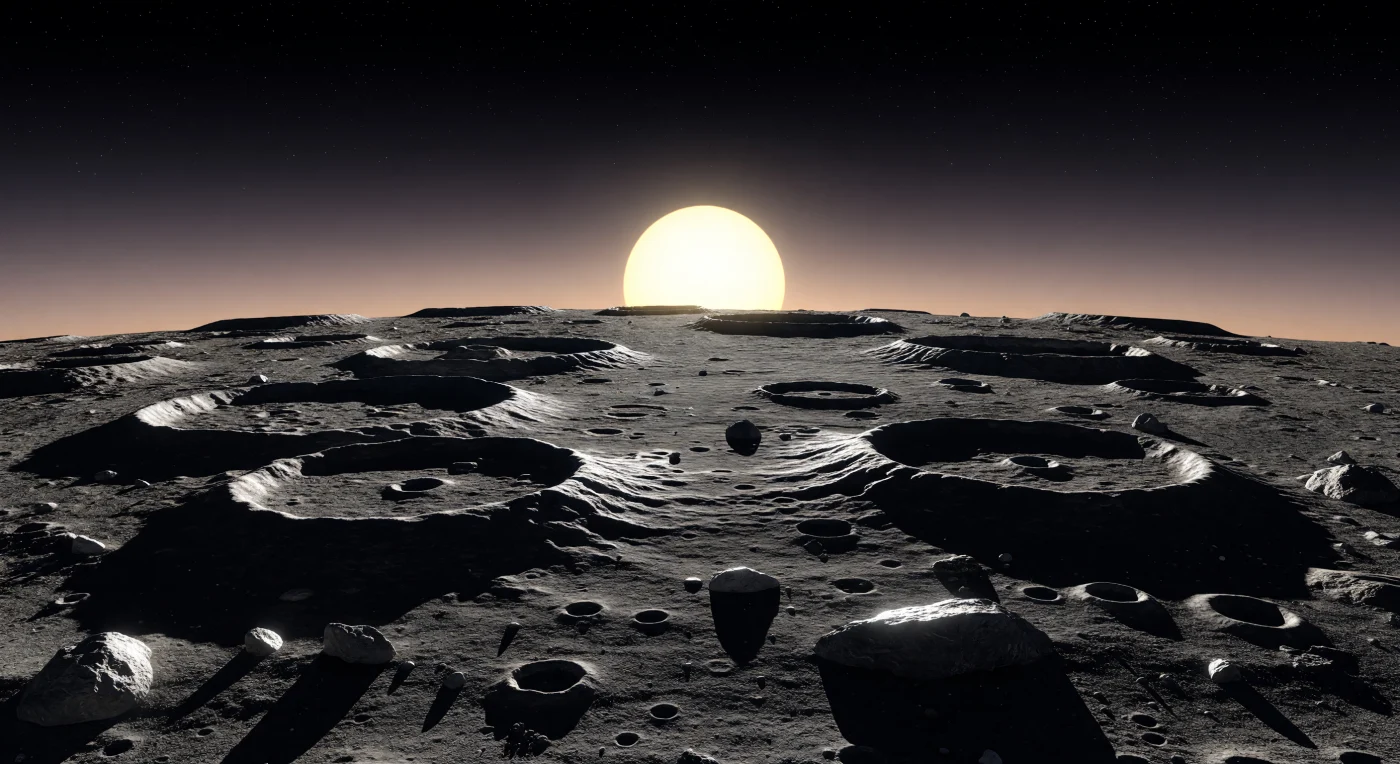
An immense white-yellow Sun hangs half-risen above a battered plain of ancient impact craters, its disk appearing vastly oversized on the horizon while the ground around you alternates between brilliant silver-gray and absolute black. In the near vacuum, there is no blue sky to soften the light: a faint pale orange glow clings to the eastern horizon, likely shaped by scattering in the planet’s tenuous exosphere, but only a short distance overhead the sky turns star-filled black. Every rim, boulder, ejecta blanket, and terraced crater wall throws a razor-sharp shadow across the regolith and exposed bedrock, revealing a surface sculpted by billions of years of impacts and preserved by the absence of weather and liquid erosion. The sunrise feels almost suspended in time, because the planet’s slow rotation makes the Sun’s climb barely perceptible over many hours, leaving you in an eerie stillness beneath a sky where daylight and space coexist.
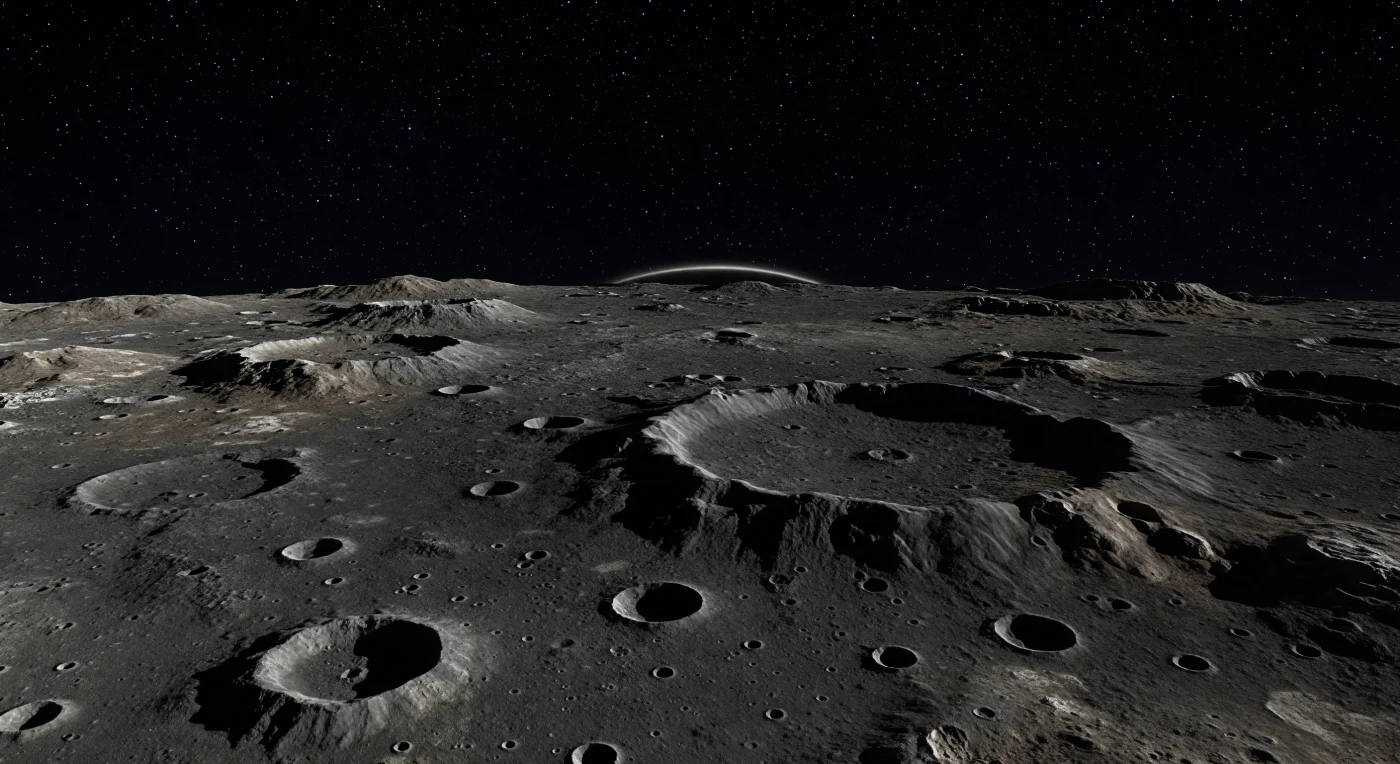
Under a perfectly black, airless sky, the ground stretches away as a desolate field of craters, shattered bedrock, and dusty regolith in muted charcoal, brown, and ash-grey, with only starlight teasing out the rims of ancient impacts and the broken edges of boulders. In this vacuum, there is no haze, no glow, and no twinkling—stars burn with hard, steady brilliance while wrinkle ridges and towering lobate scarps, raised as the planet’s interior cooled and contracted, cut across the darkness like frozen tectonic waves. The surface is brutally old and barely softened by erosion, preserving sharp crater walls, ejecta blankets, and subtle patches of darker low-reflectance material beside lighter plains, all revealed only as faint tonal contrasts and knife-edged black shadows. On the far horizon, a razor-thin crescent of sunlight marks the distant subsolar region still weeks away, a reminder of the world’s sluggish day-night cycle and of the staggering temperature extremes that grip this silent, star-lit wasteland.

From the rim of this young impact crater, the landscape fans outward in immense pale-gray and faintly bluish rays, fresh ejecta blasted across a darker, older regolith in spoke-like bands that run unbroken to the horizon. Beneath a pure black sky, the crater itself drops away as a sharp circular abyss ringed by steep terraced walls, angular slump blocks, shattered bedrock, and fields of coarse boulders, all carved with unusual crispness by an airless world where neither wind nor water softens the scars. The bright ray deposits are excavated subsurface material, still relatively unweathered compared with the surrounding gray-brown surface darkened by constant micrometeorite bombardment and solar exposure, while chains of secondary craters and block-strewn ejecta record the violence of the original impact. In the fierce, oversized sunlight, every rock throws a razor-edged shadow, and the stark contrast between brilliant fresh debris and ancient battered plains makes the scene feel both geometrically precise and overwhelmingly vast.
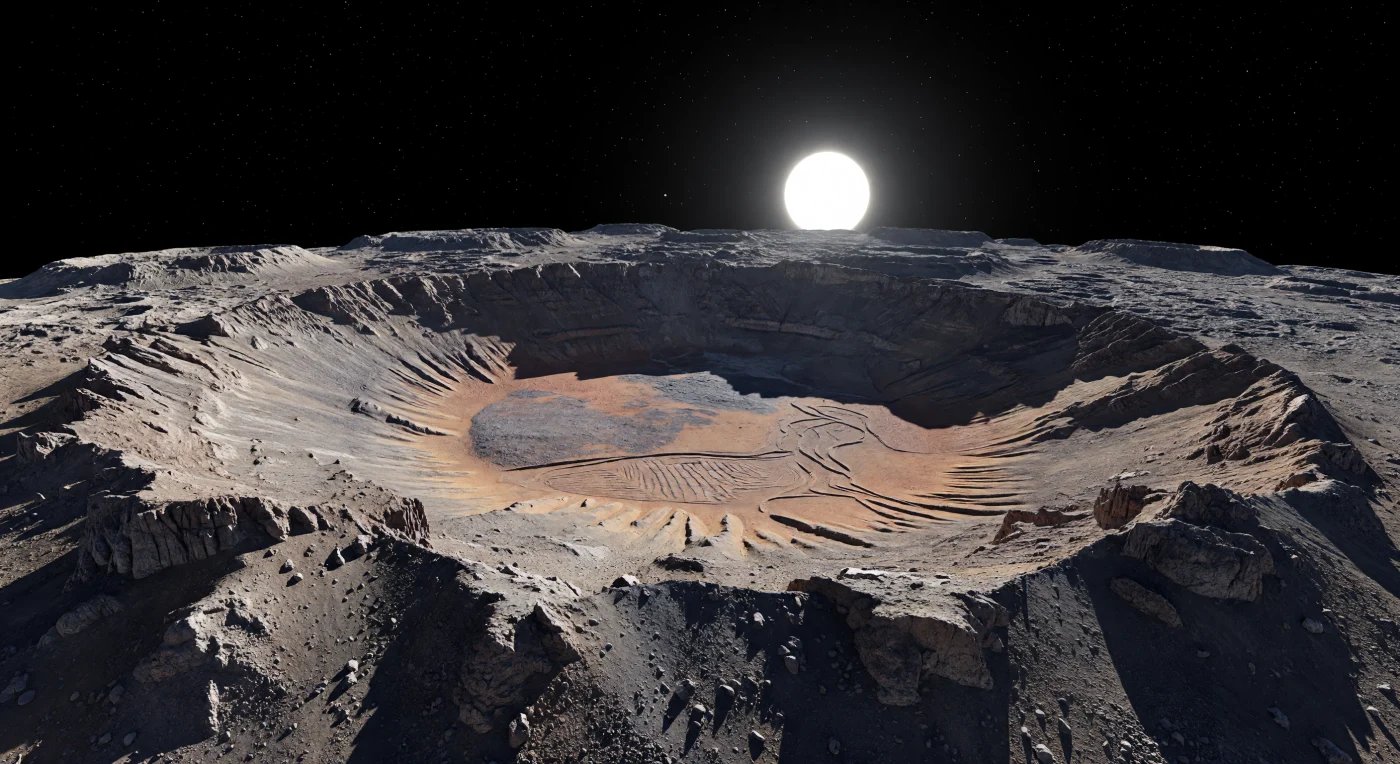
From the shattered crest of the basin’s peak ring, you look across a vast impact-sculpted amphitheater where jagged gray-brown mountains of uplifted silicate crust plunge into a broad floor of unusually smooth, subtly reddish volcanic plains. The ridge underfoot is a chaos of layered bedrock, angular breccia, and talus, while beyond it the basin interior is scored by concentric graben and low wrinkle ridges—tectonic troughs and compressional folds that record both volcanic flooding and the stresses of a cooling, contracting world. With essentially no atmosphere to soften the view, every cliff, boulder field, and distant crater rim appears in razor-sharp clarity beneath a black sky, as a huge white Sun hangs low and throws brutal, knife-edged shadows across the terrain. In this frozen silence of rock and dust, the scale is staggering: a colossal scar of ancient impact, later reshaped by volcanism and planetary tectonics, stretching outward with no haze, no wind, and no sign of life.
