Scientific confidence: High

From this ground-level vantage, the summit region spreads out as a vast, gently descending plain of dark basalt, its ancient lava flows frozen into low ridges and broad sheets that fade quickly into a dense yellow-gray murk. The volcano’s shield profile is revealed not by dramatic cliffs but by subtle relief—effusive eruptions built this landscape layer by layer, leaving overlapping basaltic flows whose weathered surfaces show faint reddish oxidation and cooling fractures in the rock. Above, the crushing carbon-dioxide atmosphere and sulfuric-acid cloud haze scatter sunlight so completely that the sky becomes a uniform, oppressive glow, erasing shadows and shrinking the visible world to only a few kilometers. Standing here would feel like being inside a furnace-sized caldera rim, where immense volcanic scale is sensed more than seen through the heat shimmer and the endless, muted sweep of volcanic stone.

Before you rises a colossal corona, its broad central dome swelling gently from the plains while rings of concentric fractures and radial grabens carve the dark basaltic crust into precise, web-like patterns that extend to a hazy horizon. The rock under this dense, yellow-gray light is mostly ancient volcanic basalt, stained by long exposure to a hot carbon-dioxide atmosphere and sulfur-bearing chemistry that leaves subtle reddish, yellowish, and sulfate-rich coatings on broken surfaces and dust-filled troughs. These immense circular structures are thought to form where hot mantle material pushed the crust upward, then fractured and partly collapsed it into annular depressions, creating a landscape that records both uplift and subsidence on a scale of hundreds of kilometers. Beneath the opaque cloud deck, with no Sun or sky objects visible and only diffuse illumination filtering through the atmosphere, the scene feels unnervingly still and immense—as if you are standing inside the scar of a planet’s buried internal heat.

Before you rises a colossal flat-topped lava dome, its pale, radar-bright cliffs encircling a summit nearly thirty kilometers wide and split by a web of radial and concentric fractures that spread outward like stress lines in cooling glass. The dark, cracked central floor has sagged into a broad subsidence bowl, exposing fresher basalt beneath a chemically altered outer crust and recording the slow collapse of extremely viscous lava after eruption. Around it, the basaltic plain lies broken into angular slabs and ancient flow textures, preserved in a world where dense carbon dioxide air and sulfur-rich chemistry weather rock more than wind ever does. Everything is bathed in a dim yellow-gray glow diffused through the thick atmosphere, with no sharp shadows and no relief from the featureless sky, making the immense dome feel at once flattened, suffocating, and impossibly vast.
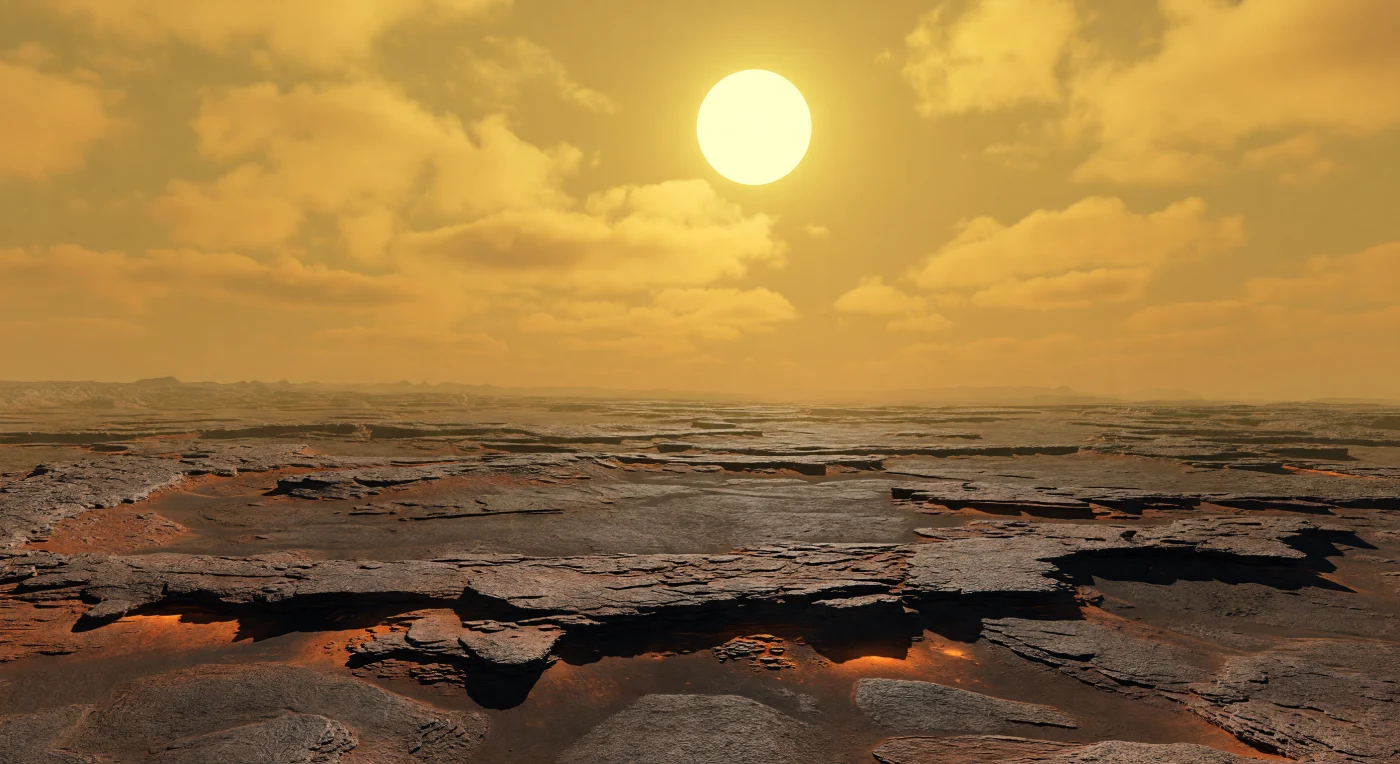
Across the plain, dark basaltic lava flows stretch in broad, nearly featureless sheets, broken only by long, low wrinkle ridges—subtle folds in the crust formed when volcanic plains were later squeezed and compressed, raising swells roughly 100 meters high and many kilometers wide. The rock underfoot appears fractured and weathered, its charcoal surface stained with rusty iron-oxide coatings produced by relentless chemical alteration in an atmosphere hot enough to soften the boundary between stone and heat. Above, a dense yellow-orange haze of sulfuric-acid aerosols and cloud-filtered light smothers the horizon, limiting visibility to only a few kilometers and causing the ridges to dissolve into a dim, glowing murk. Standing here would feel like being on the floor of a pressurized furnace: the ground rolling away in vast, silent undulations, every shadow softened by the thick air, every surface shaped by volcanism, compression, and an atmosphere crushing enough to rival the pressure deep beneath Earth’s oceans.

At the edge of this immense rift, the ground falls away into a straight-sided graben several kilometers wide, where near-vertical fault scarps rise 600 to 900 meters and expose dark, layered basaltic crust like the pages of a planetary history book. Those horizontal bands record repeated lava emplacement and tectonic stretching, while fractured faces, slump scars, iron-oxide stains, and pale sulfate coatings testify to rock altered under searing temperatures near 460°C and a crushing atmosphere about 92 times denser than Earth’s at sea level. The dense air and high haze scatter sunlight into a flat yellowish-gray glow, softening every shadow and swallowing the distance so completely that the far end of the rift dissolves within a few kilometers. Standing here would feel like looking into a wound torn open by crustal extension—vast, silent, and oppressive, with dust and volcanic particles drifting low across a floor shaped more by volcanism, faulting, and chemical weathering than by wind or water.

A broad tick-dome volcano rises out of the basaltic plains like a flattened mountain of tan-gray rock, its gently concave summit feeding a remarkable pattern of long, blade-like ridge spurs that radiate outward for many kilometers from the central uplift. Along its scalloped flanks, fractured lava and landslide scarps record the slow emplacement and collapse of unusually viscous volcanic material, shaped under an atmosphere so dense that the surface pressure is about 93 times that of Earth and the heat hovers near 465°C. The light is eerie and nearly shadowless—about as bright as an overcast day on Earth, yet filtered through carbon dioxide and sulfur-rich haze into a muted yellow glow that erases the horizon only a short distance away. Standing here, you would feel enclosed within a vast furnace, where even a 1-kilometer-high volcano seems half swallowed by the thick air and every ridge fades into a wall of luminous murk.

From this high plateau, the ground stretches away in fractured sheets of basalt, its ridges and narrow troughs warped by immense tectonic compression and littered with sharp, angular debris. The highest exposures gleam with an uncanny silvery brightness: at these elevations, where temperatures drop to about 380°C and pressure falls to roughly 45 bar, metal-bearing compounds such as lead and bismuth sulfides can condense onto the rocks, creating the radar-bright coating long seen from orbit. Overhead, a pale gray-yellow sky filters the sunlight into a muted glow, with slightly clearer air than the lowlands allowing nearby shadows to stand out before distant ridges fade into orange-gray haze. Even here, in one of the cooler and less oppressive places on the surface, the landscape feels immense, airless in spirit, and utterly alien—an elevated desert forged by heat, pressure, and exotic chemistry rather than wind or water.

From ground level, the landscape unfolds as a vast quilt of overlapping basaltic lava plains, where older, smoother ropy flows are overtaken by younger, darker a'a lobes with steep blocky fronts and sinuous channels cut between raised levees tens of meters high. Subtle ridges mark one eruption episode against the next, but the thick yellow-gray atmosphere scatters the light so completely that shadows vanish, flattening the terrain and making distance and relief strangely hard to judge even as the lava fields stretch for kilometers into murky obscurity. Fine chemical weathering from the hot, sulfur-bearing air dusts the basalt with a grainy altered coating, while the most heat-soaked darker surfaces seem to whisper a faint reddish glow in the furnace-like 460°C conditions. Standing here would feel like being surrounded by the frozen anatomy of immense volcanic floods—geologically familiar in their basaltic forms, yet rendered profoundly alien by the crushing atmosphere, toxic haze, and the oppressive stillness of a world where no water, wind, or life softens the stone.

From this high plateau, the ground looks dusted with a strange metallic frost: a silvery-gray, crusty coating that gleams softly under the dim light diffused through the dense yellow haze. A sharp boundary slices across the landscape where the bright highland veneer gives way to darker basaltic rock below, marking the elevation where cooler conditions allow certain mineral compounds—possibly metal-rich sulfides, chlorides, or oxides detected as radar-bright terrain—to condense and remain stable. The airless clarity of a desert is absent here; instead, the horizon and distant peaks fade into a thick gray-gold atmosphere of carbon dioxide and sulfuric haze, muting shadows and making the immense plateau feel both close and unreachable. Standing here, you would be surrounded by a world of crushing pressure and furnace heat, yet one whose chemistry paints the mountaintops with a ghostly, almost snowy sheen.

At the base of a towering, weathered scarp, the ground rises into a 40-to-60-meter wall of exposed crust, where pale gray volcanic layers alternate with darker basaltic bands in a ribbed, terraced pattern carved by faulting and slow erosion. Loose talus spills from the steep face onto broad, dark plains of ancient lava, their dimpled surfaces dotted with scattered blocks and thin patches of lighter sediment. The exposed strata preserve a geologic record of repeated volcanic emplacement, tectonic deformation, and chemical weathering under surface temperatures hot enough to soften lead and pressures strong enough to crush unprotected machinery. All of it is seen through a dense carbon-dioxide atmosphere veiled with sulfuric-acid aerosols, which filters the light into a muted golden glow and smothers the horizon in haze, making the landscape feel both immense and claustrophobic—as if the world ends only a few kilometers away.

At ground level, the plain is broken into an immense tessellation of dark basalt blocks, where intersecting faults and cooling cracks carve the surface into polygons that stretch kilometer after kilometer beneath a featureless yellow-gray glow. Some fractures are mere etched seams in ancient lava, while others open into graben-like chasms hundreds of meters deep, exposing layered volcanic rock whose oxidized surfaces tint the charcoal terrain with rusty orange. This is a landscape shaped by both the cooling and contraction of vast lava flows and by tectonic stresses that pulled and compressed the crust, deforming smooth pāhoehoe plains and rougher ʻaʻā fields into a fractured mosaic. The dense, opaque atmosphere scatters the weak sunlight so thoroughly that even deep breaks in the ground hold little shadow, giving the scene an uncanny flatness—as if you were standing on the floor of a colossal, overheated world where the horizon dissolves into haze and the rock itself seems to have been slowly torn apart.

A broad volcanic plain stretches away in every direction, its surface paved with interlocking slabs of fractured basalt and low wrinkle ridges that hint at immense lava flows long since cooled under a crushing atmosphere. In the warm amber light—bright as an overcast day on Earth yet completely diffuse—the rocks lose their natural dark tones and glow orange-brown beneath a dense veil of carbon dioxide and sulfuric acid clouds, with almost no shadows to sharpen the scene. Far off, a single mountain rises as a dark, softened silhouette through the yellow-gray haze, its details erased by the extraordinary thickness of the air and the limited visibility near the ground. Standing here would feel like being at the bottom of a vast, overheated ocean of gas: still, heavy, and eerily monochrome, on a landscape shaped by volcanism and relentless chemical weathering.

At the crater’s edge, the ground drops into a fresh three-kilometer-wide impact basin whose walls descend in broad, stair-stepped terraces, each bench exposing dense basaltic rock and darker sheets of impact melt in charcoal, slate, and brown-gray tones. Angular ejecta blocks, shattered slabs, and powdery regolith litter the rim and foreground, while the crater floor is strewn with breccia and subtle lobes of glassy melt formed when the impact briefly liquefied the crust. Everything is seen through a thick yellow-gray veil: the massive carbon-dioxide atmosphere and sulfuric-acid haze scatter the light so completely that there is no visible Sun, no blue sky, and almost no shadows, only a dim, directionless glow that softens the far rim into obscurity within a few kilometers. Standing here would feel like peering across a wound in a volcanic basalt plain under a hot, crushing sky, where immense pressure, searing temperatures, and murky air turn even a geologically young crater into an eerily muted, otherworldly monument.

You stand on a vast basaltic plain where several enormous shield volcanoes swell out of the haze, their broad, low flanks overlapping into a single clustered massif punctuated by wide summit calderas and broken collapse rims. The ground is a harsh mosaic of fractured slabs, angular ejecta, and heat-altered lava—smooth, ropy surfaces grading into rougher clinker-like flows—recording repeated eruptions of fluid basalt under conditions hot enough to soften rock and pressure high enough to crush any familiar sense of open air. Through the dense carbon dioxide atmosphere, the yellow-gray light is so thoroughly scattered by the planet’s global cloud cover that shadows nearly vanish, leaving the volcanoes looming as dark, immense forms against a featureless ochre sky. With no water, no life, and no clear horizon, the scene feels oppressive and colossal, a volcanic world preserved beneath a furnace-hot haze where even mountains seem to rise in silence.

At ground level, the landscape is a tangled stone labyrinth: dark gray, shattered bedrock rises in low, intersecting ridges and drops into narrow grooves, forming the polygonal, grid-like fabric of ancient tessera terrain. These intensely deformed rocks—broken, folded, and faulted by powerful crustal stresses—appear radar-bright because their rough surfaces and possibly metal-rich or unusual mineral coatings strongly reflect radar, the tool that first revealed this terrain through the planet’s opaque clouds. Fine ochre dust gathers in cracks between angular boulders, while the ridge network fades into a dense yellow-butterscotch haze that erases any sharp horizon and softens the world into immense scale. Above, a dull gray-beige sky glows with weak, diffuse light filtered through the crushing atmosphere, leaving only blurred shadows and a furnace-like stillness that makes the ancient plateau feel both geologically tortured and utterly alien.
