Scientific confidence: High

You stand beside a sharp, bowl-shaped young crater where the surface has been freshly blasted open, scattering angular blocks of crystalline water ice across a bright ejecta apron in dazzling blue-white contrast against the older cream-gray, contaminant-darkened regolith. Radial streaks from the impact slash outward over a landscape already crowded with ancient craters, while the tiny moon’s weak gravity preserves steep rims, brittle rubble, and crisp scarps that would slump away on a larger world. Under a hard, distant Sun in an airless sky, every clean ice face flashes with cold brilliance and every hollow falls into absolute black, revealing a surface made almost entirely of frozen water, pulverized by eons of impacts and untouched by wind, liquid, or haze. The low curved horizon and vast silence make the fresh crater feel both intimate and immense—a pristine wound in an ancient shell of ice suspended in vacuum.

From the shattered summit of the central peak, you stand amid a chaos of angular water-ice bedrock, broken slabs, and brecciated rubble lightly dusted with pale regolith, all rendered in cold whites and bluish grays under stark, airless sunlight. The immense crater around you rises as a complete ring of mountainous walls, its terraced inner slopes and fractured scarps towering across the horizon like icy ramparts, while the basin floor far below is strewn with slump deposits, ejecta blocks, and smaller impact scars. With gravity only a tiny fraction of Earth’s and no atmosphere to soften the view, every ridge remains razor-sharp, shadows fall almost perfectly black, and clean ice facets flash with brilliant reflections. Above the jagged skyline hangs Saturn, huge and softly banded, its angled rings glowing with reflected sunlight against a star-filled black sky, making the summit feel both precariously small and suspended inside one of the Solar System’s grandest impact landscapes.

At local sunrise on Herschel’s inner wall, you would be standing among jagged water-ice blocks and frost-bright talus, looking across an immense amphitheater of giant stepped terraces descending toward the crater floor, each bench striped by razor-sharp shadows from the low Sun. Fresh slump scarps expose clean bluish-white crystalline ice beneath older, grayer regolith and thin debris aprons darkened by dust and contaminants mixed into the surface, a record of impact excavation and downslope collapse on an airless, ice-rich world. With gravity so weak, fractured slabs, narrow ledges, secondary craters, and long boulder trails remain stark and precarious, while the basin’s colossal concentric walls and distant central peak make clear that this crater is enormous compared with the tiny body it nearly dominates. Above the rim, Saturn hangs huge in a perfectly black sky where there is no haze, no twilight, and no softening of light at all—only cold white-gold illumination, deep black shadow, and faint stars still visible in the vacuum.

From this shattered crest, the ground is a mosaic of bright gray-white water ice—crystalline bedrock split into angular slabs, strewn with frost-dusted boulders and a skin of loose, granular regolith darkened here and there by trapped micrometeoritic dust. Just beyond your feet, the rim collapses abruptly into an immense 130-kilometer-wide impact basin, its inner walls carved into terraces, slump blocks, sharp scarps, and rubble aprons that record the violent excavation and slow collapse of ancient ice under extremely weak gravity. Across the abyss, a solitary central peak rises 5 to 6 kilometers high, startlingly distant yet sharply defined in the airless vacuum, while the small world’s curved horizon and crater-saturated plains emphasize how tiny and battered this frozen moon is. Overhead, a perfectly black sky holds a few faint stars and the enormous disk of pale yellow Saturn with its razor-thin rings hanging fixed above the horizon, as hard, cold sunlight throws pitch-black shadows and brilliant glints from clean ice, making the whole scene feel silent, stark, and impossibly vast.

At this polar crater field, the ground is a labyrinth of overlapping impact rims, shallow frost-bright hollows, and hummocky ejecta, all carved into ancient water-ice regolith and lit by a tiny Sun grazing the horizon. In the airless vacuum, light falls with brutal clarity: broken rim crests flash with crystalline highlights while steel-blue-black shadows pour unsoftened across the surface, stretching from half-buried ice boulders and jagged ridgelets into crater interiors that vanish into darkness. The moon’s extremely weak gravity helps preserve this crisp small-scale relief, so even nearby blocks and slump faces look steep and sharp against a stark black sky where faint stars can persist in the glare-free distance. Successive crater rims fading toward the open horizon reveal a world saturated by impacts, coated mostly in bright water ice with just traces of darker contaminant dust, and—if local geometry allows—a pale, banded giant hangs low beyond the frozen landscape like a silent horizon of its own.
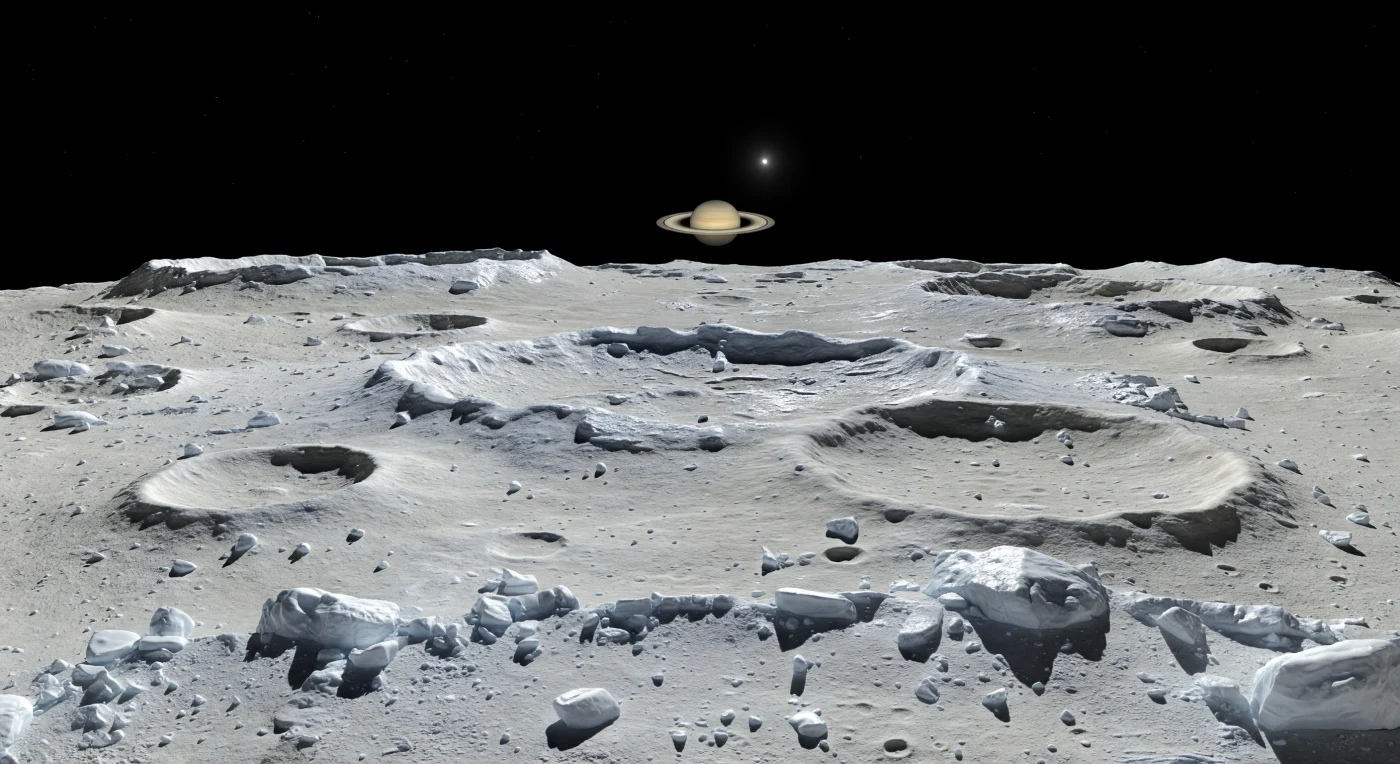
Across the equatorial highlands, the surface stretches away as a tightly packed maze of ancient crater bowls, low hummocks, and softened basin rims carved into water-ice bedrock and blanketed by impact-brecciated icy regolith in shades of white, gray, and faint bluish cream. Billions of years of bombardment have churned and shattered this frozen crust, rounding once-sharp ejecta ridges into subdued swells while frost-cemented blocks and scattered ice boulders lie frozen in stark, black-shadowed relief. In the airless stillness, there is no haze to soften distance: every fractured outcrop remains razor crisp beneath a small, fierce Sun, and the horizon curves away only a few kilometers off, revealing the tiny scale of this compact world. If Saturn hangs above, it would loom enormous over the desolate scene, but even without it the landscape feels profoundly alien—an ancient, frozen battlefield of impacts preserved in near-perfect silence.

Across this ancient, airless plain, fine ivory-gray regolith and scattered angular blocks of water ice lie frozen under a hard white Sun, their shadows falling perfectly black across shallow craters and low ejecta hummocks. The ground is built almost entirely by impacts—compacted ice dust mixed with darker contaminants, fresh bluish-white fractures on newer blocks, and older cream-gray surfaces softened only by time, not weather, because there is no atmosphere, no liquid, and no active geology to reshape the land. Above the low, slightly curved horizon, the same hemisphere forever faces its primary, so a colossal banded disk hangs fixed in the black sky, its rings stretching in a luminous arc with the Cassini Division etched between brighter bands of ice. In this tiny world’s feeble gravity, crater walls rise steep and crisp in the distance, and the faint glow reflected from that giant planet gently lifts the shadows, making the entire scene feel both starkly scientific and impossibly grand.

You are standing on a shattered plain of ancient water ice and impact-churned regolith, where pale gray-white ground with faint cream and bluish tints is broken by low, irregular ridges, narrow troughs, and thin dark fissures that slice through the crust like stress scars. This fractured terrain is thought to record the global shock of the giant impact that carved the moon’s immense opposite-side basin, leaving intersecting rupture belts, subdued hummocks, and collapse furrows instead of any signs of wind, water, or volcanism. In the airless vacuum, low-angle sunlight falls harshly from a distant Sun, throwing long black shadows across angular ice blocks, frost-dusted rubble, and crisp crater rims that remain unusually sharp in the moon’s feeble gravity. Above the curved horizon, Saturn hangs enormous and unmoving in the black sky, its softly banded disk and tilted rings towering over the frozen wasteland and making this small, silent world feel at once intimate underfoot and immense beyond measure.

Under the faint ivory glow reflected from Saturn and its rings, the nightside surface stretches away as a silent field of silver-gray ice: powdery regolith, angular shattered blocks, and low hummocky ejecta ridges surrounding countless sharp-rimmed craters. With no atmosphere to soften the view, every star burns needle-clear above a perfectly black sky, while crater floors and the lee sides of boulders fall into absolute darkness, untouched by any haze, twilight, or airglow. This terrain is built largely of ancient water ice, subtly stained in places by older, darker contaminants, and its crisp preservation reflects both the moon’s extremely low gravity and the near-total absence of erosion, weather, or active resurfacing. The close, low horizon reveals how tiny this world is, yet beneath the enormous presence of Saturn overhead, the broken plains and overlapping scars of impacts feel immense, frozen, and profoundly otherworldly.

Under a perfectly black, airless sky, an ancient plain of water-ice regolith sinks into eclipse as Saturn looms overhead as a vast dark disk, blotting out the Sun while its rings cast only a dim silver band of ringlight across the ground. Around you, the surface is a frozen wilderness of dusty gray-white and faint cream ice, churned by eons of impacts into low hummocks, shallow overlapping craters, sharp little bowls, and scattered angular blocks whose fractured faces flash bluish-white where fresher ice is exposed. In the moon’s feeble gravity and vacuum, crater rims remain unnaturally crisp and shadows fall as deep black voids, with only the faint glow reflected from Saturn tracing the edges of boulders a few meters wide and rims tens of meters high. Farther out, cratered ridges fade toward the tiny world’s curved horizon, and with no atmosphere to soften the view, the stars blaze with startling clarity over a landscape that feels silent, inert, and almost impossibly desolate.
