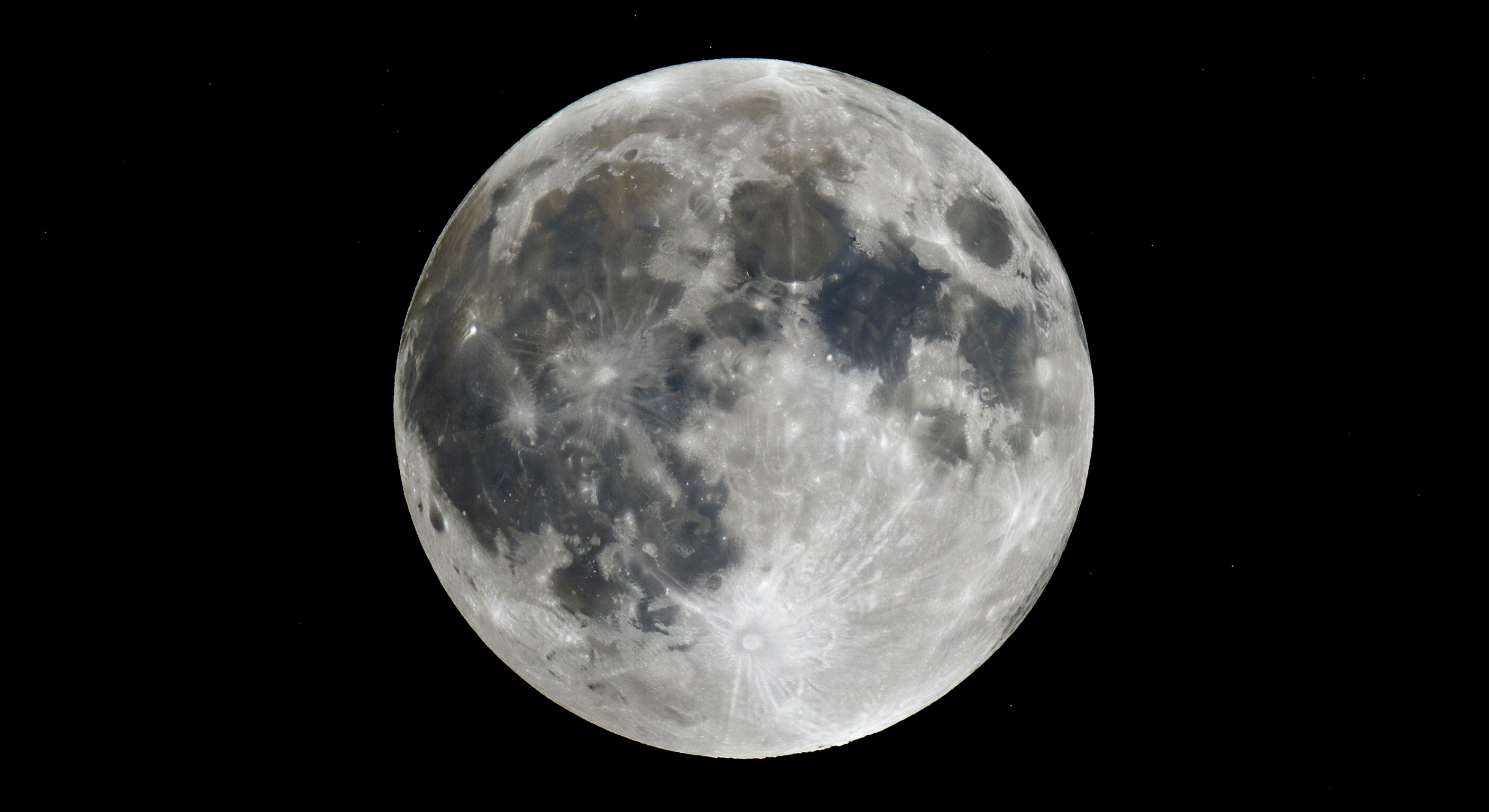
Scientific confidence: Very High
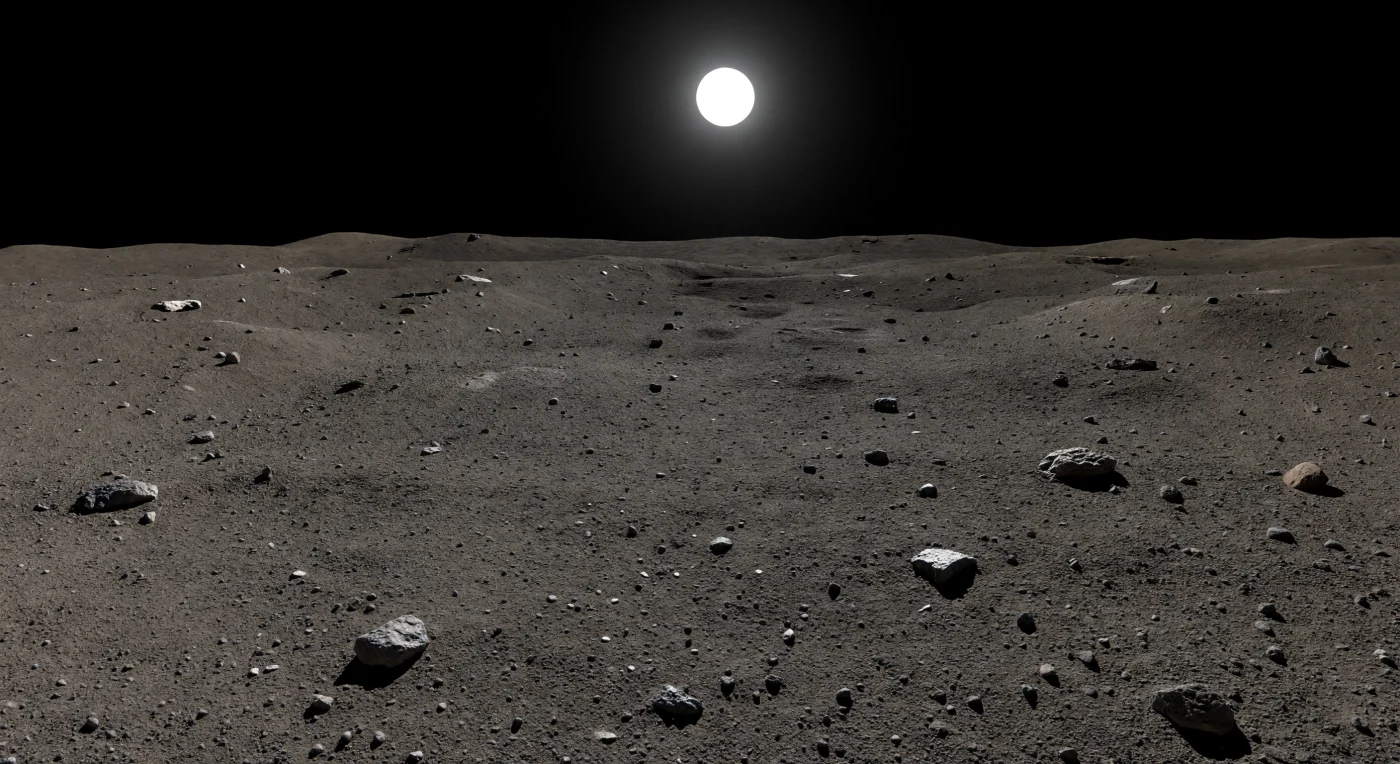
At local noon on the mare, you stand on an immense plain of dark basaltic regolith—powdery ash-gray dust and compacted soil strewn with sharp, vesicular lava fragments, tiny glassy impact clasts, and a few half-buried blocks whose edges remain unworn in the absence of wind or water. The land rolls so gently it seems almost perfectly flat, broken only by subtle wrinkle ridges, miniature secondary craters, and faint ejecta aprons, while the horizon appears strikingly close and crisp, a consequence of the world’s small size and utterly clear vacuum. Overhead, the Sun blazes in a pure black sky, casting only stunted, razor-edged shadows directly beneath rocks and crater rims, with no atmosphere to soften the light or tint the scene. These dark plains are ancient flood basalts—lava seas laid down billions of years ago—now ground by countless impacts into mature regolith, creating a landscape that is both geologically revealing and profoundly stark in its silent, airless scale.
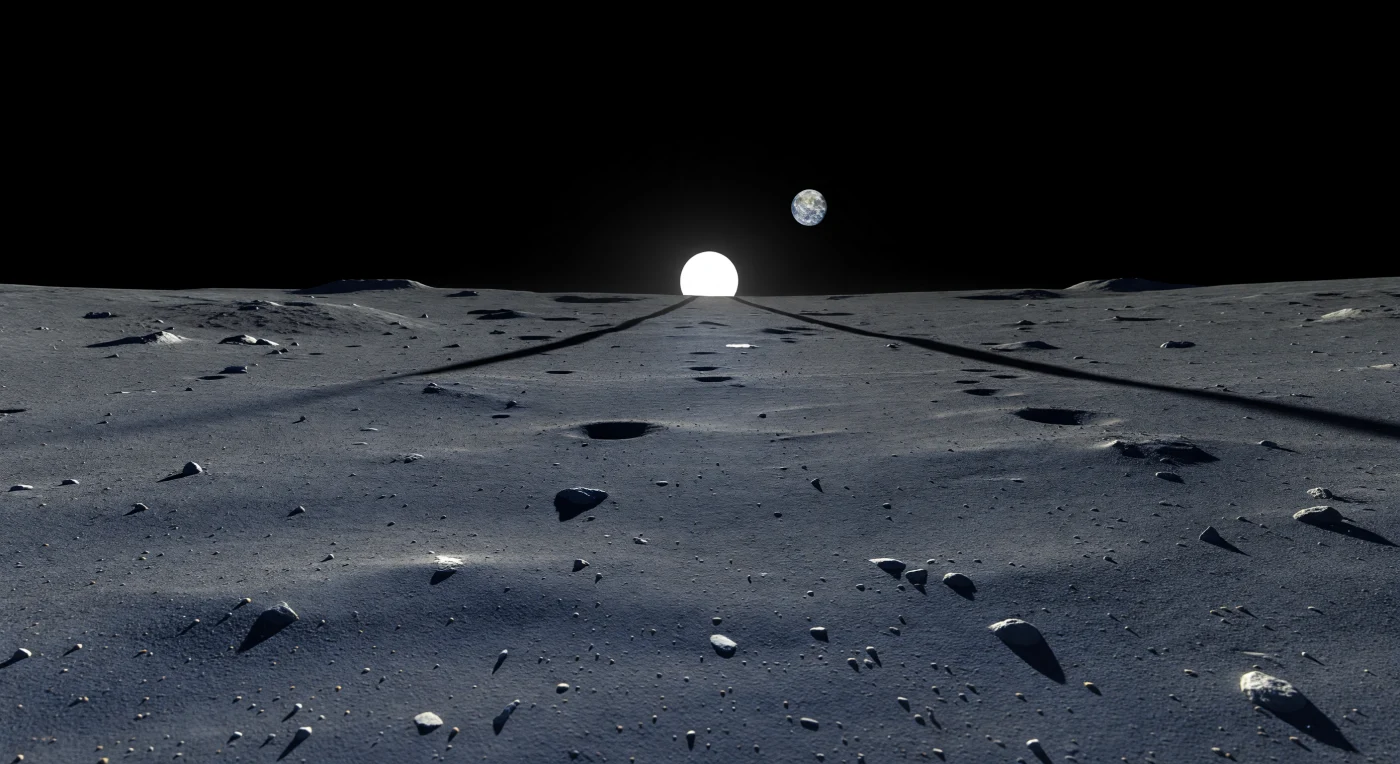
At sunrise on the dark volcanic plain, the low Sun skims the mare and turns every pebble, crater rim, and shard of basalt into a silver-edged form, throwing impossibly long, ink-black shadows across bluish charcoal regolith. This broad, almost level surface was built by ancient lava flows that flooded an immense impact basin, and in the airless stillness its fine dust, glassy grains, sharp micro-craters, and blocky ejecta remain nearly untouched for millions of years, preserved without wind or water to soften them. The horizon is unnervingly crisp beneath a sky of pure black, where a bright Earth hangs low and nearly motionless, while distant low ridges and subdued crater rims reveal the enormous scale of the lava-flooded plain. Standing here, you would feel the stark logic of a vacuum world: harsh unfiltered sunlight, no haze, no sound, and a landscape of cold metallic grays shaped by fire, impacts, and deep time.

You stand on a brilliant anorthositic plateau where pale ash-gray regolith, angular breccia blocks, and shattered feldspar-rich boulders sprawl through a maze of overlapping ancient craters, their softened rims and hummocky ejecta preserving a record of bombardment from the earliest Solar System. Mid-angle sunlight cuts across the landscape with undiffused intensity, throwing razor-sharp charcoal shadows into shallow crater bowls and across rubble-strewn slopes, while the airless vacuum leaves every ridge crest, secondary crater chain, and sparkling glassy fragment etched in impossible clarity all the way to the stacked highland massifs on the horizon. These uplands are composed largely of anorthosite—the buoyant crust formed from an ancient magma ocean—later shattered, mixed, and pulverized by billions of years of impacts into the fine, powdery regolith underfoot. Above it all hangs an absolute black sky, and, if you are on the near-facing hemisphere, a blue-white Earth suspended almost motionless over this silent, frozen wilderness, making the stark scale and antiquity of the highlands feel both intimate and immense.
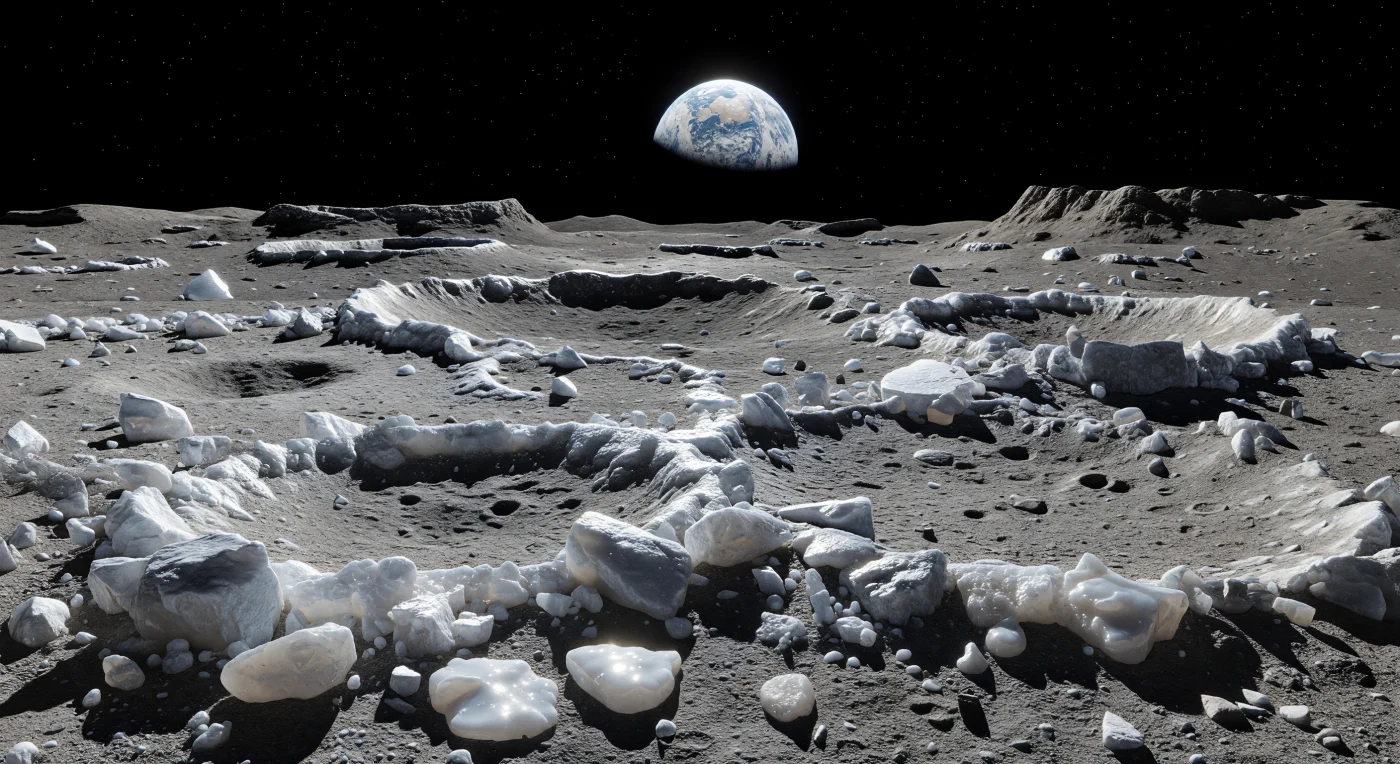
You stand in a violent freeze-frame of impact geology: a chaotic plain where brilliant young ejecta, blasted from a nearby crater, lies in chalky gray-white sheets across older, darker regolith, broken into hummocks, overlapping chains of secondary craters, and splashes of once-molten rock now hardened into glossy lobes. Meter-scale angular boulders and shattered breccia blocks crowd the foreground, their knife-sharp edges preserved by an airless world with no wind, water, or weather to soften them, while distant rims and highland massifs rise with unnerving clarity through the vacuum. Under a pure black sky, the Sun burns as a harsh white disk, casting razor-edged shadows across pulverized anorthositic debris mixed with darker basaltic dust, and a large half-lit Earth hangs almost motionless above the horizon, luminous with white cloud bands over blue oceans and brown continents. The low gravity and complete lack of atmospheric haze make every ridge, craterlet, and block field feel starkly magnified, as if the landscape extends in crisp silence forever.
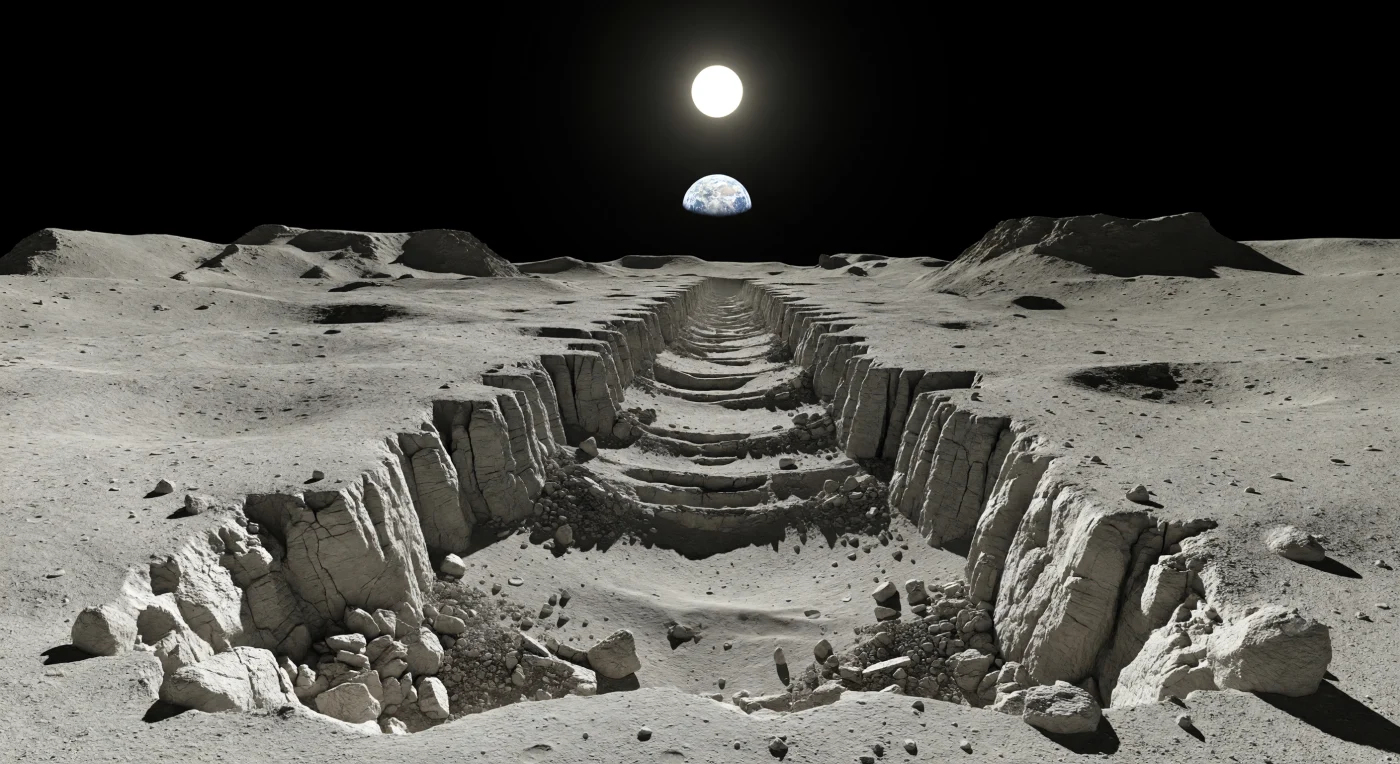
A ruler-straight graben cleaves the barren plain like a tectonic wound, its near-parallel fault scarps dropping into a long, geometric trough where bright fresh bedrock exposures stand out against darker mature dust. At your feet, angular talus blocks and shattered crust have fallen from the cliffs, while fine gray regolith has drifted and pooled across the floor, smoothing the low ground in the absence of air, water, or wind. Under the hard white Sun, every boulder and step-fault bench throws a razor-edged shadow, revealing how normal faulting stretched and pulled apart the crust, leaving anorthositic and basaltic layers exposed in crisp relief. Beyond the fractured foreground, the depression runs for kilometers toward a black sky and distant highlands, its stark linearity and immense scale made even more surreal by the silence, the low gravity, and the complete lack of erosion softening the scene.

At the bend of the great rille, the mare opens into a stark volcanic trench: a sinuous, steep-walled channel cut through dark basaltic regolith, its floor littered with angular blocks, talus, and glass-specked breccia that gleam in the hard sunlight. Low Sun angles throw the inner walls into deep black shadow and pick out layers in the exposed lava flows, revealing that this feature was likely carved by ancient basaltic volcanism—either as a collapsed lava channel or by thermal erosion as molten rock once streamed across the plain. Around you, the powdery surface is charcoal to gray, broken by scattered fragments and tiny craterlets, while the distant Apennine mountain front rises in pale highland rock above the mare, its sharp relief exaggerated by the Moon’s low gravity and the absence of air. Overhead the sky is perfectly black, with no haze or softening of distance, and Earth hangs nearly motionless above the horizon—larger than the Sun, blue-white and alive-looking—making the silence, scale, and desolation of this landscape feel even more profound.
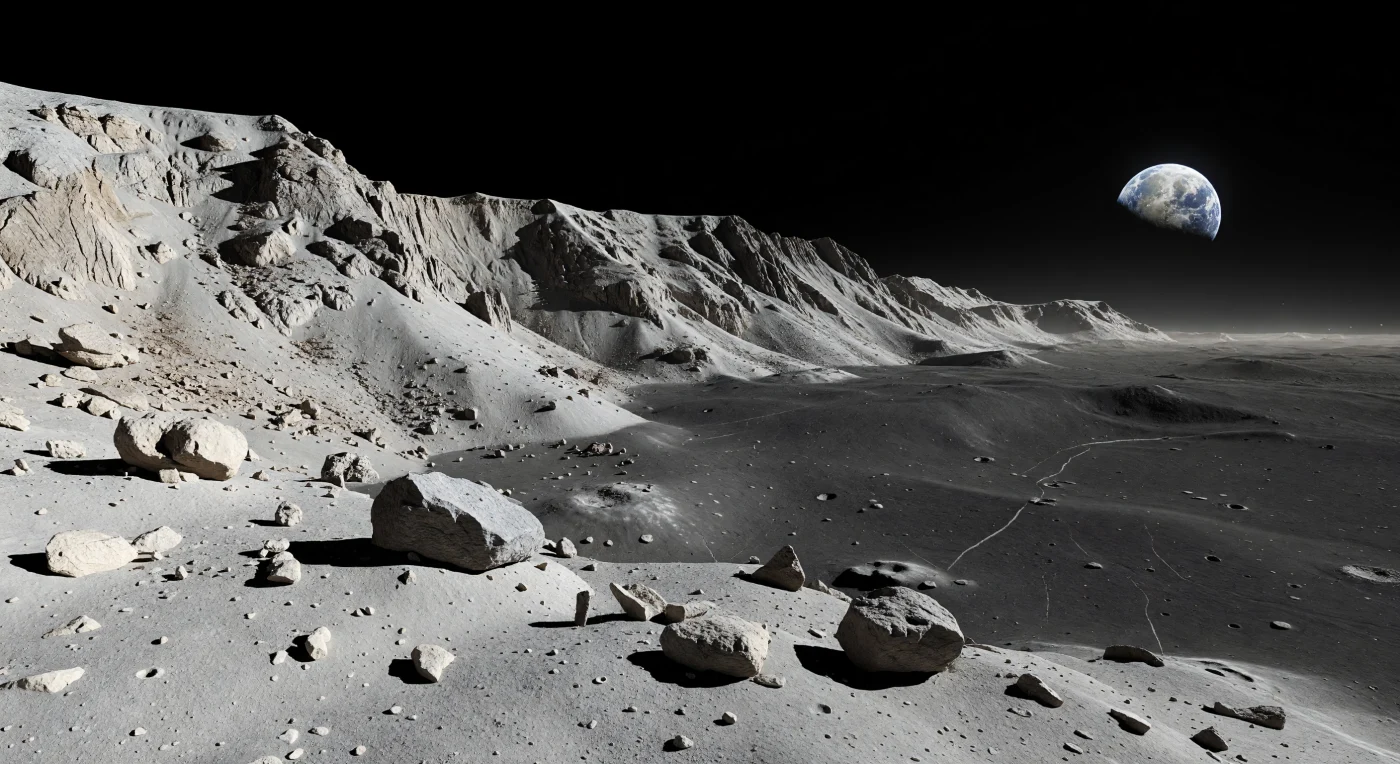
You stand on a silvery-gray plain of powdery regolith and shattered breccia, where angular blocks and house-sized boulders lie strewn beneath the colossal Apennine rampart rising like a broken wall from the edge of the dark mare. The pale massifs are ancient highland crust rich in anorthosite, uplifted and fractured during the Imbrium basin-forming impact, while the smoother, charcoal-toned plain beside them was later flooded by basaltic lava that cooled into the mare surface, now crossed by subtle wrinkle ridges, small craterlets, and faint streaks of brighter ejecta. In the airless vacuum, nothing softens the view: every ledge, slump scar, talus apron, and impact-shattered outcrop is etched in brutal clarity under hard sunlight, with shadows dropping into absolute black. Against a sky as black as space itself, the immense scale becomes almost unsettling, as tiny foreground rocks give way to mountains that stride for many kilometers into the distance, preserving a stark record of bombardment and volcanism untouched by wind, water, or weather.
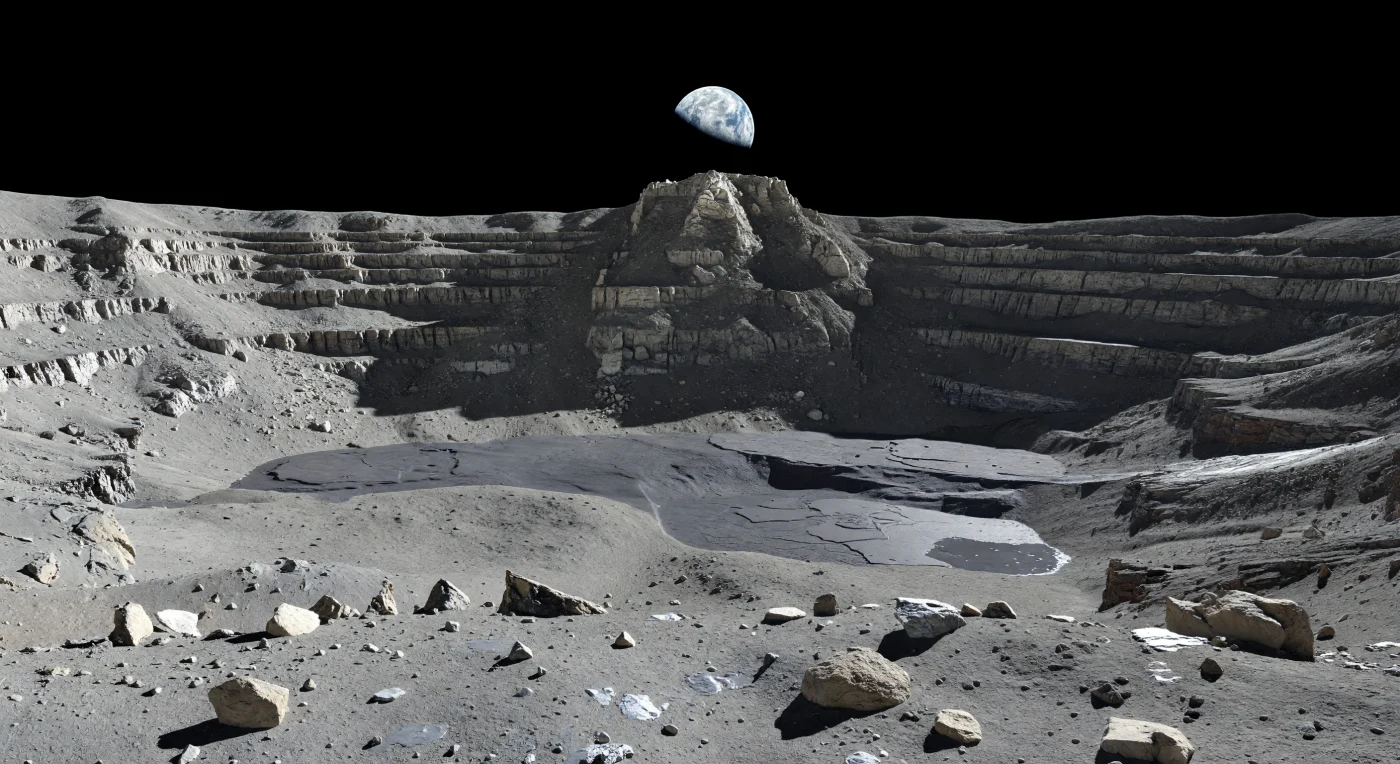
You stand on a floor of powdery gray regolith and shattered highland rock where every grain, breccia fragment, and glassy splash of once-molten ejecta lies perfectly preserved in the Moon’s airless stillness, untouched by wind or water. Around you, colossal stair-step terraces slump down the crater walls in frozen landslides, exposing pale anorthositic crust and talus-choked scarps, while darker, smoother sheets of impact melt spread across parts of the floor in lobes and cracked ponds that record the immense heat of the collision that carved this basin. Beyond them, a steep, block-strewn central peak towers upward—deep crustal material rebounding from the impact and thrust skyward into a jagged massif under one-sixth Earth gravity. In the black, atmosphere-free sky, low sunlight slices across the landscape with brutal clarity, casting razor-edged shadows, while Earth hangs luminous above the horizon, making the crater feel at once silent, immense, and profoundly near to home.

Before you stretches a remarkable dark mantle, a broad, velvety sheet of fine volcanic ash and glass-rich regolith draped so smoothly across the ground that older hills and ridges survive only as faint swells beneath it. Sparse angular rocks and sharp little impact craters puncture the charcoal-black surface, some exposing lighter material below and revealing this deposit as a relatively thin blanket laid down by explosive fire-fountaining rather than flowing lava. Under the fierce, unfiltered sunlight of an airless world, every pebble casts a razor-edged shadow, while the distant escarpments and fractured rims of the plateau stand with unnatural clarity against a sky of pure black. The scene feels both silent and immense: a frozen volcanic fallout plain, preserved for eons in one-sixth gravity with no wind, water, or weather to soften its pristine texture.
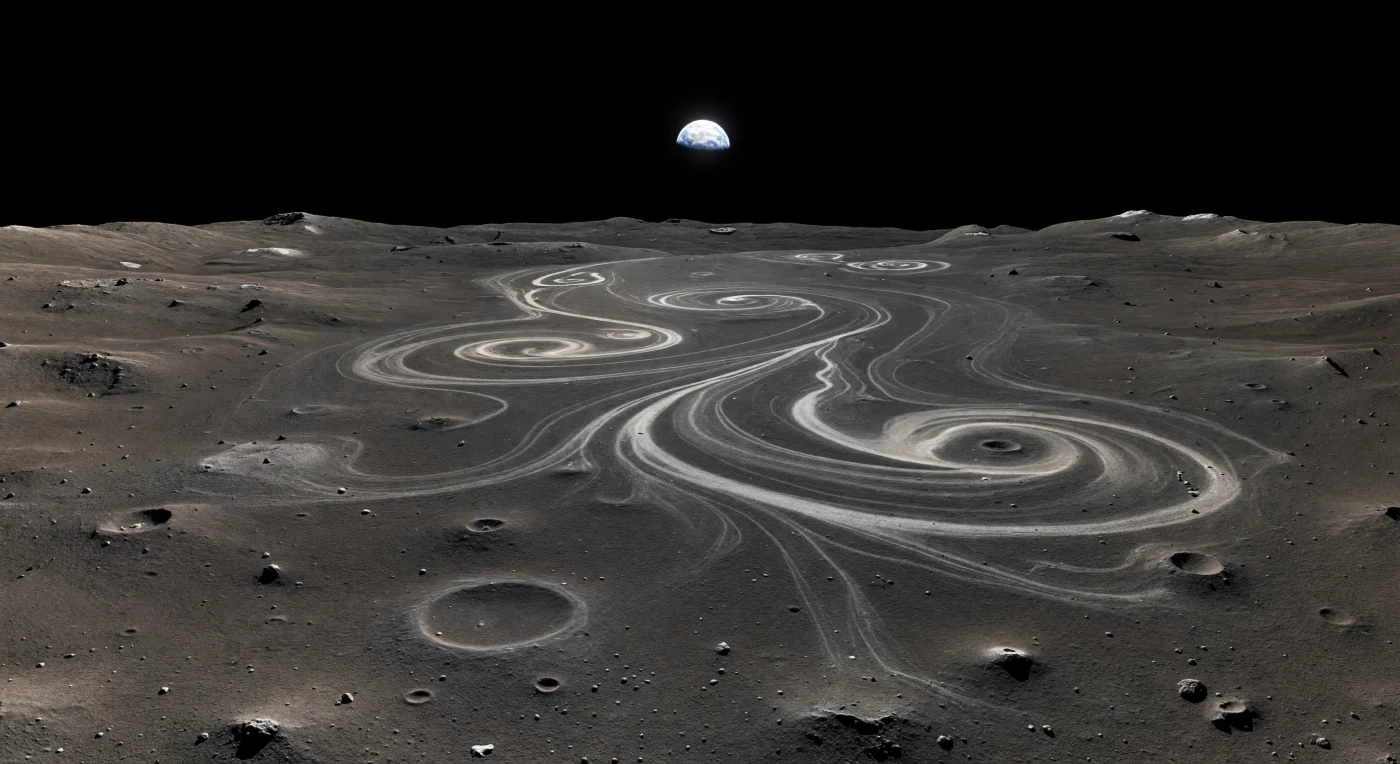
Under a pure black sky, a nearly level basaltic plain stretches outward in dark charcoal-gray tones, its powdery regolith littered with angular rock fragments, tiny glassy impact beads, and crisp-rimmed craterlets casting ink-black shadows in the unfiltered Sun. Across this otherwise ordinary mare surface, the Reiner Gamma swirl appears like a luminous script written directly onto the ground—bright, looping ribbons and comma-shaped streamers of paler dust draped over the basalt with almost no topographic expression at all. These high-albedo markings are thought to be places where localized magnetic fields have partially shielded the surface from the solar wind, slowing space weathering and preserving a fresher, lighter regolith than the darker, more mature soil around it. The result is an eerie landscape where chemistry and magnetism, rather than hills or cliffs, draw vast shining patterns across the plain, giving the horizon a strange, delicate grandeur.
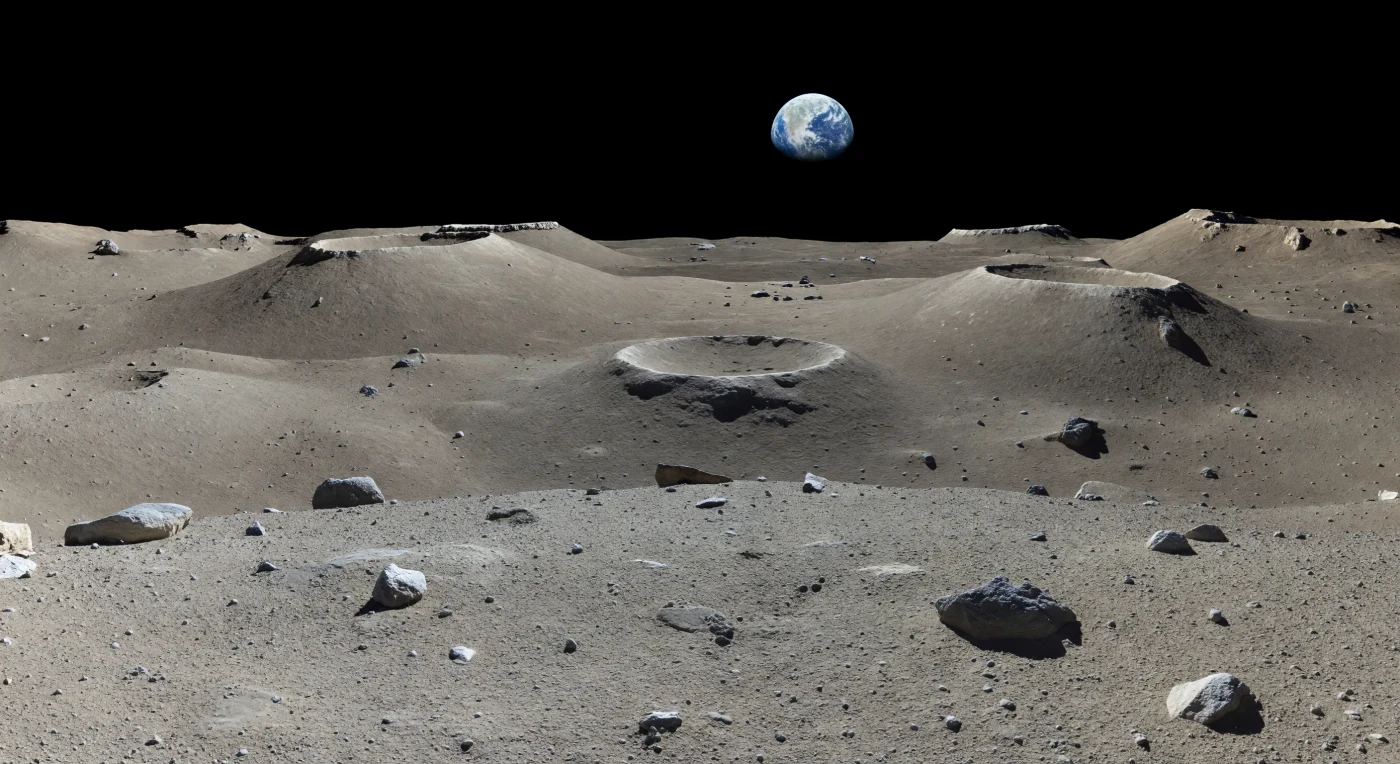
Ahead, the Gruithuisen Dome Field rises almost imperceptibly from the powdery gray regolith, its broad volcanic swells so shallow that only the low Sun reveals them, tracing their convex flanks with delicate yet knife-edged shadows. Underfoot lie fine dust, angular impact-shattered rocks, and scattered brighter highland fragments mixed with darker basaltic pieces and micrometeorite-glazed grains, while small, darker summit pits mark places where viscous, silica-rich lava once welled up and later collapsed near the domes’ crests. In the airless vacuum, nothing softens the light: shadows fall pitch black, crater rims stay crisp, and the muted landscape stretches for kilometers toward distant rims and rugged uplands, preserved in stark detail by the absence of wind, water, and erosion. Beneath the pure black sky, the scene feels both silent and immense, as if you are standing inside a geologic record untouched for billions of years.
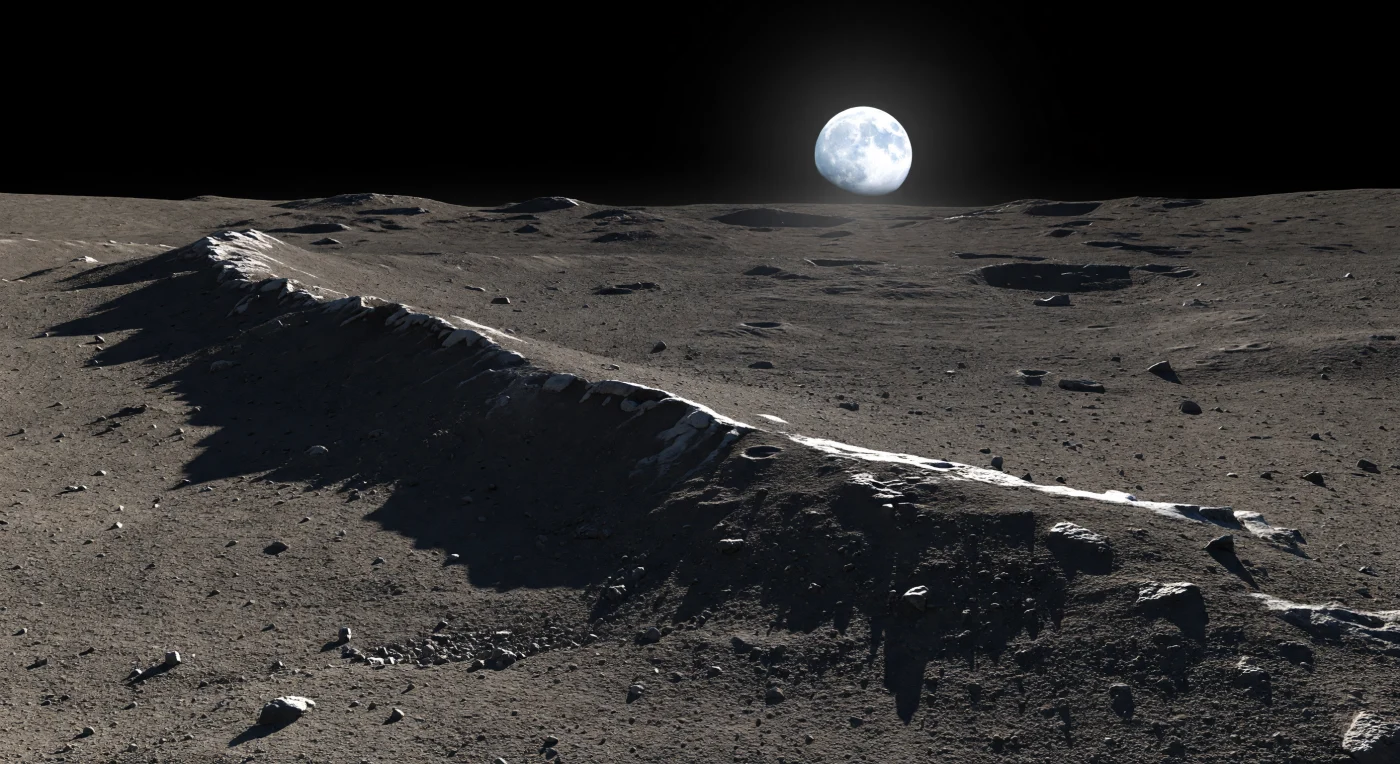
You stand on an immense mare plain of dark basaltic regolith, where a broad, sinuous wrinkle ridge rises from the otherwise level surface like a frozen wave, its uneven crest and asymmetric flanks carved into stark relief by the Sun skimming just above the horizon. These ridges formed when ancient lava-filled plains cooled and contracted, compressing the crust into long low arches and scarp-like folds; here, tiny superposed craters, ejecta aprons, and blocky basalt debris along the base reveal how impacts have slowly reworked the surface in an airless environment for billions of years. With no atmosphere to scatter light, every rock casts a razor-edged shadow into absolute blackness, and the plain stretches outward with no haze to soften distance, making the ridge feel both gently uplifted and monumentally long. Above the charcoal-gray ground and brilliant white sunlit rims, the sky is a pure vacuum black, and on the near side a blue-white Earth can hang almost motionless above the horizon, underscoring the silence, scale, and alien stillness of the scene.
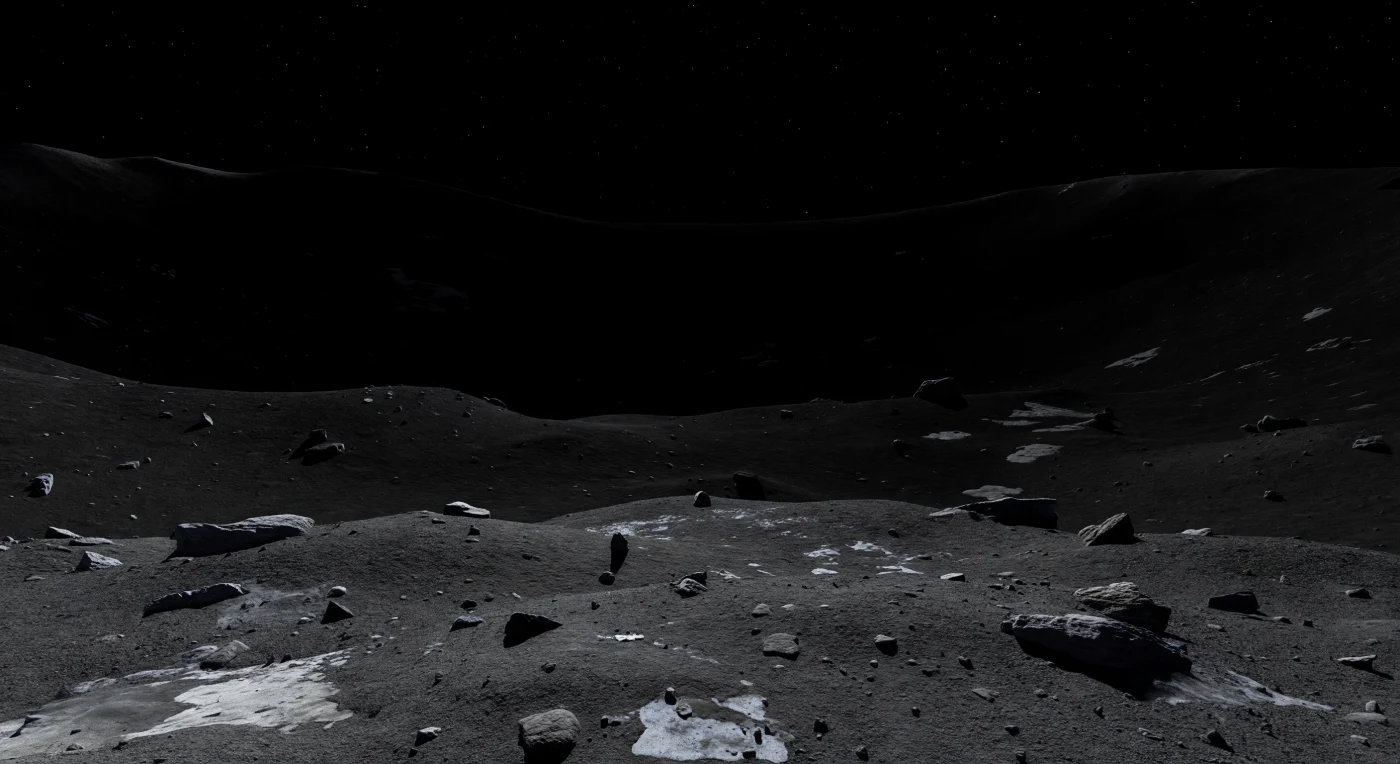
From deep on the floor of this polar crater, the landscape is a near-absolute blackness in which only faint, cold light reflected from faraway rim crests reveals a rough skin of ancient regolith—powdery dust, compacted granular soil, softened ejecta blocks, and scattered angular breccia. In protected hollows and at the bases of rocks, water ice survives not as bright exposed sheets but as dull, dirty frost-rich patches mixed into the soil, subtle traces preserved in one of the coldest natural environments in the Solar System. The immense inner walls rise overhead as curved black silhouettes, their barely illuminated upper edges hinting at the crater’s staggering depth and the permanent shadow created by the very low polar Sun angle. With no air, no weather, and almost no direct light, every visible texture appears unnervingly still and razor-sharp, as if you are standing inside a frozen geological archive untouched for billions of years.
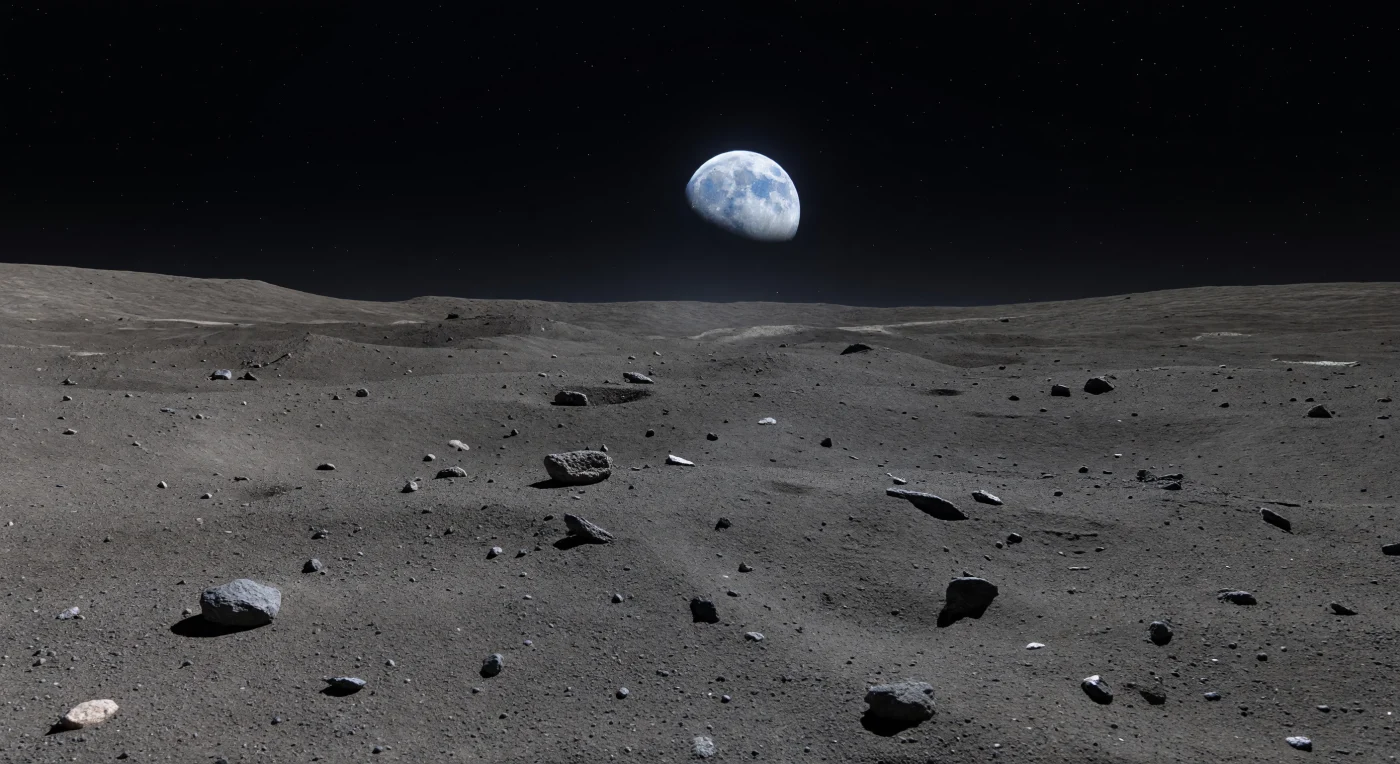
Under a black, airless sky, a brilliantly full Earth hangs almost motionless above the horizon, its blue oceans, white cloud bands, and sunlit continents casting a cold silver-blue glow across the dark mare plain. At your feet, the powdery regolith is a finely crushed blanket of basalt and impact-made glass, sparkling faintly in places and broken by sharp-rimmed craters, scattered angular rocks, and low wrinkle ridges that ripple across the distant horizon. With no atmosphere to soften the light, even this dim Earthshine throws crisp, delicate shadows from ejecta blocks and crater edges, revealing a landscape shaped not by wind or water but by ancient lava flooding, relentless micrometeorite bombardment, and eons of unweathered stillness. The plain stretches outward in muted grays and ash-brown tones, immense and silent, while the glowing world above becomes the only vivid color in an otherwise stark, frozen night.
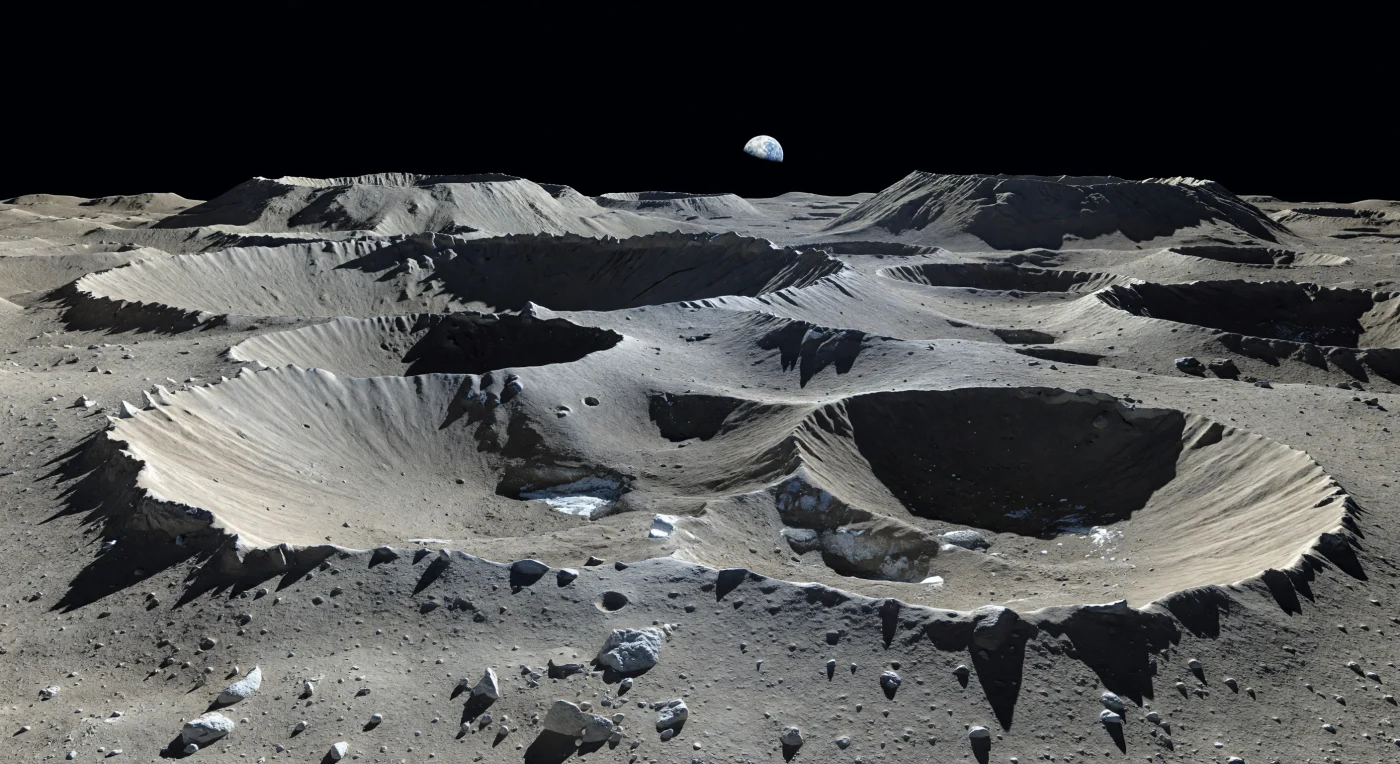
From this jagged polar rim, the surface appears split between brilliance and oblivion: pale gray, slightly tan highland regolith and brecciated impact rocks blaze under a Sun skimming the horizon, while neighboring hollows plunge instantly into perfect blackness with no twilight to soften their edges. Angular boulders, shattered ejecta blocks, powder-fine dust, and tiny superposed craterlets sharpen every crest and scalloped wall, preserved with unusual crispness by low gravity, airlessness, and the absence of erosion. In the faintest reflected light, sheltered inner slopes hint at patchy water-ice frost trapped in deep cold pockets, but most of the terrain remains dry, dusty anorthositic crust—the ancient flotation rock of the lunar highlands—cut by steep, talus-free slopes and razor-long shadows. Beyond the rim, overlapping crater rings and polar massifs recede beneath a black sky, where the harsh white Sun and, at times, a small blue-white Earth emphasize the stark scale and stillness of this near-eternal light at the edge of permanent darkness.