Scientific confidence: Medium
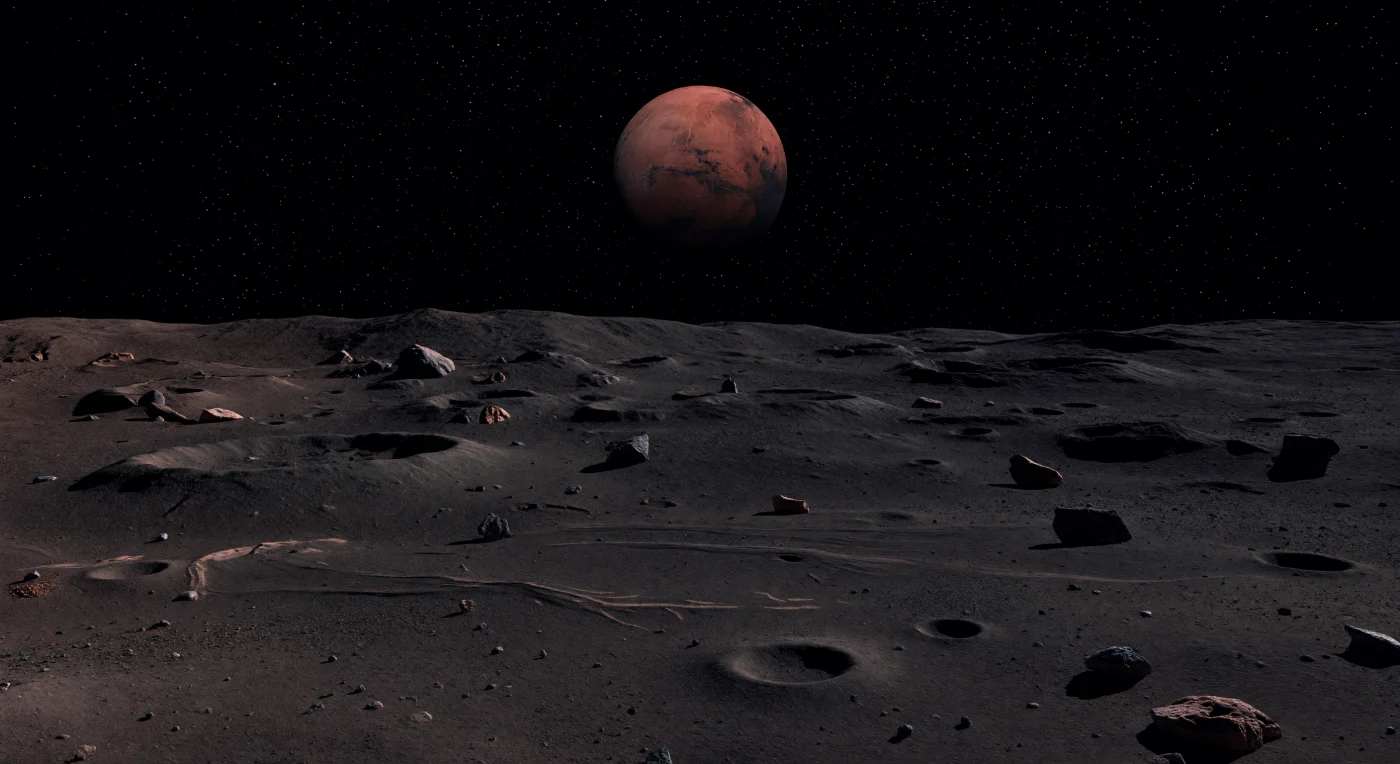
Under a sky of absolute black, the plain stretches away in muted charcoal dust and dark, powdery regolith, its surface broken by tiny bowl-shaped craters, half-buried stones, and low rims whose shadows fall into pure darkness. The only light comes from the vast rust-red disk hanging overhead, bathing upper slopes in a faint copper glow while undersides of boulders, pits, and shallow fracture-like grooves vanish into razor-sharp black, a consequence of the hard vacuum and complete lack of atmosphere. This dark, fine-grained surface is rich in carbonaceous, dust-laden material, and in the moon’s extremely weak gravity even modest impacts can leave crisp ejecta blocks and loosely slumped patches of soil undisturbed for long spans of time. With the horizon unnaturally close and enormous Mars fixed above it, the scene feels both intimate and immense, a silent, frozen landscape where every grain, craterlet, and star stands out with eerie clarity.

At sunrise, the low Sun skims almost horizontally across a corridor of parallel grooves and narrow rock ribs carved into dark, dusty regolith, casting razor-long shadows that stretch toward a surprisingly close, curved horizon under a sky of absolute black. The surface is a battered mix of charcoal-gray powder, angular breccia, porous boulders, and pebble-sized ejecta, with fine dust pooled in groove bottoms and tiny superposed craters recording countless impacts; the material’s low reflectivity and subtle brownish tones are consistent with carbonaceous, asteroid-like rock. In this airless, ultra-low-gravity environment, there is no twilight or haze to soften the light, so every ridge edge remains unnervingly crisp while groove interiors fall into near-total darkness. Over it all looms a vast rust-red disk filling the sky on one side, its faint reflected glow brushing the shadowed ground as the grooves recede for kilometers, making this fragile little world feel both intimate at your feet and immense in its desolation.
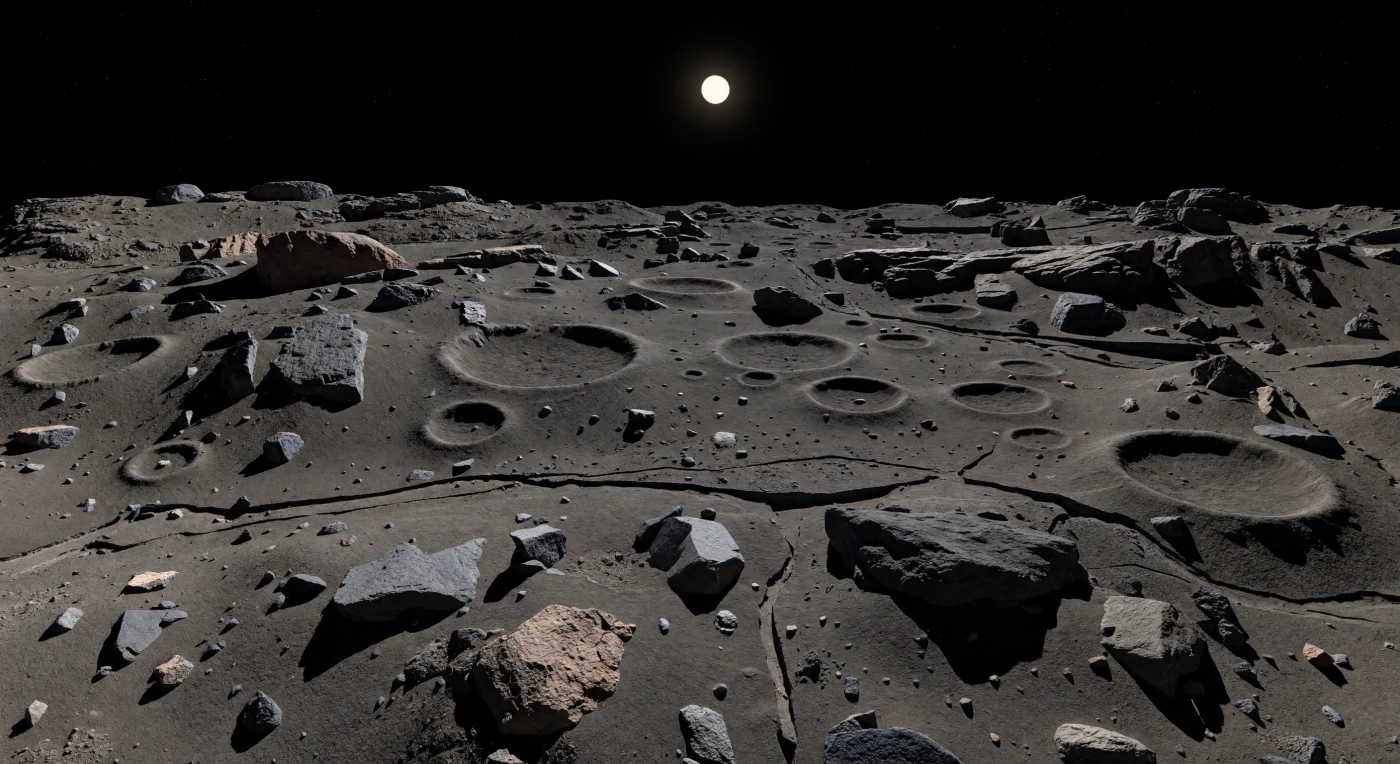
Under a small but fiercely brilliant noon Sun, the far-side uplands stretch away as a broken plain of dark charcoal regolith, overlapping meter-scale craters, and jagged slabs of fractured rock, every rim and boulder etched by razor-sharp shadows into the blackness of an airless sky. The surface looks like a battered, carbon-rich rubble world: porous breccia blocks, pebble-sized clasts half-buried in fine dust, and shallow grooves and fractures crossing hummocks whose steep edges stay improbably crisp in gravity so weak that loose material settles differently than it would on a planet. With no atmosphere to soften the light, distant ridges and cratered rises remain startlingly clear, their sharp outlines emphasizing both the tiny scale of this irregular moon and the relentless impact gardening that has churned its surface for eons. Standing here, you would feel surrounded by silence, darkness, and stone—an exposed remnant of primitive Solar System material, stripped of air, water, and weather, yet textured everywhere by collisions and dust.

From the knife-edged rim of the giant impact basin, a steep slope of dark, powdery regolith and jagged boulders drops away into a crater so immense that its far wall curves along the tiny moon’s warped horizon. The ground is almost black—dry, porous, carbon-rich rubble ground down into fine dust and broken slabs—while the moon’s feeble gravity leaves the crest sharp, unstable, and littered with talus, ejecta blocks, and grooves that score the surrounding terrain. Over it all hangs an astonishing sight: an enormous orange-rust planetary disk, nearly fixed in the black vacuum sky because this battered world keeps the same face turned inward as it orbits. In sunlight weaker than at Earth yet still fierce in airless space, every pebble throws a razor-edged shadow, the crater’s depth feels vertiginous, and the silence of bare rock and dust makes the landscape seem both primitive and impossibly close to the larger world looming overhead.

You stand on a dusty, moderately steep slope of charcoal-gray regolith where narrow boulder tracks slash downhill in long, crisp lines, each one exposing slightly brighter material beneath the dark, space-weathered surface and bordered by tiny clasts shoved aside as the rocks rolled past. The ground is a mix of powdery dust, coarse gravel, angular carbon-rich fragments, shallow impact pits, and precariously perched blocks, all preserved with extraordinary sharpness because there is no air, no wind, and no weather to soften the scene. In this feeble gravity, boulders can travel surprisingly far, carving uninterrupted trails across loose talus while distant grooves and crater rims reveal a fractured, heavily battered world shaped by impacts and constant regolith movement. Over everything hangs a black vacuum sky and a hard white Sun that casts razor-edged shadows, while an enormous red-orange Mars looms near the horizon, making the landscape feel both desolate and impossibly small.
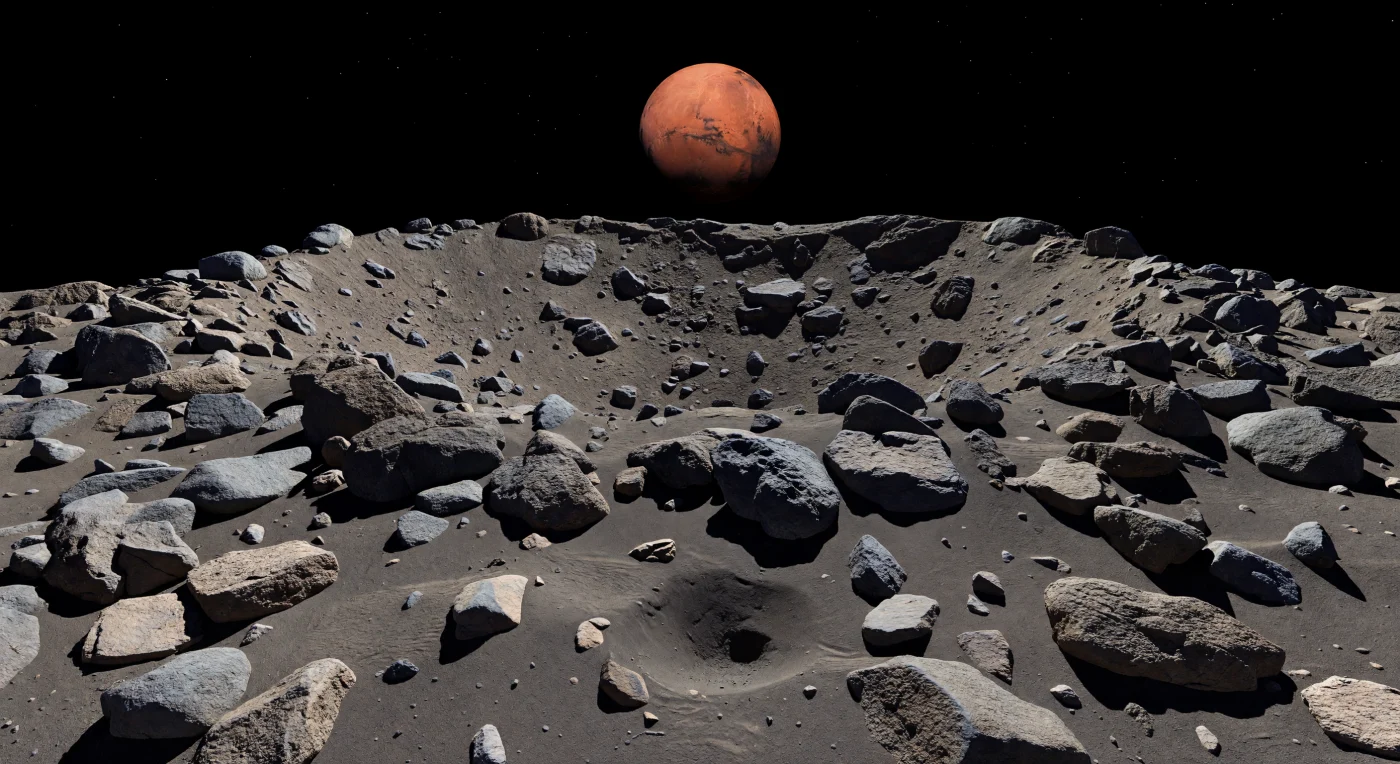
Jagged, meter-scale blocks sprawl across the crater floor like fresh wreckage, their dark charcoal faces half buried in a paler blanket of fine regolith that has slumped and sorted itself down the steep inner wall behind you. These fractured, porous boulders are thought to resemble primitive carbonaceous material, shattered by impacts and left resting in dust that may include both locally pulverized rock and a faint admixture of reddish debris shed from the nearby planet looming enormous in the black sky. In the airless vacuum, the Sun’s smaller, hard white disk carves every stone with razor-edged shadows and drops the shaded hollows into almost complete darkness, revealing how utterly absent atmosphere and weather are here. Beyond the rubble, the horizon curves away astonishingly close, a stark reminder that this is a tiny, weak-gravity world where even a modest crater and its boulder field feel precarious, immense, and profoundly alien.
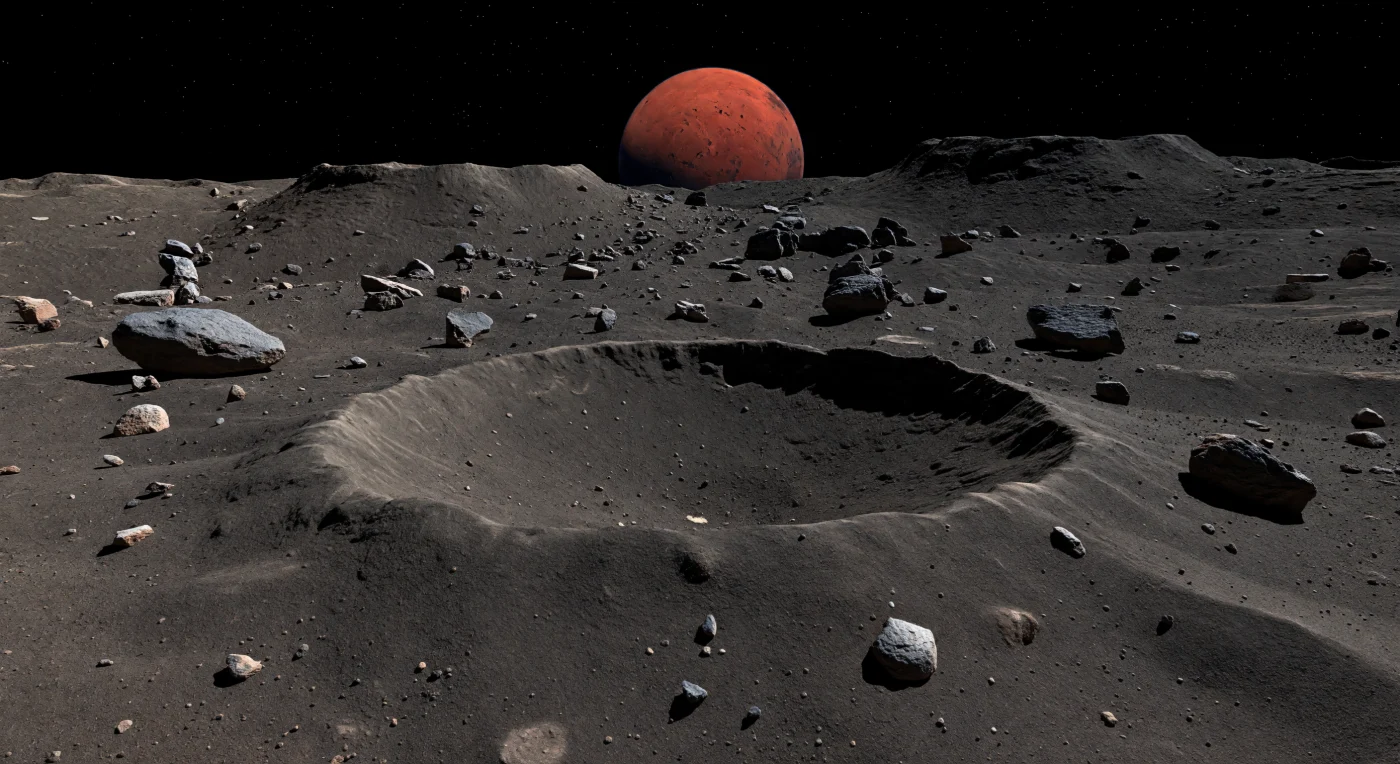
At the edge of a sharply carved young crater, the ground is a mosaic of charcoal-gray dust, darker freshly exposed subsurface material, and angular ejecta blocks that look as though they were flung out only yesterday. In the airless vacuum, the smaller-than-Earth Sun casts brutally crisp light, so the crater’s raised rim throws a knife-edged shadow across its bowl and every pebble, pit, and fractured boulder stands out with unnatural clarity against the black sky. The surface here is a porous, carbonaceous-chondrite-like regolith mantling an irregular, heavily battered body whose weak gravity preserves delicate ejecta streaks, faint grooves, and shallow troughs across the surrounding plains. Above it all hangs an enormous rust-red Mars, its disk dwarfing the horizon and making this intimate scatter of dust and stone feel suspended on a tiny, fragile world.
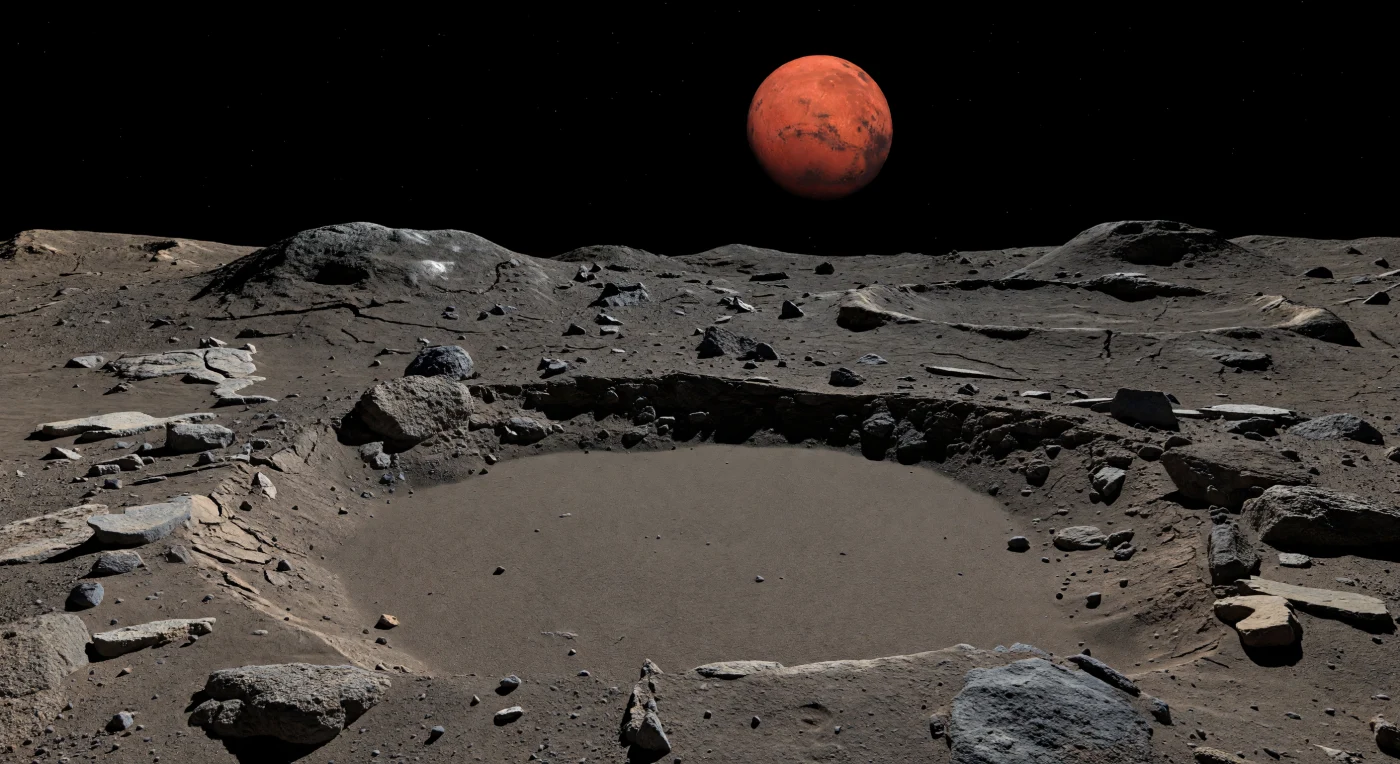
At ground level, the eye is drawn to a quiet, shallow hollow where ultra-fine regolith has settled into an eerily smooth, pond-like sheet of matte brown-gray dust, so level and velvety that only a few dark pebbles and angular clasts break its surface. Around this pocket of stillness, the terrain turns abruptly rough—fractured slabs, porous carbonaceous-chondrite-like boulders, coarse debris, micro-craters, and groove-related cracks record countless impacts and the restless shifting of dust in gravity so weak that loose material can drift and bank against rock edges with only the slightest disturbance. Under a hard, high Sun in airless vacuum, every texture appears razor-sharp: shadows crouch tightly beneath stones, deeper fractures fall into blackness, and the battered plain beyond rises into a hummocky horizon marked by an old crater rim. Above it all, a pure black sky and the looming rust-red disk of nearby Mars make the scene feel both intimate and immense, as if you are standing inside a silent basin of powder on the surface of a shattered worldlet.

From the floor of a shadowed alcove carved into a steep crater wall, you look across a tumble of charcoal-gray dust, fine talus, and sharp, fractured blocks whose porous, primitive rock hints at carbon-rich material little changed since the early Solar System. In Phobos’s feeble gravity, the crater slopes rise and break at unnaturally steep angles, their brittle faces etched with subtle grooves and strewn with loose scree and impact-shattered boulders, all rendered with vacuum-sharp clarity by the absence of air, haze, or weather. Outside the alcove, illumination is strangely subdued: Mars hangs enormous in the black sky, partly covering the smaller, more distant Sun, so the exposed terrain lies in hard-edged but muted light while the alcove itself glows faintly with reflected brightness from nearby dusty walls. The result is an eerie stillness—an airless world of abrupt drop-offs, close horizons, and immense emptiness, where even a crater interior feels both intimate and cosmic.

From this low summit at the edge of night, a skin of dark charcoal dust lies draped over fractured bedrock and jagged impact rubble, while angular boulders and slabby rocks protrude from the regolith as the ground breaks away into shallow basins, overlapping crater rims, and long parallel grooves whose pit-chained floors vanish directly into blackness. With no atmosphere to soften anything, the small hard Sun casts a razor-thin strip of pale golden light across ridge tops and steep inner slopes, leaving knife-edged shadows so deep that distant terrain fades only by entering night, not by haze. The surface is thought to be rich in porous, carbonaceous-chondrite-like material that has been pulverized by countless impacts into a loose mantle, and the moon’s extremely weak gravity helps preserve precarious blocks, crisp regolith banks, and the sharp, uneroded relief of this lumpy, asteroid-like world. Off to one side, Mars hangs immense in the vacuum sky, its muted red glow faintly brushing the shadowed rocks, making the whole panorama feel both intimate and immense—as if you are standing on a battered fragment of primordial Solar System debris suspended above a planet.
