Scientific confidence: Low

At the dawn-lit tropopause, you appear to drift among immense fields of methane-ice cirrus: pure white crystalline veils, filament bands, and delicate frost-like sheets suspended in a pale blue-white sky that deepens into azure and cobalt below. The distant Sun is reduced to a brilliant pinprick on the horizon, yet its hard, frigid light makes the ice crystals flash with silvery highlights and throws razor-sharp, lace-like shadows onto a muted haze deck roughly 35 kilometers beneath you. Here, near the .1-bar level, the atmosphere is still dense enough for methane to condense into high-altitude cloud particles, while powerful winds sculpt the clouds into elongated streaks and vast curtains that stretch to the curvature-softened horizon. With no surface in sight—only layered mist, suspended frost, and continent-scale cloud structures fading into blue depth—the scene feels both weightless and immense, a frozen weather world suspended in perpetual motion.

You seem to be hovering above an endless, storm-tossed ocean of cloud, where scalloped ridges of hydrogen, helium, and methane haze rise into the edge of a colossal dark vortex whose curved boundary vanishes beyond the horizon. Its interior is a deep navy-charcoal void, a pressure-elevated anticyclone with fewer high clouds, while around it gleams a crown of brilliant methane-ice companion clouds—towering arcs and hooked white streamers formed as surrounding air is forced upward over the storm’s flanks. Fine cirrus veils and shredded tendrils peel away in the ferocious wind shear, revealing layered haze and violent vertical structure within an atmosphere where supersonic winds can outrun any hurricane on Earth. Under a cold blue-green sky lit by a tiny, distant Sun, the scene feels immense and unreal: no land, no sea, only continent-sized weather sculpted in dim cobalt light.

You seem to be suspended inside a vast vertical chasm of atmosphere, where a rare clear window opens through pale cyan and blue-white methane-ice cirrus to reveal more than 60 kilometers of descending cloud layers fading into darkness. Near at hand, delicate ice-crystal filaments and translucent haze glow with cold silver-blue light, while far below, darker cobalt bands, scalloped vortex rims, and anvil-like convective towers sink into a nearly black abyss, making the atmosphere itself feel like a landscape with kilometer-high relief. This immense depth is scientifically plausible in an ice-giant atmosphere shaped by methane condensation, hydrocarbon hazes, and violent wind shear exceeding 2,000 kilometers per hour, with cloud decks stacked by pressure, temperature, and chemistry rather than by any solid surface. Overhead, a tiny, dim Sun shines like a distant star through the blue-white haze, and the whole scene is silent, frigid, and alien—an endless sky falling away beneath you.

You are suspended in a vast vertical wilderness of cloud, descending from delicate white methane-ice cirrus at nearly −200°C into broad pale-gray ammonia sheets and then into immense buff-colored hydrogen sulfide banks that swell upward like continents of fog. Above, the sky is a washed blue-white with only a tiny, piercing point of Sun filtering through the haze; below, it deepens through cyan to blue-gray as pressure rises toward about 10 bars and visibility fades into layered mist. Filamentary ice crystals, torn cloud rifts, terraced storm shelves, and towering convective plumes reveal an atmosphere sculpted by ferocious winds and internal heat, with structures tens of kilometers tall behaving almost like geology in motion. With no solid surface anywhere beneath you, only ever-thickening cloud decks and shadowed storm troughs, the scene feels less like weather than a descent into a colossal, living ocean of air.
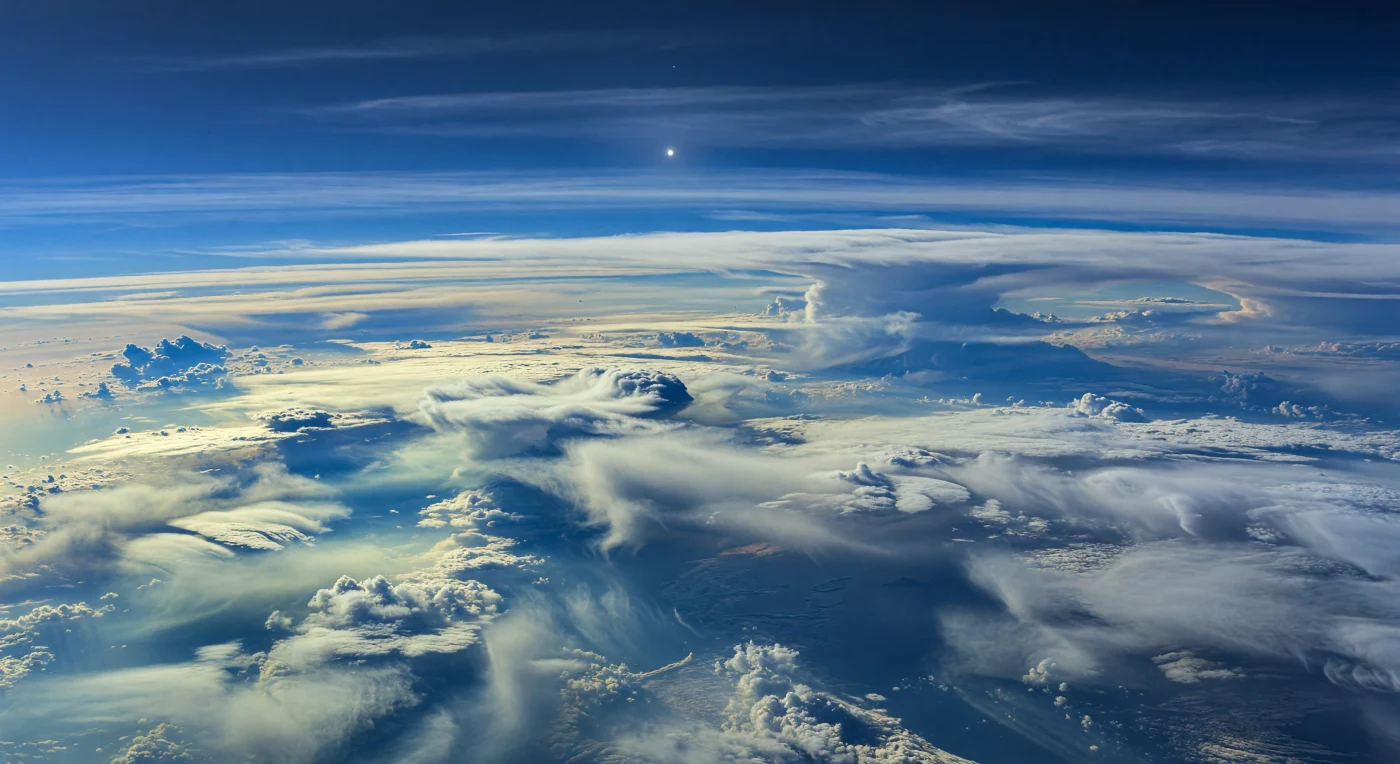
You are suspended within a vast equatorial cloud band where methane is far more abundant than at higher latitudes, and the atmosphere itself becomes the landscape: luminous cream-white and pale cyan cloud plains sweep around the horizon, broken by darker cobalt troughs where clearer, methane-rich air absorbs more red light and deepens the blue. Towering convective walls and flattened storm anvils rise like mountain ranges from the surrounding haze, their edges shredded into streamers and scalloped ripples by fierce wind shear, while delicate methane-ice veils and fine icy precipitation fade downward into indigo depths with no solid surface anywhere below. Overhead, a deep azure sky glows dimly through layered mist, lit only by a tiny, cold Sun whose feeble light leaves silver-blue highlights and soft twilight shadows across the rolling cloud decks. The result is an immense, restless atmospheric world—moist with suspended ice crystals, banded on a planetary scale, and shaped by some of the fastest winds in the solar system.

From this high perch in the upper atmosphere, the south polar region curves away beneath you in immense bands of cobalt, azure, and muted blue-green cloud tops, their methane-rich decks streaked with darker lanes and veiled by thin, bright cirrus of methane ice. Above the pole hangs a subtle cap of reddish-brown haze—photochemical aerosols forged when sunlight breaks apart atmospheric molecules and allows more complex organic compounds to form—spreading outward in wispy, translucent layers hundreds of kilometers wide. The warm spot here is relative rather than mild, rising to about minus 190°C, roughly 10°C warmer than surrounding latitudes, and that slight temperature contrast helps make this polar haze region stand out against the deeper blue atmosphere. In the nearly black stratospheric sky, lit only by a tiny star-like Sun, faint pale greenish-blue auroral glows shimmer delicately within the haze, so dim and diffuse that they feel less like lights than ghostly stains suspended over a world of cold, wind-sculpted cloud and planetary-scale weather.

Here, nearly 100 kilometers beneath the cloud tops, the atmosphere has become a lightless abyss: a black vault enclosing immense walls and hollows of pale gray, buff, and faint blue-gray cloud, their icy textures revealed only by a dim, grazing glow that catches drifting crystals and ragged veils of haze. There is no ground at all—only atmospheric topography—where ammonia and water-ice condensates suspended in hydrogen, helium, and traces of methane build towering cloud cliffs, rolling decks, rising plumes, and scalloped cavities tens of kilometers across. At roughly 50 bars of pressure, comparable to the crushing conditions in Earth’s deepest ocean trenches, and in temperatures near −50°C, this region marks the onset of a deeper interior where sunlight no longer penetrates and the air itself feels like a cold, compressed wilderness. Standing in this murk would feel like hovering inside a frozen storm canyon, surrounded by colossal, shifting structures that fade into darkness without horizon or end.

Suspended in the tenuous upper stratosphere, you look out across an immense atmospheric wilderness where no land or ocean exists—only vast, curved sheets of pale cyan and blue-white methane clouds far below, streaked with darker cobalt bands and soft vortices that hint at fierce storms raging deeper down. Around you, an almost invisible veil of photochemically produced hydrocarbons tints the thin air with a delicate tan-brown haze, formed when ultraviolet sunlight breaks apart methane and drives the creation of complex organic aerosols high above the main weather layers. Above, the sky deepens from washed blue to near black, where the distant Sun burns as a tiny, piercing white spark and a small icy crescent hangs nearby, emphasizing the enormous scale and remoteness of this cold, wind-shaped realm. The light is dim and bluish, softened by forward scattering through the haze, so the cloud decks below glow with faint silver-cyan highlights while their colossal bands vanish over the planetary curvature thousands of kilometers away.
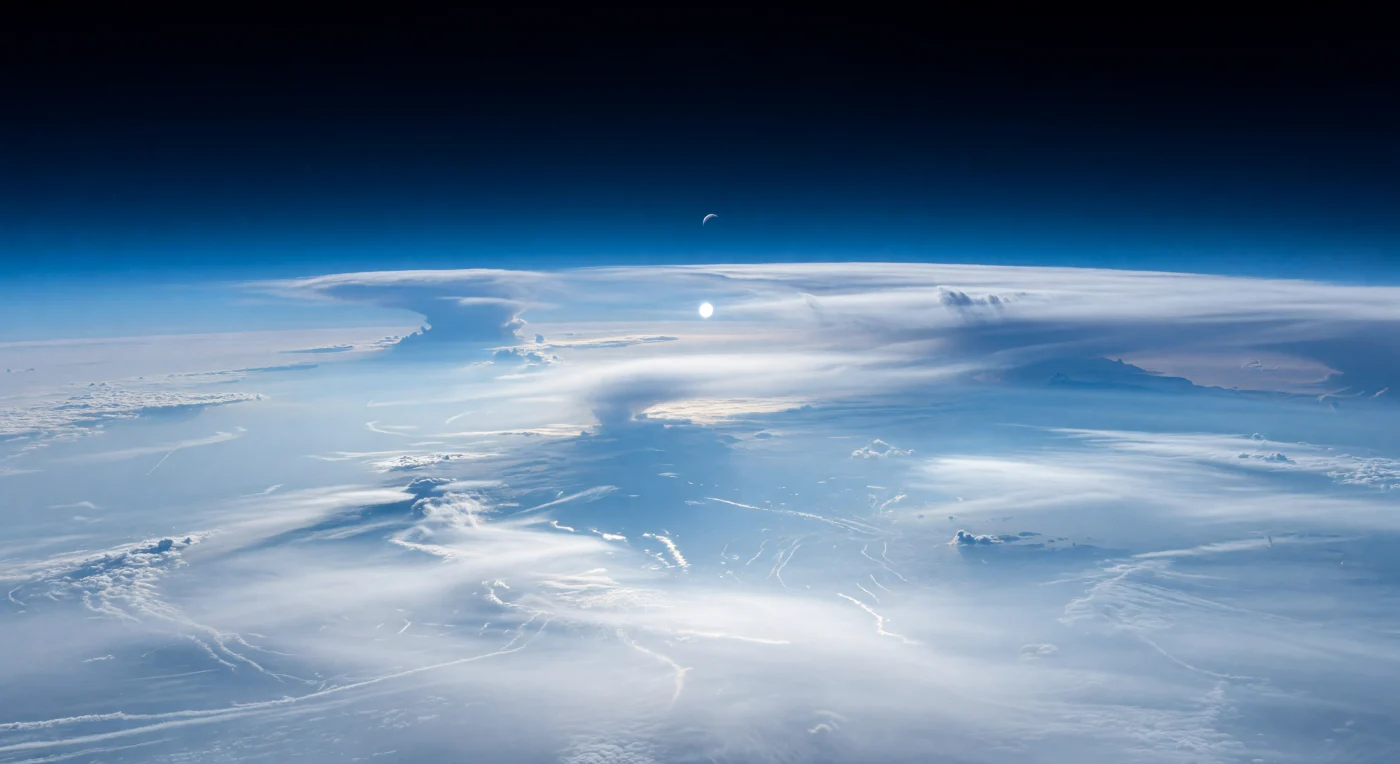
Ahead, the atmosphere itself becomes the landscape: luminous white cloud decks and bluish mist stretch away like frozen plains, fading into a gently curved horizon that reveals the immense scale of the world beneath you. Above that bright edge, the sky grades with striking precision from pale cyan and soft blue through saturated cobalt to near-black, where the methane-hydrogen-helium atmosphere thins toward space and a tiny, hard white Sun burns like a distant spark. High, translucent veils of methane-ice cirrus, scalloped cloud bands, and haze-softened storm anvils hint at meteorology of astonishing power, driven by frigid temperatures and winds that can outrun any storm on Earth. In the dim blue-white twilight, light scatters through suspended ice crystals and dense haze, giving every layer a pearly glow and making this vast, turbulent air ocean feel at once serene, alien, and immense.
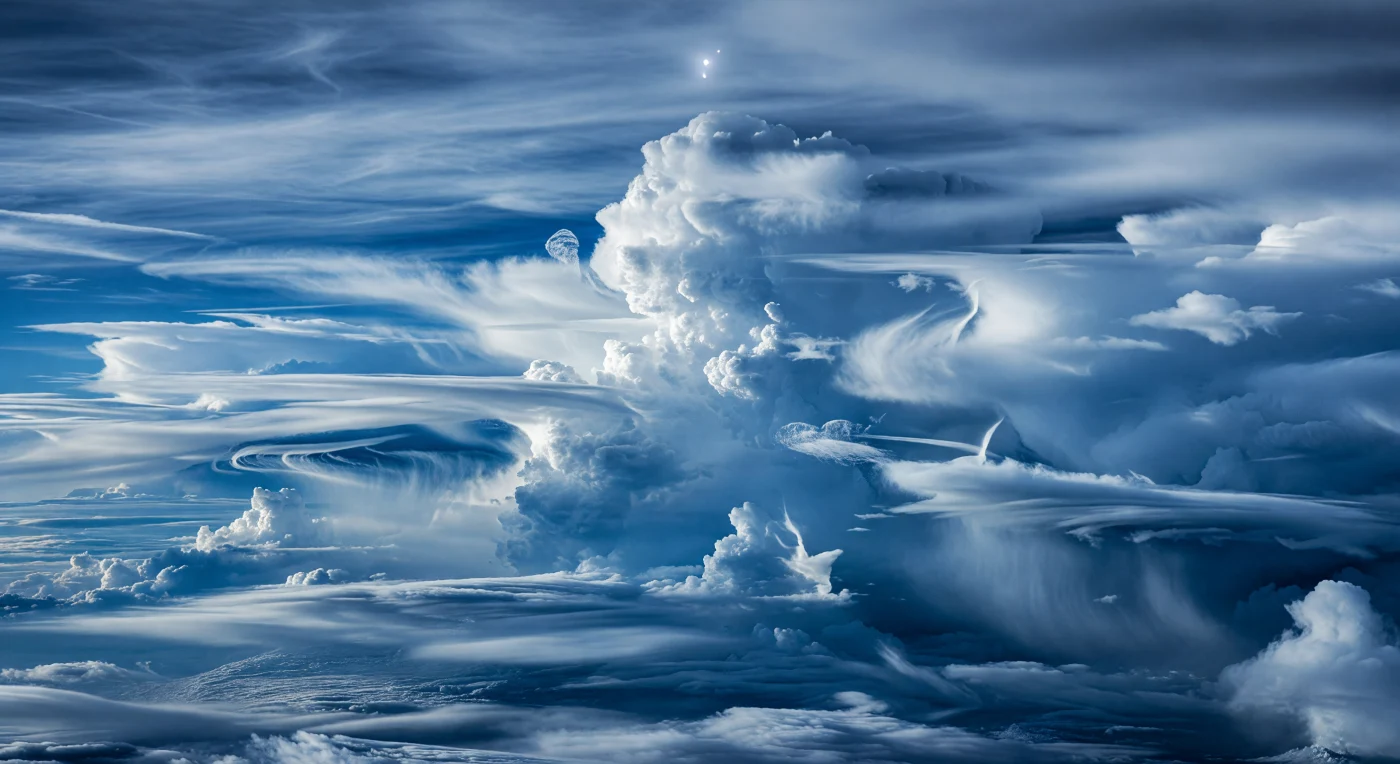
A colossal convective tower surges upward through the upper troposphere like a vertical continent of methane-ice cloud, its brilliant white summit blooming into cauliflower billows, frosted anvils, and crystalline cirrus that glow against the darker cobalt-blue haze. Around it, zonal winds exceeding 1,000 kilometers per hour shear neighboring cloud decks into long streamers, hooked bands, and shredded veils, while faint curtains of methane-ice virga trail into the deep ultramarine below, revealing a fully atmospheric landscape with no solid surface anywhere in sight. The tiny, distant Sun is reduced to a cold pinprick behind thick scattering, casting only weak blue-white light that makes the tower’s highest clouds shine and leaves broad shadows dissolving into layers of cyan mist and suspended ice particles. Standing here would feel like hovering inside a storm system larger than continents on Earth, where internal heat drives powerful updrafts and the chemistry of hydrogen, helium, and methane turns turbulence into an immense, luminous architecture of ice and wind.
