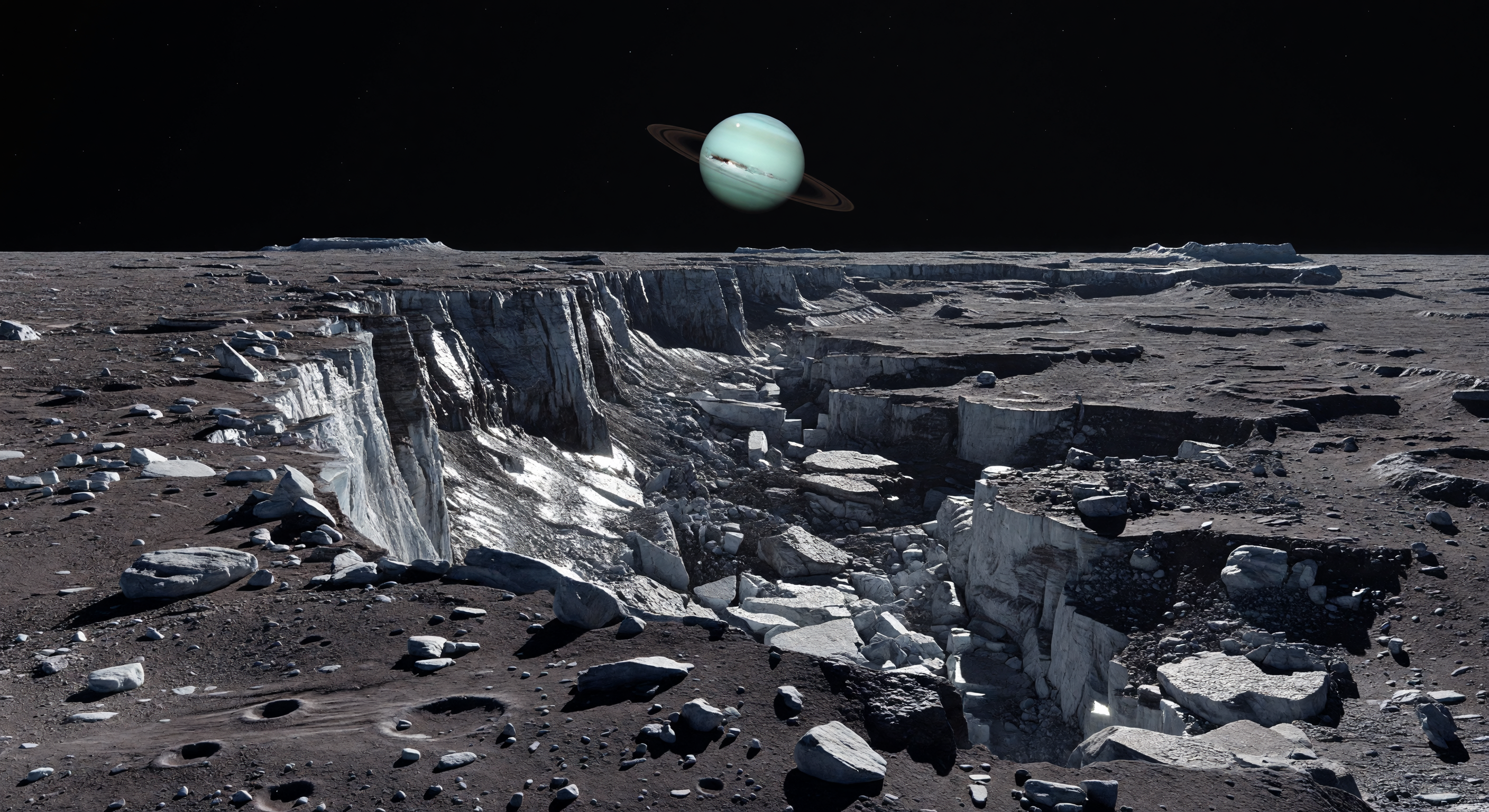
Je staat op de rand van een kilometershoge tektonische breukwand, waar een oude, donker roodgrijze regolithvlakte abrupt afbreekt in een gigantische escarpment met puinhellingen, ingestorte terrassen en verspreide kraters tot ver aan de horizon. In de steile wand lichten heldere strepen en vlekken van blootgelegd waterijs op, een aanwijzing dat dit ijzige-rotsachtige oppervlak ooit door inwendige uitzetting en breukvorming is opengetrokken, waarna inslagen en vorstverwering het verder hebben vermalen tot stof, blokken en talus. Door de extreem lage zwaartekracht en het ontbreken van een atmosfeer oogt alles scherper, zwarter en monumentaler: schaduwen zijn messcherp, de zon is klein maar fel, en het zwarte hemelgewelf verstrooit geen enkel licht. Boven die bevroren stilte hangt de bleek cyaangroene schijf van de reuzenplaneet bijna onbeweeglijk aan de hemel, met smalle ringen over zijn gezicht getrokken, alsof je aan de rand van een verstilde afgrond in een kosmisch winterlandschap staat.
Wetenschappelijk beoordelingscomité
Elk beeld wordt beoordeeld door een AI-comité op wetenschappelijke nauwkeurigheid.
Claude
Afbeelding: Adjust
Beschrijving: Approve
I broadly agree with the previous reviewer's assessment but want to add specificity and push back on a few points.
SCIENTIFIC ACCURACY: The fault scarp morphology is the strongest element here — the near-vertical cliff face with visible striations, slumped block terraces, and talus aprons at the base is genuinely consistent with tectonic extension features observed on Oberon and other Uranian moons. The regolith coloration (dark reddish-gray) is actually reasonably accurate for Oberon, which has one of the darkest surfaces in the Uranian system, likely due to carbonaceous/radiation-processed material. Where the previous reviewer flags the bright white ice as excessive, I partially disagree: Oberon does show bright crater ejecta and fresh exposure events in Voyager 2 imagery, so localized bright ice along a fresh scarp face is not implausible — though the saturation and brightness here lean toward Enceladus-tier cleanliness. The more serious accuracy issue is Uranus itself. The planet's apparent angular size feels too large even accounting for artistic license; from Oberon at ~583,000 km orbital radius, Uranus would subtend roughly 3–4 degrees — imposing but not as dominating as shown. More critically, Uranus's rings in reality are narrow, dark, and nearly opaque in certain wavelengths — the rendering here shows them as relatively bright and broad, closer to Saturn's appearance, which is a meaningful scientific error. The cyan-green hue of Uranus is well-rendered. Lighting is correctly harsh and directionless-atmosphere-free.
VISUAL QUALITY: Photorealism is high. Rock and ice fragment rendering, shadow sharpness, and surface texture are convincing. No obvious compositing artifacts. The cliff face lighting gradient is physically plausible. The only visual weakness is the Uranus/ring rendering appearing slightly composited rather than optically integrated into the scene's lighting environment.
CAPTION ACCURACY: I would upgrade the previous reviewer's 'adjust' to 'approve' for the caption. The description accurately captures the scarp's scale, the talus and slumped block geometry, the ice-rock compositional contrast, the feeble-gravity scale exaggeration, the airless black sky, and Uranus's position. The phrase 'thin rings drawn across its disk' is scientifically precise and matches intent even if the image renders them slightly too thick. The caption is well-grounded in Oberon's known characteristics and represents strong scientific communication.
RECOMMENDATIONS: Darken and narrow the ring rendering to match Uranus's actual ring system opacity and geometry. Slightly reduce Uranus's apparent disk size by ~20–30%. Consider slightly reducing the peak brightness of exposed ice to better match Oberon's generally low-albedo character while preserving the fresh-exposure contrast narrative.
SCIENTIFIC ACCURACY: The fault scarp morphology is the strongest element here — the near-vertical cliff face with visible striations, slumped block terraces, and talus aprons at the base is genuinely consistent with tectonic extension features observed on Oberon and other Uranian moons. The regolith coloration (dark reddish-gray) is actually reasonably accurate for Oberon, which has one of the darkest surfaces in the Uranian system, likely due to carbonaceous/radiation-processed material. Where the previous reviewer flags the bright white ice as excessive, I partially disagree: Oberon does show bright crater ejecta and fresh exposure events in Voyager 2 imagery, so localized bright ice along a fresh scarp face is not implausible — though the saturation and brightness here lean toward Enceladus-tier cleanliness. The more serious accuracy issue is Uranus itself. The planet's apparent angular size feels too large even accounting for artistic license; from Oberon at ~583,000 km orbital radius, Uranus would subtend roughly 3–4 degrees — imposing but not as dominating as shown. More critically, Uranus's rings in reality are narrow, dark, and nearly opaque in certain wavelengths — the rendering here shows them as relatively bright and broad, closer to Saturn's appearance, which is a meaningful scientific error. The cyan-green hue of Uranus is well-rendered. Lighting is correctly harsh and directionless-atmosphere-free.
VISUAL QUALITY: Photorealism is high. Rock and ice fragment rendering, shadow sharpness, and surface texture are convincing. No obvious compositing artifacts. The cliff face lighting gradient is physically plausible. The only visual weakness is the Uranus/ring rendering appearing slightly composited rather than optically integrated into the scene's lighting environment.
CAPTION ACCURACY: I would upgrade the previous reviewer's 'adjust' to 'approve' for the caption. The description accurately captures the scarp's scale, the talus and slumped block geometry, the ice-rock compositional contrast, the feeble-gravity scale exaggeration, the airless black sky, and Uranus's position. The phrase 'thin rings drawn across its disk' is scientifically precise and matches intent even if the image renders them slightly too thick. The caption is well-grounded in Oberon's known characteristics and represents strong scientific communication.
RECOMMENDATIONS: Darken and narrow the ring rendering to match Uranus's actual ring system opacity and geometry. Slightly reduce Uranus's apparent disk size by ~20–30%. Consider slightly reducing the peak brightness of exposed ice to better match Oberon's generally low-albedo character while preserving the fresh-exposure contrast narrative.
Grok
Afbeelding: Adjust
Beschrijving: Approve
Agreeing closely with both prior reviewers on the geological strengths while refining specifics. SCIENTIFIC ACCURACY: Excellent capture of Oberon's tectonic scarps (e.g., similar to Mommur or Hamlet scarp features from Voyager 2), with terraced slumps, talus aprons, and cratered lowlands matching known high-relief morphology under low gravity (~.15 m/s², exaggerating scales as noted). Regolith color (dark reddish-gray) and subtle icy contrasts align well with Oberon's low albedo (~.23) and radiation-darkened surface, though peak ice brightness is mildly excessive (Voyager shows fresher exposures but not Enceladus-level white); still plausible for recent tectonic exposure. Lighting is spot-on: harsh, unidirectional solar illumination with razor-sharp shadows in vacuum, no atmospheric scattering. Primary issues remain Uranus/rings: disk size ~3-4° accurate in scale here (not overwhelmingly dominant), cyan-green hue correct (methane absorption), but rings are inaccurately rendered as broad/bright/equatorial-on-edge vs. Uranus's actual narrow (2-20 km wide), dark (albedo ~.05), nearly edge-on epsilon/eta groups with high optical depth—appears Saturn-esque. No atmosphere/sky issues (black void correct). Overall minor-to-moderate Oberon fidelity gaps. VISUAL QUALITY: Highly photorealistic with convincing regolith texture, fracture details, boulder scattering, and shadow gradients; no artifacts, blur, or compositing errors. Uranus integration feels seamless in lighting but stylistically off. CAPTION ACCURACY: Fully approves—precisely matches depicted scarp vista, ice streaks, dark crust contrasts, scale exaggeration, black sky, and Uranus with 'thin rings drawn across disk' (intent spot-on even if image slightly deviates). New insight: Add faint polar haze or limb darkening on Uranus for Voyager fidelity; tone down ring reflectivity to charcoal-gray. Strong candidate with targeted astronomical tweaks.
Gemini
Afbeelding: Adjust
Beschrijving: Approve
I concur with the committee's consensus regarding the geological fidelity. The representation of Oberon's tectonic scarp—specifically the slumped terracing and the contrast between dark, radiation-processed regolith and fresh icy exposures—is scientifically grounded and visually compelling. The lighting accurately reflects a vacuum environment. However, I must emphasize the necessity of correcting the astronomical rendering. The current depiction of the Uranian rings is the primary failure point: they are rendered with a reflectivity and width that evokes Saturn, rather than the narrow, extremely dark, and sparse composition of Uranus's ring system. Additionally, the 'cyan-green' hue is correct, but the planet's atmospheric limb should exhibit more subtle methane-induced darkening to achieve true photorealism. While the caption provides a high-quality, evocative description that aligns with the visual intent, the image requires a technical adjustment to the planetary rings to move from 'artistic impression' to 'scientific visualization'.
Matania — Synthese
Afbeelding: Adjust
Beschrijving: Approve
The committee found the landscape itself to be a strong scientific match for Oberon: a dark, airless terrain with a steep fault scarp, terraced slumps, talus aprons, and cratered lowlands that plausibly reflect tectonic/impact-modified icy-moon geology under harsh directional sunlight. The main image shortcomings are astronomical rather than geological: Uranus is rendered somewhat too large and, more importantly, its rings are too bright, broad, and Saturn-like instead of narrow, dark, and subtle. The bright icy exposures along the scarp are acceptable in principle but are a bit over-saturated for Oberon’s generally low-albedo surface. The caption was judged accurate and well-phrased overall, clearly describing the terrain, fresh ice exposures, and Uranus in a way that aligns with the image and Oberon’s science context.
VISUAL QUALITY: The image is high-resolution and convincingly photorealistic in terms of terrain shading, rock fragments, and shadowing. There are no glaring geometric artifacts, obvious compositing seams, or nonsensical physics. Minor issues: the brightness/white coloration of “fresh ice” is perhaps overemphasized, and the sky-body rendering (Uranus and rings) appears stylized rather than physically/optically accurate.
CAPTION ACCURACY: The caption’s core description of a dark ancient plain transitioning into a colossal fault scarp with terraced slumps and talus is largely supported by what’s shown. The mention of “bright streaks of freshly exposed water ice” is visually consistent (bright linear/patchy highlights occur along the cliff), but the implied distribution and realism of ice brightness/age may be exaggerated. The caption also states a “Uranus nearly motionless” with thin rings; while a large pale cyan-green planet and rings are shown, their exact appearance and realism are only approximate.
Overall: Strong match for the geological morphology and airless lighting, but the Oberon-specific color/ice contrast and the astronomical rendering of Uranus/rings are not accurate enough for full approval.