Scientific confidence: Medium

You stand amid a frozen blast zone where the young impact of Othello has splashed pale bluish-white water-ice across an older, darker crust, leaving patchy rays and jagged blocks strewn over reddish-charcoal regolith like shards from a colossal explosion. House-sized boulders, shattered icy breccia, low hummocks, and chains of small secondary craters stretch to the horizon, their forms preserved with extraordinary sharpness by weak gravity and the complete absence of wind, liquid erosion, or air. The bright debris marks freshly excavated ice from beneath a surface made of mixed water ice and darker rocky material, while the ancient terrain around it has been altered over immense spans of time by radiation, impacts, and space weathering into muted gray, brown, and black tones. Above it all hangs a perfectly black sky, and the distant Sun—tiny yet still fierce—casts hard, razor-edged shadows that make every ridge, scarp, and broken crater wall feel stark, silent, and impossibly far from any familiar world.

From the shattered crest of a colossal crater rim, jagged slabs of water ice and dark silicate-rich breccia teeter in feeble gravity above an immense abyss, where terraced walls, slump benches, and blocky talus descend into a floor drowned in black shadow. The surface here is ancient and heavily battered: dirty ice mixed with rocky material has been fractured by impact and later tectonic faulting, leaving steep scarps, angular boulders, and almost no softening from erosion in this airless, weatherless cold. Under a tiny, hard-edged Sun, every ridge throws razor-sharp darkness while cleaner ice flashes faint bluish-white against a broader landscape of charcoal and reddish-gray plains, their distant crater rims curving subtly with the small moon’s horizon. Low over that bent horizon hangs a pale blue-green Uranus, an eerie disk in the black sky, making the scale and silence of this frozen basin feel almost overwhelming.
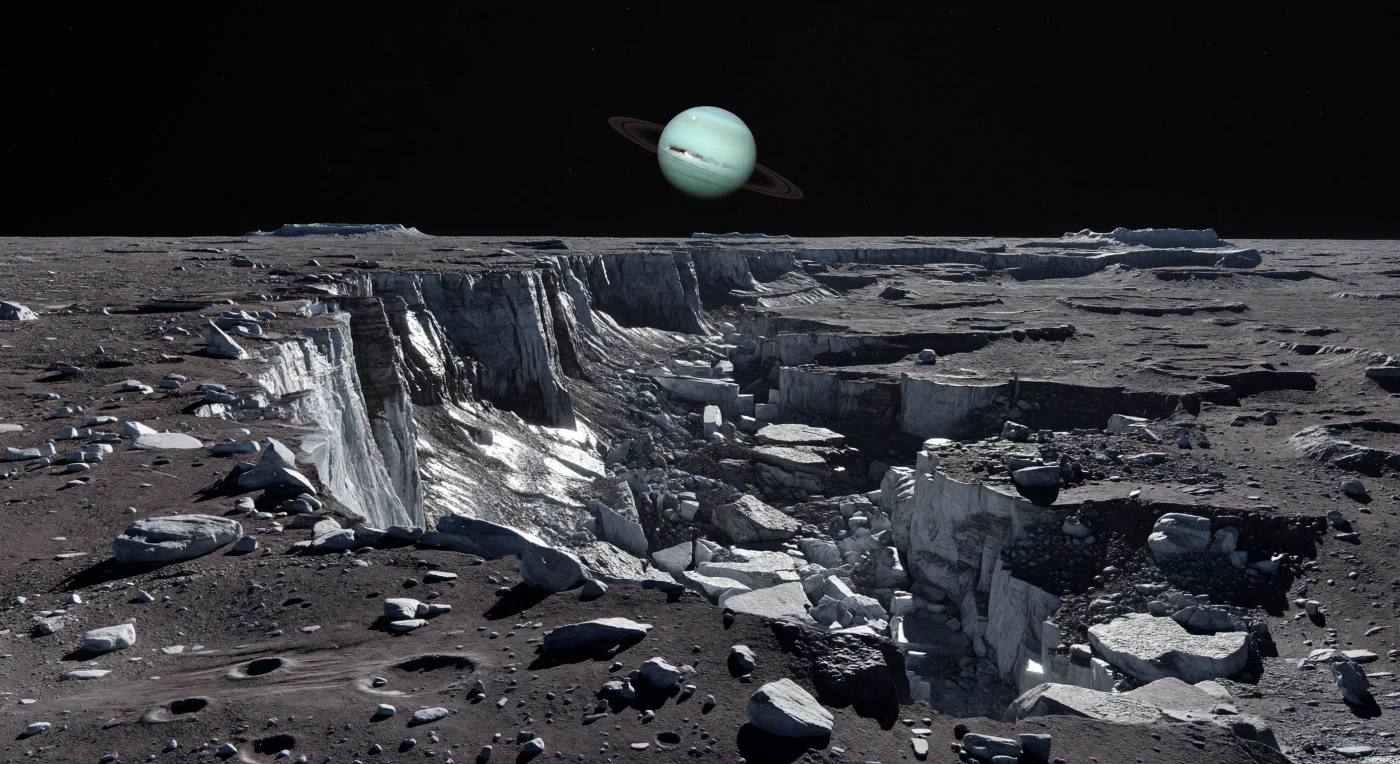
You stand on a dark, ancient plain of reddish-gray regolith and shattered icy rock where the ground suddenly breaks away into a colossal fault scarp, its several-kilometer wall dropping into terraces of slumped blocks, talus, and cratered lowlands that stretch to a distant, frozen horizon. Bright streaks of freshly exposed water ice gleam along the cliff face, contrasting with older, darker ice-rock crust and hinting at a world shaped not only by relentless impacts but also by tectonic extension that split and lifted the surface long ago. In the moon’s feeble gravity, every landform feels exaggerated in scale—boulders sit stark and sharp, crater rims linger far away, and the escarpment seems almost impossibly tall beneath the hard, cold sunlight. Above it all, in a sky utterly black and airless, a huge pale cyan-green Uranus hangs nearly motionless with its thin rings drawn across its disk, while razor-edged shadows and icy glints make the entire scene feel silent, crystalline, and profoundly alien.

From the floor of this ancient basin, the view stretches across a vast plain of dark reddish-gray to brownish-charcoal regolith, its matte surface broken everywhere by overlapping small craters, softened rims, and scattered angular blocks of ice-rich rock that seem frozen in place under weak gravity. The distant inner wall rises in broad, degraded terraces and rounded escarpments, where fresher impacts have punched through the dark surface lag to reveal paler water-ice-rich material in bright streaks and isolated patches. Here, on this airless icy world, countless impacts and long exposure to radiation and micrometeorite bombardment have matured the surface into a subdued, heavily space-weathered crust of mixed water ice and silicate-rich debris. Under a tiny Sun, the light feels like cold terrestrial twilight, yet every shadow is perfectly black against the absolute sky, making the enormous scale of the crater and the stark stillness of the landscape feel almost impossibly alien.

From the floor of Mommur Chasma, you look along a colossal rift carved through an ancient ice-rock crust, where dark reddish-gray regolith, shattered boulders, and bright chips of cleaner ice lie scattered beneath towering pale scarps. The walls expose fault planes, layered fractured bedrock, talus aprons, and long parallel cracks that record crustal extension, likely driven by internal expansion as the moon’s deep interior cooled and evolved early in its history. In the airless vacuum, a tiny distant Sun throws hard, low-angle light across the trough, turning every block, crater, and broken slab into stark relief with knife-edged shadows and no atmospheric haze to soften the scene. The result is immense and unnervingly still: a frozen tectonic landscape of water ice mixed with rocky material, darkened by radiation processing and impact gardening, stretching away under a black sky with the scale and silence of the outer Solar System.

Under a pure black sky, a tiny white Sun grazes the horizon and turns this polar plain into a study in stark geometry: low crater rims, fault-bounded icy ridges, and scattered angular blocks cast razor-edged shadows that run for kilometers across the dark, nearly monochrome ground. The surface is an ancient regolith of water ice mixed with rocky material and radiation-darkened contaminants, giving the plain its subdued charcoal and reddish-gray tones, while fresh fractures and ejecta blocks occasionally flash brighter where cleaner ice has been exposed. In the weak sunlight and extremely low gravity, even modest scarps and collapsed crater rims look crisp and enduring, their forms preserved for immense spans of time on this airless, frozen world with no haze, no twilight, and no softening of contrast. Far above the silent horizon hangs a small pale cyan disk, and with stars visible beside it, the landscape feels vast, cold, and almost impossibly still—as if you are standing at the edge of a shadow that will take hours to move.

At the day-night boundary, an immense chain of ancient crater rims rises from a frozen plain of dark, reddish-gray ice and silicate-rich rubble, each crest etched in hard white sunlight while the crater interiors fall away into absolute black. Under this grazing illumination, fractured ice-rock slabs, angular breccia blocks, low ejecta hummocks, and fault-bounded scarps stand out in razor-sharp relief, revealing a surface shaped by billions of years of impacts and later tectonic stretching in an airless environment. The muted palette of silver-gray, ash, slate, and faint rusty tones reflects a crust made of water ice mixed with rocky material, with occasional bright glints where cleaner ice is exposed, while the low gravity makes distant rims and massif-like highlands feel improbably tall and far-reaching. Beneath a pure black sky and a tiny, remote Sun, the landscape is silent and severe, as if the world’s ancient scars are emerging one by one from night itself.

Under the cold blue-green glow of planetshine, the frozen ground stretches away in stark silence: dark reddish-gray regolith and dirty water ice lie almost black between scattered angular breccia blocks and frost-dusted boulders, while fresh ejecta from a younger impact cuts across the scene in bluish-gray streaks that gleam against the ancient surface. A nearby crater rim rises abruptly with steep inner slopes and hummocky debris aprons preserved by weak gravity and the absence of air or liquid erosion, beyond which a vast plain of overlapping craters, softened rims, isolated central peaks, and distant fault-bounded scarps records billions of years of impacts and tectonic fracturing in an ice-rock crust. The contrast is extreme: cleaner, ice-rich material reflects the faint Uranus-light, but the mature, radiation-darkened regolith sinks toward near-total blackness. Overhead, with no atmosphere to scatter or dim the view, the stars and the Milky Way blaze razor-sharp above an immense landscape whose horizons fade only by distance, making the scene feel both crystalline and immeasurably remote.

From this ground-level vantage, the landscape stretches away as a labyrinth of overlapping craters etched into ancient dark reddish-gray crust, where water ice is intimately mixed with rocky silicate material and dulled by a thin mantle of dusty regolith. Fractured ice bedrock, angular breccia blocks, subdued crater bowls, broken rim arcs, and hummocky ejecta remnants merge into broad intercrater plains, recording billions of years of impacts on a tectonically quiet, airless world. In the weak gravity, even low escarpments and distant crater walls feel immense, their sharp edges throwing long black shadows under the tiny, hard-white Sun, while occasional pale streaks and fresh rim segments reveal cleaner exposed ice amid the somber tones. Above the frozen highlands, the sky remains pitch black and star-filled in daytime, and near the horizon a small pale cyan disk hangs silently, underscoring the cold isolation and enormous scale of this battered outer-system terrain.

At your feet, a fresh bowl-shaped crater only a few tens of meters wide cuts sharply into the ancient plain, its raised white-gray rim and smooth, steep inner walls revealing cleaner water ice beneath a darker, space-weathered crust of ice mixed with rocky silicate material. Angular blocks thrown out by the impact lie scattered across the reddish-gray regolith like shattered masonry, from small frost-bright chips to boulders meters across, all preserved in unusually crisp detail by the moon’s feeble gravity and airless stillness. In the hard, distant sunlight, every pebble casts a razor-black shadow and every icy face flashes cold highlights, while beyond the crater the subdued uplands, faint micro-craters, and low fault scarps hint at a surface shaped by both relentless bombardment and ancient tectonic fracture. Over the black horizon hangs a small pale cyan disk of the parent planet, serene and remote, deepening the sense that this frozen landscape is both intimate in texture and immense in geological time.
