Scientific confidence: High

A vast south-polar plain of nitrogen frost stretches away in white, cream, and faint blush-pink sheets, its surface broken by polygonal crust, brittle cracks, shallow sublimation pits, and low icy ridges where harder water-ice bedrock pushes through the smoother volatile veneer. Fine dark streaks of organic-rich dust lie wind-drawn across the frost like brushstrokes, likely fallout from distant nitrogen geysers, while the strongly curved horizon reveals the small scale of this frozen world and the weakness of its gravity. Above the stark, nearly black sky, a thin amber-gray haze clings to the horizon in the moon’s tenuous nitrogen atmosphere, and the tiny Sun throws crisp, elongated shadows across the cryogenic textures with almost no atmospheric softening. Nearly fixed overhead hangs an enormous deep-azure Neptune, with only the faintest hairline arcs of rings beside it, turning the scene into a silent, ultracold polar desert where volatile ices slowly migrate, crack, and sublimate under one of the outer Solar System’s most alien skies.
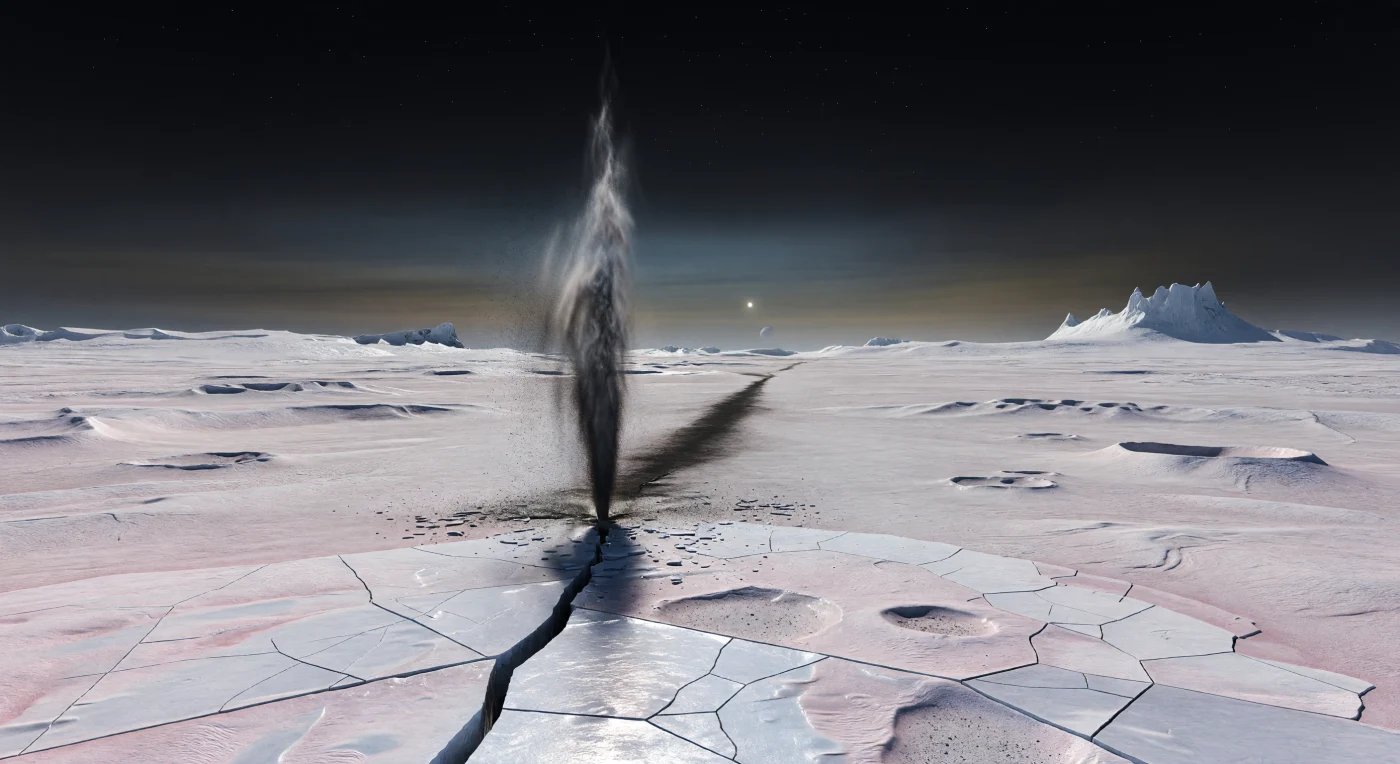
A bright slab of nitrogen frost and pink-white water-ice crust fills the foreground, broken into polygonal plates and hairline vents, where one narrow fissure is actively blasting a dark column of gas and dust high into the black sky. In the weak but sharply angled sunlight, the plume’s edge glows faintly while near-surface winds bend it into a long drifting fan, sprinkling carbon-rich particles across the frozen plain and painting a black streak that runs to the horizon. Around it lie geologically young cryovolcanic plains of volatile ices, softened craters, shallow troughs, and patches of dimpled hummocks, with steep water-ice mountains rising unnaturally high in the low gravity beyond. Beneath the charcoal vault of an atmosphere so thin it is almost space, and above a faint smoky haze hugging the horizon, the scene feels silent, frigid, and immense—a world where sunlight is feeble, frost migrates with the seasons, and the surface still breathes.

A vast plain of pale cream and bluish-white ice stretches outward in eerie silence, its smooth, geologically young surface broken by wandering fractures and shallow troughs whose razor-dark shadows betray the tiny, distant Sun and the almost airless clarity above. Underfoot, the frozen crust appears slightly glassy and subtly polygonal, likely water-ice bedrock resurfaced by cryovolcanic flows and mantled with nitrogen frost, while faint pink-beige tints and scattered dark specks hint at methane-derived stains and dust-rich lag exposed along the cracks. Low ridges, subdued collapse pits, and only a sprinkling of small impact craters suggest a landscape recently reworked from below, where frigid volatiles once welled up and froze across the plain. Over the low horizon, a thin band of bluish-gray to amber haze clings to the edge of a black sky where a few stars still shine, making the entire scene feel immense, pristine, and profoundly alien.
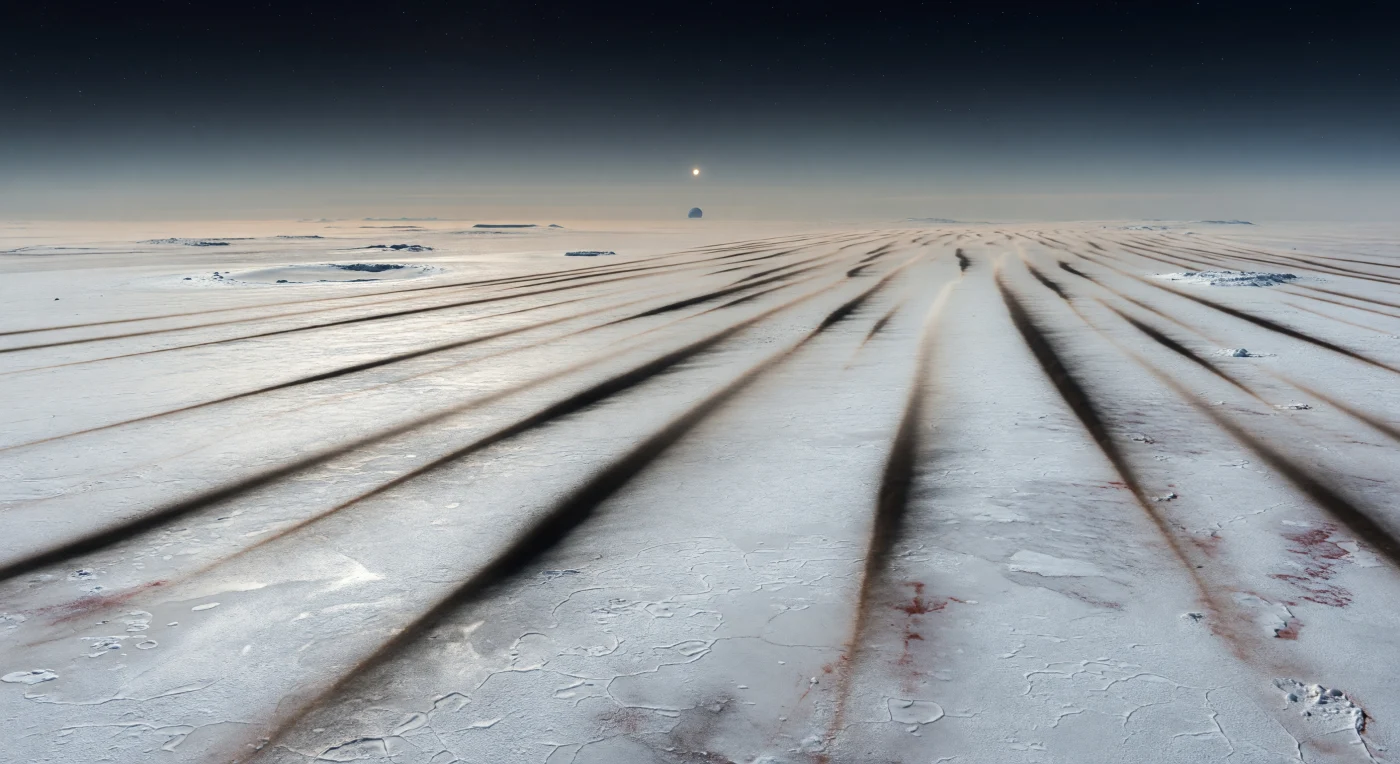
You are standing on an immense frozen plain where bright nitrogen ice and methane frost gleam under a tiny, distant Sun, their pale surface broken only by delicate polygonal cracks, shallow sublimation pits, and low ripples of frost. Across this nearly level expanse, long charcoal and umber streaks with feathered edges run in parallel bands to the horizon, the fallout traces of nitrogen geysers whose dark particles have been swept downwind for tens to hundreds of kilometers across the cryogenic surface. Here and there, slightly dirtier patches of water-ice regolith and reddish organic dust interrupt the luminous frost, while far-off icy rises, softened impact depressions, and isolated knobs of harder bedrock barely disturb the overwhelming flatness. Above, a sky that is almost black fades into a thin bluish-gray haze near the horizon, where the weak atmosphere subtly mutes the distance and makes the stark, striped landscape feel vast, silent, and profoundly alien.

At ground level, the landscape is a vast quilt of rounded tan-beige and muted salmon domes, each separated by shallow pits and softly scalloped troughs that give the uplands their uncanny cantaloupe texture. In the weak twilight of a tiny, star-like Sun, fine veneers of nitrogen and methane frost glint over protruding ledges of harder water-ice bedrock, while dark reddish-brown dust collects in sheltered hollows and delicate frost crusts fracture along the dome crests. These repeating cells, each tens of kilometers across, are thought to record tectonic deformation, diapiric upwelling, or cryovolcanic resurfacing in an ice shell shaped by extreme cold and a whisper-thin nitrogen atmosphere. Above the rolling frozen uplands, the sky stays almost black, yet a faint rose and lilac haze clings to the horizon, making the silence, the low gravity, and the immense scale feel both intimate and profoundly alien.

You are looking across a frozen tectonic belt where the crust of hard water ice has been stretched and broken into long, nearly parallel ridges and grooves that march for kilometers into a hazy horizon. Thin veneers of nitrogen and methane frost brighten the ridge crests to chalky white with a faint pink cast, while the troughs reveal darker blue-gray ice mixed with dust and photochemical deposits, a record of seasonal volatile transport on a world cold enough for these gases to freeze solid. In the weak, low-angle sunlight, every ridge throws a crisp charcoal shadow, making the landscape read as repeating bands of light and darkness, with sharp scarps, scattered broken blocks, and occasional fractures appearing especially stark in the moon’s low gravity and airless-seeming stillness. Above the faint bluish-brown haze of the tenuous nitrogen atmosphere, the sky deepens almost to black, and low over the distance hangs a small bluish disk of Neptune, giving the scene an eerie sense of standing on an active, captured outer-system world where ice behaves like rock and frost can migrate like weather.

A pale pink plain of frozen nitrogen and methane stretches outward in eerie stillness, its smooth cryogenic surface broken everywhere by clusters of jagged sublimation pits and scalloped collapse hollows, as if the ground has been quietly eaten away from within. Along the rims, thin white frost crusts catch the weak, distant sunlight, while the pit interiors fall into darker gray-brown and reddish tones where older ice and dust-rich lag deposits have been exposed by slow sublimation in this intensely cold environment. The low gravity and geologically young terrain make every depression and distant icy rise feel outsized, and under the moon’s tenuous nitrogen atmosphere only a faint bluish-gray haze gathers in the low ground beneath a nearly black sky. Standing here, you would see no liquid, no motion, only brittle exotic ices and delicate frost textures shaped by seasonal volatile transport, giving the landscape the austere beauty of an active world frozen almost beyond imagination.

A towering tectonic scarp rises abruptly from the frozen plain, its crest edged in dazzling white nitrogen frost that catches the distant sunlight like a blade, while the near-vertical face below drops into bluish-gray and steel-colored walls of fractured water-ice bedrock. At its base, shattered talus—angular blocks ranging from boulders to house-sized slabs—spills outward across compacted frost and powdery dark dust, with long razor-sharp shadows stretching over the smooth cryovolcanic lowlands beyond. In this brutal cold, every volatile is locked solid, and the cliff itself records crustal faulting in an ice-rich shell where low gravity helps preserve steep ledges, tension cracks, and towering polygonal slabs that would slump more quickly on heavier worlds. The sky above is almost black, yet near the horizon a faint nitrogen haze glows softly in the backlight, making the immense frozen escarpment feel at once silent, active, and profoundly alien.

You are standing on one of the few ancient surfaces that escaped renewal, where hard gray-white water-ice bedrock, peppered with darker rocky fragments, preserves a battered record of impacts now softened by immense age and the slow migration of exotic ices. Low, rounded crater rims stretch toward an improbably distant horizon, their floors partly glazed with bright nitrogen and methane frost while darker lag deposits—dust and less-volatile residue left behind as more volatile ice sublimates—collect in streaks and hollows across the fractured regolith. In the weak, star-like sunlight, long razor-sharp shadows and faint silver-blue reflections reveal polygonal cracks, scattered ice blocks, buried ejecta, and subtly embayed plains, all beneath a sky that is almost black overhead, fading only to a delicate haze near the horizon. The air is so thin and the gravity so slight that the landscape feels vast, silent, and eerily suspended, an ancient frozen remnant poised between impact history and ongoing atmospheric frost transport.

Across the basin floor, overlapping lobes of frozen cryolava spread outward like a stalled icy flood, their dirty-white to pale cyan-gray fronts edged by low levees, pressure ridges, and rippled crusts of water-ammonia ice that caught and froze in motion. Between the flow fronts lie patches of compact nitrogen frost, exposed bluish water ice, and scattered reddish-brown to charcoal plume dust, while polygonal cracks, low hummocks, and partly embayed older lobes record repeated resurfacing in one of the coldest active environments known. Far off, fault-block scarps, softened crater rims, and sharp icy hills stand out with unusual clarity in the weak but hard-edged sunlight, because the thin nitrogen atmosphere is too sparse to blur either distance or shadow; near the horizon, slender dark plume columns and their streamer-like fallout hint that this frozen landscape is still being reshaped today. Overhead, the sky remains almost black even at midday, fading to a faint bluish-gray haze near the horizon, and the immense silence, low gravity, and glassy glints on the ammonia-rich ice make the scene feel both starkly alien and geologically alive.

Under a perfectly black sky crowded with hard, unwavering stars, a frozen plain of silver-white nitrogen frost stretches away in gentle swells, its surface etched into polygonal sublimation patterns and broken by shallow pits, low ripples, and scattered blocks of darker water ice dusted with tholin-rich debris. Across the middle distance, faint charcoal streaks mark the tracks of ancient nitrogen geyser plumes, wind-laid bands that run for kilometers over a crust of volatile ice resting on harder water-ice bedrock, while subdued cryovolcanic rises and steep icy scarps loom unnaturally sharp in the weak gravity. The landscape is lit not by a sun, but by the cold cobalt glow of the giant world overhead, whose reflected light draws out dim blue shadows and tiny glints from crystalline frost without erasing the stars. Near the horizon, a delicate violet auroral veil briefly stains the darkness, a subtle sign that even this nearly airless, intensely cold desert still interacts with charged particles and remains a geologically active world.

From this brittle ridge near the limb, the ground is a mosaic of shattered nitrogen frost draped over hard water-ice bedrock, where jagged translucent plates, polygonal cracks, wind-softened drifts, and dark dust streaks from settled plume particles lead the eye across pale rose-beige cryovolcanic plains and subdued hummocks stretching for tens of kilometers. Low gravity and extreme cold have preserved a landscape of smooth volatile-ice patches, softly scalloped frozen flow lobes, partly buried impact scars, and the distinctive hummocky “cantaloupe” terrain, all under a sky so thin-aired it remains almost black except for a faint haze glowing along the horizon. There, an immense cobalt disk with subtle atmospheric banding hangs impossibly large, partly covering the tiny distant Sun and casting the scene into a spectral twilight: a razor-bright crescent of sunlight rims its edge while blue reflected light washes the frost and ice in a steel-blue sheen. Standing here, you would feel the profound stillness of a world where no liquid can exist at the surface—only frozen nitrogen, water ice, and traces of darker organic-rich dust—lit by both a dying sunbeam and the cold glow of a giant world.
