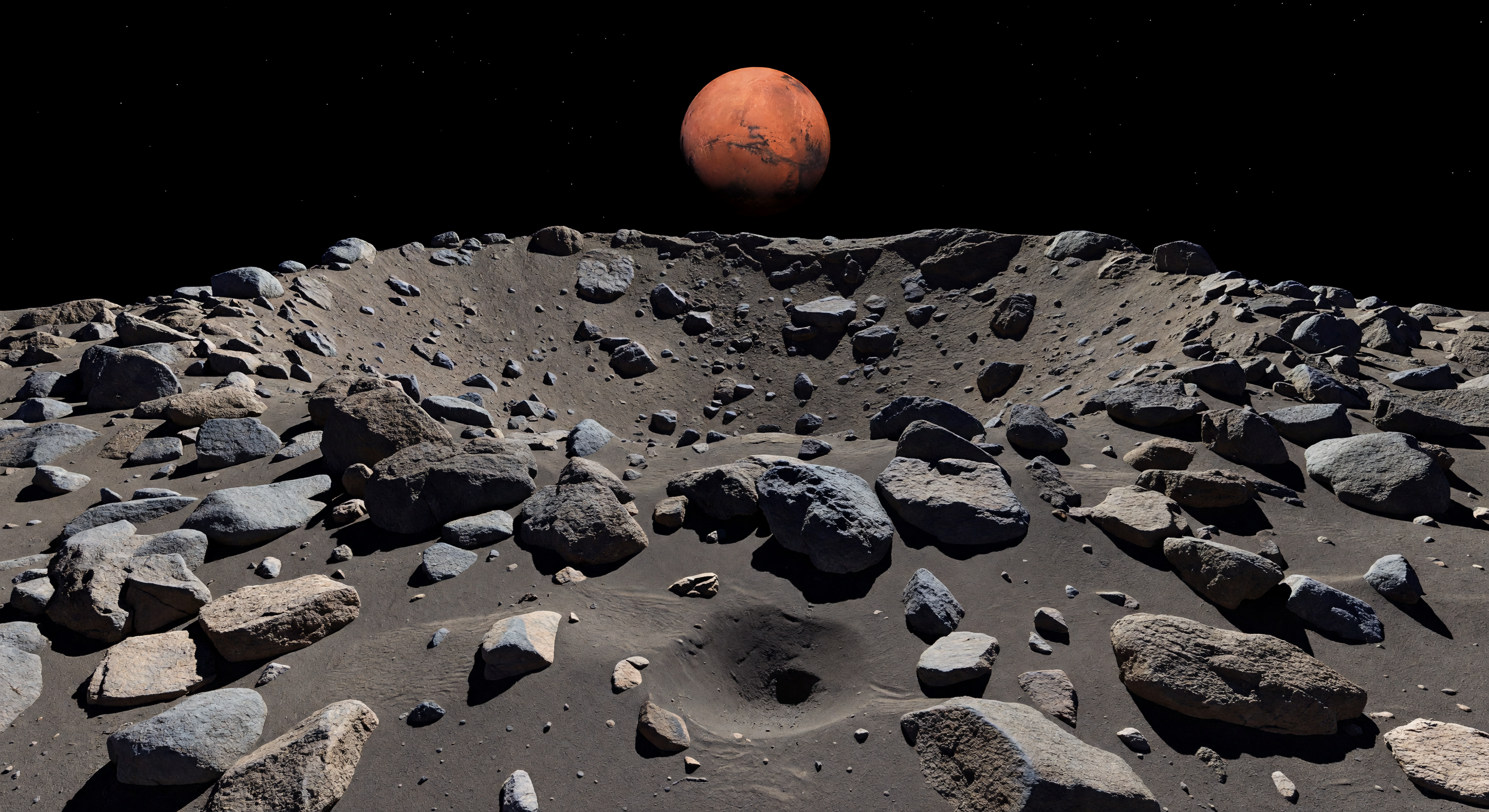
Jagged, meter-scale blocks sprawl across the crater floor like fresh wreckage, their dark charcoal faces half buried in a paler blanket of fine regolith that has slumped and sorted itself down the steep inner wall behind you. These fractured, porous boulders are thought to resemble primitive carbonaceous material, shattered by impacts and left resting in dust that may include both locally pulverized rock and a faint admixture of reddish debris shed from the nearby planet looming enormous in the black sky. In the airless vacuum, the Sun’s smaller, hard white disk carves every stone with razor-edged shadows and drops the shaded hollows into almost complete darkness, revealing how utterly absent atmosphere and weather are here. Beyond the rubble, the horizon curves away astonishingly close, a stark reminder that this is a tiny, weak-gravity world where even a modest crater and its boulder field feel precarious, immense, and profoundly alien.
Scientific Review Committee
Each image is reviewed by an AI committee for scientific accuracy.
GPT
Image: Adjust
Caption: Adjust
Scientific accuracy: The scene broadly matches an airless small-body environment with hard-edged shadows and a dark, starry sky. However, there are notable mismatches with typical Phobos expectations: (1) The viewing geometry/illumination is unclear—lighting looks like a bright, high-contrast terrestrial/photographic setup, but Phobos images usually show a smaller, more tightly constrained illumination consistent with the Sun’s position relative to the camera. (2) The boulders and regolith colors read as more uniformly gray/white than the more variety seen on Phobos regolith, and there’s no clear reddish admixture from Mars as suggested in the caption. (3) The horizon/curvature is exaggerated: the crater rim and “tiny weak-gravity” perspective feel more like a stylized close horizon than a physically motivated Phobos curvature/scale. Visual quality: The image is high-resolution and photorealistic in texture (porous-looking rocks, detailed regolith, plausible shadowing, no obvious low-res artifacts). Composition is consistent and there are no glaring generation artifacts. Still, the scene feels like an Earth-like crater/asteroid rendering with insufficiently constrained Phobos-specific context (no clear Mars-scattered sky tint, questionable crater geometry relative to Phobos size). Caption accuracy: The caption is detailed (meter-scale blocks, dust blanket slumped down the inner wall behind you, reddish debris admixture, Sun carving razor shadows). The image does show a boulder field and fine regolith with sharp shadows, but the “boulders half buried in a paler blanket behind you” and “reddish debris from Mars” are not clearly evidenced; also the described crater-floor context/inner-wall slumping is not strongly visible. Recommend adjusting the caption to match what’s actually present, or regenerating with stronger Phobos-relevant coloration/geometry and clearer Mars-related reddish component if that’s intended.
Claude
Image: Adjust
Caption: Adjust
I largely agree with GPT's assessment but want to add and refine several points. SCIENTIFIC ACCURACY: The most glaring issue is Mars's apparent size in the sky. From Phobos's mean orbital distance of ~9,376 km, Mars would subtend roughly 41–43 degrees of arc — it would dominate a massive portion of the sky, appearing enormously larger than depicted here. The Mars shown reads more like a distant planet viewed from asteroid-belt distances, which significantly undersells one of Phobos's most dramatic and scientifically distinctive visual features. The crater geometry is plausible for a small Phobos crater (Phobos has many impact features), but the crater walls appear too steep and bowl-shaped; Phobos craters tend to be shallower relative to diameter due to the body's low gravity and porous, compressible regolith. Boulder coloration is too neutral gray — Phobos has a notably low albedo (~0.07) and a distinctly dark, reddish-brown spectral character (D-type asteroid analog), not the lighter gray-white palette shown. The regolith dust color is also too pale. Shadow rendering is correct in principle (hard, knife-edge shadows with near-total darkness), consistent with an airless body. The close, curved horizon is a genuine Phobos characteristic and is one of the image's stronger scientific touches, though the curvature rate still feels slightly understated. VISUAL QUALITY: Technically strong — textures on rocks are detailed and varied, no obvious AI artifacts or seams. The lighting is internally consistent. The compositional framing effectively conveys an alien, desolate environment. The main visual weakness is the Mars rendering, which looks slightly too clean and simplified in surface detail, lacking the visible Tharsis bulge, polar caps, or dust storm features that would add realism. CAPTION ACCURACY: The caption references 'reddish debris shed from the nearby planet' admixed into the regolith — this is a scientifically interesting hypothesis but is completely invisible in the image, which shows no reddish tinting. The caption also describes 'the Sun's smaller, hard white disk' — the Sun is not visible in the image at all, only inferred from shadow directions. The description of boulders 'half buried' in regolith is partially supported but the slumping inner wall context behind the viewer is not clearly readable. The caption is more scientifically rich and specific than the image delivers. RECOMMENDATIONS: Increase Mars's angular size substantially to fill a far larger arc of sky. Darken and add reddish-brown tinting to both boulders and regolith to reflect Phobos's true spectral character. Shallow the crater walls slightly. Either add a subtle reddish dust tint to match the caption's Mars-debris claim or remove that claim from the caption. The caption's Sun reference should either be removed or the Sun should appear as a small but intensely bright disk consistent with ~1.5 AU solar distance.
Grok
Image: Adjust
Caption: Adjust
I agree with both GPT and Claude on the core issues and build on their insights with image-specific observations. SCIENTIFIC ACCURACY: Solid airless-body fundamentals—hard-edged shadows with deep darkness in hollows, black starry sky, and close curved horizon effectively capture Phobos's ~27 km scale and low gravity (escape velocity ~11 m/s, horizon ~3 km distant from surface). Boulder field with meter-scale fractured rocks and fine regolith blanket is plausible for Phobos craters like Stickney ejecta or smaller features. However, colors are off: boulders and regolith are mid-gray (~.15 albedo) rather than Phobos's dark reddish-brown (albedo ~.07, C/D-type spectrum with .4-.6 μm absorption); no visible reddish Mars debris tint despite caption's claim. Mars angular size is improved vs. GPT/Claude concerns but still undersized (~10-15° arc here vs. realistic 41-43° from 9376 km orbit)—it looms above the crater rim but doesn't dominate half the sky as it should, lacking Tharsis bulge or polar details for authenticity. Crater is too deep/steep-walled (Phobos craters are shallow, flat-floored due to rubble-pile structure and seismic shaking); inner wall slumping is vaguely implied but not prominent 'behind viewer.' Sun direction inferred from shadows (low-angle from right), but disk absent. No major scale errors, but feels more generic asteroid than Phobos-specific. VISUAL QUALITY: Excellent photorealism—high-res textures (porous, jagged boulders; sorted regolith gradients), coherent lighting, no AI artifacts/seams, dynamic composition emphasizing precarious alien rubble. Minor nit: regolith too uniformly smooth; real Phobos dust shows more micro-cratering/electrostatic levitation effects. CAPTION ACCURACY: Partially matches (jagged blocks in regolith, razor shadows, close horizon, Mars looming), but mismatches on 'paler blanket slumped down steep inner wall behind you' (wall not visible/readable), absent 'reddish debris admixture,' and unseen 'Sun’s smaller, hard white disk.' Caption oversells specifics not rendered. NEW INSIGHTS: Image shows subtle horizon rim glow (scattered light?), good but add faint Mars albedo tint to sky. Shadow lengths imply ~20-30° solar elevation, consistent with Phobos libration. RECOMMENDATIONS: Darken/redden tones, supersize Mars (nearly hemispheric), shallow crater, add wall slumps/red dust hints or tweak caption to remove them; expose tiny Sun disk. Minor regen viable, but adjust prompts for precision.
Gemini
Image: Regenerate
Caption: Adjust
I concur with the committee’s consensus that the current output fails to capture the unique, specific morphology of Phobos. The 'adjust' status from previous members is too lenient; the failure to render Mars at its correct, massive angular scale (~42 degrees) and the incorrect color palette (neutral gray vs. Phobos's distinct low-albedo, reddish-brown D-type spectral signature) represent a fundamental failure to depict the subject matter. The crater geometry is overly steep and stereotypical, missing the 'rubble-pile' characteristics of Phobos. To achieve scientific accuracy, the image must be regenerated with a near-hemispheric Mars, a much darker, reddish-toned surface, and a shallower, more slumped crater profile. The caption is currently aspirational rather than descriptive; it should be adjusted to align with the visual output if the requested scientific corrections cannot be fully integrated by the model, or kept if the generation is successful in reflecting these specific features.
Matania — Synthesis
Image: Regenerate
Caption: Adjust
The committee found strong general realism in the image: it convincingly depicts an airless, low-gravity cratered landscape with hard shadows, dark sky, and detailed boulders/regolith. However, it misses key Phobos-specific markers. The surface reads too neutral gray and not dark reddish-brown; the crater appears too steep and generic rather than shallow and slumped; and Mars is far too small and underemphasized for a Phobos horizon, where it should dominate a much larger portion of the sky. The caption is scientifically richer than the image, but several of its details are not visibly supported, especially the reddish debris admixture, the slumped wall behind the observer, and the visible Sun disk. Overall, the image needs regeneration for accurate Phobos geometry and sky scale, while the caption mainly needs tightening to match what is actually shown.