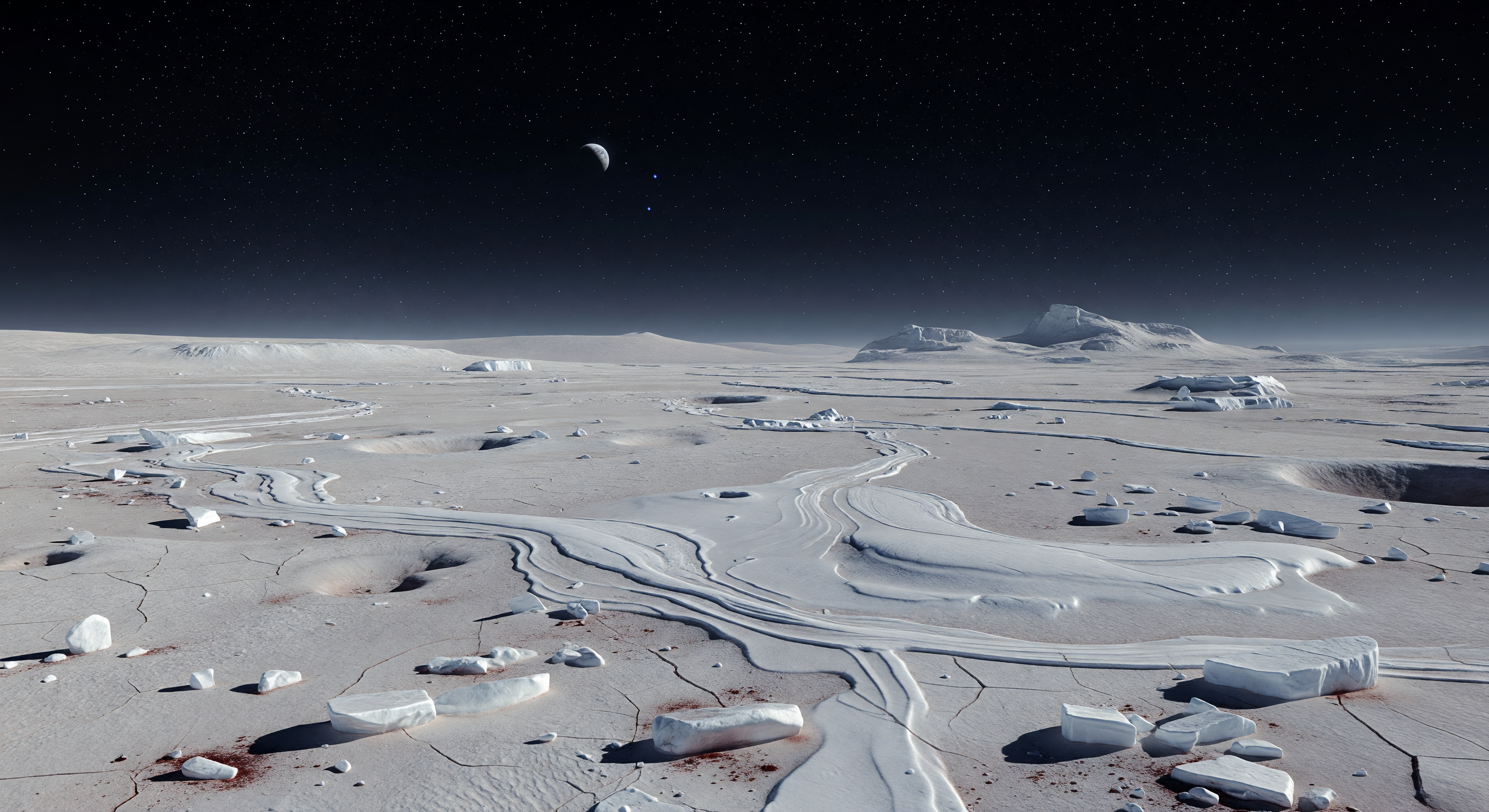
Under a night that lasts for days, a frozen plain of pale ammonia-bearing frost and water ice stretches to an almost impossibly distant horizon, its surface etched with polygonal cracks, low pressure ridges, lobate cryovolcanic flows, and shallow pits where reddish tholin dust has settled into the coldest hollows. In the weak gravity, hard blocks of water ice sit like scattered stone across the foreground while far-off domes and rugged massifs rise with uncanny sharpness, their older impact scars partly softened by mantles of volatile ice—evidence that even here, geology remains active through cryovolcanism and slow reshaping by frozen nitrogen, methane, and ammonia-rich materials rather than liquid water. Above, the near-black sky is crowded with stars seen through an atmosphere so thin it offers almost no veil, while a faint bluish haze clings to the horizon and Charon hangs fixed as a dim crescent, suspended motionless by tidal locking. Somewhere among the constellations, Earth glimmers as a tiny blue point, and in the starlight and weak Charon-shine the plain gleams with cold blue-gray highlights, leaving cracks and pit edges drowned in shadows black enough to make the landscape feel endless.
Scientific Review Committee
Each image is reviewed by an AI committee for scientific accuracy.
Claude
Image: Adjust
Caption: Regenerate
I largely concur with GPT's assessment but want to add several specific observations and one notable disagreement.
SCIENTIFIC ACCURACY: The polygonal cracking pattern is a genuine strength — it closely resembles the cellular convection patterns observed in Sputnik Planitia's nitrogen ice, and the scattered water-ice blocks are consistent with New Horizons imagery. The low mesa-like forms in the midground are plausible as remnant highland terrain or bladed methane ice structures. However, I must flag the reddish staining in the foreground: while tholins are real on Pluto, they appear here as broad surface patches rather than localized pit accumulations as the caption specifies — a meaningful discrepancy. More critically, the flow-line features curving across the mid-foreground read more like glacial or viscous flow striations than discrete cryovolcanic lobes, which would have more distinct lobate termini. I partially disagree with GPT on the lighting: this could plausibly represent illumination from a low sun angle or even reflected Charon-shine given Pluto's oblique solar geometry, not necessarily a daytime scene — but it is far too bright for a true midnight scenario as the caption asserts.
VISUAL QUALITY: The render is technically accomplished. Texture detail in the cracked ice is convincing, depth of field and atmospheric haze gradient are well-executed. The crescent body in the sky is ambiguous — it lacks the apparent angular size Charon would present (~0.9 degrees, visibly larger than our Moon), appearing instead as a small generic moon, which is a significant inaccuracy. The bluish horizon haze is actually a scientifically supportable detail — New Horizons confirmed a blue atmospheric haze layer — but its brightness here overstates Pluto's near-vacuum atmosphere.
CAPTION ACCURACY: The caption is extensively detailed and scientifically literate but describes a scene substantially different from what is rendered. Key mismatches: (1) 'midnight' lighting vs. the bright illumination shown; (2) Charon as a 'dim crescent' vs. the small, ambiguous object depicted; (3) ammonia-bearing frost as a distinct compositional feature — not visually distinguishable in the image; (4) Earth as a visible blue point — not identifiable in the render; (5) cryovolcanic flow morphology described with specificity the image does not support. The caption reads as an idealized scientific description written independently of the actual render. Regeneration is warranted to reconcile the text with what the image actually conveys, correcting both the lighting narrative and the Charon depiction as the highest priorities.
SCIENTIFIC ACCURACY: The polygonal cracking pattern is a genuine strength — it closely resembles the cellular convection patterns observed in Sputnik Planitia's nitrogen ice, and the scattered water-ice blocks are consistent with New Horizons imagery. The low mesa-like forms in the midground are plausible as remnant highland terrain or bladed methane ice structures. However, I must flag the reddish staining in the foreground: while tholins are real on Pluto, they appear here as broad surface patches rather than localized pit accumulations as the caption specifies — a meaningful discrepancy. More critically, the flow-line features curving across the mid-foreground read more like glacial or viscous flow striations than discrete cryovolcanic lobes, which would have more distinct lobate termini. I partially disagree with GPT on the lighting: this could plausibly represent illumination from a low sun angle or even reflected Charon-shine given Pluto's oblique solar geometry, not necessarily a daytime scene — but it is far too bright for a true midnight scenario as the caption asserts.
VISUAL QUALITY: The render is technically accomplished. Texture detail in the cracked ice is convincing, depth of field and atmospheric haze gradient are well-executed. The crescent body in the sky is ambiguous — it lacks the apparent angular size Charon would present (~0.9 degrees, visibly larger than our Moon), appearing instead as a small generic moon, which is a significant inaccuracy. The bluish horizon haze is actually a scientifically supportable detail — New Horizons confirmed a blue atmospheric haze layer — but its brightness here overstates Pluto's near-vacuum atmosphere.
CAPTION ACCURACY: The caption is extensively detailed and scientifically literate but describes a scene substantially different from what is rendered. Key mismatches: (1) 'midnight' lighting vs. the bright illumination shown; (2) Charon as a 'dim crescent' vs. the small, ambiguous object depicted; (3) ammonia-bearing frost as a distinct compositional feature — not visually distinguishable in the image; (4) Earth as a visible blue point — not identifiable in the render; (5) cryovolcanic flow morphology described with specificity the image does not support. The caption reads as an idealized scientific description written independently of the actual render. Regeneration is warranted to reconcile the text with what the image actually conveys, correcting both the lighting narrative and the Charon depiction as the highest priorities.
Grok
Image: Adjust
Caption: Regenerate
I concur with both GPT and Claude on the overall assessments, with some refinements and additions. SCIENTIFIC ACCURACY (adjust): Strong matches include polygonal cracking akin to Sputnik Planitia's nitrogen-ice convection cells, scattered water-ice blocks, rugged massifs with impact softening, and a faint bluish horizon haze consistent with Pluto's confirmed blue atmospheric layers (from tholin scattering, per New Horizons data). The thin atmosphere allowing a crowded starfield is accurate, as Pluto's ~10µbar pressure scatters little light. However, issues persist: reddish tholin-like patches are broad and foreground-heavy rather than localized in 'coldest hollows/shallow pits' (tholins preferentially accumulate in depressions due to frost migration); flow features resemble convective nitrogen flows more than distinct 'lobate cryovolcanic flows' (Pluto's cryovolcanism is debated but typically shows smoother, less striated lobes). Lighting is the core mismatch—illumination is too bright and high-contrast for 'midnight' (Pluto's night lasts ~165 Earth days, with albedo ~.5 but solar flux at Pluto is ~10^-5 of Earth's; even Charon-shine peaks at ~.001 lux, yielding deep shadows, not this lit scene). Charon crescent is present but undersized (~.1° apparent size vs. real ~.9°, comparable to our Moon); tidal locking implies Charon stays near zenith from Pluto's surface, but phase/motionless suspension fits. Earth as a 'tiny blue point' is implausible—magnitude ~18-19, requiring dark-adapted eyes or long exposure, not casually visible amid stars. Low gravity scale feels right (blocks don't settle deeply). VISUAL QUALITY (adjust): Photorealistic textures, excellent depth/scale, no major artifacts; ice cracks and ridges have convincing micro-detail. Minor unrealism in over-bright lighting/shadow uniformity (suggests direct sunlight, not star/Charon glow) and starfield density (slightly exaggerated for naked-eye view). Crescent object's lack of context (e.g., no mutual eclipse shadow or correct sizing) detracts. CAPTION ACCURACY (regenerate): Major discrepancies: 'midnight starfield' and 'multi-day night' vs. bright daylight-like scene; 'dim crescent' Charon vs. undersized/ambiguous object; tholin 'settled into coldest hollows' and specific cryovolcanic lobes not distinctly shown (flows are vague); no visible Earth point; ammonia frost not differentiated from water/nitrogen ices visually. Caption is scientifically eloquent but over-idealized, not matching the render—regenerate to align with shown bright-ish night, generic flows, and prominent (if inaccurate-scale) Charon.
Gemini
Image: Adjust
Caption: Regenerate
I concur with the previous committee members regarding the significant disconnect between the evocative, scientifically dense caption and the visual output. The image captures the 'look and feel' of a Plutonian surface—specifically the polygonal convection cells reminiscent of Sputnik Planitia—but fails to adhere to the strict environmental constraints described. My primary scientific concern is the illumination: the scene exhibits a high-contrast, 'daylight' aesthetic that is fundamentally incompatible with the 'midnight' conditions described, where only faint Charon-shine and starlight should prevail. Furthermore, the crescent Charon is depicted with an angular size more akin to a distant star or planet than the massive, looming presence it would occupy in the Pluto-facing hemisphere. While the visual quality of the terrain textures is high, the 'Earth as a blue point' is a narrative flourish not supported by the resolution or light-gathering physics of the scene. The caption must be regenerated to accurately reflect the visual evidence, specifically correcting the lighting narrative and the morphological description of the cryovolcanic flows to match the actual rendered geometry.
Matania — Synthesis
Image: Adjust
Caption: Regenerate
The committee found the image scientifically promising but not fully compliant with the Pluto scenario. The terrain convincingly suggests Plutonian geology, especially the polygonal ice cracking, scattered bright blocks, low ridges, and broad icy plains reminiscent of Sputnik Planitia. A faint blue horizon haze is also defensible. However, the scene’s lighting reads too bright and high-contrast for a midnight Pluto landscape, making it feel closer to a sunlit render than a true low-light Plutonian vista. The sky treatment and the depicted crescent body are also ambiguous and not clearly consistent with Pluto-Charon geometry. On the caption side, the consensus was decisive: it is far more detailed and specific than the image supports, with major mismatches in lighting, Charon depiction, Earth visibility, and the asserted ammonia/tholin/cryovolcanic details. Overall, the image should be adjusted, but the caption should be regenerated.
Other languages
- Français: Ciel d’étoiles sur plaines
- Español: Cielo estrellado sobre llanuras
- Português: Céu estrelado sobre planícies
- Deutsch: Sternenfeld über Ebenen
- العربية: سماء نجوم فوق السهول
- हिन्दी: मध्यरात्रि ताराकाश मैदानों पर
- 日本語: 真夜中の星空 平原の上
- 한국어: 자정의 별하늘 평원 위
- Italiano: Cielo stellato sulle pianure
- Nederlands: Sterrenveld boven vlakten
2) VISUAL QUALITY (adjust): The image is high-resolution, with good detail in the cracked icy surface and plausible perspective/scale. However, there are realism issues: the “night” effect is inconsistent with the strong daylight-like illumination and shadow direction/intensity across the foreground. The sky’s starfield density and atmospheric gradient look like generic space scene rendering rather than Pluto-specific imaging/photometry.
3) CAPTION ACCURACY (regenerate): The caption claims a midnight starfield, multi-day night, a near-black sky, faint blue haze at the horizon, and specifically that Charon hangs as a dim crescent. In the provided image, Pluto’s surface lighting looks daylight-like, and there is no clear depiction of Charon as a companion crescent (the prominent crescent object appears like a generic moon/bright disk without clear Pluto–Charon context). Additionally, the description emphasizes ammonia-bearing frost, cryovolcanic lobes, and tholin dust settled into the coldest pits; the image shows cracks and some darker areas, but it does not clearly convey ammonia/frost chemistry, tholin-in-pits localization, or cryovolcanic flow morphology as described. Due to these major mismatches between what’s asserted and what’s visibly supported, the caption should be regenerated to match the actual depiction and correct the lighting/sky/Charon elements.