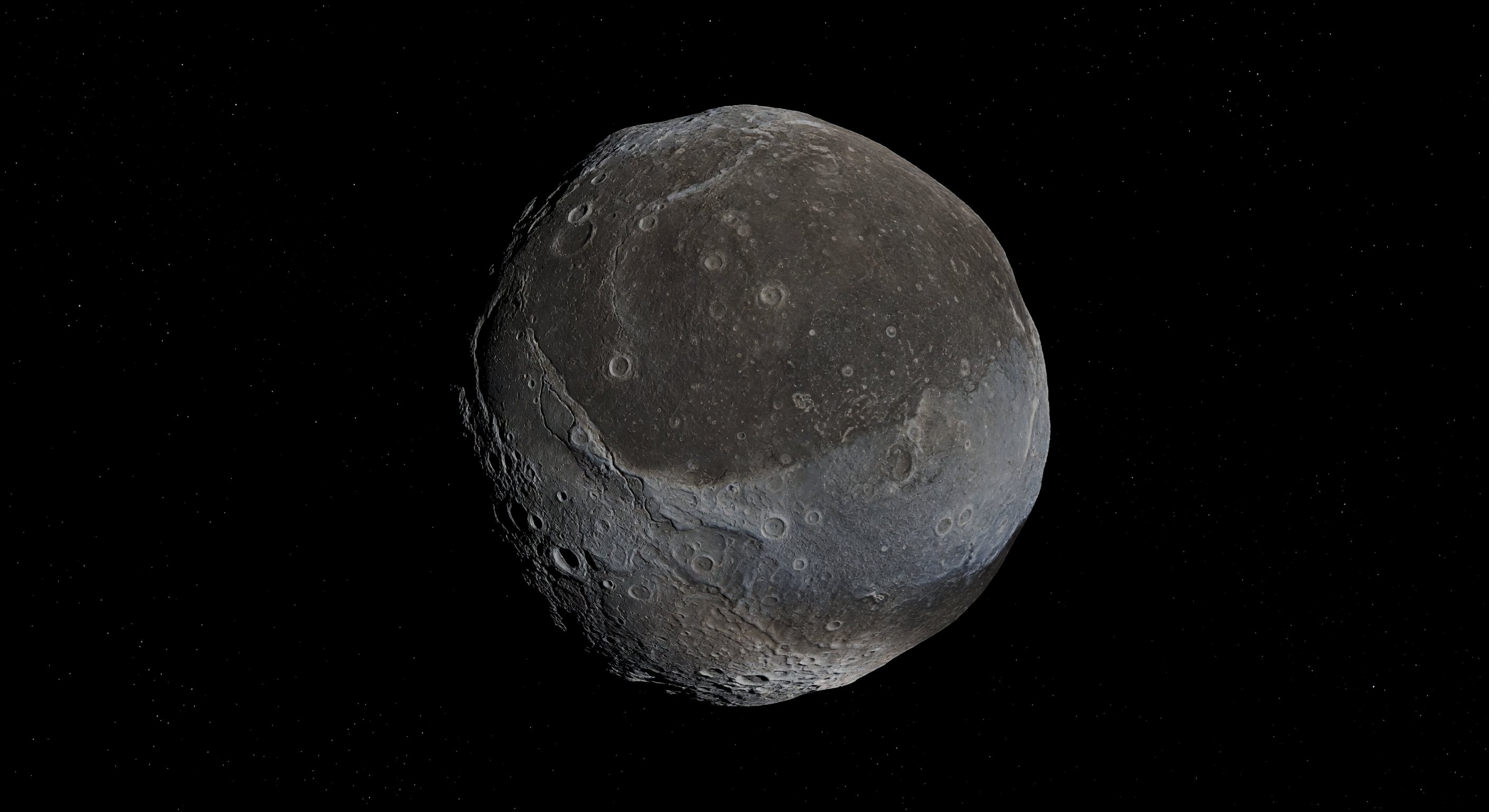
Scientific confidence: Low

From the floor of Pharos, the landscape spreads out as a vast, muted plain of compacted slate-gray to charcoal regolith, its granular surface broken by small secondary craters, low hummocky rubble mounds, and scattered angular blocks of ice-rock breccia. This dark material is thought to be a mixture of dirty water ice, silicate fragments, and carbon-rich debris, reworked by countless impacts and slowly altered by long exposure to radiation and micrometeoroid bombardment in vacuum. Under the weak but unforgiving midday Sun, every pebble and crater rim throws a razor-sharp shadow into the black, airless sky, while the distant basin wall curves across the horizon with no haze to soften its immense scale. Above it all, the giant blue disk of Neptune hangs silently overhead, making the scene feel both frozen in time and profoundly alien.

You are standing on an immense equatorial plain where crater overlaps crater to the horizon, their rims worn low and softened into a dark, gently rolling surface of powdery regolith and fractured icy rock. This ancient terrain records billions of years of impacts into a crust made largely of water ice mixed with silicate and carbon-darkened material, with constant micrometeorite “gardening” churning the surface into fine grains and muting what were once sharper scars. In the weak gravity, some ejecta blocks and crater walls still hold slightly steeper faces than they would on a larger world, yet under the high, hard sunlight the landscape feels old and subdued rather than rugged, every shallow depression and buried ridge etched with airless clarity. Above the black, star-pricked sky hangs a huge blue planet, while below it the plain stretches outward in cold charcoal and dirty-ice tones, a silent fossil field of impacts on a small world too cold and inactive to erase its past.
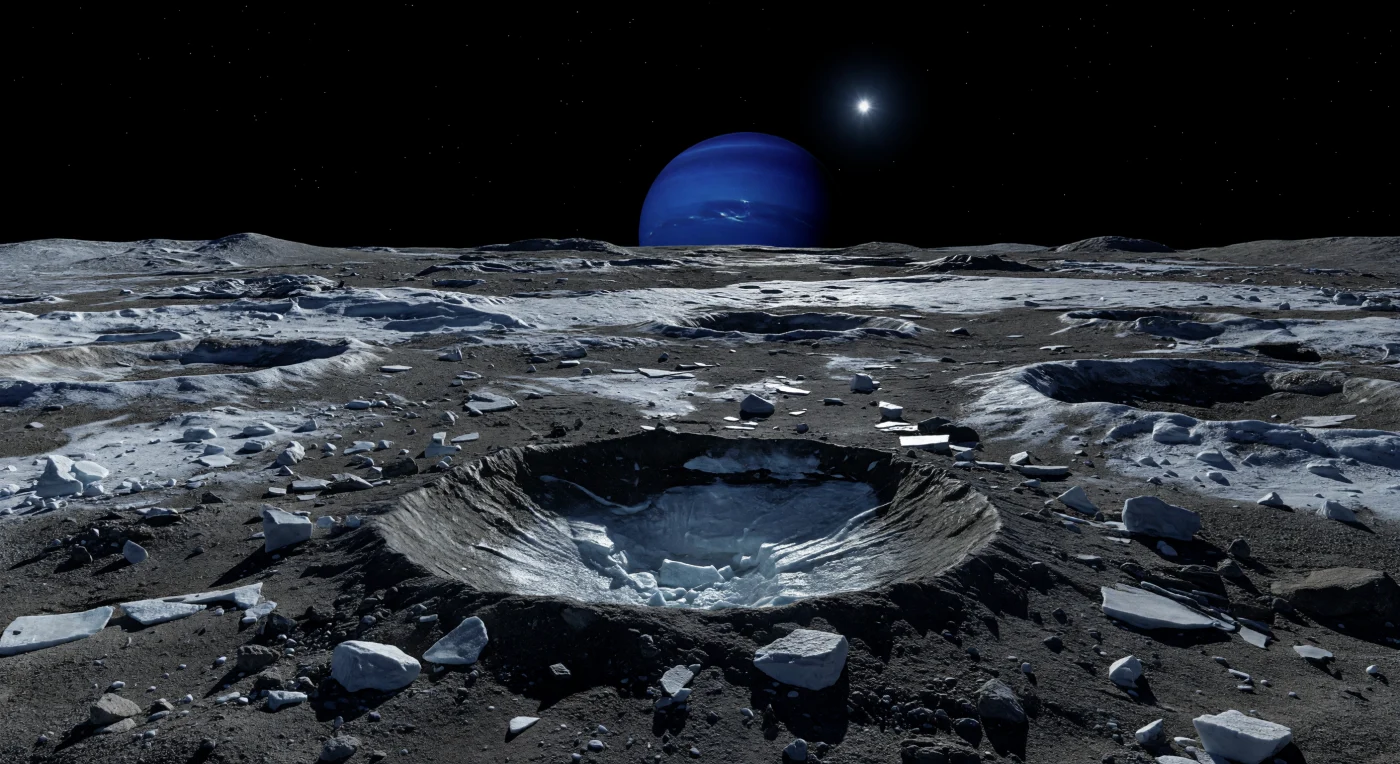
You stand at the edge of a young bowl-shaped crater whose razor-sharp rim and steep walls have punched through Proteus’s dark, carbon-rich ice-rock crust, scattering a crisp radial apron of brighter bluish-gray material across the older charcoal plain. The fresh ejecta, rich in cleaner water ice, lies among house-sized angular blocks and shattered slabs that remain stark and jagged in the moon’s feeble gravity, with almost no erosion to soften them. Beyond, ancient craters and hummocky rises stretch across a battered, irregular landscape, while the tiny distant Sun casts cold, hard light that carves inky black shadows and flashes off exposed ice faces. Above the airless silence, stars linger in a black sky and a vast cobalt disk with faint pale bands hangs overhead, making the frozen rubble at your feet feel both intimately detailed and dwarfed by the scale of the outer solar system.

From this jagged perch on Pharos’s shattered rim, the ground is a chaos of angular charcoal-dark breccia, fractured water-ice bedrock, and scattered blocks that plunge down steep terraces into an enormous impact basin whose far walls remain starkly visible across immense distances in the airless clarity. Proteus’s weak gravity and deep cold have preserved a landscape of unusually sharp relief for such a small moon: serrated outcrops, slump scars, talus slopes, hummocky ejecta, and secondary craters remain crisp because there is no atmosphere, no liquid erosion, and no weather to soften them. The surface materials appear dark because dirty ice is mixed with silicate and carbon-rich debris, while exposed ice flashes with cold white glints under the tiny, low Sun, which casts kilometer-long shadows black as ink. Above the horizon hangs a colossal blue Neptune, nearly motionless in the sky, turning this silent overlook into a place that feels both frozen in time and vast beyond measure.
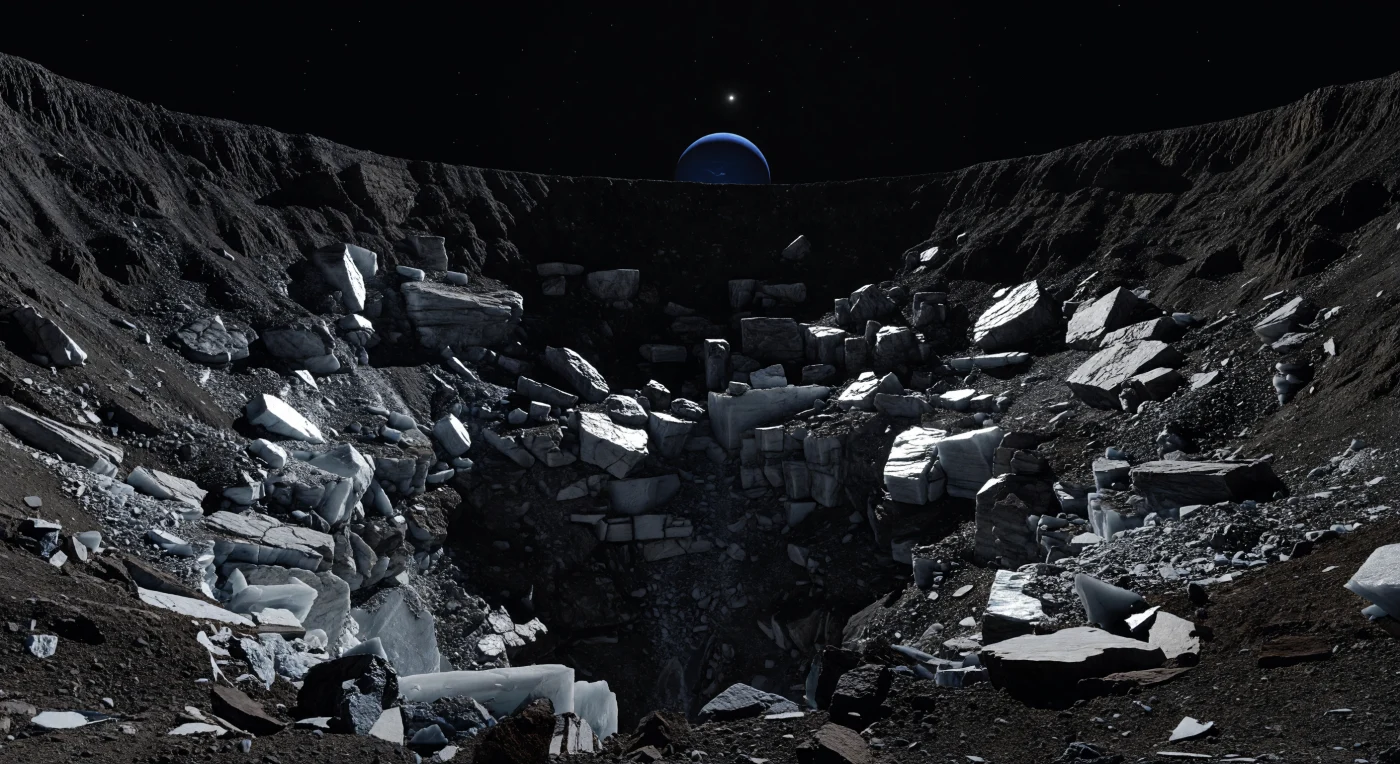
From the base of this oversteepened crater wall, the ground appears to be flowing in slow motion: house-sized to cliff-sized angular blocks of water ice and ice-rich rock, shattered slabs, and coarse talus spill downward through charcoal-dark regolith into a basin of complete shadow. In the hard, airless light, freshly broken faces flash silver-blue and pale gray, while older surfaces are dulled by space weathering and micrometeorite gardening, recording a surface made of porous ice mixed with darker rocky material and preserved in the deep cold of the outer Solar System. The tiny Sun casts razor-sharp black shadows between perched monoliths, collapsed scarps, and narrow debris chutes, exaggerating the jagged relief that weak gravity allows to remain so steep and unstable. High above the distant rim, a vast blue disk hangs in the star-filled blackness, making the enclosed slope feel at once intimate and immense, as if you are standing inside a frozen avalanche suspended for ages in silence.

You stand amid a chaos of overlapping crater rims that have fused into serrated highlands, where steep saddles, knobby massifs, and angular scarps rise from a surface of shattered water-ice bedrock darkened by rocky and carbon-rich contaminants. In the weak gravity of this small, unsphered moon, impact debris and breccia remain piled in rough block fields and talus-like slopes, while hollows trap fine regolith dust and every ridge is sharpened by long, black shadows cast by the distant Sun. Most of the crust is charcoal-dark, but fresh breaks expose cleaner ice that flashes pale white to faint blue in the grazing light, revealing the moon’s mixed icy composition and relentless impact history. Above the subtly curving horizon, a huge luminous blue disk hangs in a black, airless sky, making the landscape feel at once frozen, ancient, and startlingly close to the edge of space.
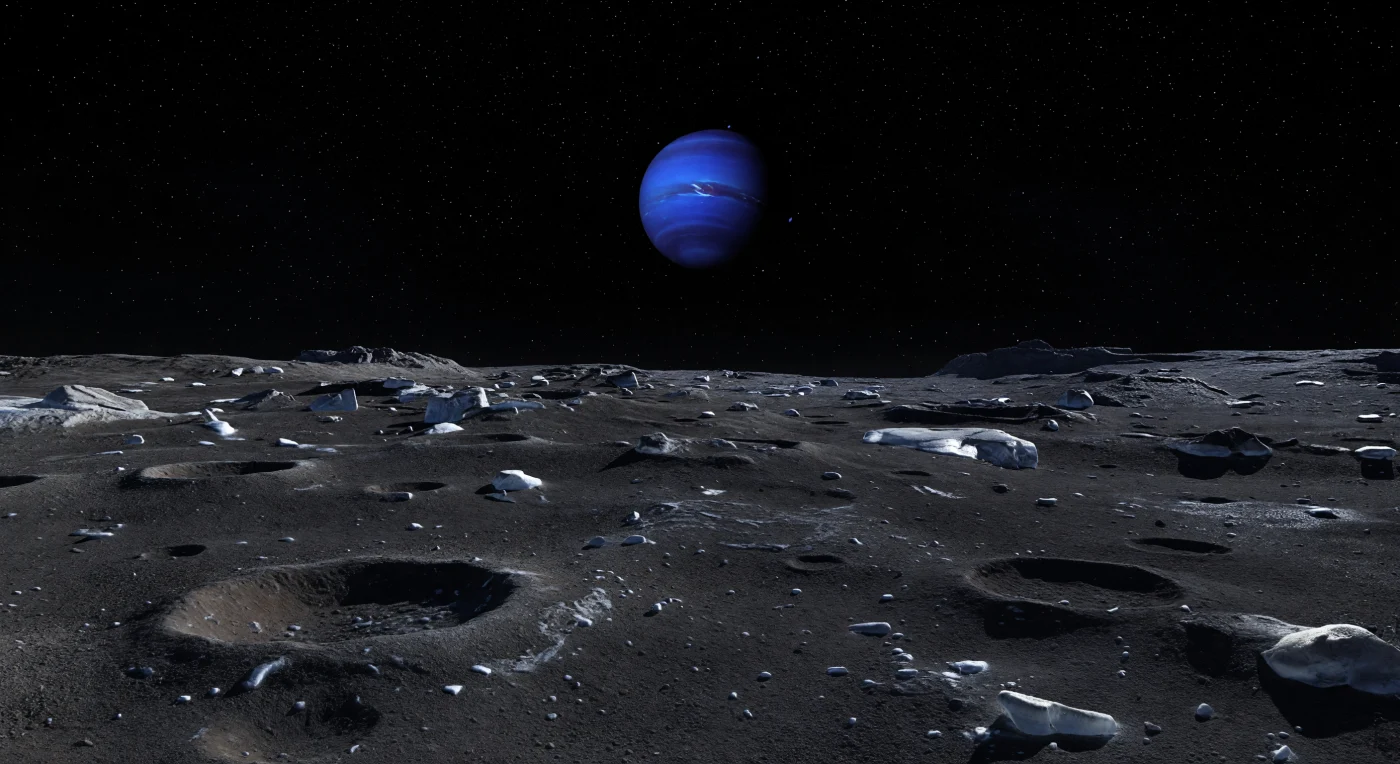
Under a pitch-black, star-crowded sky, a broad plain of charcoal-dark regolith rolls away in gentle swells, its shallow overlapping craters and muted ejecta ridges barely lifted by the weak gravity of this battered, irregular moon. The ground is a mixture of impact-churned dirty water ice, rocky fragments, and carbon-rich dark material, with scattered angular boulders and occasional brighter ice broken open on fresh scarps, all softened by eons of micrometeorite bombardment in absolute vacuum. Above the horizon hangs an immense cobalt disk streaked with pale cloud bands, flooding the landscape with an eerie blue planetary glow that creates soft, low-contrast yet razor-sharp shadows impossible on any world with air. In the distance, low crater walls and isolated knobby uplands hint at a body too small and cold to have relaxed into a sphere, leaving you surrounded by an ancient frozen surface that feels both starkly still and unimaginably vast.

From the floor of this polar shadow crater, the landscape is almost swallowed by darkness: a jagged plain of charcoal-black rubble, shattered boulders, and granular ice-rich regolith, with only a few bluish-gray frost patches faintly lifting out of the gloom. The towering crater walls rise steeply overhead in crisp ledges, slump terraces, and talus slopes, their heavily cratered water-ice bedrock darkened by space weathering and mixed with carbon-rich and silicate material, preserving sharp relief because the airless, frigid surface experiences virtually no erosion. In the weak vacuum clarity, stars burn above while a giant blue planet hangs low beyond the rim, casting a dim cold glow that barely traces the frost and the edges of house-sized blocks across this ancient, uneven floor. The scene feels immense yet frozen in time, revealing how a small world with extremely low gravity can remain rugged, irregular, and mechanically strong instead of relaxing into a smoother sphere.
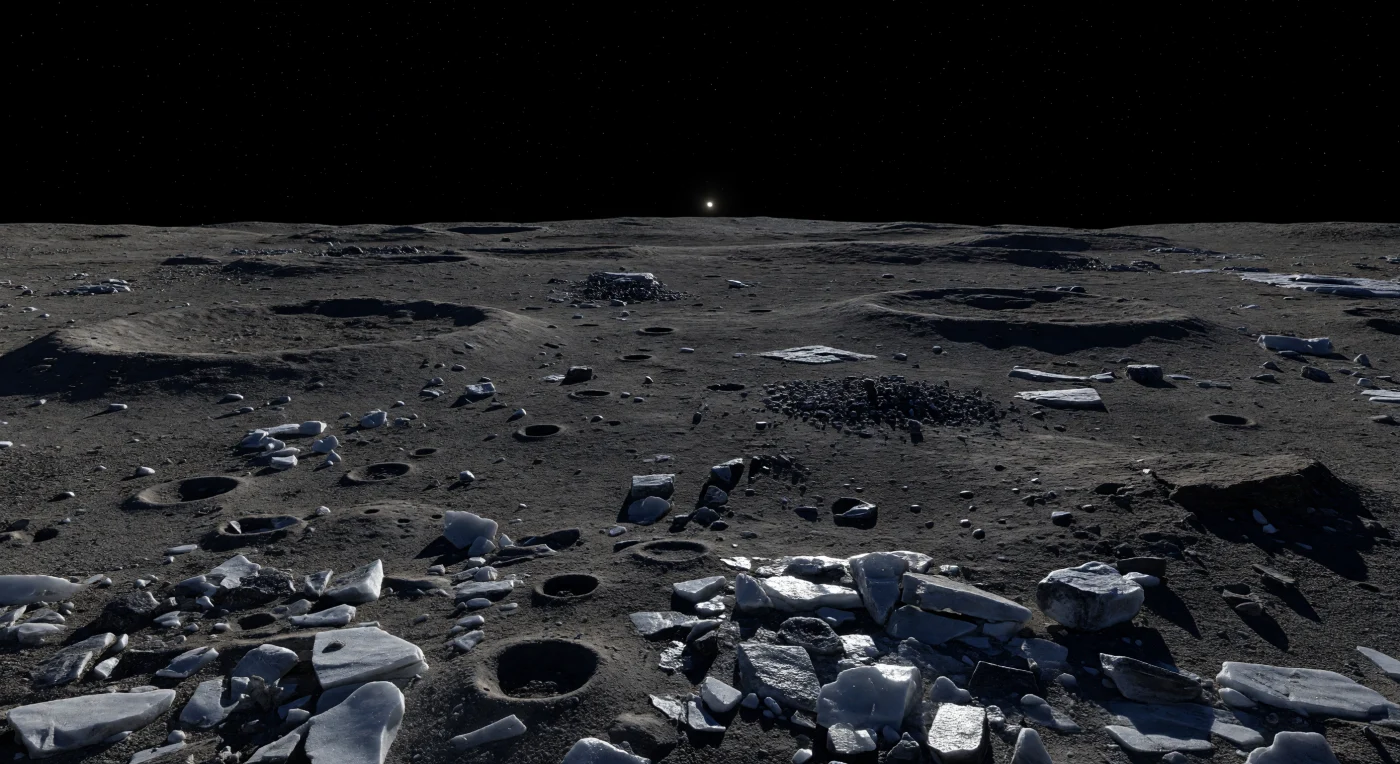
From this anti-planet-facing lowland, the view is a silent plain of charcoal-dark ice and impact-shattered debris, where countless small bowl-shaped craters overlap across the ground and older rims fade into subdued circular swells under a black, star-filled sky. The surface is thought to be water-ice bedrock mixed with silicate material and carbon-darkened contaminants, giving it a slate-gray to brown-black tone, while occasional exposed ice facets catch the weak sunlight in faint bluish-white glints. With no atmosphere to soften the scene, every rock edge and crater shadow appears razor-sharp in the dim, highly directional twilight of the tiny distant Sun, and the subtly curving horizon reveals the small scale and weak gravity of this ancient, irregular moon. Standing here would feel like standing in a frozen vacuum relic of the outer Solar System: inert, heavily cratered, and preserved almost unchanged by eons of impacts and space weathering.
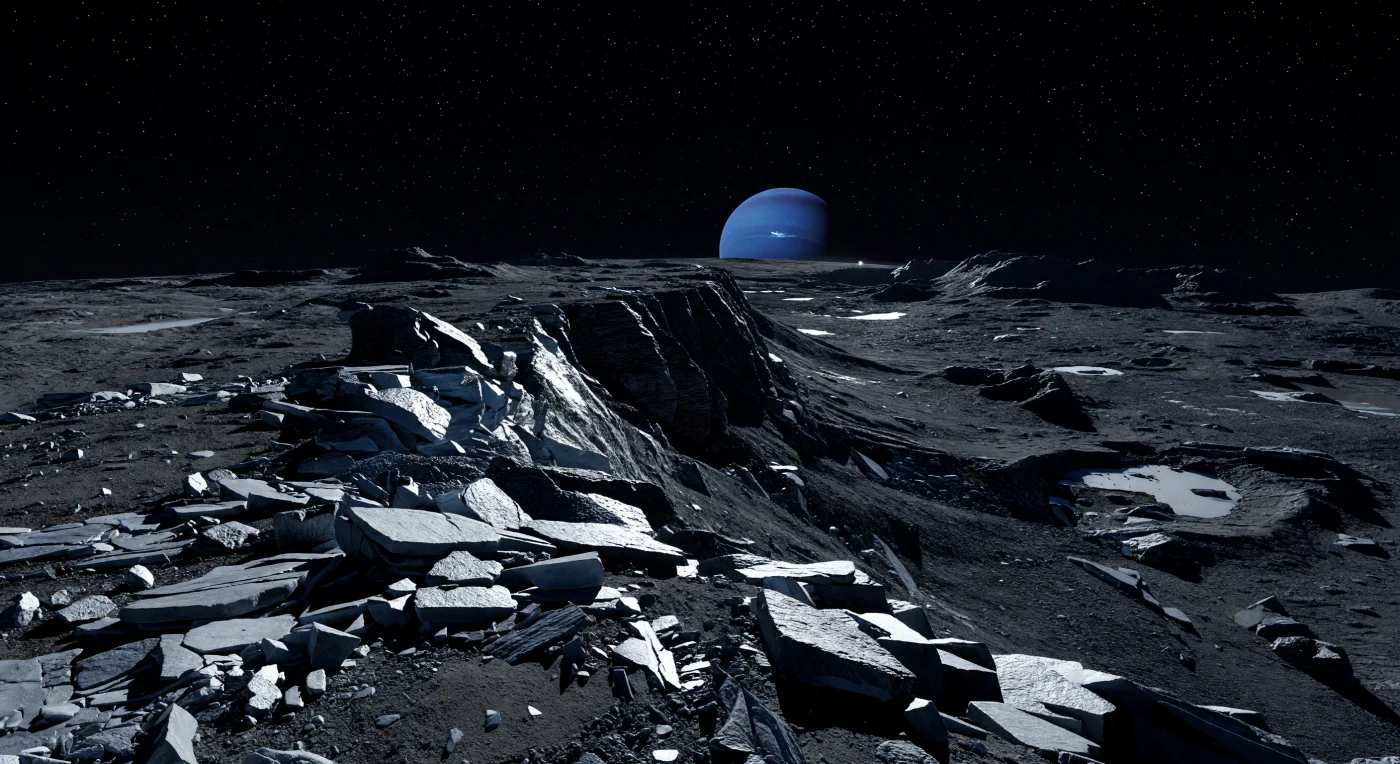
At the brink of a fractured escarpment, the ground is a chaos of angular slate-gray ice-rock plates, charcoal-dark rubble, and frost-touched talus, all split so sharply that each fragment flashes silver on the Sunward side and disappears into absolute black on the other. The tiny Sun, only just lifting above the strongly curved horizon, reveals how small this world is: crater rims, ejecta hummocks, and jagged uplands recede quickly toward the limb, their silhouettes stark against a star-filled sky where an enormous blue planet hangs low, immense yet eerily subdued. This ancient crust is a frozen mixture of water ice, darker silicate material, and carbon-rich regolith, its battered surface preserving countless impact scars because there is no atmosphere, no liquid erosion, and almost no gravity to soften or round the debris. Standing here would feel like standing on a primordial shard of the outer Solar System, in a landscape of brutal contrasts—silent, airless, and lit by a cold sunrise that cuts the terrain into black void and gleaming ice.