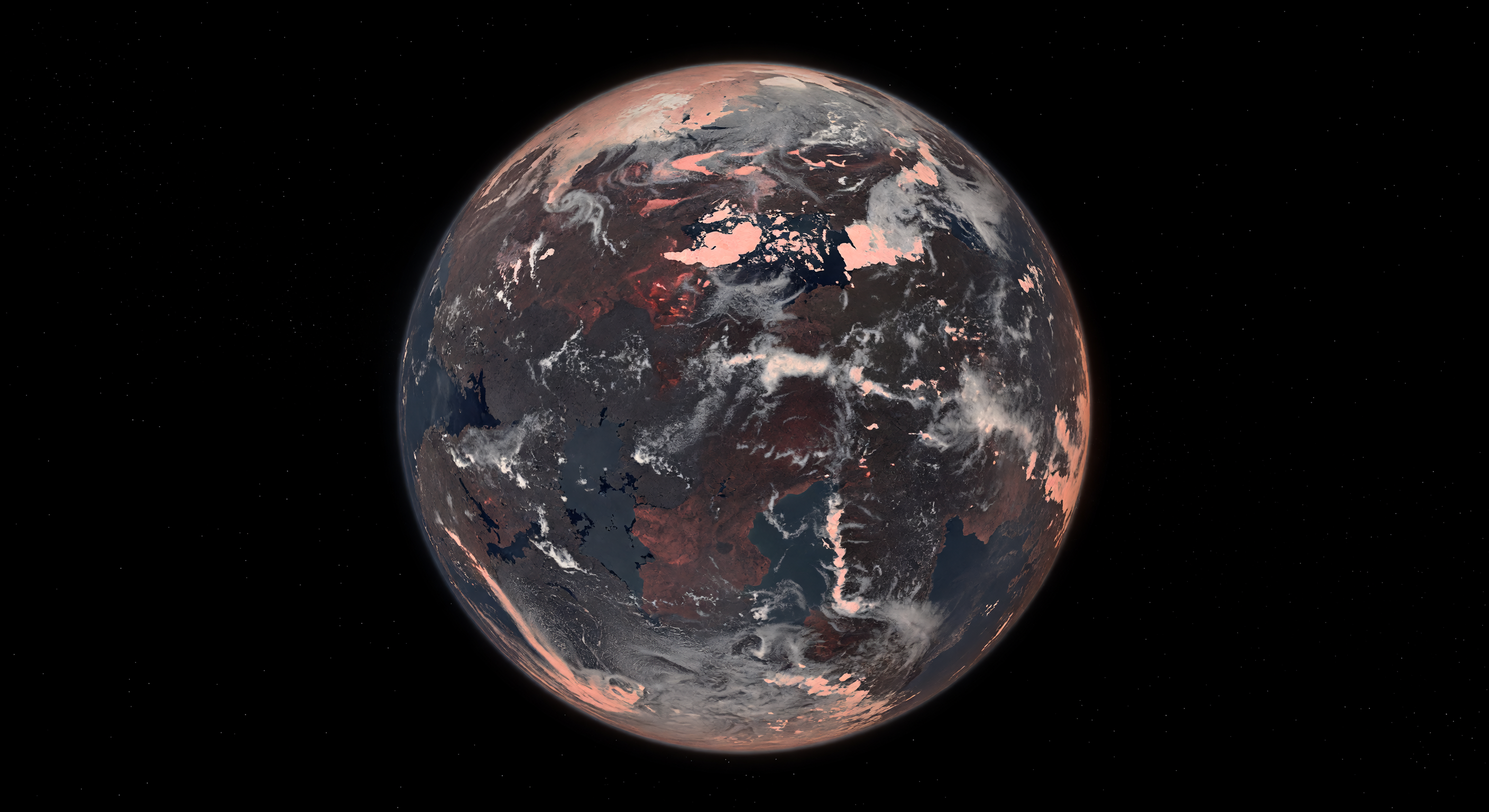
Scientific confidence: Speculative
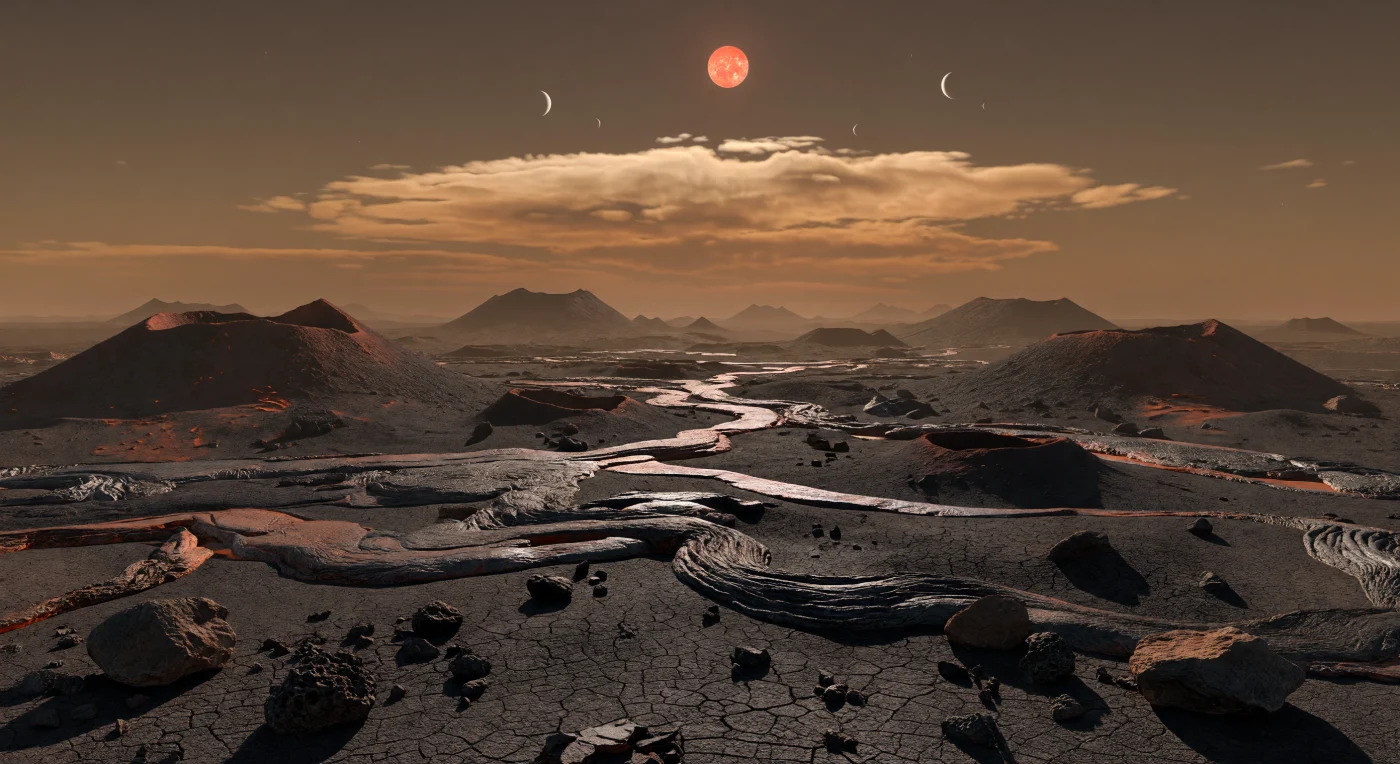
Under the fixed, reddish disk of its ultra-cool star, a seemingly endless volcanic plain stretches to a low, hazy horizon: charcoal-black basalt broken into cooling polygons, jagged ʻaʻā rubble, smoother ropy lava, and car-sized vesicular blocks scattered among shallow collapsed tubes and frozen channels. Low cinder cones and squat spatter ramparts, dusted with rusty ash, rise from the plain in broad subdued forms that fit a rocky world with slightly lower gravity and a long history of basaltic eruptions rather than sharp mountain building. The dim amber-brown sky and bright, nearly motionless cloud shield overhead suggest a tidally locked dayside, where a thin to moderate secondary atmosphere, suspended volcanic dust, and constant heating beneath the substellar point soften the light into warm copper tones and blur the distance with heat haze. Standing here, with soft red-orange shadows and neighboring worlds hanging as bright disks in the darkened upper sky, the landscape feels both furnace-warm and eerily still—an immense volcanic face of a habitable-zone world unlike anything on Earth.
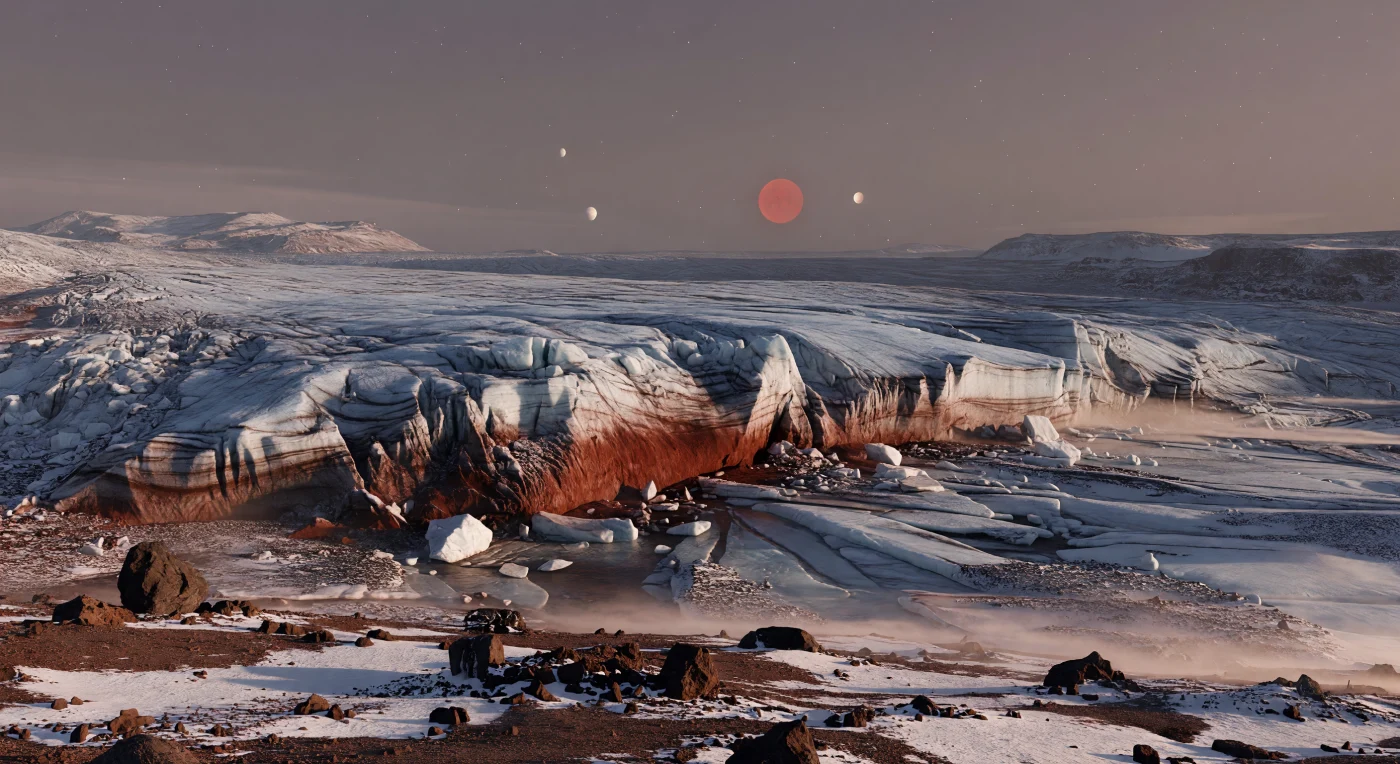
At the edge of perpetual twilight, a vast blue-white glacier spills out of the frozen dark and inches across a plain of rust-brown grit and black basalt, its surface striped with compressed flow bands, ash-dark dust, crevasses, and debris-rich ridges that reveal active ice moving under alien conditions. The low, fixed red-orange star skims the horizon, bathing the glacier’s fractured face in copper light while mauve haze, thin ice fog, and streamers of windblown spindrift soften the scene, evidence of a thin to moderate atmosphere capable of transporting frost and dust across the terminator. In the foreground, volcanic cobbles and frost-shattered boulders protrude through a skin of snow and ice, while frozen melt-scoured channels and low moraines hint that water ice here can deform, fracture, and perhaps briefly thaw at its margins where illumination and temperature are finely balanced. Far off, cratered mountains fade into the gloom and the glacier vanishes back into the nightside, while neighboring worlds hang as bright disks in the dim sky, making the landscape feel both geologically familiar and unmistakably extraterrestrial.
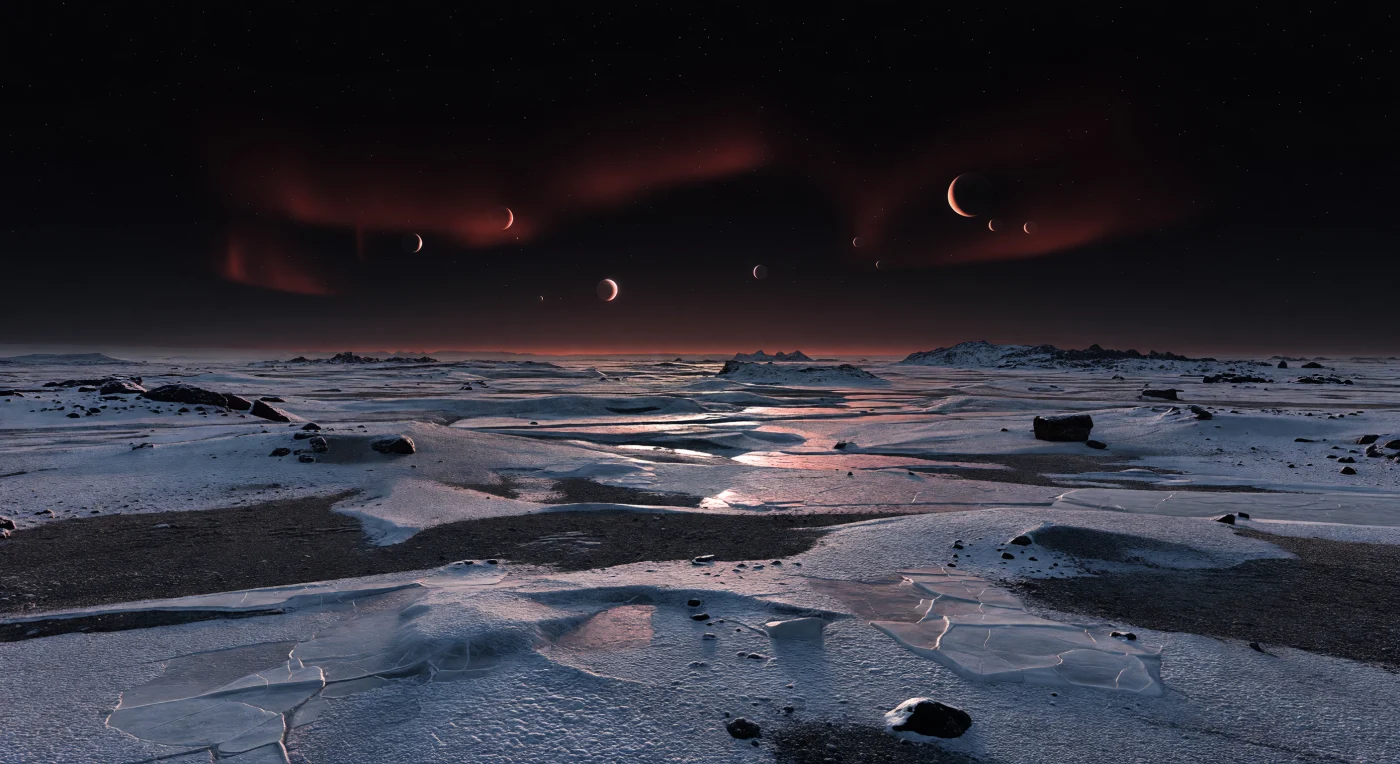
You stand on a permanent nightside plain where fractured plates of water ice and carbon-dioxide frost knit together with dark basaltic regolith, their polygonal cracks, pressure ridges, and wind-shaped frost dunes fading outward into a vast frozen horizon. In this extreme cold, repeated thermal contraction, sublimation, and the slow movement of brittle ice have etched shallow troughs and ridged plains, while scattered black volcanic boulders and frost-dusted silicate hills hint at a rocky world only thinly mantled by volatile ices. The sky is almost perfectly black, yet the far edge of the world glows with a dull red band from the eternal twilight ring, and overhead soft crimson auroras—likely driven by the active ultracool dwarf star’s magnetic violence—wash the frost in faint blood-red light. Hanging above it all are oversized companion worlds, bright disks and crescents suspended nearly motionless, making the immense, silent desert feel both geologically stark and cosmically crowded.
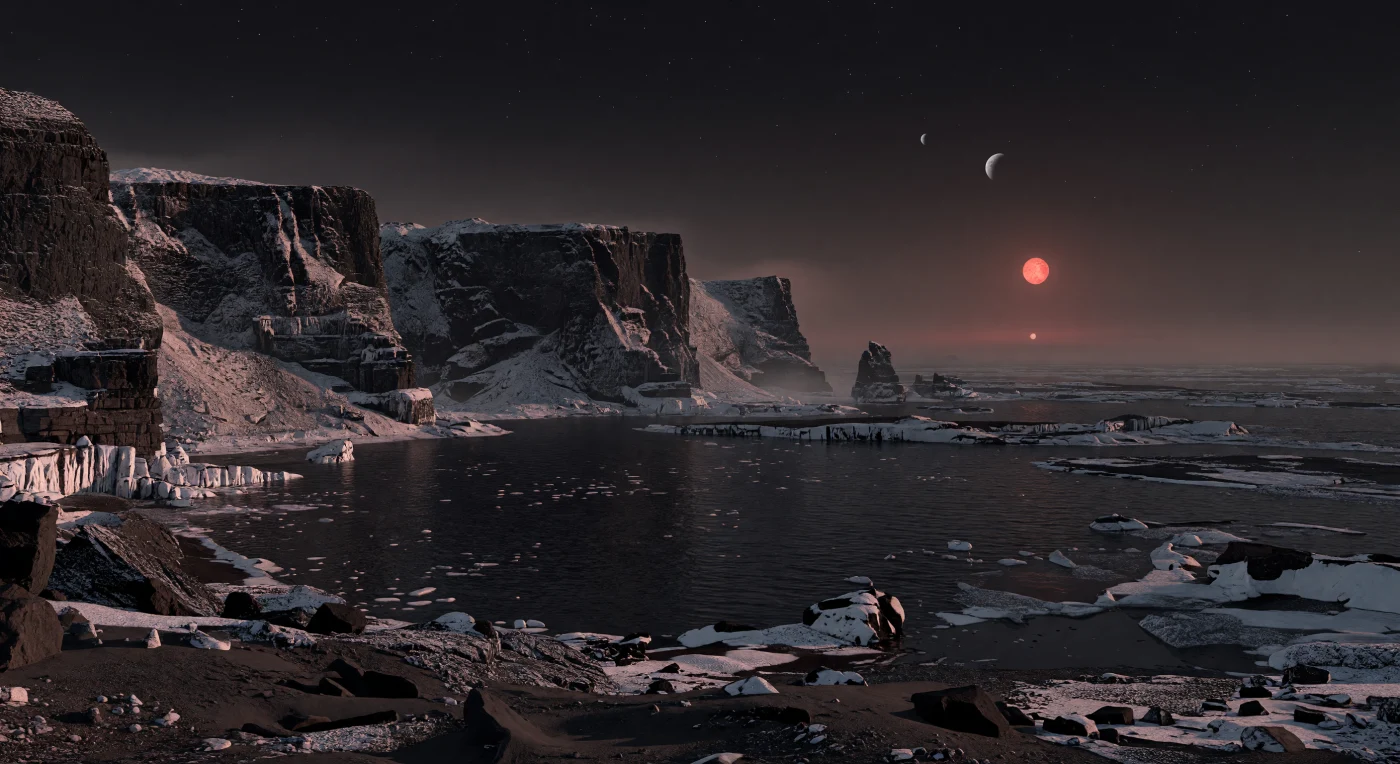
At the edge of perpetual dusk, immense charcoal-black basalt cliffs loom above a fractured shoreline, their columnar faces glazed with frozen salt spray, rime, and wind-blown frost that catches the dim red light in dull ember tones. Below, black volcanic boulders and glassy cobbles frame a strip of nearly lightless open water, where faint ripples and skim ice give way offshore to broken gray-black pack ice and pressure ridges fading into the planet’s permanent night. The landscape hints at a geologically active rocky world shaped by stacked lava flows, wave-cut notches, freeze-thaw cracking, and relentless coastal erosion, all under a thin-to-moderate atmosphere that leaves the sky dark enough for stars even while the ultra-cool red dwarf hangs forever on the horizon. In that deep violet-black sky, a neighboring world glows as a bright tiny crescent above the dark sea, making the coast feel at once habitable in principle and profoundly alien in practice.

At the edge of the planet’s permanent dayside ocean, steel-dark water slides over black basalt ledges and vesicular lava blocks, leaving thin pale rims of evaporite minerals where repeated wetting and drying concentrate dissolved salts. Copper-red light from the fixed ultra-cool star glints off tide pools and iron-stained rock, while mist rises from the relatively warm sea and softens the outlines of distant volcanic headlands and immense fractured boulders. Overhead, a vast wall of white-to-peach convective clouds towers around the substellar region, a hallmark of tidally locked climate models in which constant heating drives persistent upwelling, humidity, and a long-lived ocean beneath a dense secondary atmosphere. The scene feels both intimate and planetary in scale: a geologically fresh volcanic shore under a motionless crimson sun, where liquid water, basaltic crust, and permanent weather meet in a strange but physically plausible habitable-zone world.
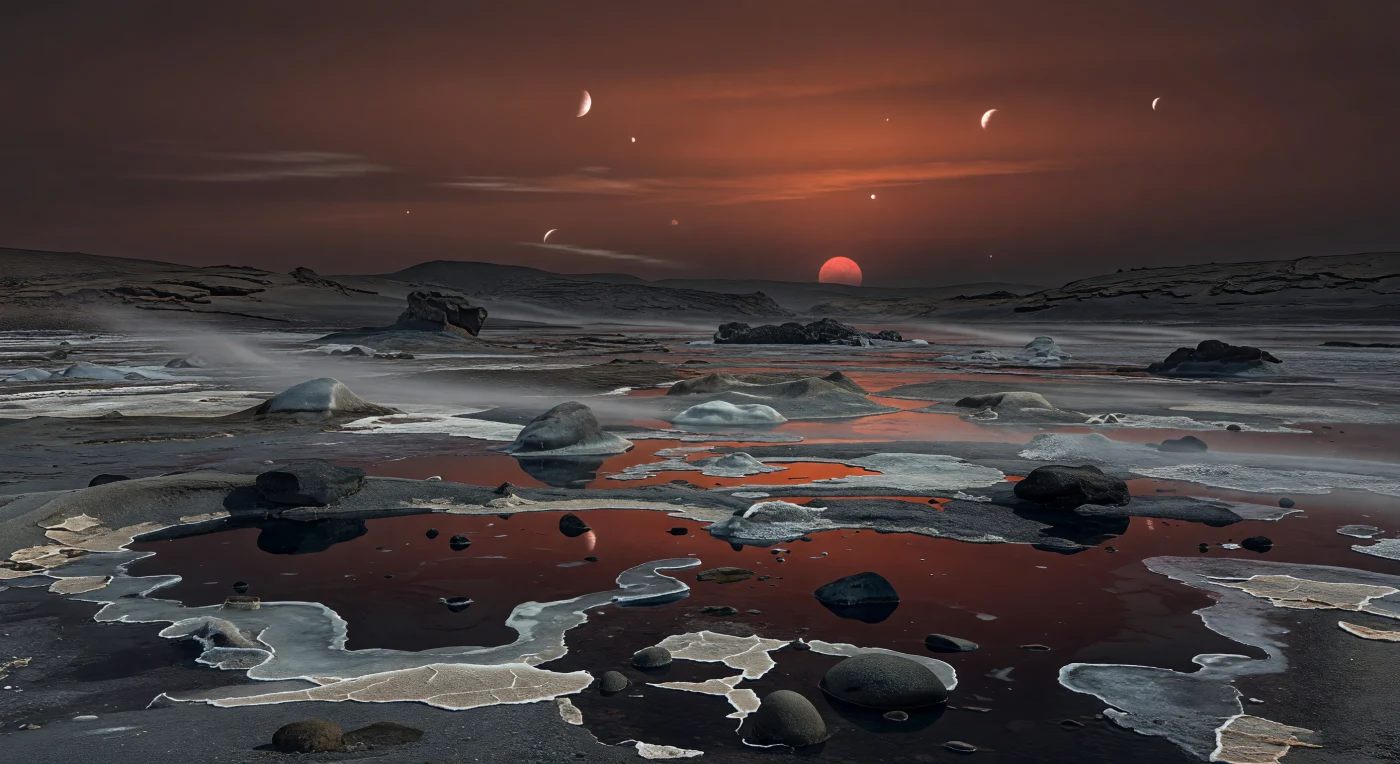
At the edge of eternal day and night, a flat wetland of black brine pools and dirty blue-gray slush stretches beneath a dim red sky, their dark surfaces reflecting only a muted crimson glow from the star fixed low on the horizon. Gray silicate mud, pale salt crusts, and polygonal freeze-thaw cracks surround scattered basalt cobbles and low eroded outcrops, hinting at a rocky world where dissolved salts keep some water liquid despite the cold. Thin fog streams sideways in steady winds, and long rust-colored shadows trail toward the unseen nightside, while distant volcanic uplands fade into haze and the broad plain seems to sink into darkness. It is a landscape shaped by tidal locking, mineral-rich water chemistry, and weak, reddish illumination from an ultra-cool dwarf—an austere, habitable-zone frontier that feels both geologically familiar and profoundly alien.
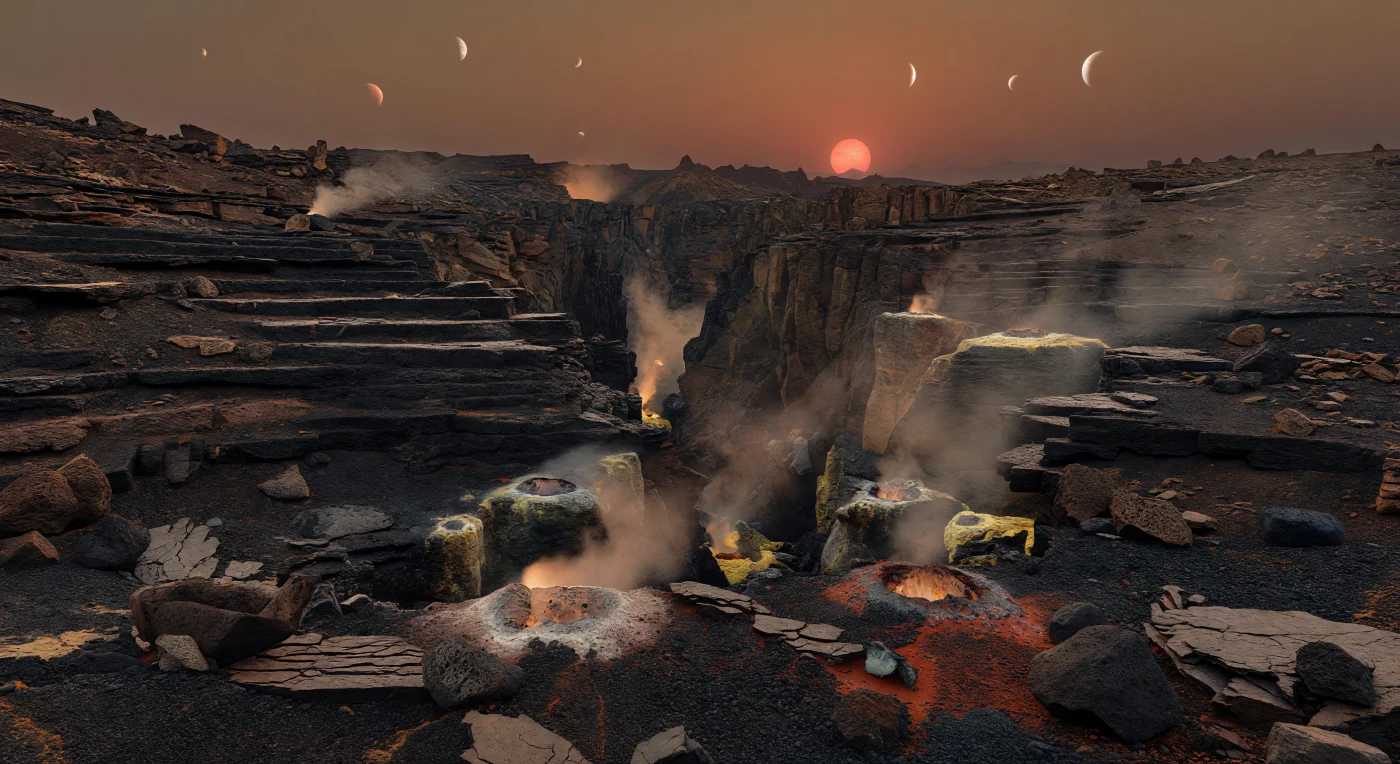
At the edge of the permanent twilight, a colossal tectonic rift drops away for a kilometer through stepped terraces of black and rust-brown basalt, each ledge picked out by the low, unchanging red glow of the star crouched on the horizon. Underfoot lie jagged vesicular lava blocks, fractured slabs, and dark gravel dusted with iron-rich red sediment, while below, sulfur-stained fumaroles exhale amber-gray gases that pool in the cold canyon as a dense haze, tracing ongoing internal heat and volcanic degassing in a rocky silicate crust. The dim, reddish-orange light of an ultra-cool dwarf softens the shadows even as it exaggerates every fracture and cliff, and the thin-to-moderate atmosphere catches that light in faint glowing veils of aerosol and steam. Above the smoky violet sky, neighboring worlds hang as conspicuous disks and crescents, making the scene feel at once scientifically plausible and profoundly alien—as if you are standing on the frozen skin of an active world still breathing from its depths.

At ground level, the volcano’s vast flank stretches away as a wilderness of dark iron-rich basalt: ropy lava crusts freeze beside jagged ʻaʻā rubble, collapsed channels carve sinuous trenches through the plain, and fresh scoria cones scatter rust-red ash across the black surface. These landforms are the classic signature of low-viscosity volcanic eruptions, where fluid basalt pours outward in broad sheets, drains into tubes, and later leaves skylights, pressure ridges, and sunken roofs behind. Above, a dense copper twilight hangs under high cloud, with a thin sulfurous haze softening the horizon and an ember-colored plume rising from the distant massif, all lit by the fixed, low red-orange star whose oblique light fills even the cracks with a dim ruddy glow. Far off, sibling worlds gleam as outsized disks through the haze, making the immense shield volcano and its kilometer-spanning cone fields feel both geologically familiar and profoundly alien.
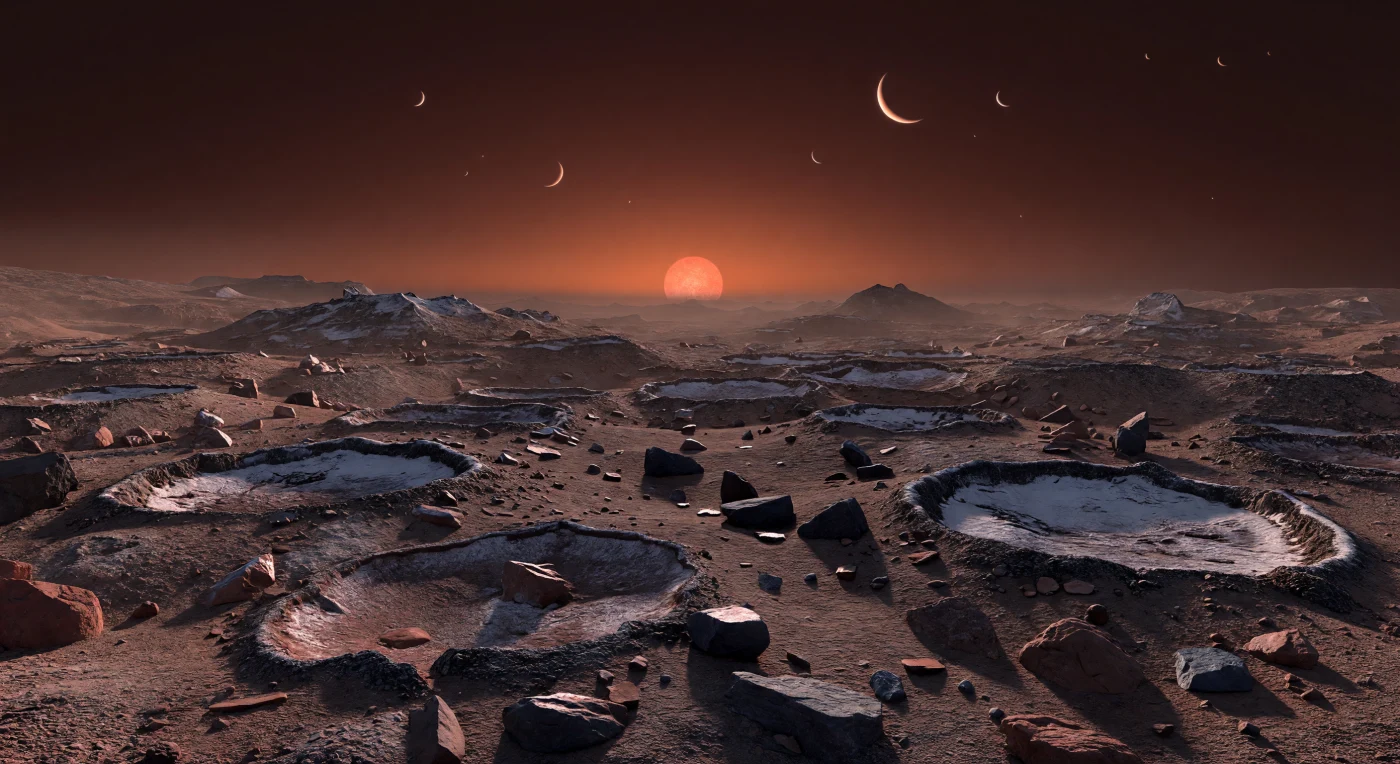
A battered highland plain stretches to every horizon, its surface crowded with overlapping impact craters, shattered silicate bedrock, and heaps of angular breccia and dark basaltic boulders draped in fine rust-colored dust. In the dim red-orange light of a low, swollen ultracool star, shadowed crater rims and sheltered inner walls hold lingering frost deposits—dull white to bluish-gray patches likely preserved where sunlight rarely reaches and temperatures remain perpetually low beneath a thin, dusty atmosphere. The sky glows copper near the horizon and deepens to maroon and near-black overhead, where neighboring worlds appear as striking bright disks, while distant crater chains and escarpments fade into haze, making the landscape feel immense, ancient, and geologically exhausted. Standing here, you would be surrounded by the record of relentless bombardment and deep planetary time: a cold, tectonically quiet surface shaped by impacts, scattered volcanism, and the austere climate of a tidally locked rocky world.

At ground level, you stand in a frozen maze where towering seracs, shattered ice bridges, and knife-dark crevasses split the nightside ice sheet into a landscape of constant hazard and immense scale. The ice is not pure white but layered blue-gray, steel, and charcoal, with embedded dust bands and scattered basaltic fragments recording volcanic debris and long cycles of snowfall, burial, compression, and fracturing under glacial flow in slightly lower gravity than Earth’s. A thin secondary atmosphere softens the sky into a faint horizon haze, while a large neighboring world hangs low as a reddish crescent and red-violet auroral curtains wash the polished crevasse walls in dim crimson and purple light. In that eerie glow, the chasms fall into near-total blackness, and the frozen plain seems continental in extent—silent, airless-looking, but not a vacuum, and utterly alien.

At ground level, the plateau stretches away in dark ribs of basalt and hardened volcanic ash, carved by relentless winds into long, parallel yardangs while chocolate-brown dunes and rusty dust collect in their lee. A mineral storm advances across the plain, its gust fronts swallowing mesas and blurring the horizon into a copper-red haze, while sharp ventifacts and fractured iron-rich stones in the foreground gleam faintly under abrasive polishing. The dim red dwarf hangs fixed near the horizon, backlighting the airborne ash so the landscape glows ember-like rather than sunlit, with soft, elongated shadows nearly erased by suspended particles in the thin to moderate atmosphere. Through brief gaps in the dust, a few neighboring worlds appear as oversized disks in the murky sky, reinforcing the uncanny scale of this arid volcanic terrain and the likely synchronous rotation that keeps the star forever poised in the same place.

At the permanent twilight boundary, jagged basalt mountains rise like black teeth from a wind-scoured plain of mafic gravel, fractured lava, and angular boulders, their sunward faces washed in a deep orange-red glow while the slopes falling into darkness are glazed with thin silver frost. Around you lie vesicular and columnar basalt, collapsed lava terraces, talus fans, and old frozen flows—signs of a volcanic crust shaped by cooling, cracking, and relentless temperature contrasts in a tidally locked world where one horizon never sees full day and the other never sees dawn. A dim, oversized red dwarf hangs fixed near the horizon, lighting rust-colored cloud banks on the warm side while the opposite sky opens abruptly into star-crowded blackness, where neighboring planets appear as bright disks and crescents above the frozen dark. The low-angle light stretches softened shadows for kilometers, and with haze, ice crystals, and mist gathering in the cold ravines, the entire landscape feels immense, silent, and suspended between fire and frost.
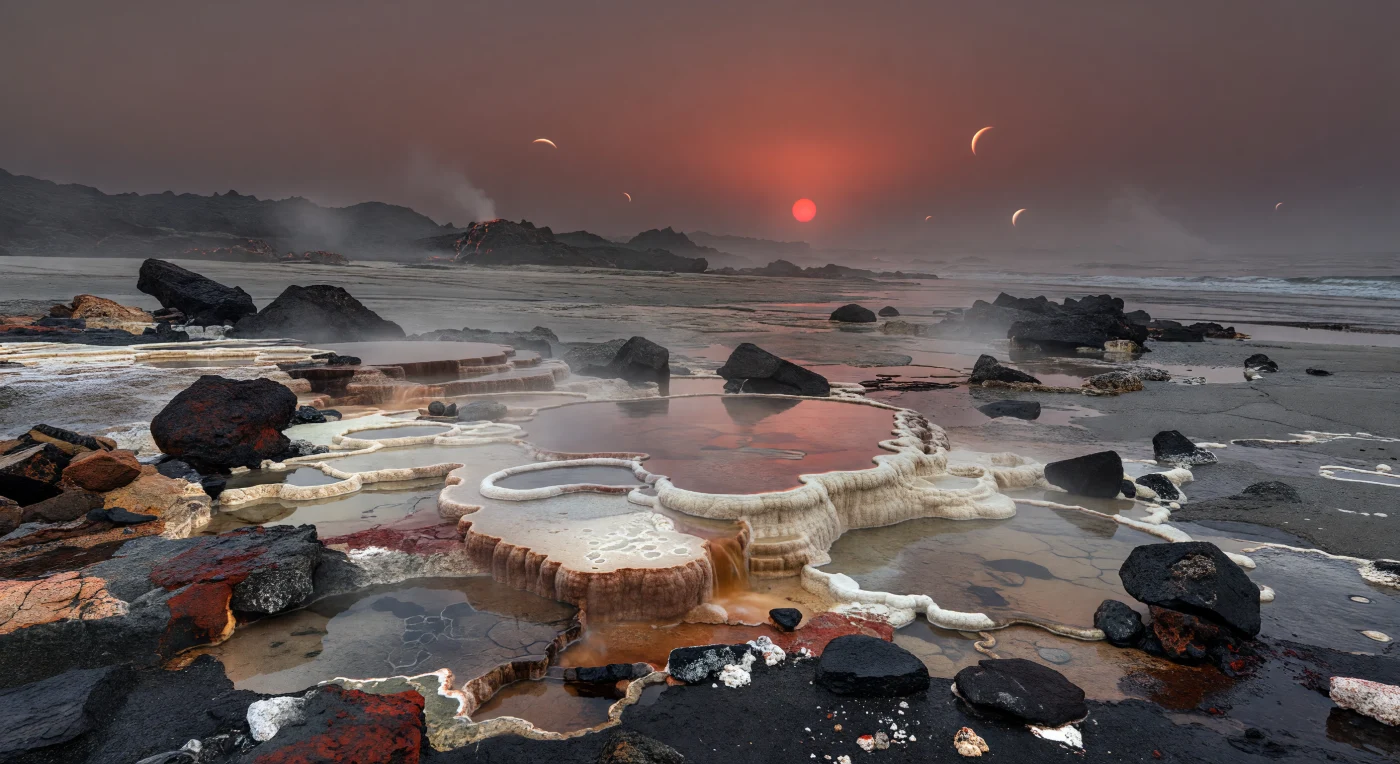
At the edge of eternal twilight, steaming spring pools spread across fractured basalt, their black volcanic surfaces altered to iron-red, charcoal, and sulfur-gray and banded with cream-white mineral terraces that step gently toward a steel-dark sea. Warm, silica- and carbonate-rich waters spill in thin rivulets over scalloped rims and wet sinter crusts, while fumaroles, fog, and drifting condensation blur the shoreline into lava plains and broken volcanic ridges beyond. The dim reddish star hangs fixed near the horizon, casting a weak scarlet glow through the haze, and in gaps between steam and cloud, neighboring worlds appear as large bright disks low in the sky. Standing here would feel both strangely intimate and immense: near-Earth gravity anchoring broad, believable landforms, yet everything colored by hydrothermal chemistry, tidal locking, and the hush of a cold ocean meeting heat from the planet’s interior.

Under the fixed glow of its red-orange star, a vast volcanic plain stretches toward a horizon swallowed by storm, its dark basalt fractured into cooling polygons and glazed with thin rainwater that flashes copper-crimson as a stellar flare suddenly brightens the cloud canopy. Rounded black boulders, low lava hummocks, and glassy vesicular outcrops rise from the slick ground while narrow runoff threads through shallow cracks, hinting at geologically young, iron-rich lava fields repeatedly altered by heat, rain, and chemical weathering under a substantial atmosphere. Overhead, towering convective clouds merge into a permanent storm deck, their smoky maroon undersides lit from within as distant curtains of rain descend near the substellar center, where constant heating would drive vigorous uplift on a tidally locked world. Through thinner breaks in the haze, neighboring planets hang low as bright disks, reinforcing the uncanny scale of this place—an immense, wet, flare-lit basalt wilderness where familiar volcanic processes unfold beneath an alien sky.

At the edge of perpetual twilight, a vast caldera opens across the landscape, its shattered basalt rim and fractured inner walls striped with layered lava flows, collapse pits, and frost-bright mineral crusts, while the foreground is strewn with black mafic blocks, glassy volcanic shards, and ash-dark gravel glazed with thin translucent ice. Deep crimson fissures cut the caldera floor in branching lines, their heat glowing through iron-rich rock as vents exhale dense steam that rapidly condenses in the cold air and freezes into glittering crystals streaming downwind, hinting at a thin-to-moderate secondary atmosphere where water can cycle between vapor, frost, and ice. Low, reddish light from the ultra-cool dwarf star skims the terrain from just above the horizon, turning smooth ice patches copper at the edges and leaving soft shadows that fade into haze, while the sky deepens from dusky violet toward night where neighboring planets hang as oversized disks and crescents. Standing here, you would feel the immense scale of a geologically active world balanced between fire and frost, where volcanism, tectonic fracturing, and persistent terminator cold sculpt an environment both alien and physically plausible.