Scientific confidence: Medium
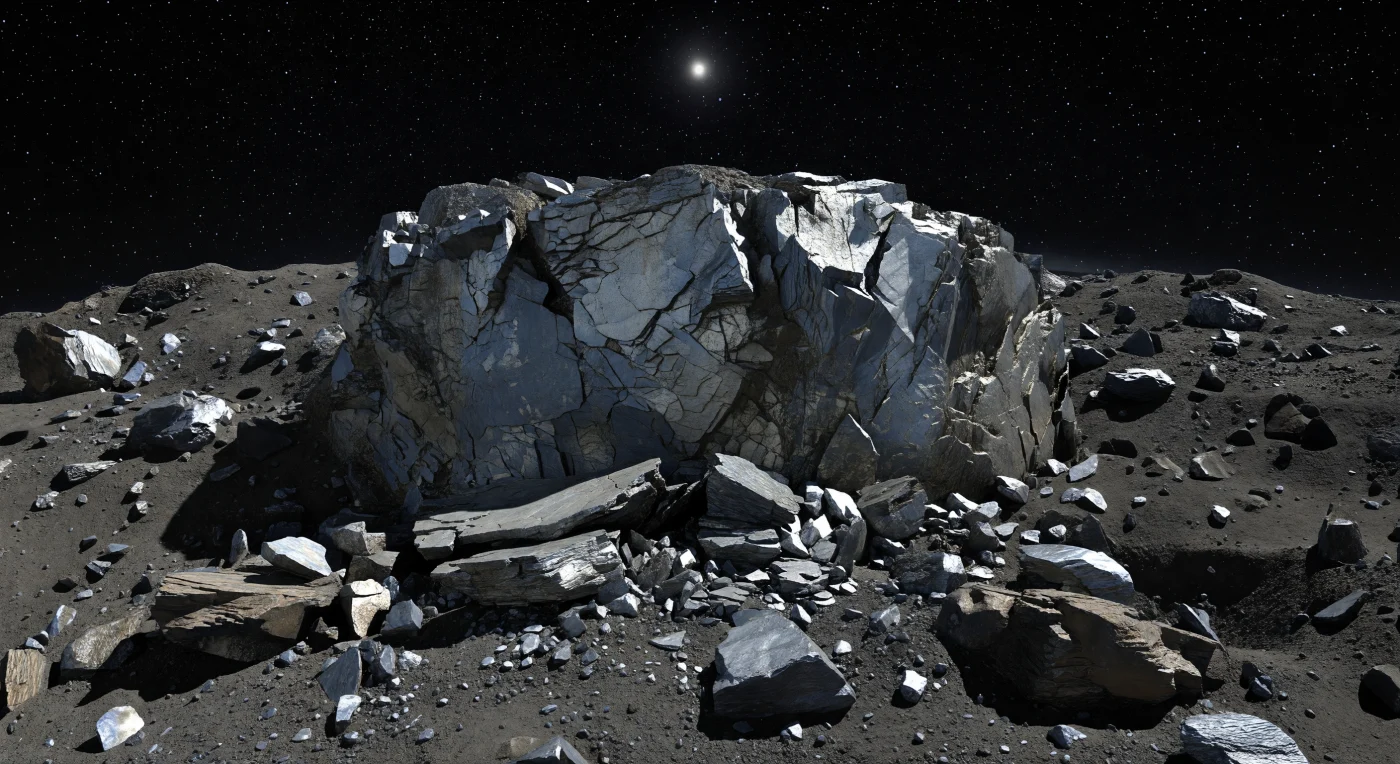
A near-vertical scarp rises from the surface like a wall of torn metal, its fractured face split into jagged plates of steel-blue and dull silver iron-nickel bedrock, crossed by black seams and stained with brown-gray space-weathered tarnish. At its foot, angular slabs, sharp boulders, and dark metallic dust lie in a rubble field that seems almost delicately balanced, a reminder that in this tiny world’s weak gravity even steep, unstable-looking forms can persist for long spans of time. The horizon curves away startlingly close, underscoring the small scale of the body, while the airless sky remains pitch black and crowded with stars even in daylight beneath a smaller, hard-white Sun. With no atmosphere to soften the light, every fracture and shard throws a razor-edged shadow, making the landscape feel cold, silent, and eerily like the exposed interior of an ancient protoplanet.

At local noon on the jagged crest of Meroe Rim, the ground is a harsh tangle of dark gunmetal iron-nickel bedrock, charcoal regolith, and angular metallic rubble, with fresh fractures catching the Sun in muted silver flashes while older surfaces remain dull and micrometeoroid-darkened. Just beyond your feet, the crater’s inner wall plunges steeply into absolute black shadow, interrupted only by narrow sunlit ledges of mixed metal-silicate debris and iron-rich outcrops, a reminder that this small world’s crust may preserve material unlike that of ordinary rocky asteroids. The horizon feels startlingly near and visibly curved, emphasizing the body’s tiny size and weak gravity, which allow sharp, precarious blocks and splintered ridges to endure. Overhead, in a sky that stays perfectly black despite noon, a small blazing Sun and faint stars shine together, casting razor-edged shadows that make the entire landscape feel cold, airless, and profoundly alien.
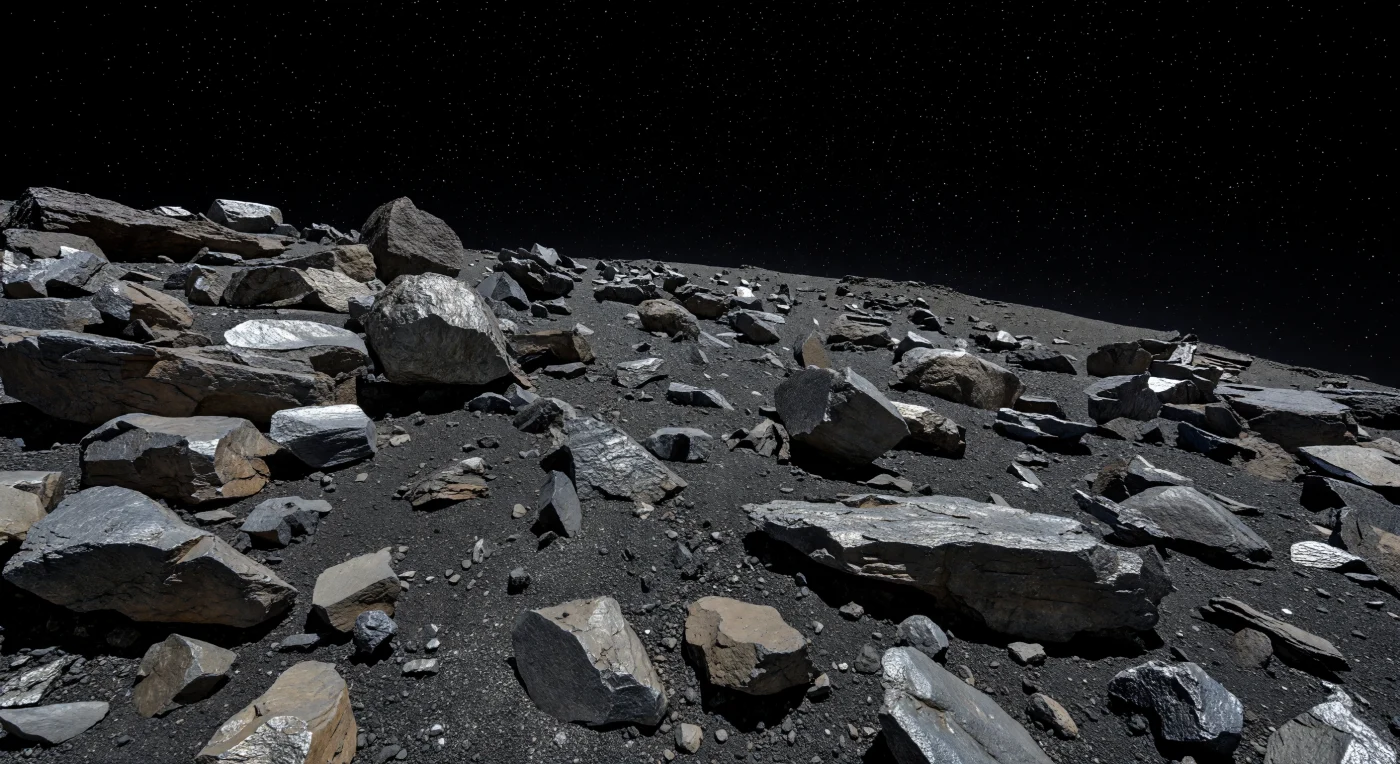
You stand on a steep, treacherous incline where meter-scale angular blocks of iron-nickel-rich rock, metallic breccia, and shattered silicate-metal rubble seem almost impossibly balanced, perched on knife-edge contact points above thin drifts of charcoal-dark regolith dusted with glittering metallic grains. In the hard white sunlight, every fractured face shows dull steel, bronze-gray, and faint rusty-brown weathered tones, while razor-sharp black shadows carve deep voids beneath boulders and ledges, revealing the stark vacuum and complete absence of air. The slope drops away so quickly that the horizon curves startlingly close, a reminder that this is a tiny world where gravity is too weak to pull unstable-looking debris into collapse and where even low ridges and crater rims rise only modestly from the surface. Against the pitch-black sky, with stars still visible beyond the glare, the landscape feels both intimate and immense: a hazardous field of exposed metal-rich geology that may preserve clues to the deep interior materials of an ancient protoplanet.

You stand at the edge of a shallow hollow where the floor has settled into an eerily smooth pond of ultra-fine charcoal regolith, a metal-silicate dust so still and level in the weak gravity that it looks almost liquid until grazing sunlight picks out a faint bronze-gray sheen. Sparse half-buried stones, iron-rich cobbles, and a few angular fragments rest lightly on the surface, while around the basin rough ridges of fractured iron-nickel bedrock rise only a few tens of meters yet appear stark and dramatic, their gunmetal faces broken by small impact pits, rubble aprons, and sharp-edged boulders. With no atmosphere to soften the view, a small hard Sun casts cold white light and absolute black, knife-edged shadows from every pebble, and the nearby curved horizon makes the landscape feel both intimate and strangely precarious. The scene hints at a world shaped by impacts and enriched in metal, where fine debris can migrate into low hollows and settle into unusually smooth deposits unlike the looser, rockier surfaces seen on more familiar asteroids.

An ancient fracture trough cuts like a black blade through the old, crater-pocked metallic ground, its parallel scarps exposing broken faces of iron-nickel-rich bedrock in angular slabs and inward-tilted blocks. Along the smoother floor, dark regolith fines and metallic dust have collected in shallow pockets between scattered boulders of mixed metal and silicate breccia, recording both tectonic-style breaking and relentless impact reworking on a world with extremely weak gravity. The low Sun, smaller than seen from Earth, throws hard white light across dull steel-gray terrain and turns every ledge, pebble, and meter-high mound into a study in razor-edged shadow, while the horizon curves away startlingly close under a star-filled black sky. Standing here, you would feel the vacuum’s uncanny clarity and the intimate scale of a small body whose surface is neither ordinary rock nor pure metal, but a battered, alien blend of both.

From the floor of this immense impact basin, you would stand on a dark plain of compacted regolith—iron-rich dust, crushed metal-silicate rubble, and angular fragments of nickel-iron bedrock—broken by low hummocks, tiny secondary craterlets, and brighter slabs of exposed metal that catch the Sun in cold, restrained glints. Around you, broken terraces and steep, fractured walls sweep upward in a crescent, their mixed breccia, ferrous outcrops, and rubble slopes seeming both monumental and strangely delicate under gravity so weak that sharp forms and precariously perched blocks can endure. The nearby horizon curves away unmistakably, a reminder that this is a small world only a few hundred kilometers across, where even modest ridges feel dramatic at ground level. Above it all hangs a pitch-black sky, stars visible in daylight, while the distant Sun casts hard, undiffused light that turns every boulder, scarp, and metallic vein into a study in brilliant silver-gray highlights and absolute black shadow.
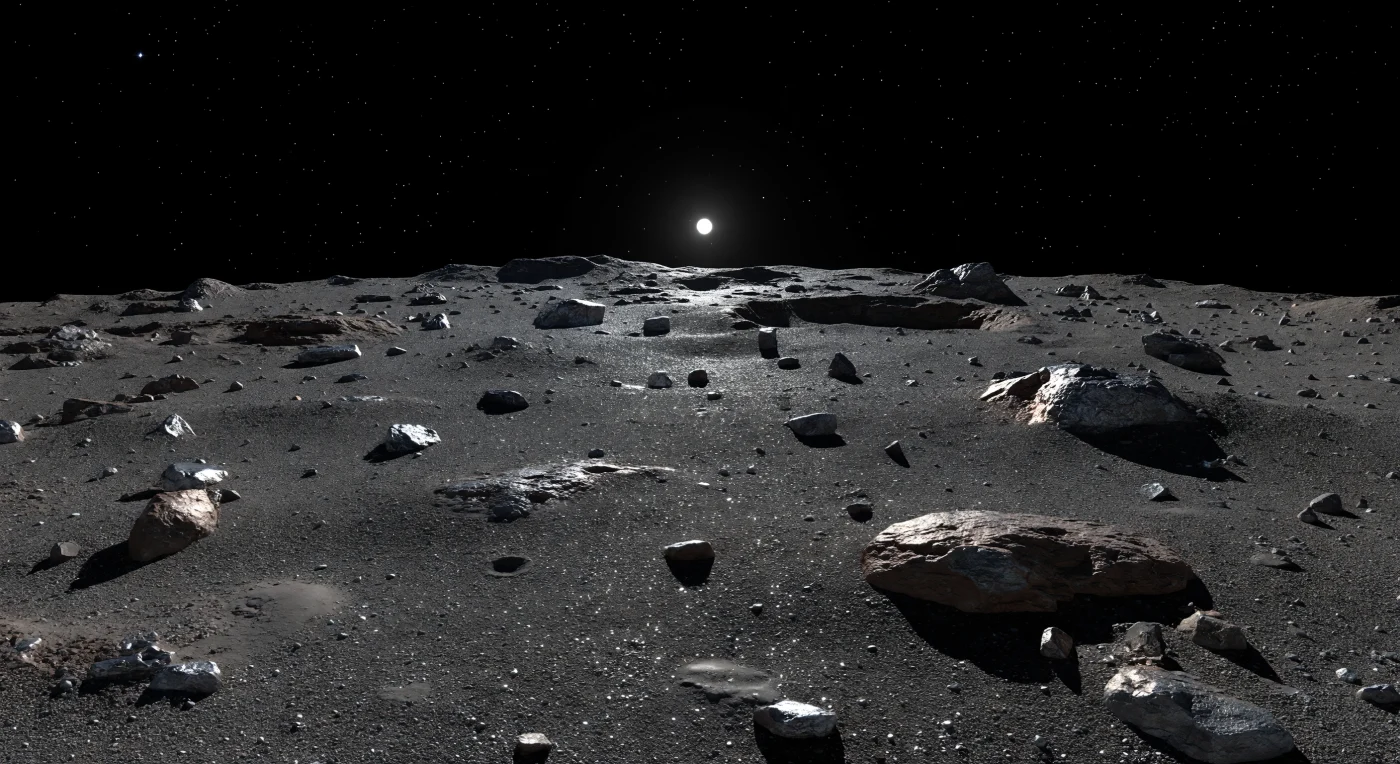
A broad plain of coarse charcoal regolith and shattered metal-silicate rubble stretches away across a horizon so near and so visibly curved that you feel the smallness of the world beneath your feet. The ground is mostly matte graphite, steel gray, and dull gunmetal, but in the hard white sunlight countless iron-nickel grains ignite as tiny silver flashes, while exposed slabs of weathered metallic bedrock and angular boulders gleam with colder, mirror-bright highlights. With no air to soften the view, every pebble throws a razor-edged black shadow, shallow micro-craters and delicate ejecta textures remain perfectly preserved, and low ridges only a few tens of meters high rise like miniature mountains in the weak gravity. Above it all hangs a pitch-black sky studded with sharp daylight stars, making this silent plain of metal-rich debris feel both scientifically revealing—a surface shaped by impacts, vacuum, and an unusually ferrous composition—and profoundly otherworldly.

At your feet, a crisp young crater slices into an older, dark metal-rich plain, its slightly raised rim strewn with overturned rubble, perched blocks, and tiny secondary pits. Around it, a ragged halo of fresh ejecta spreads across the charcoal regolith: angular silver-gray iron-rich fragments, blocky metallic breccia, and bright excavated slabs that catch the hard sunlight in brief cold flashes, while the weathered surface between them remains dull and soot-darkened by long exposure to space. The steep inner walls plunge into almost perfect blackness, a stark effect of airless vacuum and razor-sharp shadows, while nearby fractured bedrock reveals a mixed ferrous and silicate substrate pitted by micrometeorite impacts and dusted with thin drifts of fine dark grains. Beyond, the ground falls away quickly toward a close curved horizon under a star-filled black sky, with only low ridges, craterlets, and rubble hummocks interrupting the tiny world’s metal-laced, weak-gravity landscape.

Under a sky so black it seems to erase distance, the night side stretches away as a field of shattered iron-rich rubble, jagged dark slabs, and fractured metal-silicate ground, their edges picked out only by faint silver highlights from starlight and a distant sunlit rim. The horizon curves sharply and unnervingly close, a reminder that this is a very small world with feeble gravity, where even crater rims only a few tens of meters high loom dramatically above a landscape of charcoal-gray regolith, ejecta ridges, and angular boulders. The surface materials are thought to be unusually rich in iron and nickel, with dull gunmetal and bluish-steel tones hinting at metal-bearing bedrock exposed and broken by countless impacts over billions of years. In the absolute stillness of vacuum, with no air to soften shadows or dim the Milky Way blazing overhead, the wasteland feels both intimate and immense—like standing on the cold wreckage of a protoplanetary interior laid bare to the stars.
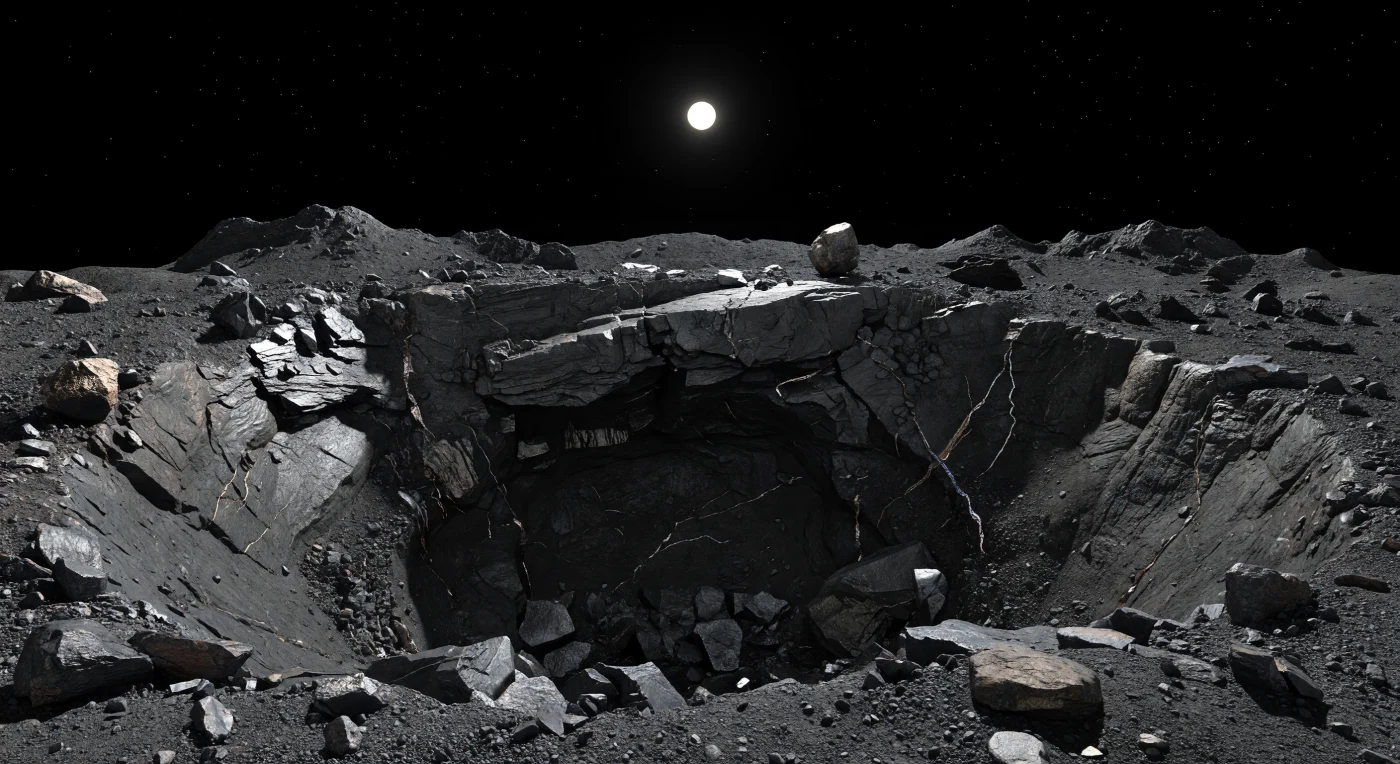
At ground level inside the crater, a broken slab of iron-nickel-rich bedrock juts from the inner wall to form a shallow overhang above a recess so dark it seems to swallow light itself, with only faint reflections tracing dull silver edges, jagged fracture planes, and heaps of angular rubble below. The surrounding terrain is a dense scatter of metallic gravel, shattered boulders, and brecciated rock—a mix of exposed metal and silicate debris produced by repeated impacts—while thin brighter veins and blocky outcrops hint at the unusually metal-rich crust beneath your feet. In the airless vacuum, sunlight arrives as a hard, distant beam, casting razor-sharp shadows with almost no softening, so the abyss under the ledge remains nearly featureless black and the few glints on nearby surfaces feel cold rather than bright. Beyond the crater rim, the horizon curves away startlingly close on this tiny world, and low jagged rises only tens of meters high look like miniature mountains, making the whole scene feel both claustrophobic and immense at once.
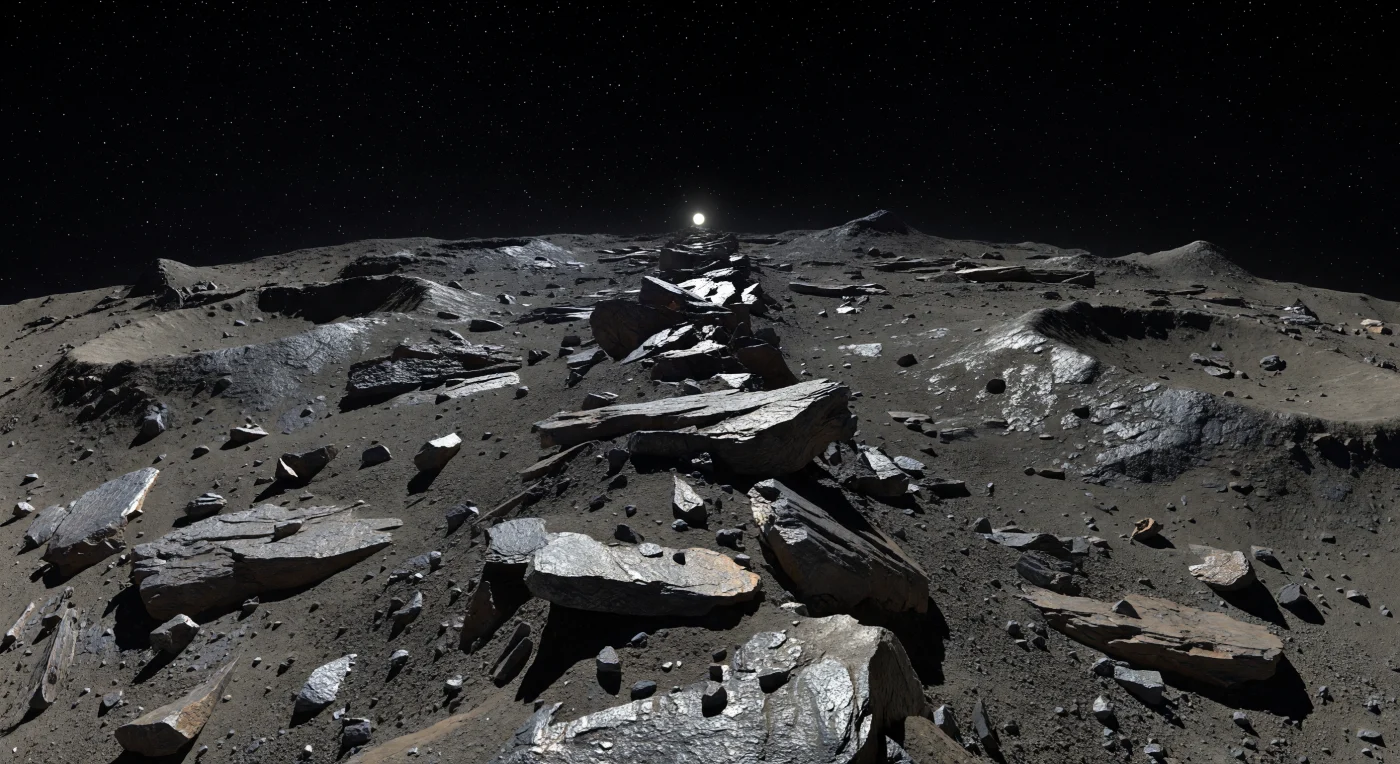
You stand on a ridge only a few meters wide, where jagged slabs of iron-nickel-rich bedrock jut upward through a thin skin of charcoal dust and glittering metallic rubble, each tilted plate and fractured outcrop casting a black, knife-edged shadow far across the plains below. The Sun hangs low as a small hard white disk, dimmer than at Earth yet still fierce in the airless vacuum, so there is no twilight, no haze, and no softening—only stark light, cold specular flashes off metal faces, and absolute darkness in every hollow and crater lip. On both sides, the surface drops away quickly toward a startlingly near, curved horizon, revealing shallow basins, crisp little crater rims, and steep hummocks that look outsized for their height because weak gravity and the absence of wind or water leave every edge sharp. Beneath the black sky, where stars remain visible even in daylight, the landscape feels like the exposed skeleton of an ancient protoplanet: a world of mixed metal and silicate rock, impact-shattered and eerily still.

At the edge of day and night, the ground stretches out as a dark, intimate plain of gunmetal regolith, glittering with nickel-iron grains and broken by sharp-edged metallic rubble, fractured boulders, and low ribs of exposed bedrock that rise from the dust. The horizon feels startlingly near and strongly curved, so that even modest ridges and crater rims loom like distant hills under the weak gravity of this small world, while a hard white Sun hangs low and casts razor-black shadows across iron-rich soil and scattered metal-silicate blocks. In the grazing light, a ghostly veil of ultrafine dust appears and disappears just above the surface, lofted by electrostatic charging into delicate arcs and hovering sheets that drift between rocks only where the sunlight catches them. Beyond that thin golden shimmer, the sky remains a perfect black vacuum crowded with sharp stars, making the metallic landscape feel both frozen and immense—an exposed relic of early planetary building material suspended in airless silence.
