Scientific confidence: Low

Below you stretches not a surface but an immense atmospheric plain: a bluish-white deck of methane-ice clouds and hydrogen-helium haze, softly banded and faintly scalloped, curving away into a vast horizon like a frozen ocean made entirely of vapor. Wisps of brighter condensate, translucent fog banks, and occasional deeper cyan openings reveal the layered structure of an ice giant’s upper atmosphere, where pressure increases steadily downward and no solid ground ever appears. High above, the sky fades from pale cyan to blue-green through photochemical haze, and the distant Sun is reduced to a tiny, fierce white point whose light is so weakened by nearly 19 times Earth’s distance that it casts only muted silver-blue shading across the cloud tops. In the extreme cold, under temperatures near 60 kelvin, the whole scene feels hushed and colossal—an endless, luminous weather world suspended between mist and depth.

You appear to be hovering above an endless plain of softly undulating methane-ice cloud tops, a vast frozen mist ocean tinted in pale aquamarine, cyan, and white, with only the faintest hint of zonal banding stretching across the haze-softened distance. There is no ground anywhere below—only deeper atmosphere—because at these levels the visible “surface” is really the upper tropospheric cloud deck, where methane condenses in extreme cold near 59 kelvin under pressures around one to a few bars. The tiny, faraway Sun casts a weak bluish-white light that produces pearly highlights and almost no shadows, while suspended haze gradually erases the horizon into luminous blue-green mist. In every direction the scene feels calm, cold, and immense, its near-featureless continuity revealing the scale of a world where atmosphere replaces landscape.
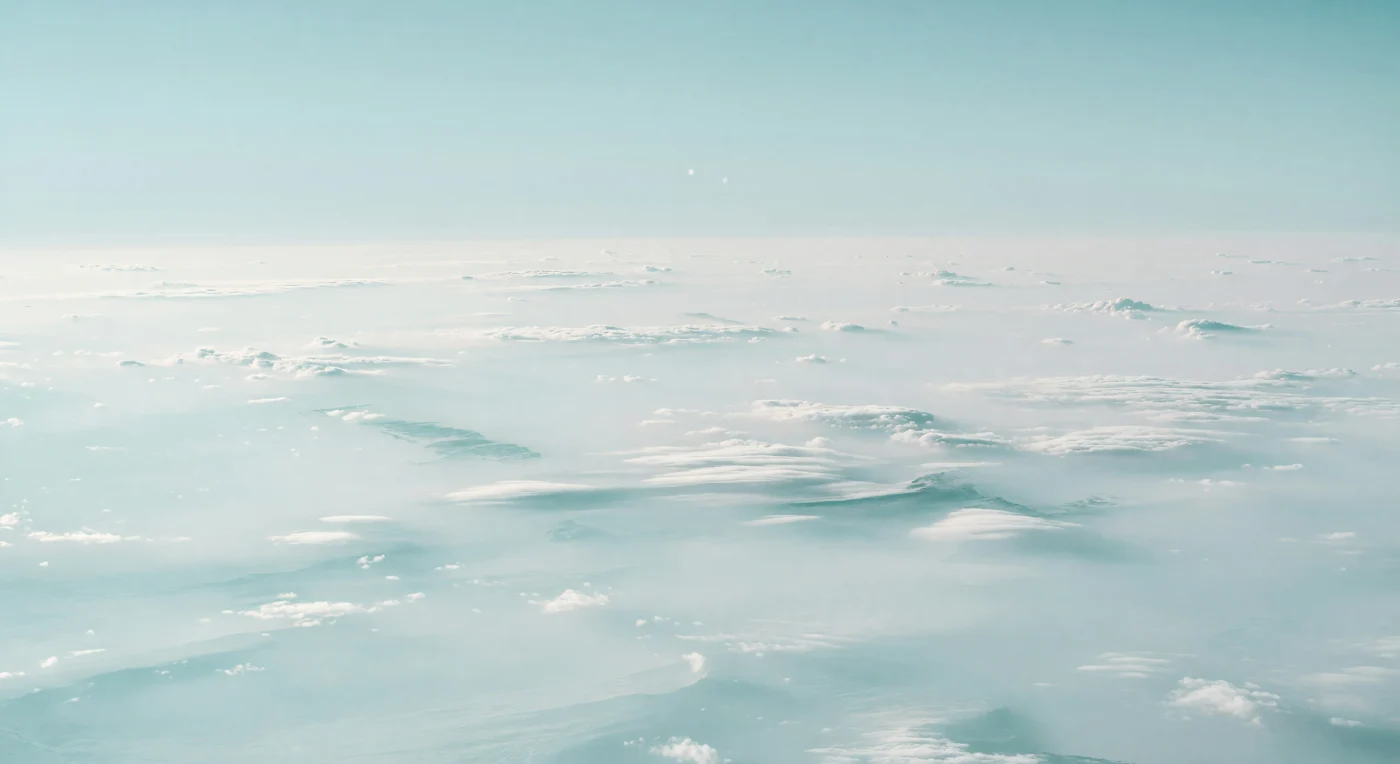
All around you, the world is nothing but atmosphere: a vast, pale white-cyan expanse of softly layered haze and faintly mottled cloud tops, their shallow swells and scalloped turbulence fading into a horizon so fog-bright it disappears into the sky. The scene is lit by an extraordinarily distant Sun, leaving the hydrogen-helium air and methane-rich aerosols washed in cold turquoise and silver-blue tones with almost no shadows, as if the entire landscape glows from within. These bright polar cloud layers are part of a high-latitude hood of condensed particles and methane haze suspended in the upper troposphere, where red light is absorbed and the visible world becomes desaturated, luminous, and eerily uniform. With no solid ground anywhere below—only deeper and denser atmospheric layers descending into high-pressure fluids—the immense, repeating fog banks and subdued cloud cells create a disorienting sense of standing inside an endless, frozen sea of sky.

From this floating vantage just above the upper cloud deck, the world appears as an immense atmospheric plain of pale turquoise and cyan, striped by long, parallel white ridges that ripple away like frozen surf into bluish haze. These bands are atmospheric gravity waves—broad oscillations traveling through stable layers of hydrogen, helium, and methane-rich air—where gentle upwellings cool enough for methane-ice cloudlets to brighten the crests while the troughs remain a deeper blue-green under suspended photochemical haze. A tiny, dim Sun hangs in the luminous aquamarine sky, its distant light softened by the thick atmosphere into a cold silvery wash that skims the scalloped wave tops and leaves only muted teal shadows. With no solid ground anywhere below, only deeper mist and descending cloud layers, the repeating wave-train corridor feels vast beyond intuition, an ocean of weather shaped into orderly bands that fade with the planet’s curvature over thousands of kilometers.

Suspended within the upper cloud decks, you would look across an immense atmospheric plain where a continent-sized rift opens through pale methane haze into a darker, teal-blue layer sinking away beneath it. The bright, softly scalloped margins are likely banks of methane-ice and other condensate aerosols, their white and faint cyan edges feathering into translucent fog while subtle convective textures and streamer-like bands reveal slow, powerful motions in the cold troposphere. Here there is no ground at all—only stacked cloud layers descending into deeper, denser gas, with methane absorbing red light and leaving the scene washed in aquamarine, pale turquoise, and saturated blue-green. Far above, the Sun is reduced to a tiny, dim point in the luminous haze, casting only weak, diffuse illumination that gives the abyssal opening and distant cloud terraces a quiet, vast, and profoundly alien depth.

A vast cloudscape of pale turquoise and aquamarine stretches to a curved horizon, where layered haze ridges fade into a dense blue-green sky, and from this softly banded expanse a single convective storm swells upward like a luminous dome of vapor. Its summit shines bright white with freshly condensed methane ice, while cauliflower-like lobes, flattened anvil outflow, rolling wave patterns, and shadowed cloud chasms reveal the fluid dynamics of an atmosphere made not of air over land, but of hydrogen, helium, methane clouds, and deep haze with no solid ground anywhere below. In the weak sunlight this far from the Sun, illumination is cold and diffuse, so the storm’s edges blur into a bluish mist and darker teal gaps hint at deeper atmospheric layers sinking beneath the visible deck. Standing here would feel like hovering above an endless, frozen weather ocean, where scale is planetary, motion is slow and powerful, and every visible hill, trough, and terrace is built entirely from cloud, condensate, and the physics of convection in one of the Solar System’s coldest upper atmospheres.
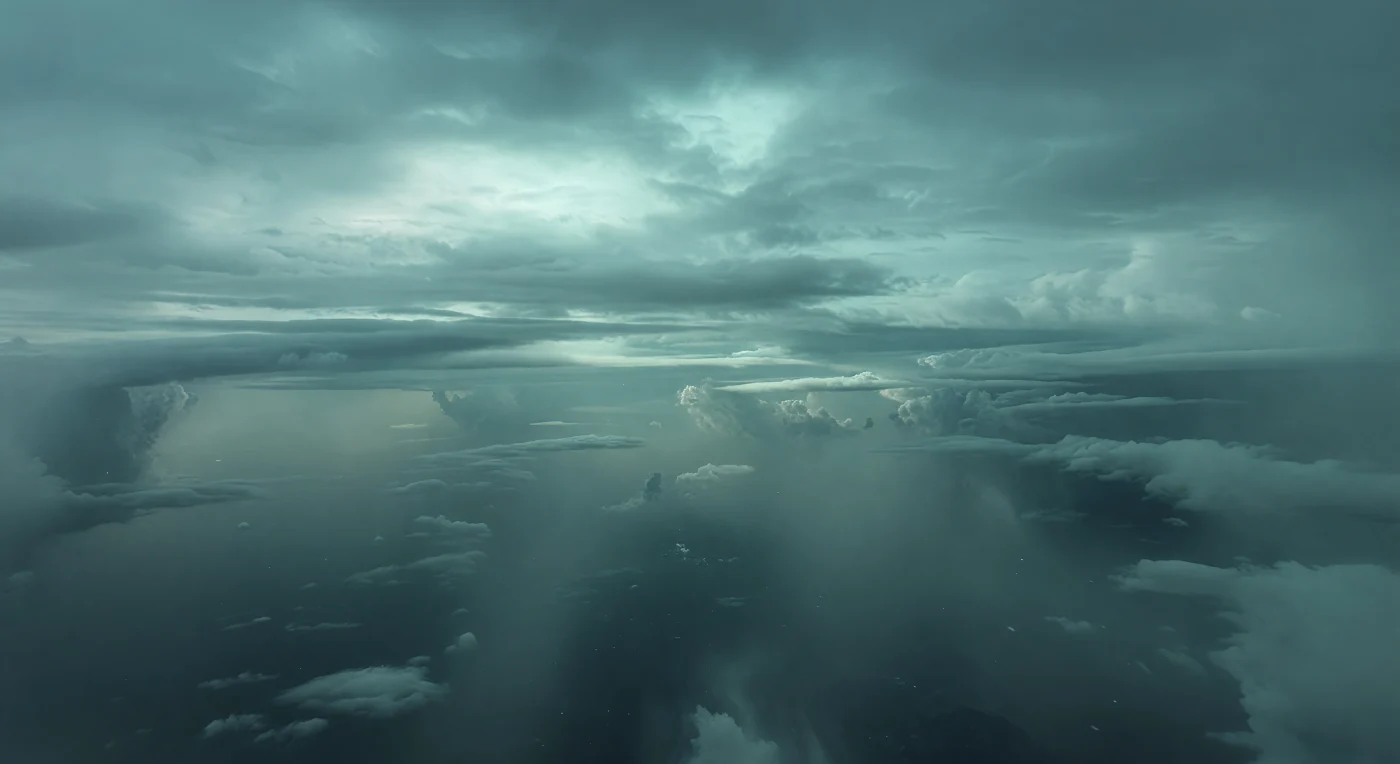
You are suspended in a vast, dim interior sky where there is no horizon and no ground—only layers of teal-gray haze and immense cloud decks fading into a cold, lightless depth below. Far overhead, a pale cyan ceiling of stratified methane-rich clouds glows faintly with sunlight weakened by nearly twenty times Earth’s distance from the Sun, diffused so thoroughly through hydrogen, helium, and hydrocarbon aerosols that it becomes a soft, directionless blue-green radiance with almost no shadows. Around you, city-sized eddies, rolling fog banks, and ghostly curtains of condensate drift through the murk, revealing an atmosphere of enormous scale and rising pressure rather than any solid surface. The effect is eerily quiet and oppressive: an alien ocean of cloud and chemistry, where the visible world is nothing but luminous mist suspended above an abyss of deeper unseen layers.

You seem to be hovering above an endless, darkened ocean of cloud, where subdued ridges, flattened domes, and scalloped banks of methane-hazed vapor stretch to a vast curved horizon under a nearly black-blue sky. There is no solid ground here—only layered atmospheric decks and deeper blue-black bands descending into the ice giant’s cold, high-pressure atmosphere, their pale cyan and muted turquoise tones softened by hydrocarbon haze and stratified mist. High above the high-latitude night side, a faint aurora appears not as bright curtains but as broad, patchy greenish-blue veils, blurred by the dense upper air and cast by the planet’s unusually tilted, offset magnetic field interacting with charged particles. In the dim, hushed light, with stars almost erased by the murk and shadows reduced to soft fissures in the cloud tops, the scene feels immense beyond intuition: a silent polar sky suspended over thousands of kilometers of slowly undulating atmosphere.

You hover above an immense aquamarine cloud plain with no solid horizon anywhere, only softly layered methane haze, pale cyan condensate banks, and deeper teal troughs sinking into the dim upper troposphere. At equinox, the ring system reveals itself twice: overhead as impossibly thin charcoal arcs in the milky pastel sky, and below as faint, razor-straight gray shadow bands drawn with geometric precision across the gently billowing clouds. Those crisp lines contrast with the atmosphere’s smooth curves because the rings are narrow, dark, and dusty, casting unusually sharp shadows through the cold, low-contrast light of a tiny distant Sun. In the bluish-green mist, where far cloud bands fade into turquoise veil and the planet’s curvature is felt more than seen, the scene feels vast, silent, and profoundly otherworldly—an ice giant’s atmosphere turned into a landscape.

At the edge of day, the atmosphere becomes a vast suspended landscape of cloud plains and shadowed belts, with no solid ground anywhere—only layered decks of methane haze and ammonia-hydrosulfide clouds sweeping toward a visibly curved horizon. The tiny Sun, reduced at this distance to a sharp white point just above the terminator, skims the haze at a shallow angle, drawing out silver-cyan, aquamarine, and deep teal bands while long diffuse shadows pour through trough-like separations and around bright convective towers that rise like ice-white mesas tens of kilometers high. Scalloped fog banks, faint wave ripples, and distant ringed vortices emerge and fade within the thick, cold aerosols, revealing an atmosphere shaped into landform-like structures by immense meteorology rather than rock or sea. Standing here would feel like hovering above an endless aerial canyon system carved from light, ice particles, and photochemical smog in one of the coldest, most subdued skies in the Solar System.
