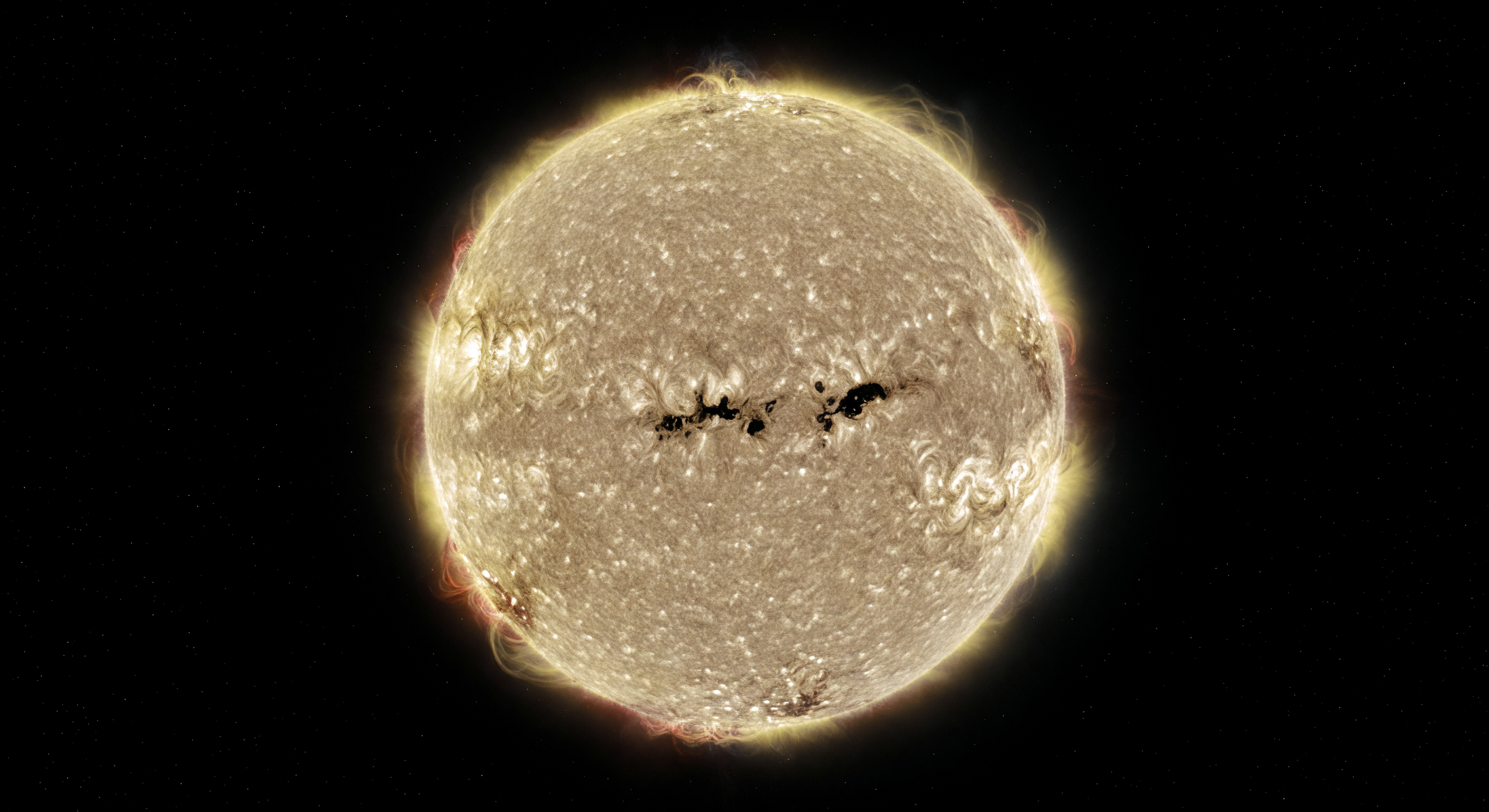
Scientific confidence: Very High

At the boundary between the chromosphere and transition region, the view opens across a vast, non-solid sea of magnetized plasma where no rock or soil exists—only layered light and motion. Dark red and maroon fibrils weave in dense bands above glowing plage, while slender spicules rise like needles along the horizon and the faint cellular pattern of the photosphere flickers through gaps below as softened yellow-white granulation. The scene is lit entirely by self-emission: saturated hydrogen glow in deep scarlet and ruby tones gives way rapidly upward to a stark blackness of the transition region and low corona, with only ghostly hints of hotter coronal streamers overhead. Every feature is shaped by intense magnetic fields and differential flows, stretching structures tens of thousands of kilometers wide and making the landscape feel less like a surface than a living, incandescent atmosphere suspended in colossal scale.

Just beyond the Sun’s brilliant curved limb, a colossal quiescent prominence hangs in space like a suspended curtain, its rose-red and maroon plasma woven into countless razor-sharp strands, braids, and folded veils. Beneath it, the photosphere seethes as incandescent granulation—bright yellow-white convection cells separated by darker lanes—while tiny magnetic bright points and a few darker pores hint at the immense magnetic forces shaping the scene. The prominence is cooler and denser than the surrounding corona, so it glows in H-alpha-like crimson tones as it traces invisible magnetic field lines, arching tens of thousands of kilometers high above the solar edge. Beyond that blazing wall of plasma, the background is pure black and starless, making the scale feel vast and impossible, as if you are floating at the boundary between searing light, magnetic tension, and empty space.

A vast incandescent plasma seascape fills the frame, its granular photosphere broken into bright convective cells and dark intergranular lanes that curve away toward the star’s immense horizon. Suspended above the low chromosphere, two parallel flare ribbons blaze orange-red like magnetic scars, while a towering arcade of freshly reconnected loops rises between them, its hottest summits shining white-blue and its legs cooling through yellow, gold, and deep red as the plasma settles. Along the arches, coronal rain has begun to drain in countless tiny, glowing condensations, revealing the hidden architecture of the magnetic field and the aftermath of a powerful reconnection event. There is no ground here, only layered plasma under a blinding self-luminous vault, where harsh radiation, weak diffuse shadows, and razor-sharp solar structure make the scene feel both fragile and colossal.

Above the pale white-gold curve of the solar limb, the scene feels almost emptied of structure: a thin crimson chromospheric rim clings to the edge, bristling with countless needle-like spicules, while the photosphere below shimmers as a vast field of luminous granules and faint supergranular lanes. In this polar coronal hole, the magnetic field is largely open rather than arched into dense loop systems, so only sparse, ghostly plumes and delicate blue-white rays rise outward, rooted in small network footpoints and streaming into the blackness of space. The absence of an Earth-like sky is striking, replaced by a tenuous pearly coronal haze and Thomson-scattered glow that fades quickly away from the horizon, leaving the upper atmosphere stark and austere. Every feature is immense in scale yet razor sharp, a frozen instant in a searing plasma environment where the Sun’s own light and heat shape the landscape more than any solid terrain ever could.

With the photosphere perfectly occulted, the scene opens onto the Sun’s outer corona as a vast pearly-white crown, its faint bluish streamers and needle-thin radial rays stretching millions of kilometers into jet-black space. Along the lower edge, a glowing horizon of gold-white granulation, charcoal sunspot umbrae, bright faculae, and crimson chromospheric spicules reveals that this “ground” is not solid at all but turbulent, magnetized plasma. Towering coronal loops arch above the limb, while distant quiescent prominences burn deep red at their bases, tracing the invisible magnetic architecture that shapes the solar atmosphere. The result is a high-contrast, eclipse-like vista of immense scale and searing energy, where every filament and streamer appears frozen in razor-sharp detail against the dark void.

Within the Sun’s lower chromosphere, you would seem to float above a blinding white-gold photospheric granulation field, where hot convection cells billow like a cellular sea and narrow darker lanes trace sinking plasma between them. Rising from that incandescent base is a dense forest of chromospheric spicules: needle-thin jets of magnetized hydrogen and helium plasma, glowing crimson to scarlet in H-alpha light and reaching hundreds to several thousand kilometers high, some straight and some gently bent by the solar magnetic field. Between the spikes, the sky opens into inky black space, yet the darkness is softened by a diffuse red emission haze and by tiny suspended knots and microjets frozen in the act of bursting upward. Farther off, a dark pair of sunspots with deep umbral cores and softer penumbrae anchors the immense scale, reminding you that this “landscape” is not rock or soil at all, but a violently alive architecture of plasma held together by magnetism.

From a heat-shielded platform hovering just above the photosphere, the view is an immense curved plain of incandescent granulation, where bright white-hot and pale-gold convective cells roil like a living foam across thousands of kilometers. Each roughly 1,000-km granule marks a rising plume of hot hydrogen-helium plasma, while the darker amber lanes between them trace the cooler sinking flows, and tiny pore-like magnetic depressions punctuate the luminous texture like brief voids in the fire. Above the horizon, the sky opens into true black space, yet the scene is still flooded by brutal solar glare, with a thin reddish-orange chromospheric rim, needle-like spicules, and faint coronal haze emphasizing the Sun’s layered atmosphere and immense scale. There is no solid ground here—only seething plasma, intense magnetic structure, and searing radiation at about 5,800 K, making the entire landscape feel both impossibly vast and intimately alive.

Near the solar limb, the photosphere spreads beneath you as a vast, incandescent field of granular plasma, each cell a convecting pocket of hydrogen and helium glowing white-hot at its center and fading to orange-gold along the darker intergranular lanes. Rising from this churning texture are brilliant limb faculae and clustered magnetic bright points, sharpened by the oblique view into jagged, reef-like ridges of white-gold light, while small sunspot pores nearby appear as cooler, darker depressions in the plasma rather than true holes. The curved horizon is softened by intense glare and strong limb darkening, with a thin rim of reddish chromosphere and a faint pearly coronal haze dissolving into black space above, giving the scene an immense, three-dimensional scale where individual granules span hundreds to more than a thousand kilometers across. Every filament, spicule, and bright knot is frozen in razor-crisp detail, revealing a landscape not of rock or water but of magnetically sculpted, self-luminous plasma under extreme temperature and pressure.
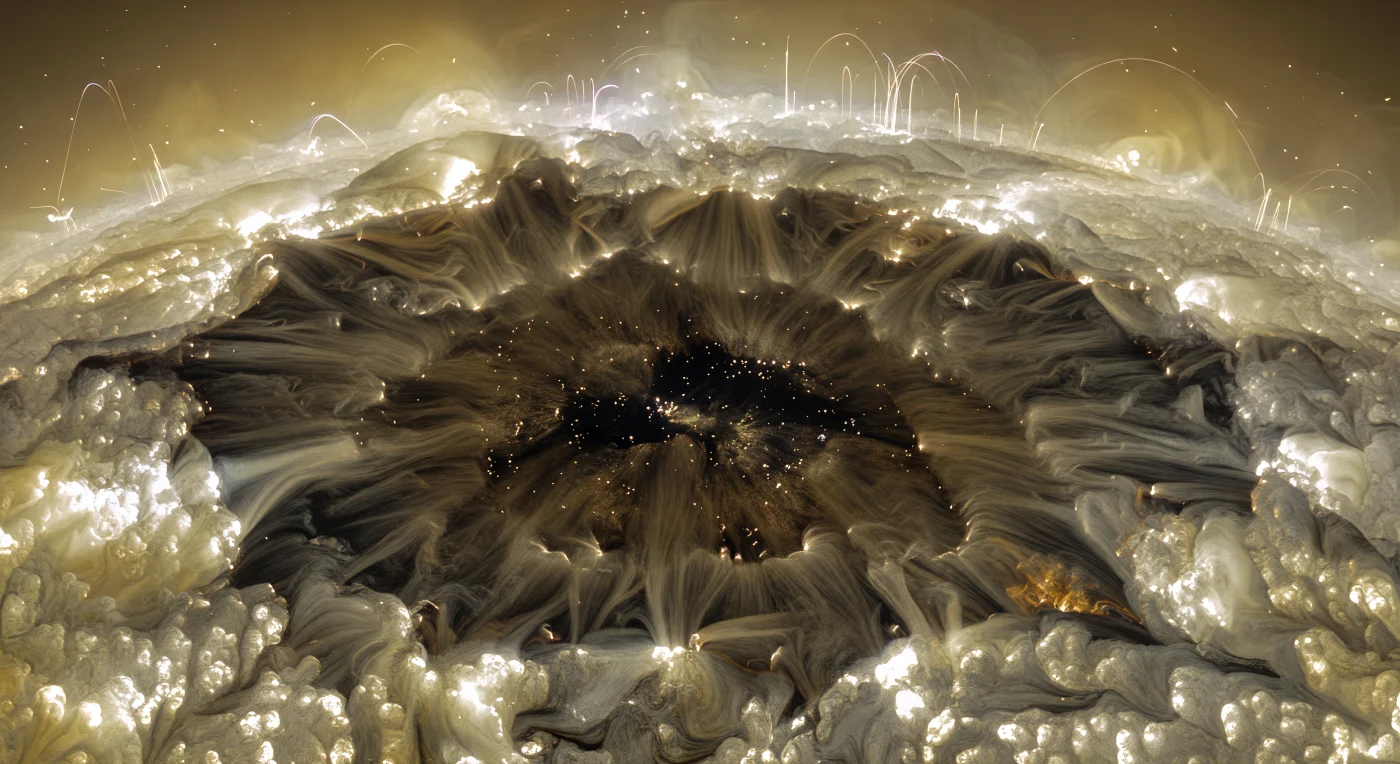
A colossal sunspot abyss fills the view as a dark charcoal-brown umbra, its mottled plasma surface dimmed where magnetic fields choke off convection and leave only a few tiny luminous flecks and umbral dots. Around it, the penumbra radiates in gray-brown and bronze fibrils, long magnetic filaments aligned like swept brushstrokes and stretching outward into the surrounding photosphere. Beyond the sunspot’s rim, the star’s white-gold granulation blazes with sharp, cellular convection cells and shimmering facular patches, while needlelike spicules and thin arching prominences rise at the margins under ferocious, self-illuminated contrast. There is no solid ground here—only layered solar plasma, from the cooler, darker active-region basin to the blazing photospheric foam and the faint amber glow of the higher atmosphere, all conveying immense scale and the raw architecture of magnetism on a star.
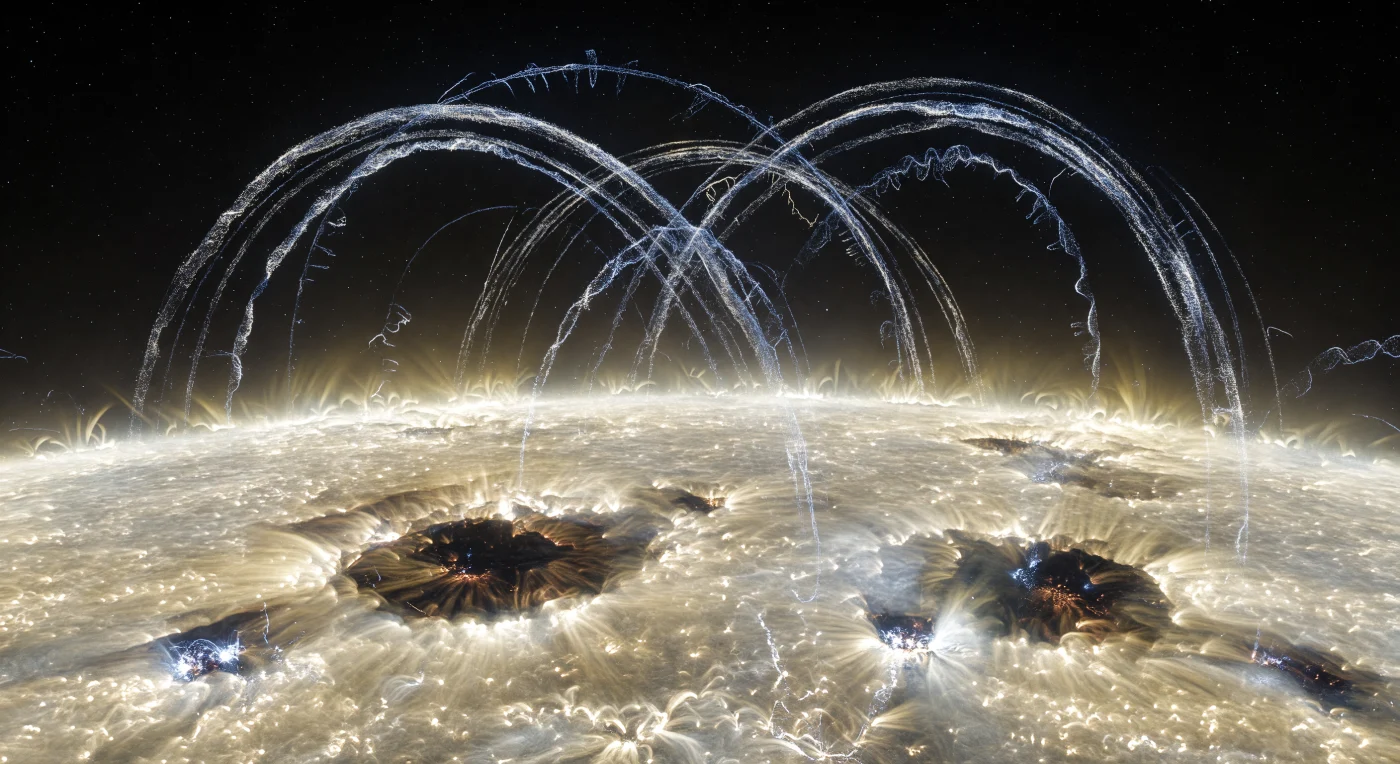
Suspended within the Sun’s low corona, the scene opens onto a dazzling white-gold photospheric “plain” of granulation, where each cellular patch is a convecting plume of ionized hydrogen and helium framed by darker intergranular lanes. Across this luminous field, near-black sunspot umbrae and filamented penumbrae interrupt the glare, while compact chromospheric brightenings and needle-thin spicules mark magnetic footpoints where intense fields concentrate energy and heat. Above them, immense coronal loops of silver, blue-white, and faint cyan plasma arch tens of thousands of kilometers overhead in braided vaults, tracing invisible magnetic field lines like a cathedral built from light. Beyond the brilliant active region, the sky falls to pure black space, and a faint pearly haze clings close to the loops, emphasizing both the star’s ferocious temperature and the staggering scale of its magnetic architecture.