
From the height of a dune crest, dark, smooth ridges of hydrocarbon-rich sand sweep away in long, parallel bands across the equatorial plain, their sinuous forms repeating for kilometers before dissolving into amber haze. At your feet, fine charcoal-brown grains are etched by wind ripples and dotted with rounded pebbles of water ice—here as hard as stone in the cryogenic cold—while the broad interdune flats between ridges lie as crusted orange-brown sediment shaped by persistent winds. The dense nitrogen atmosphere and low gravity help build these unusually elongated longitudinal dunes, and the thick photochemical haze turns the weak, distant Sun into only a dim glow that casts soft, low-contrast brown shadows. Under this muted ochre sky, with no sharp horizon and no visible stars, the landscape feels both eerily familiar and profoundly alien: a frozen desert where organic particles, not silicate sand, have been sculpted into continent-scale seas of dunes.

At ground level, the plain is a quiet mosaic of rounded pebbles and cobbles—blocks of water ice hardened by cryogenic cold into rock-like stone—each one stained ochre to dark brown by settled organic material and nestled in darker methane-damp sand and fine hydrocarbon silt. Their smoothed, river-worn shapes record an older history of flowing liquid methane, while the nearly flat surface, faint drainage textures, and cohesive sediment hint at a landscape still shaped by an active methane cycle under temperatures near 94 K. Above, a dense nitrogen atmosphere loaded with photochemical haze turns the sky into a dim amber vault, scattering the weak sunlight into soft orange illumination and washing the horizon into a gradual blur. Standing here, the scene feels both intimate and immense: a pebble field at your feet, yet one that stretches outward into a muted, alien world where ice behaves like bedrock and organics settle like dust from a perpetual smog.

A nearly black ribbon of liquid methane winds across the plain in sweeping bends, its smooth surface catching a thin silver-orange glint from a tiny, weak Sun blurred high behind the thick amber haze. Along the shallow valley, dirty gray ice-rich banks and muddy-dark point bars reveal rounded blocks of water ice, frozen sediment crusts, polygonal fractures, and dustings of orange-brown organic particles that have settled from the atmosphere, while small braided rills seep into the main channel across compacted icy mud. Here, at about 94 kelvin, water ice is the bedrock and behaves like stone, while methane and ethane flow and erode the landscape much as water does on Earth, carving low terraces and damp-looking margins through organic-rich sediment. Under the dense nitrogen sky, with blurred shadows and distant icy rises fading into ochre murk, the immense scale of the meander plain feels both familiar and profoundly alien.

A broad, pale corridor of compacted sediment stretches away at your feet, its dirty gray-beige surface made of water ice frozen so hard in the ~94 K cold that it behaves like stone, dusted with rust-brown organic particles and faintly rippled by persistent winds. On either side, immense walls of nearly black hydrocarbon sand rise in smooth, curving bands, longitudinal dunes tens to more than a hundred meters high that recede into the haze and reveal the slow, powerful sculpting of an atmosphere denser than Earth’s. The amber sky glows with diffuse light, the distant Sun reduced to a weak blur behind layers of photochemical smog, so shadows nearly vanish and the horizon dissolves into butterscotch softness. In this dry equatorial passage, with no standing liquid and only subtle polygonal cracks and shallow wind-carved hollows marking cryogenic surface change, the landscape feels uncannily familiar in form yet utterly alien in substance.

From this low icy bluff, the shoreline falls away to an immense sea of liquid methane and ethane so calm it looks like polished black glass, interrupted only by a razor-thin bronze reflection where the tiny, haze-muted Sun catches the surface. Under the dim ochre glow of a dense nitrogen atmosphere loaded with photochemical aerosols, the ground nearby is a frozen mix of water-ice bedrock, hydrocarbon sediments, dark organic dust, and cryogenic cracks—materials that, in this deep cold, behave more like stone than anything familiar from Earth. The wet, charcoal-dark margin at the water’s edge hints at active waves and weather in a world where methane plays the role of water, carving coasts, filling basins, and cycling through air and surface. Far across the haze-softened horizon, low ice hills barely emerge, making the sea feel vast and silent, as if you are standing at the edge of a dark, frigid mirror beneath an everlasting amber twilight.

At the edge of the polar sea, a dark, gently sloping beach of wet hydrocarbon-rich mud and compacted organic sediment is littered with pale water-ice cobbles—the local equivalent of rock—some rounded smooth, others angular and dusted with brown-orange haze fallout. Beyond it lies an almost black sheet of liquid methane and ethane, so still it reads like polished obsidian, fading into an amber-gray veil where the far shore is completely erased by the dense nitrogen atmosphere. The dim Sun is only a weak brightening behind the smoggy sky, casting soft honey-colored light and blurred shadows across low hummocks, damp rills, and wave-lapped margins shaped by cryogenic weather at about 94 kelvin. Under low gravity and perpetual haze, the coast feels vast, cold, and strangely familiar: a shoreline built by rain, erosion, and seas, but with ice as bedrock and hydrocarbons standing in for water.

From this ridge, a maze of branching valleys fans across bright uplands, carving pale beige-gray plains of water-ice bedrock into tributaries, benches, and shallow canyon-like troughs that stretch for many kilometers into the haze. At Titan’s frigid surface temperature of about 94 K, water ice is as hard as rock, so these dissected highlands record long episodes of erosion by flowing methane rainfall and runoff, while darker orange-brown organic particles from the atmosphere collect in fractures, hollows, and along drainage paths like a soot of hydrocarbons. The ground nearby is littered with angular ice blocks and frost-cemented sediment, and the plateau itself is streaked with rusty, tan, and brown stains where complex organics have settled or been concentrated by surface processes. Above it all, a dense nitrogen atmosphere loaded with photochemical smog turns the sunlight into a weak amber glow, softening every shadow and fading the farthest ridges into layered orange mist, making the landscape feel both eerily familiar and profoundly alien.

At the edge of the polar sea, rounded cobbles of water ice and dark hydrocarbon sediment lie like wet stone under a dim amber glow, while shallow tongues of liquid methane and ethane slide in with small, glossy waves almost black beneath the haze. Beyond the shoreline, the sea spreads outward into drowned lowlands and broad sedimentary plains, its rippled surface fading into murk as low shoals and the horizon are swallowed by airborne mist. Overhead, a heavy deck of methane storm clouds hangs in a dense nitrogen atmosphere loaded with orange-brown photochemical haze, and distant rain falls in blurred curtains that nearly merge sea and sky. In this cryogenic landscape, where ice is rock-hard at about 94 kelvin and sunlight arrives only as a faint diffuse stain, the scene feels at once eerily familiar and profoundly alien.

Under a dim bronze sky, kilometer-scale ridges of pale water-ice bedrock rise and fold away into a vast maze, their fractured, rounded faces dropping into dark troughs veiled with pooled haze. The bright high ground is not rock in the terrestrial sense but ice frozen so hard by the near-94 K cold that it behaves like stone, while the low floors are mantled with brown to charcoal organic sediments and dust produced by atmospheric chemistry and reworked by winds and methane-driven erosion. Low-angle sunlight, heavily blurred by the dense nitrogen atmosphere and its photochemical smog, spreads broad soft shadows through branching canyons, scalloped escarpments, and collapsed ledges, emphasizing a landscape carved over immense spans of time rather than built into sharp peaks. Standing here, you would see ridge after ridge fading into the amber murk for many kilometers, an immense frozen labyrinth where geology familiar in form becomes utterly alien in substance.

At the brink of this steep polar depression, the ground gives way abruptly to a basin whose knife-sharp rim and brittle, near-vertical walls expose water ice that is as hard as bedrock in the deep cold, its dirty bluish-gray faces streaked with brown-orange deposits of complex atmospheric organics. Far below, an almost black lake of liquid methane and ethane lies unnaturally still, faintly mirroring the dim amber haze, while scalloped shorelines, fractured terraces, frost-dusted rubble, and boulder-sized fallen ice blocks reveal active collapse, erosion, and retreat along the basin edge. Beyond the foreground blocks, the broad hollow and its far wall fade into a dense orange atmosphere where sunlight is reduced to a weak, diffuse glow by thick nitrogen air and layered methane haze, muting shadows and swallowing distance. It feels both intimate and immense: a cryogenic shoreline shaped by weather and liquids familiar in form yet utterly alien in substance, under conditions cold enough for water to stand here as stone and hydrocarbons to pool like ink.

You stand at the floor of a vast, empty polar basin where a dark expanse of organic-rich mud and hydrocarbon sediments spreads outward in smooth flats, broken here and there into polygonal crust plates, shallow channels, and pitted patches that hint at repeated wetting and drying under cryogenic conditions. Encircling the lakebed is a striking ring of pale cream, beige, and faint peach evaporite crust—materials thought to precipitate as methane-ethane lakes retreat and dissolved organics are left behind along former shorelines and terraces. Beyond, low plains of water ice—rock-hard at these temperatures—fade into hummocks and softened depressions under a dense nitrogen atmosphere loaded with orange photochemical haze. The tiny Sun is only a weak blur in the butterscotch sky, casting diffuse honey-colored light with almost no shadows, so the whole landscape feels immense, silent, and eerily flattened, like an alien shoreline preserved in perpetual winter.

At the foot of the Mithrim massif, fractured walls of water-ice bedrock loom like stone mountains in the deep cold, their bluish-gray ice dulled to tan and amber beneath a thick orange-brown haze while their lower slopes dissolve into atmospheric murk. Underfoot, rounded ice cobbles, frost-shattered blocks, gritty organic dust, and pockets of charcoal-dark hydrocarbon sand scatter across the plain, with talus fans, shallow gullies, and broken benches recording slow erosion and collapse in a world where ice is as hard as terrestrial rock at about 94 K. Beyond the boulder-strewn foreground, darker smoother plains stretch away with faint channel-like traces and low sediment drifts, and in sheltered hollows any liquid would appear only as tiny, still, black mirrors of methane-ethane rather than water. The light is dim and strangely gentle, filtered through dense photochemical smog so thoroughly that the Sun is only a weak diffuse glow overhead, leaving the immense escarpments to fade softly into an alien twilight.
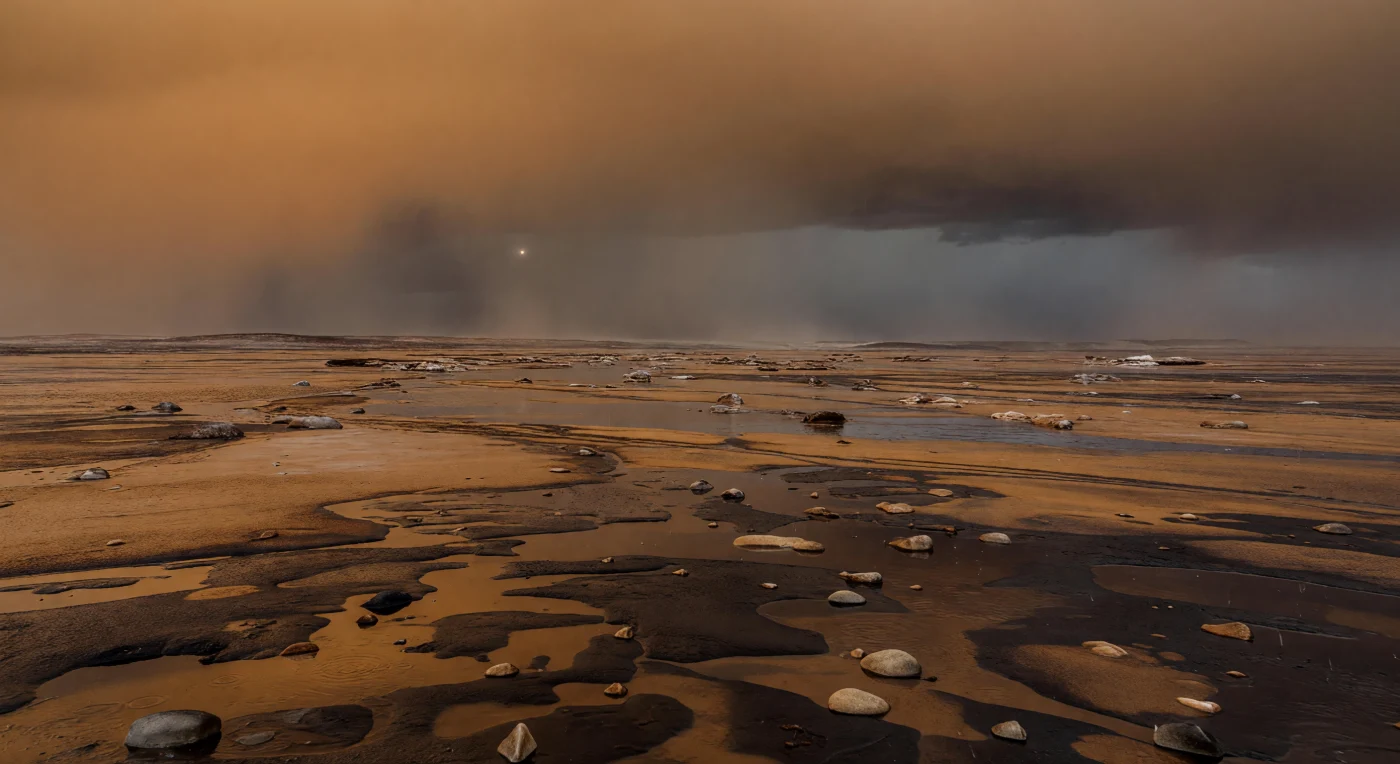
A dim, amber-gray storm light hangs over an immense lowland plain where methane rain turns organic-rich sediment into slick black-brown films and shallow, mirrorlike puddles pooled among rounded cobbles of water ice—the bedrock here frozen so hard it plays the role of stone. Braided rivulets and faint erosional runnels thread across the flat ground, while polygonal cracks and low icy hummocks are partly drowned beneath liquid methane and ethane, showing an active hydrocarbon cycle that in this frigid world replaces Earth’s familiar water weather. Above, a dense nitrogen atmosphere loaded with photochemical haze and heavy methane clouds presses low, filling the air with mist and reducing the weak, distant sunlight to a dull glow with almost no shadow. The far plain-edge scarp dissolves into orange-brown murk, making the landscape feel endless, cold, and strangely intimate—as if you are standing inside a rainstorm on a world where rock, rain, and river are made of entirely different substances.

From the mouth of a deeply cut canyon, a broad alluvial fan spreads across the low plain like a frozen river delta, its surface littered with icy pebbles, cobbles, and compacted brown-orange sediment that grade from coarse debris near the cliffs to finer, darker material farther out. The canyon walls expose bright water-ice bedrock—here as hard as terrestrial stone at roughly 94 K—fractured into pale blocks and rubble, while faint branching streaks across the fan mark former methane-ethane runoff channels carved not by liquid water, but by hydrocarbons moving through this cryogenic landscape. Under the dense nitrogen atmosphere and suspended tholin haze, the light is dim, amber, and strangely flat, softening shadows and reducing the vast plain to muted bands of ochre, umber, and dirty bluish-white ice. Standing here, you would feel the immense stillness of an active yet frozen world, where familiar geological forms are built from alien materials beneath a smothering orange sky.

Under a thick butterscotch haze, the ground is littered with dark organic sand and hydrocarbon dust pooled between angular blocks of water ice that, in this deep cold, are as hard as terrestrial rock. Ahead, the landscape swells into a broad pale dome of broken icy crust, its hummocky mounds, scarps, and lobate aprons suggesting either cryovolcanic resurfacing or tectonic uplift, with rough, frozen flows of water-ammonia-rich material wrinkled into ridges and rubbly margins. Steep-sided dark pits interrupt the dome like collapsed vents or subsidence hollows, their shadowed interiors collecting even darker organic sediments, while faulted ridges and subdued icy highlands fade into low plains etched by shallow channels. In the weak amber daylight filtered through the dense nitrogen atmosphere, every shadow is soft and blurred, and the immense frozen complex feels both geologically active in its history and eerily motionless in the present.

From the dark, compacted floor of this ancient impact basin, the landscape stretches away in a broad plain of brown-black organic sediment and hydrocarbon dust, dotted with rounded ice cobbles and fractured blocks of dirty water ice that stand in for rock at these cryogenic temperatures. Far ahead, a low, pale arc of tan-gray icy rubble marks the deeply worn basin rim—once a sharper circular wall, now softened by immense age, erosion, burial beneath sediments, and slow aeolian reworking under a dense 1.5-bar nitrogen atmosphere. The amber sky glows dimly through thick photochemical haze, with the Sun reduced to a tiny diffuse spark and distant landforms fading into a veiled horizon, while faint swales, hummocks, and buried ejecta remnants hint at the basin’s violent origin beneath the quiet surface. Everything feels vast, muted, and strangely familiar yet profoundly alien: a frozen world where water behaves like stone, hydrocarbons shape the plains, and time and haze have nearly erased the scars of catastrophe.

Under a heavy winter hood of methane cloud and orange-brown photochemical haze, the polar ground lies dim and almost shadowless: a vast, low basin of dirty amber water-ice bedrock, fractured plates, and rounded icy cobbles dusted with rusty organic fallout. Shallow depressions hold nearly black pools and lakelets of liquid methane and ethane, their margins darkened as if wet, while faint polygonal cracks, subdued rims, and shallow channels hint at slow erosion, collapse, and sedimentation in this cryogenic landscape where water is rock-hard and hydrocarbons flow and freeze. The dense nitrogen air and suspended haze erase the Sun to little more than a weak diffuse glow, hiding distant relief so completely that the plains seem to dissolve into a murky, horizonless brown. Standing here would feel like being at the edge of a frozen, air-filled sea world in permanent twilight, where every texture is familiar in shape yet made from utterly alien materials.

Under a sky of smoky amber-brown haze, the icy upland is almost swallowed by darkness, its broad plateau only faintly revealed where weak atmospheric backscatter brushes fractured water-ice bedrock with dull bronze-gray highlights. At these frigid surface temperatures, near 94 K, water ice is as hard and brittle as stone, so the ground breaks into angular slabs, frost-shattered blocks, shallow troughs, and subtle polygonal cracks, with darker organic sediments and a thin dusting of hydrocarbon particles collecting in low spots between scattered cobbles. Farther out, low hummocks and subdued ice hills dissolve into the dense nitrogen atmosphere, while the upper sky carries a barely perceptible auroral-like veil of airglow—soft amber with a hint of greenish bronze—muting all but a few faint stars behind the thick photochemical haze. The result is a vast, silent landscape that feels both intimate and immense, a frozen world of rock-hard ice and suspended organics lit only by the dim breath of its own atmosphere.

Under a dim polar twilight, a black shoreline of hydrocarbon-rich sediment and rounded cobbles of water ice stretches away into a vast, nearly lightless sea whose methane-ethane surface looks oily and glass-dark, broken only by faint ripples and shallow channels etched through frozen ground. The low plain beyond is subdued and immense—muted icy ledges, polygon-cracked mud, eroded scarps, and distant bluffs all softened by a dense nitrogen atmosphere loaded with orange-brown photochemical haze, where water ice is not soft or white but as hard as rock and stained by organic fallout. Hanging low in that smog-dark sky is Saturn, enormous yet strangely ghostly: a blurred cream disk with its rings reduced to a barely perceptible flattened glow, its light heavily scattered until almost no stars can pierce the murk. In the weak, diffuse illumination of this far-off Sun, the landscape feels both eerily familiar and profoundly alien, a frozen shoreline shaped by weather, liquids, and erosion—but with methane standing in for water beneath a heavy, amber-brown sky.

A many-kilometer fault scarp cuts across the frozen plain like a freshly broken wall, its steep faces exposing dirty white to bluish-gray water-ice bedrock above dark aprons of fallen, organic-rich debris. At these cryogenic temperatures, water ice behaves as rock, so the sharp fracture planes, stepped offsets, icy breccia, and house-sized blocks record tectonic stresses that have split the crust and left only muted erosion under a dense nitrogen atmosphere. In the foreground, orange-brown dust, tholin-dark grains, scattered rounded ice cobbles, brittle slabs, and faint polygonal cracks texture the ground at your feet, while beyond the cliff the plain dissolves into layered orange haze. The tiny, dim Sun is only a weak brightening in the smog, casting soft amber light and almost no shadows, so the whole landscape feels vast, hushed, and strangely humid—an alien world where stone is ice and the air itself blurs the horizon.
