Scientific confidence: Medium
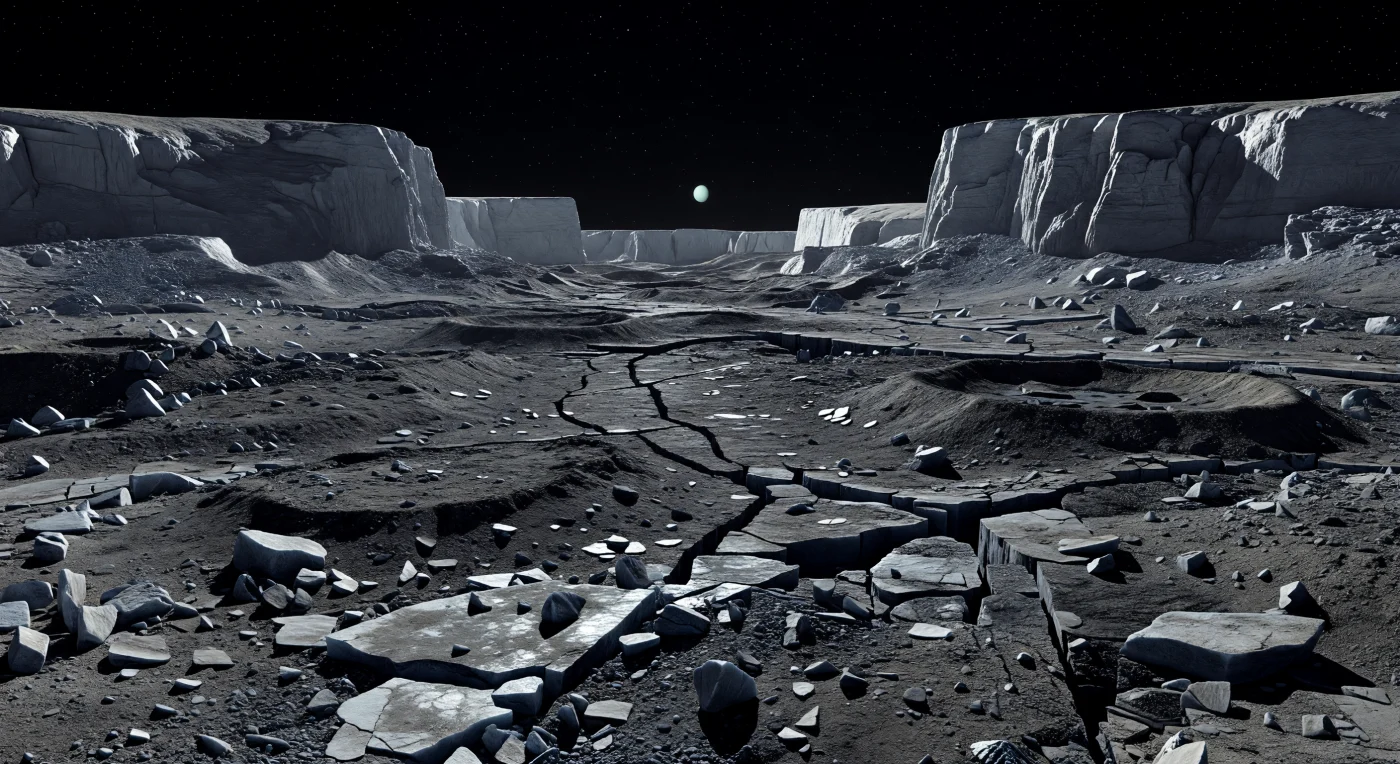
From the floor of this immense rift, the ground looks shattered and raw: hummocky collapse blocks, knife-edged slabs of dirty water ice, and scattered angular boulders lie strewn across a dark gray regolith cut by long, parallel fractures and step-like faults. Towering scarp faces of brighter, cleaner ice rise hundreds of meters to more than a kilometer overhead, their sunlit walls glowing pale against huge sections swallowed in absolute black shadow, with no air or haze to soften a single edge. The scene records a crust pulled apart by tectonic extension on a frigid rock-and-ice world, where brittle water ice mixed with darker carbon-rich material has broken, slumped, and weathered under impacts and radiation rather than wind or flowing liquid. Under a tiny, fierce Sun in a pure black sky—perhaps with a distant cyan-green planetary disk hanging above the horizon—the scale feels uncanny: every foreground crack is razor-sharp, every cliff impossibly steep in low gravity, and the silence seems as vast as the chasm itself.

At the rim of Messina Chasma, the ground underfoot is a brittle pavement of dark gray, charcoal-streaked ice-rich regolith, split into angular plates and littered with frost-dusted rubble and shattered blocks, before it breaks suddenly along sharp fault cracks into a series of terraces and a towering pale scarp of cleaner water-ice bedrock. The cliff plunges into a canyon several kilometers wide, its floor drowned in black shadow except for faint glimpses of collapsed hummocks, scattered impact scars, and tiny-looking boulder fields that emphasize the immense scale of the trench and the unusually crisp, steep relief made possible by low gravity and an airless vacuum. This landscape records a world that once stretched and fractured, opening vast extensional chasms through an ancient crust of mixed water ice and darker rocky, carbon-rich material, later modified by impacts and slow mass wasting down the canyon walls. Above it all hangs a perfectly black sky, where a tiny hard-edged Sun casts cold, razor-sharp shadows, and near the horizon a huge pale cyan disk looms almost motionless—an immense reminder that this frozen canyon lies in the grip of a distant giant planet.

You stand on a jumbled floor of broken ice-rich slabs, dark regolith dust, and scattered ejecta blocks inside a vast young impact basin, where towering terraced walls rise in crisp, stair-stepped scarps of exposed water-ice bedrock. The cleaner ice gleams bluish-white and cold gray in the weak, sharply directional sunlight, while darker fallback debris and streaks of carbon-rich contaminant material drape the slopes and collect in talus fans below, recording the violence of the impact and the collapse that followed. In this airless near-vacuum, there is no haze to soften the view and no atmospheric glow to seep into the depths, so every ledge and fractured rim segment is etched with hard-edged contrast and the crater’s deepest hollows plunge to near-black. Above the immense bowl, a black sky and tiny distant Sun heighten the sense of isolation, making the hundreds-of-meters-high terraces and tiny foreground boulders feel like parts of a frozen, silent ruin on a truly colossal scale.
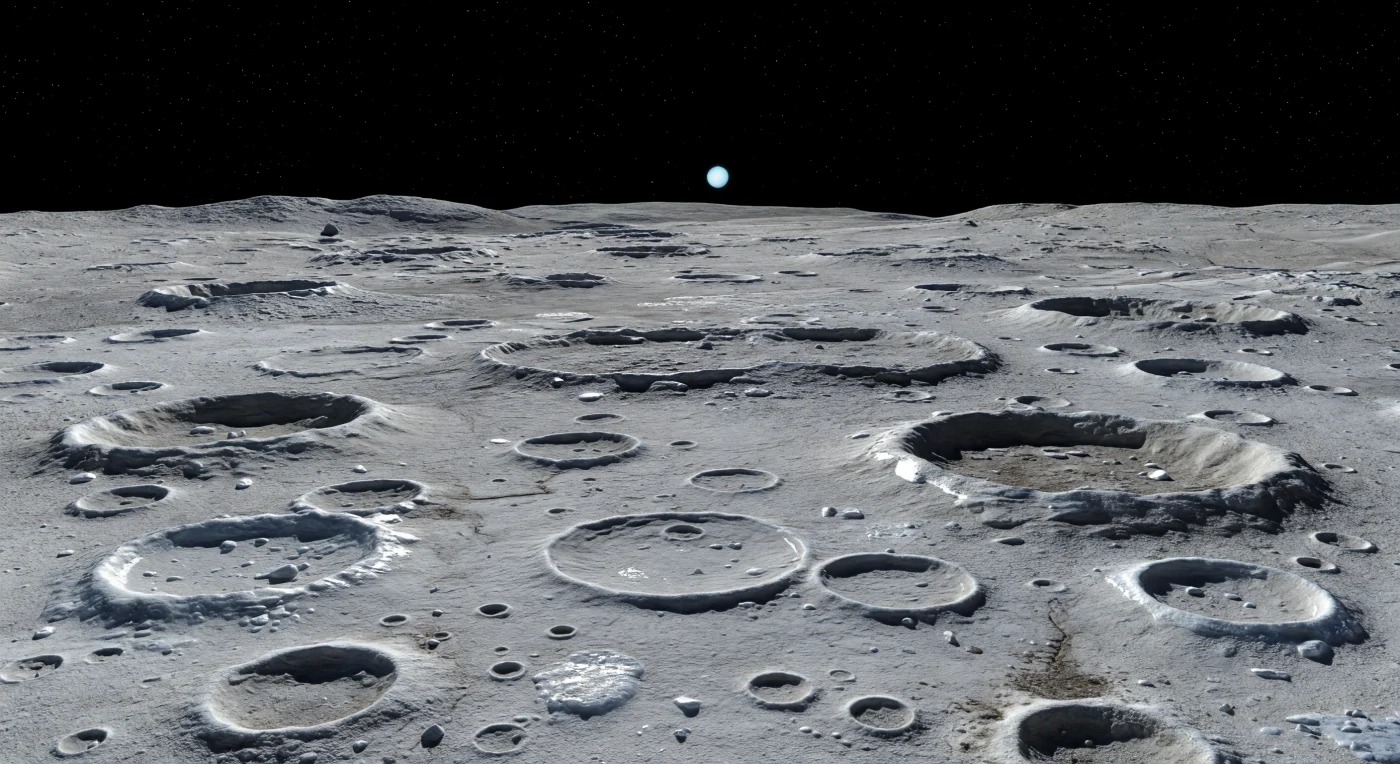
A frozen upland plain of ancient impact scars stretches away in every direction, so densely cratered that old basins overlap and merge into a single battered landscape of softened rims, shallow bowls, and low hummocky ejecta draped in fine gray regolith. Underfoot, the crust is a cryogenic mix of hard water-ice bedrock and darker rocky, carbon-rich material, with scattered angular ice fragments and occasional brighter frost along rim crests catching faint bluish-white glints in the weak, distant sunlight. The airless sky is perfectly black even in daytime, pricked with stars beyond the glare of a tiny but fierce Sun, while the close, subtly curved horizon reveals the small scale of this world and hints of distant scarps and extensional fractures record an icy shell once pulled apart. Everything is silent, dry, and motionless, preserved by deep cold and negligible erosion so that impacts from the early Solar System still dominate the scene with stark, crisp shadows and extraordinary geological age.
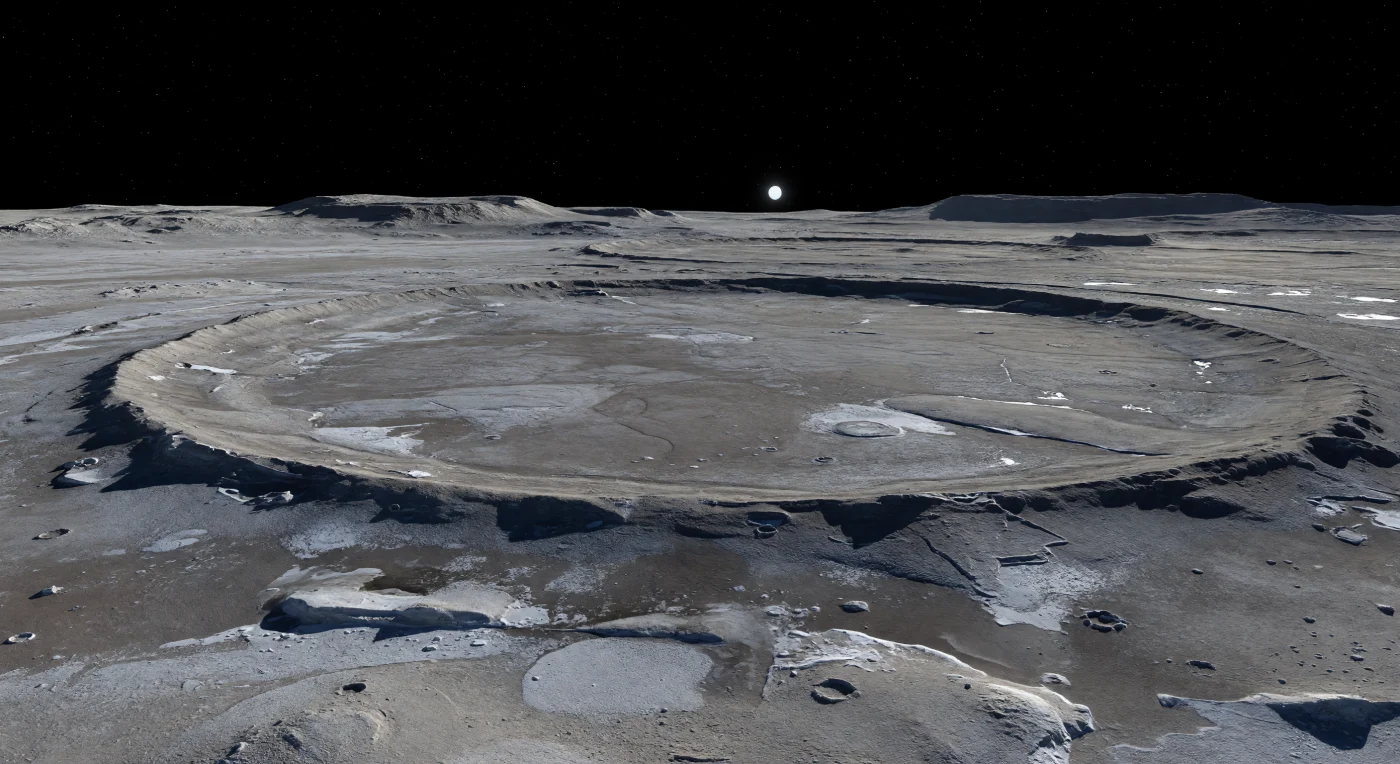
You stand on a dry, airless floor of ancient dirty water ice and dark rocky debris, looking across a colossal impact basin so old that its once-sharp rings have sagged into broad, barely perceptible rises. In the dim light of a tiny distant Sun, the basin’s hidden geometry finally reveals itself: muted concentric ridges, half-erased crater rims, fractured icy slabs, and shallow hollows where darker regolith has settled, all traced by impossibly long, razor-edged black shadows. This softened topography is the signature of viscous relaxation in an ice-rich crust, where over immense spans of time the landscape slowly slumped and blurred, leaving a frozen record of impacts, tectonic lineaments, and patchy brighter frost on fresher edges. Above the silent plain, the sky is absolutely black, stars pricking through the darkness, and the far uplands rise only gently on the horizon—making the scene feel at once starkly intimate in texture and immense beyond measure.
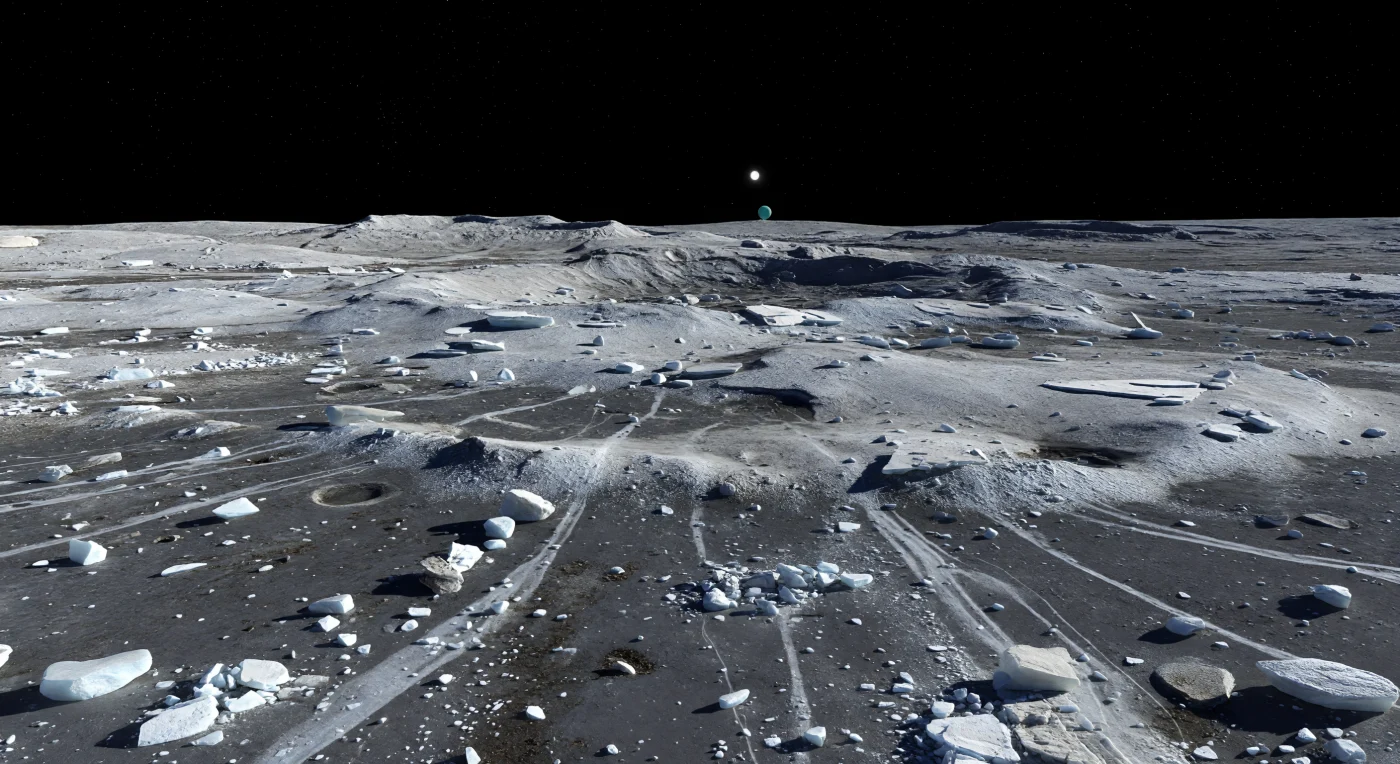
You are standing amid the shattered outskirts of a colossal impact, where pale frost-gray and off-white ejecta lies splashed in broad lobes and streaks across an older charcoal-dark icy crust, the ground heaped into hummocks, low radial ridges, and fields of angular blocks as large as small buildings. These deposits are made mostly of water-ice-rich crust excavated and flung outward by the formation of Gertrude, mixed with darker carbon-bearing material; in the airless cold, their sharp edges, secondary pits, and crisp ridge trains remain preserved for immense spans of time because no wind, rain, or haze softens them. Hard, distant sunlight from a tiny white Sun cuts black shadows beneath boulders and fractured slabs, while clean ice faces flash faint bluish highlights and the ejecta pattern stretches for hundreds of meters into cratered uplands and low scarps beyond. Above it all hangs a pure black sky, perhaps with Uranus as a still pale cyan-green disk, making the frozen debris field feel both silent and vast, like a moment after catastrophe suspended for billions of years.

You stand amid a jumbled talus of shattered water-ice crust at the base of a colossal fault scarp, where meter- to house-sized angular blocks lie heaped across a plain of darker rocky-carbonaceous debris and powdery regolith. Fresh breaks in the fallen boulders gleam pale gray-white in the tiny, fierce Sun, while older surfaces have been dulled to slate, charcoal, and dirty beige by radiation exposure and the slow settling of fine icy dust. Above, the cliff rises like a frozen wall of tectonic violence—layered, fractured, and cut by crevices—before disappearing abruptly into black shadow, a stark effect of an airless world where no atmosphere softens the light or fills the darkness. Beyond the rubble, a broader faulted valley and subdued cratered uplands hint at an ancient crust stretched apart by internal expansion, leaving behind a silent landscape of immense scale, brutal clarity, and deep time.
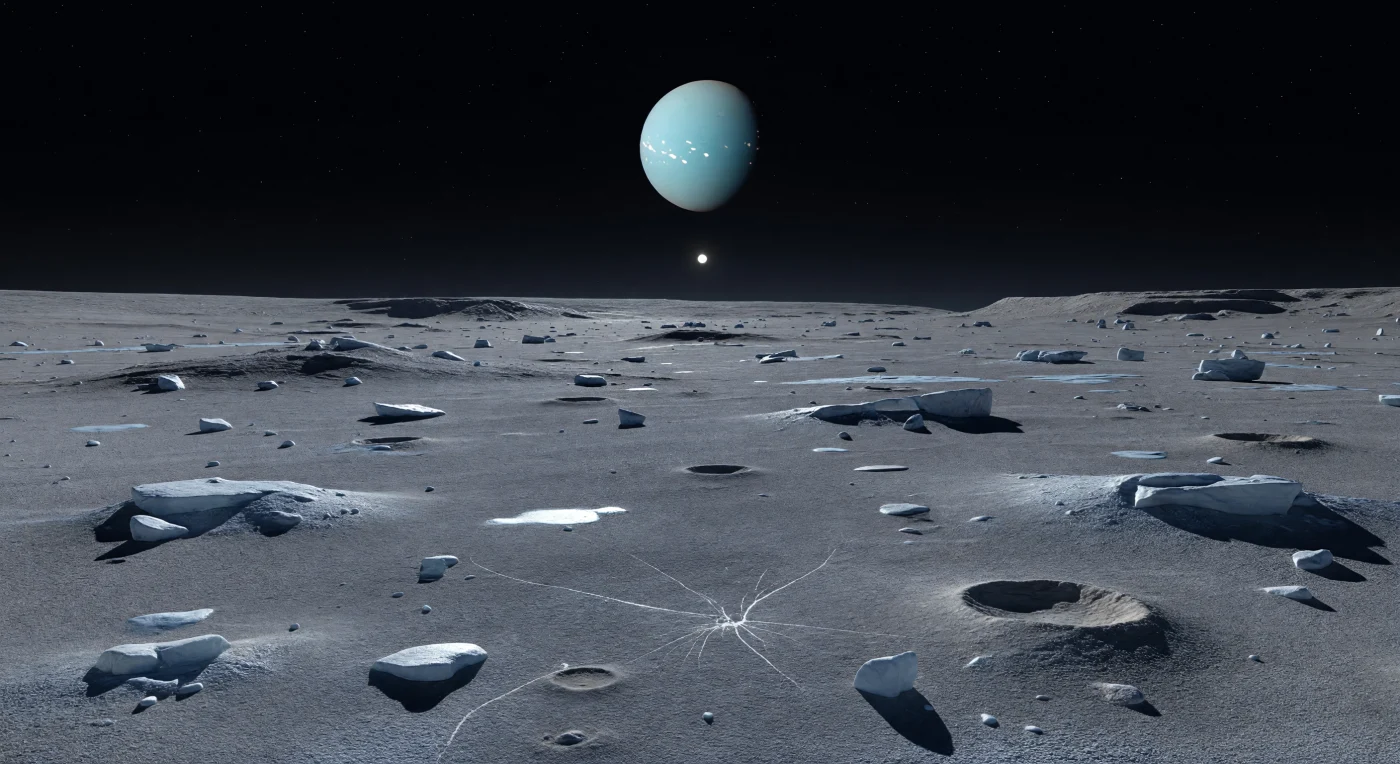
You stand on a vast, subdued plain of compact gray ice-regolith, its frozen soil darkened by carbon-rich material and broken only by scattered angular ice blocks, frost-coated hummocks, softened craterlets, and the faint bright streaks of ancient ejecta. Far across the gently undulating surface, low wrinkle-like rises and distant scarps hint at a crust that was once stretched and fractured, preserving the record of impact gardening and tectonic extension on this ancient rock–ice world. Above the utterly black sky hangs an enormous pale cyan disk, nearly motionless and so large it seems to press down on the horizon, while the Sun appears only as a tiny, fierce point casting razor-sharp shadows into crater hollows and behind boulders. In that dim, cryogenic stillness—airless, dry, and silent—the shadows take on the faintest blue-green tint from reflected planetary light, making the immense frozen plain feel both scientifically legible and profoundly alien.

Under starlight so faint it seems almost imagined, a frozen plain of ancient water-ice bedrock stretches away in muted charcoal, slate gray, and dirty white, its low crater rims and shallow hollows appearing only as ghostly silver contours in the dark. The surface is dry, airless, and razor-sharp in detail: softened old impact scars overlap across the plain, a few younger bowl-shaped craters gleam with slightly cleaner exposed ice, and subdued fault scarps and shallow troughs hint at a crust once pulled apart as the interior evolved. Mixed into the ice are darker carbon-rich materials, while thin patches of regolith-like icy debris settle in depressions and along crater edges, preserved in the stillness of weak gravity and vacuum. Above it all, the sky is a perfect black crowded with hard, steady stars, and with no atmospheric glow, no weather, and no giant world hanging overhead, the distant ridges feel immeasurably far away, as if the whole landscape has been frozen not just in ice, but in time.

Under a Sun that barely clears the horizon, the polar plateau lies in cold silver-gray stillness: fractured water-ice bedrock, charcoal-dark carbon-rich debris, and brittle frost-rimmed blocks glowing along crater crests and slope breaks while blue-black shadows stream for kilometers across the ground. Broad, overlapping impact craters and low tectonic scarps spread across the midground, preserving a record of ancient bombardment and crustal extension in a surface shaped by impacts, fracturing, radiation, and deep freeze rather than wind or liquid erosion. In the airless vacuum, every rim and ridge appears unnervingly crisp, with no haze, no dust, and no twilight softening the pure black sky, where the distant Sun is only a tiny white point and, at times, a pale cyan-green planet hangs low as a reminder of the immense scale. Standing here would feel like standing inside a frozen geological archive: silent, sharp-edged, and almost impossibly still.
