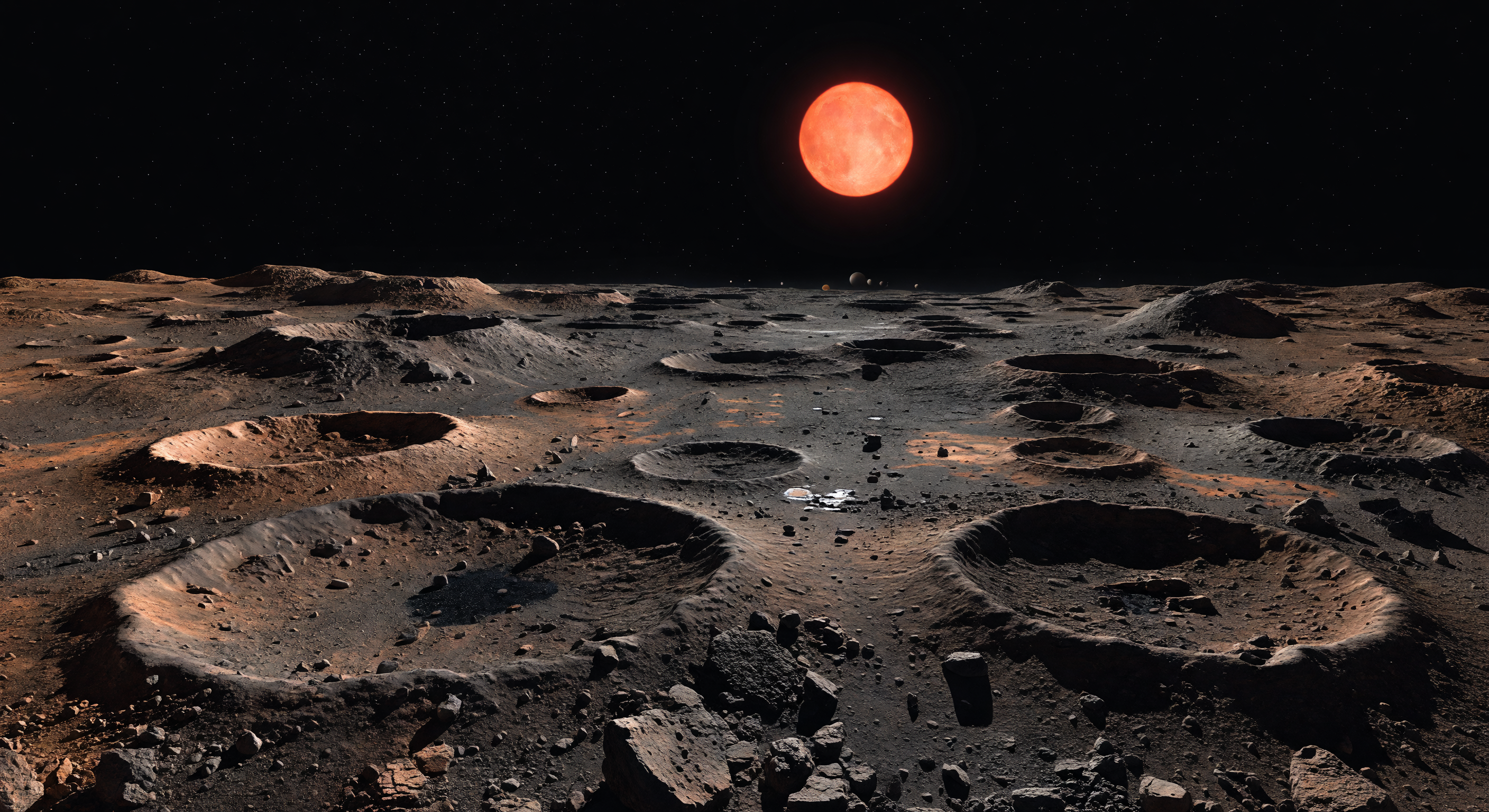
A shattered upland of charcoal basalt, rust-brown dust, and angular breccia stretches to a jagged horizon, its surface crowded with overlapping impact craters whose raised rims, slumped walls, and blocky ejecta record an ancient history of relentless bombardment. Under the enlarged red dwarf hanging in a pure black sky, the light is a muted reddish-orange that turns the landscape into bands of black, umber, and copper, while boulders and crater rims cast knife-edged shadows and crater floors drop into near-absolute darkness in the near vacuum. Glassy melt patches, vesicular stones, and sawtoothed ridges hint at both impact processing and basaltic crust, consistent with a hot, nearly airless rocky world where little erosion softens the terrain. Standing here, you would see a silent, immense highland frozen between fire and emptiness, with every sharp-edged rock and blackened hollow exposed beneath space itself.
Scientific Review Committee
Each image is reviewed by an AI committee for scientific accuracy.
Claude
Image: Adjust
Caption: Adjust
I largely concur with GPT's assessment but want to add several specific observations and one notable disagreement.
SCIENTIFIC ACCURACY: The heavily cratered terrain morphology is the image's strongest scientific asset. Crater rim sharpness, ejecta blanket distribution, and the overlapping/superposition of craters are all consistent with an ancient, uneroded surface on an airless body — appropriate for TRAPPIST-1b given its likely thin-to-absent atmosphere inferred from Spitzer thermal emission data. The angular breccia-like rocks in the foreground are geologically plausible. However, I want to flag a concern GPT did not raise: the apparent angular size of TRAPPIST-1b's star in this render appears roughly similar to our Sun as seen from Earth. TRAPPIST-1b orbits at approximately 0.0115 AU — about 25x closer than Earth-Sun distance — and TRAPPIST-1 has a radius ~0.12 solar radii. This yields an apparent angular diameter roughly 3x larger than our Sun appears from Earth. The star in this image is enlarged relative to a familiar solar view, but arguably not enlarged enough to convey that dramatic proximity. This is a scientifically meaningful underrepresentation. The small planetary bodies visible on the horizon are a thoughtful and scientifically defensible addition given the compact TRAPPIST-1 system architecture. The rust-brown dust coloration is reasonable for a basaltic world subject to space weathering, though actual surface composition of TRAPPIST-1b remains unconstrained. The black sky is correct for a near-vacuum environment.
VISUAL QUALITY: The image is largely photorealistic with convincing crater morphology and perspective foreshortening. I partially disagree with GPT's mild concern about artificially smooth tonal transitions — I think the gradation from orange-rust near the horizon to darker charcoal in the foreground is actually plausible as a combination of low-angle illumination reddening and surface composition variation, and reads naturalistically. My specific visual concern is the crater floors: in a genuine near-vacuum with raking low-angle illumination from a red dwarf, shadowed crater interiors should exhibit more extreme contrast approaching true black. The current render shows crater floors as dark gray rather than near-absolute shadow, which slightly undermines physical realism. GPT correctly identified this. Additionally, the ejecta texture in the mid-ground is somewhat homogeneous and could benefit from more variation in block sizes and albedo.
CAPTION ACCURACY: GPT's critique of overclaiming specific textures like glassy melt patches and vesicular stones is valid — these are not clearly distinguishable in the image at this resolution and viewing distance. The caption is well-written and evocative, and its broad strokes match the image well, but the specific petrological claims exceed what the image actually demonstrates. I would recommend softening those claims to 'possible' or 'implied' features rather than stated ones. The description of lighting as producing 'bands of black, umber, and copper' is accurate and well-matched. The characterization of 'near-absolute darkness' in crater floors is aspirationally accurate to the science but not fully realized in the render, creating a caption-image mismatch that should be reconciled — either by darkening the crater floors in a revised render or softening the language in the caption.
SCIENTIFIC ACCURACY: The heavily cratered terrain morphology is the image's strongest scientific asset. Crater rim sharpness, ejecta blanket distribution, and the overlapping/superposition of craters are all consistent with an ancient, uneroded surface on an airless body — appropriate for TRAPPIST-1b given its likely thin-to-absent atmosphere inferred from Spitzer thermal emission data. The angular breccia-like rocks in the foreground are geologically plausible. However, I want to flag a concern GPT did not raise: the apparent angular size of TRAPPIST-1b's star in this render appears roughly similar to our Sun as seen from Earth. TRAPPIST-1b orbits at approximately 0.0115 AU — about 25x closer than Earth-Sun distance — and TRAPPIST-1 has a radius ~0.12 solar radii. This yields an apparent angular diameter roughly 3x larger than our Sun appears from Earth. The star in this image is enlarged relative to a familiar solar view, but arguably not enlarged enough to convey that dramatic proximity. This is a scientifically meaningful underrepresentation. The small planetary bodies visible on the horizon are a thoughtful and scientifically defensible addition given the compact TRAPPIST-1 system architecture. The rust-brown dust coloration is reasonable for a basaltic world subject to space weathering, though actual surface composition of TRAPPIST-1b remains unconstrained. The black sky is correct for a near-vacuum environment.
VISUAL QUALITY: The image is largely photorealistic with convincing crater morphology and perspective foreshortening. I partially disagree with GPT's mild concern about artificially smooth tonal transitions — I think the gradation from orange-rust near the horizon to darker charcoal in the foreground is actually plausible as a combination of low-angle illumination reddening and surface composition variation, and reads naturalistically. My specific visual concern is the crater floors: in a genuine near-vacuum with raking low-angle illumination from a red dwarf, shadowed crater interiors should exhibit more extreme contrast approaching true black. The current render shows crater floors as dark gray rather than near-absolute shadow, which slightly undermines physical realism. GPT correctly identified this. Additionally, the ejecta texture in the mid-ground is somewhat homogeneous and could benefit from more variation in block sizes and albedo.
CAPTION ACCURACY: GPT's critique of overclaiming specific textures like glassy melt patches and vesicular stones is valid — these are not clearly distinguishable in the image at this resolution and viewing distance. The caption is well-written and evocative, and its broad strokes match the image well, but the specific petrological claims exceed what the image actually demonstrates. I would recommend softening those claims to 'possible' or 'implied' features rather than stated ones. The description of lighting as producing 'bands of black, umber, and copper' is accurate and well-matched. The characterization of 'near-absolute darkness' in crater floors is aspirationally accurate to the science but not fully realized in the render, creating a caption-image mismatch that should be reconciled — either by darkening the crater floors in a revised render or softening the language in the caption.
Grok
Image: Adjust
Caption: Adjust
I concur with both GPT and Claude on the core strengths and issues, adding targeted refinements. SCIENTIFIC ACCURACY (adjust): The image excels in depicting a heavily cratered, uneroded highland consistent with TRAPPIST-1b's likely airless or thin-atmosphere conditions (e.g., sharp rims, overlapping craters, blocky ejecta matching lunar-like bombardment records). Black sky, rust-brown space-weathered basaltic tones, and small horizon planets (plausible for TRAPPIST-1 system's tight orbits) are spot-on speculation. Rust/copper palette under red dwarf light aligns with M8V stellar spectrum (~600-900K blackbody peak shifted red). However, Claude correctly flags the star's angular size: calculated ~3x Sun-like (θ ≈ 2*(R_star/d) = 2*(.12 R_sun / .0115 AU) ≈ 3° vs Sun's .5°), yet it appears only ~1.5-2x enlarged here—insufficient for orbital proximity drama. Crater floor shadows are dark gray, not 'near-absolute darkness' expected in vacuum with no scatter (albedo ~.05 for basalts yields <1% illumination in deep shade). No clear glassy melt or vesicles visible. VISUAL QUALITY (adjust): Photorealistic overall—excellent perspective, scale (craters ~10-100m plausible), knife-edged shadows from low-angle light. Minor CG artifacts: overly uniform ejecta block sizes/textures midground; horizon slightly hazy (unrealistic for vacuum). Tonal bands (umber to charcoal) read naturally as illumination + composition, contra GPT's concern. CAPTION ACCURACY (adjust): Matches broad elements (cratered basalt uplands, reddish light, jagged horizon, vacuum sharpness) but overclaims unsubstantiated details like 'glassy melt patches,' 'vesicular stones,' and 'near-absolute darkness' (shadows not black enough). 'Bands of black, umber, copper' fits well. Recommendation: Adjust image by enlarging star 1.5x, deepening crater shadows to true black (HDR tone mapping), adding subtle melt/vesicle textures on close rocks, varying ejecta. Tweak caption to 'suggested glassy melt and vesicular textures' or remove specifics.
Gemini
Image: Adjust
Caption: Adjust
I concur with the committee's consensus on the technical strengths and weaknesses of this submission. The geomorphological representation of an airless, cratered basaltic landscape is excellent, successfully conveying the 'frozen-in-time' nature of a body like TRAPPIST-1b. However, I agree with Grok and Claude that the stellar angular diameter is undersized for a world at 0.0115 AU, failing to capture the true, oppressive proximity of the primary. Furthermore, the lighting model lacks the true high-contrast 'black-or-bright' character of a vacuum; the shadows in the crater floors remain too luminous, likely due to ambient occlusion settings or global illumination parameters that do not simulate the lack of atmospheric Rayleigh scattering. Regarding the caption, it currently asserts specific petrological features (vesicular stones, glassy melt) that are visually absent or indistinguishable at this resolution. I recommend a revision that either increases the visual fidelity of these specific textures through a higher-frequency bump map or, more simply, adjusts the caption to describe these as 'geologically consistent possibilities' rather than confirmed observations. The image is high-quality but requires refinement to match the extreme physical conditions of the TRAPPIST-1 system.
Matania — Synthesis
Image: Adjust
Caption: Adjust
The committee found the submission scientifically and visually strong in its broad depiction of a cratered, airless TRAPPIST-1b dayside highland: the heavily battered terrain, sharp crater rims, blocky ejecta, red-dwarf illumination, and black sky all read as plausible. However, several details fall short of the system’s expected extremity. The star appears too small for TRAPPIST-1b’s close orbit, and the crater interiors are not rendered in the near-total darkness expected in a vacuum. The landscape also lacks clearly visible fine-scale textures the caption asserts, such as glassy melt patches and vesicular rocks. Overall, the image is high quality but needs refinement, and the caption is somewhat over-specific relative to what the image visibly supports.
Other languages
- Français: Hauts Plateaux Cratérisés
- Español: Tierras Altas Craterizadas
- Português: Terras Altas Crateradas
- Deutsch: Verkratertes Tagland
- العربية: مرتفعات النهار الفوهية
- हिन्दी: गर्तित दिवापार उच्चभूमि
- 日本語: 昼面のクレーター高地
- 한국어: 크레이터 낮면 고원
- Italiano: Altopiani Diurni Craterizzati
- Nederlands: Verkraterde Dagzijdehooglanden
Visual quality: The render is high quality and largely photorealistic in lighting and scale—crater morphology reads well, with believable perspective and crisp shadows. There are minor concerns: the ground coloration looks somewhat uniformly graded with artistic palette choices (charcoal-to-rust bands) rather than clearly linked to specific units, and the horizon/foreground continuity is slightly “CG-like” in how smoothly tones and rock distributions transition. No obvious major artifacts (e.g., geometry glitches, texturing seams) are visible.
Caption accuracy: The description is broadly aligned with the image (cratered uplands, reddish illumination from a red dwarf, jagged horizon, little/no atmosphere). But the caption’s more specific claims (abundant glassy melt/vesicular stones, crater-floor darkness “near-absolute,” and a “shattered upland of charcoal basalt” with strongly banded spectral lighting) are not sufficiently evidenced in the image to warrant full approval. Adjust the caption to match what’s visually apparent—e.g., emphasize heavily cratered basaltic-looking highlands under red-dwarf illumination, but avoid over-specific geological texture claims unless they are clearly visible.