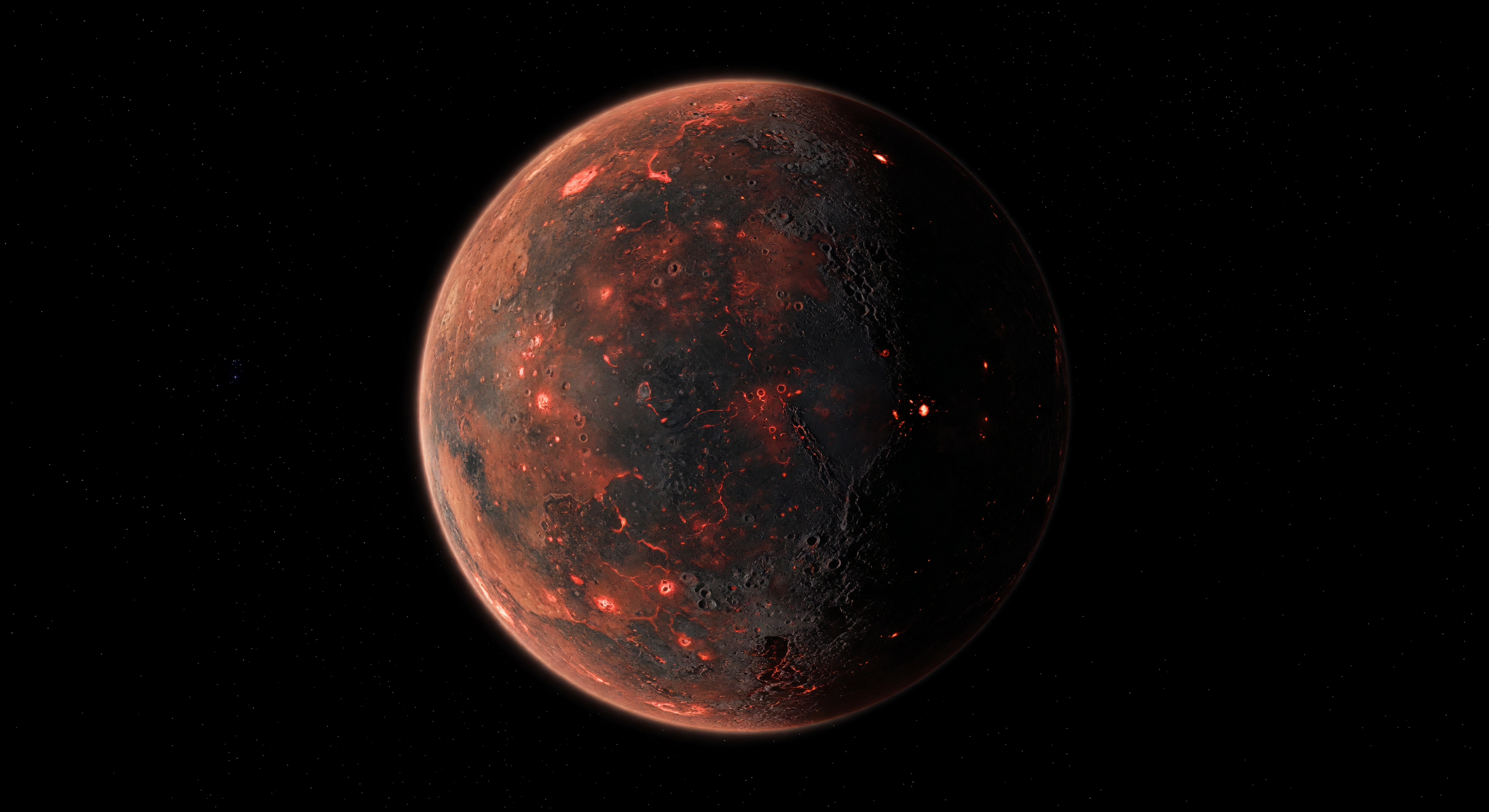
Scientific confidence: Speculative

Under a sky as black as interplanetary space, an immense plain of fractured basalt stretches toward a faintly curved horizon, its surface broken into heat-baked polygonal slabs, jagged blocks, and low sinuous pressure ridges left by ancient lava flows. Nearly overhead hangs a huge orange-red stellar disk, several times the apparent width of our Sun, pouring coppery light across the airless dayside and carving every rock edge into razor-sharp shadow with no haze to soften the view. The ground is a volcanic desert of dark igneous rock—vesicular fragments, ropy flow textures, softened impact scars, and ember-like seams of lingering warmth—consistent with a bare, resurfaced crust exposed to intense irradiation and extreme temperature contrasts on a tidally locked world with little or no atmosphere. Standing here, the scale feels merciless: a silent furnace of black stone and red light, where the landscape seems both frozen in ancient eruption and perpetually scorched beneath a star that never moves.
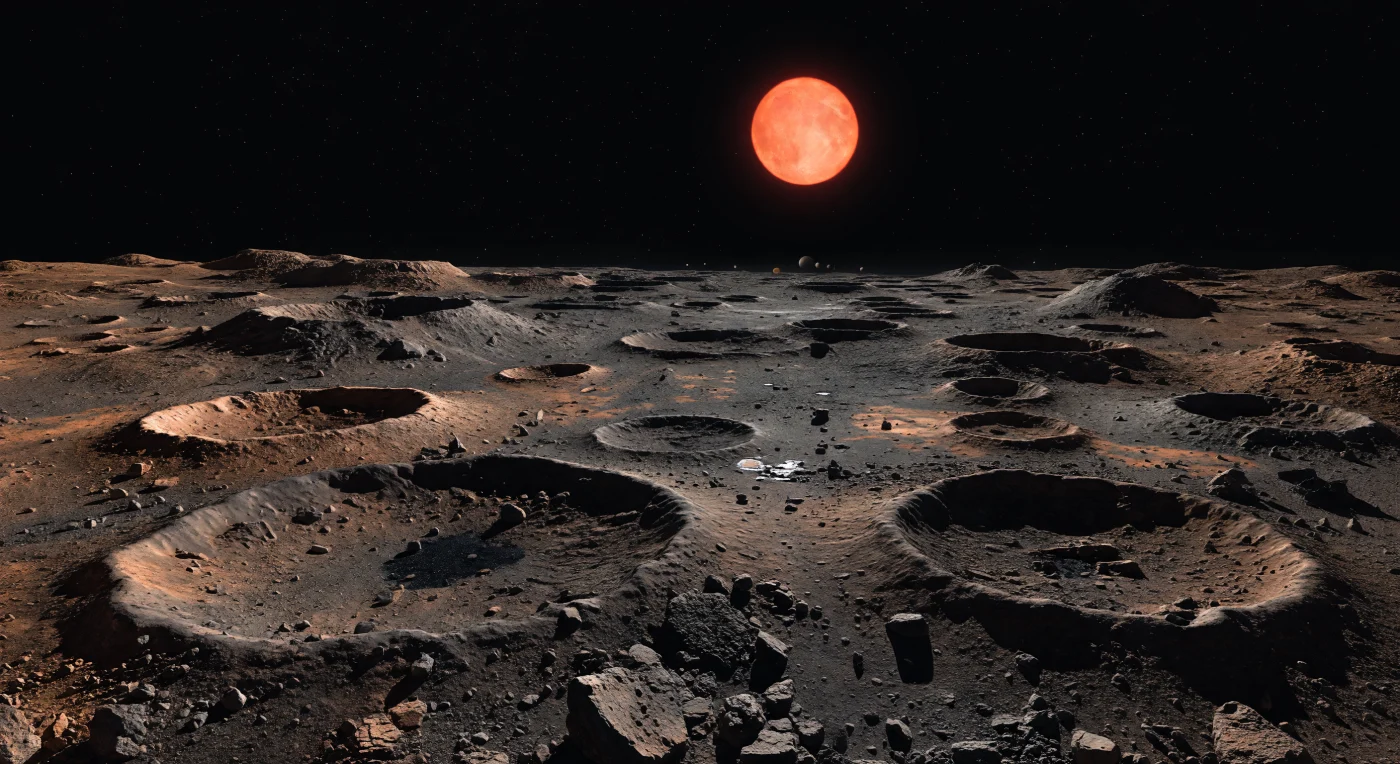
A shattered upland of charcoal basalt, rust-brown dust, and angular breccia stretches to a jagged horizon, its surface crowded with overlapping impact craters whose raised rims, slumped walls, and blocky ejecta record an ancient history of relentless bombardment. Under the enlarged red dwarf hanging in a pure black sky, the light is a muted reddish-orange that turns the landscape into bands of black, umber, and copper, while boulders and crater rims cast knife-edged shadows and crater floors drop into near-absolute darkness in the near vacuum. Glassy melt patches, vesicular stones, and sawtoothed ridges hint at both impact processing and basaltic crust, consistent with a hot, nearly airless rocky world where little erosion softens the terrain. Standing here, you would see a silent, immense highland frozen between fire and emptiness, with every sharp-edged rock and blackened hollow exposed beneath space itself.

You stand on a scorched, airless plain of dark basaltic regolith and fractured volcanic bedrock, where meter-scale black boulders, glassy impact breccia, and fine dust lie in razor-sharp shadow beneath a pure black sky. Ahead, a fresh crater rises across kilometers of terrain with a jagged raised rim and steep terraced walls, its pale ejecta rays splashed across the charcoal surface in muted tan-gray bands that glow copper and rust under the low reddish disk of the star. With no atmosphere to soften the light, every edge is stark: sunlit rock burns crimson-orange, shadowed hollows fall nearly absolute black, and faint stars remain visible beyond the glare. The scene records a geologically young impact on a hot tidally locked rocky world, where recent excavation has exposed brighter subsurface material across older volcanic plains, creating one of the most dramatic contrasts on an otherwise dark and barren surface.
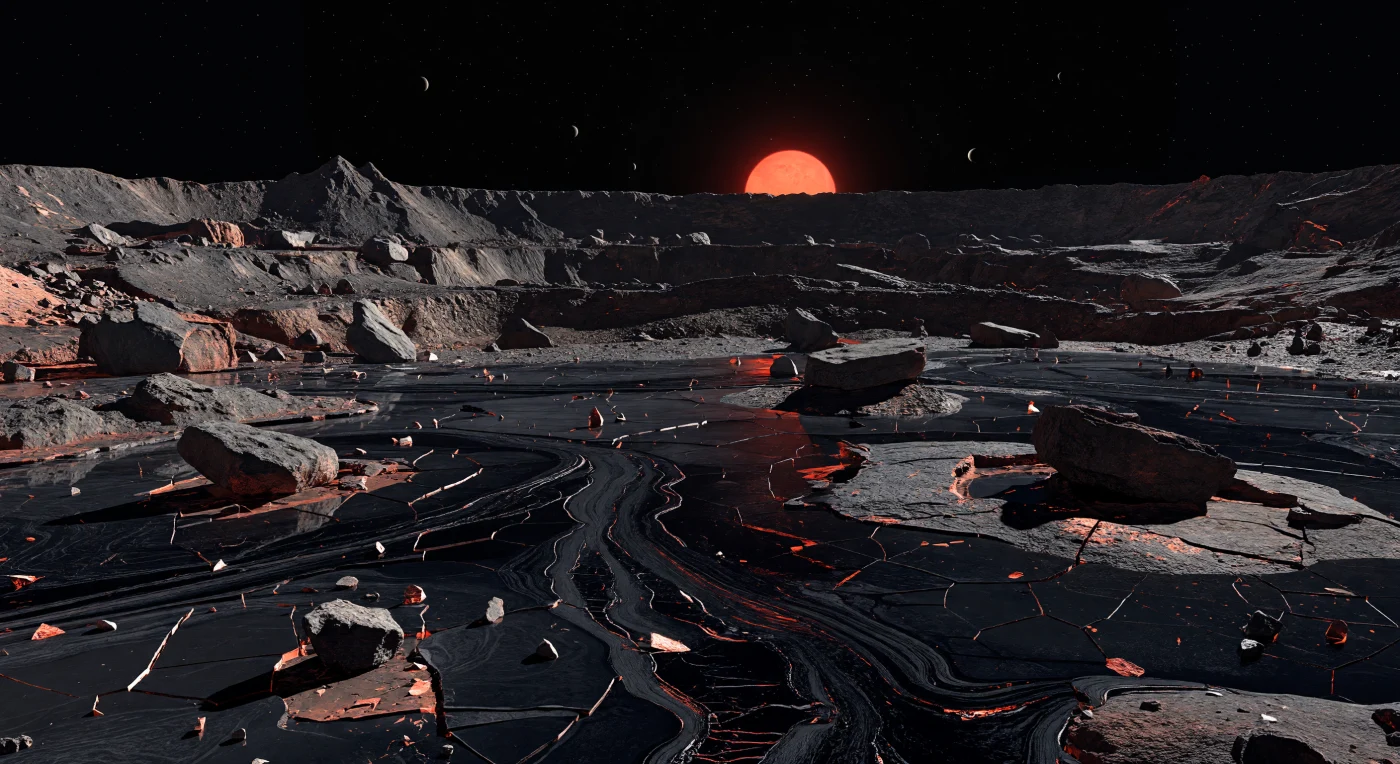
From the floor of a vast impact basin, you would look across a nearly black plain of frozen melt that shines like obsidian, its glassy surface stitched with polygonal cooling cracks, wrinkled flow textures, and scattered shards of vitrified rock catching copper and auburn flashes from the low red-orange star. Isolated breccia islands—jagged blocks of shattered basaltic and ultramafic debris stranded as the melt cooled—rise from the basin floor, while beyond them concentric terraces, slump scarps, boulder fields, and towering inner walls reveal the immense violence of the impact that liquefied and resurfaced this terrain. With little or no atmosphere to soften the view, the sky is a perfect black vacuum, shadows fall with razor edges, and every ridge and fracture remains starkly visible all the way to the hard horizon. The result is a landscape both scientifically telling and deeply alien: a hot, airless world where impact glass, broken bedrock, and crimson starlight preserve a pristine record of catastrophic bombardment on a scale of many kilometers.

Across the terminator, an immense plain of shattered basalt and broken lava crust stretches to the horizon, every jagged block and tilted slab etched in crisp detail by the ember-red star hanging permanently just above the skyline. In the near vacuum, there is no haze, no wind, and no softening of the terrain—only angular volcanic rock, vesicular fragments, impact-shattered boulders, and dust caught in cracks, preserved with a raw sharpness that on Earth would be quickly erased by weather. This rubble field is plausibly the wreckage of ancient lava flows, fractured by extreme day-night temperature contrasts and meteoroid impacts on a tidally locked world with little or no atmosphere. Under the star’s deep crimson light, the black basalt gleams with rust and copper tones while every stone throws a razor-edged shadow many times its own length, making the landscape feel both frozen in time and immense beyond measure.
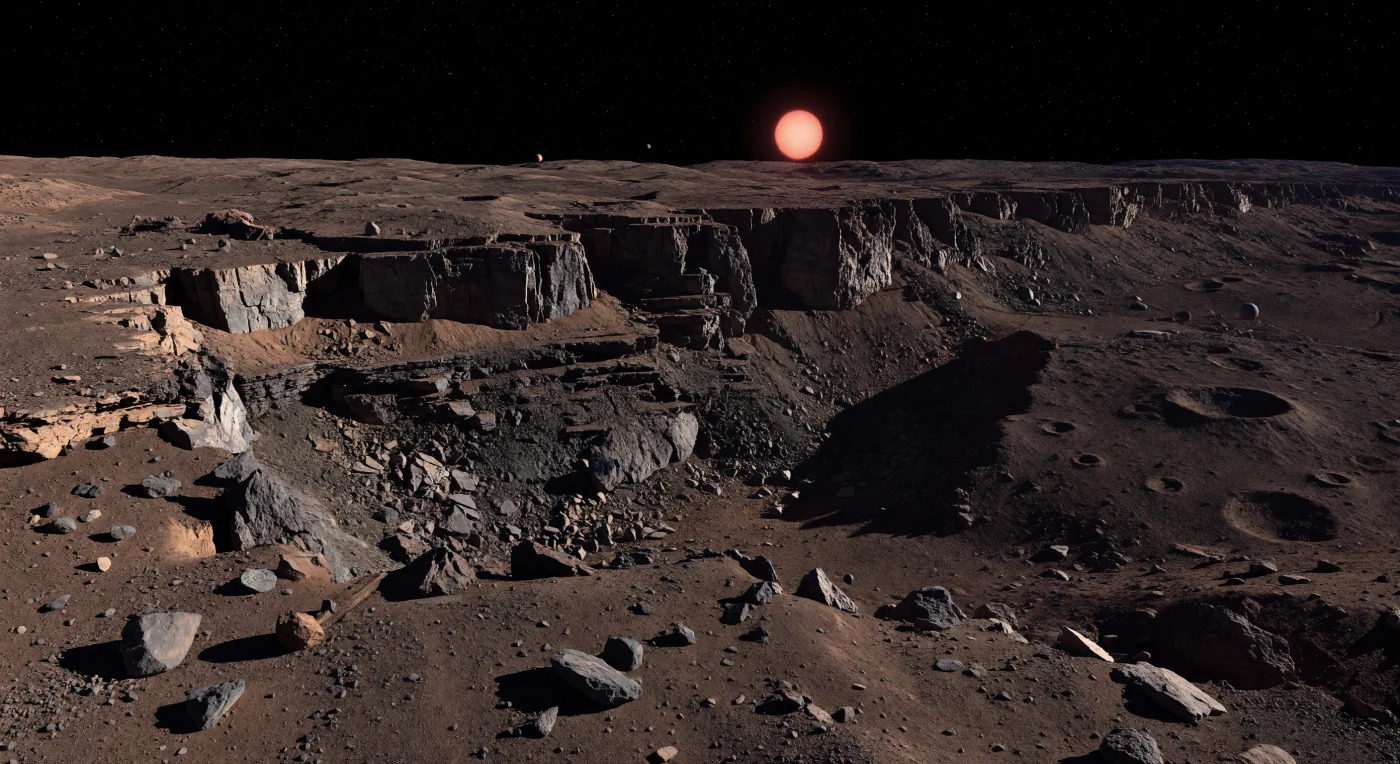
A colossal lobate scarp rises from the crater-scarred plain like a frozen tectonic wave, its stair-step wall of fractured basalt and brecciated dark rock towering above iron-brown regolith, black gravel, and house-sized shattered blocks. Under the permanent low-angle glow of the nearby red dwarf, the ground is washed in copper and crimson tones, while the nearly airless sky remains pitch black and the cliff casts a razor-edged wedge of darkness across the plain. The sharp terraces, talus fans, and fault-broken ledges record powerful crustal compression, where the surface has been thrust upward along a giant reverse fault, then left almost perfectly preserved by the lack of wind, water, or weather. Standing here, you would see a hot, desiccated world of stark relief and immense scale, where ancient impacts and planetary tectonics meet in silence under unblinking red light.
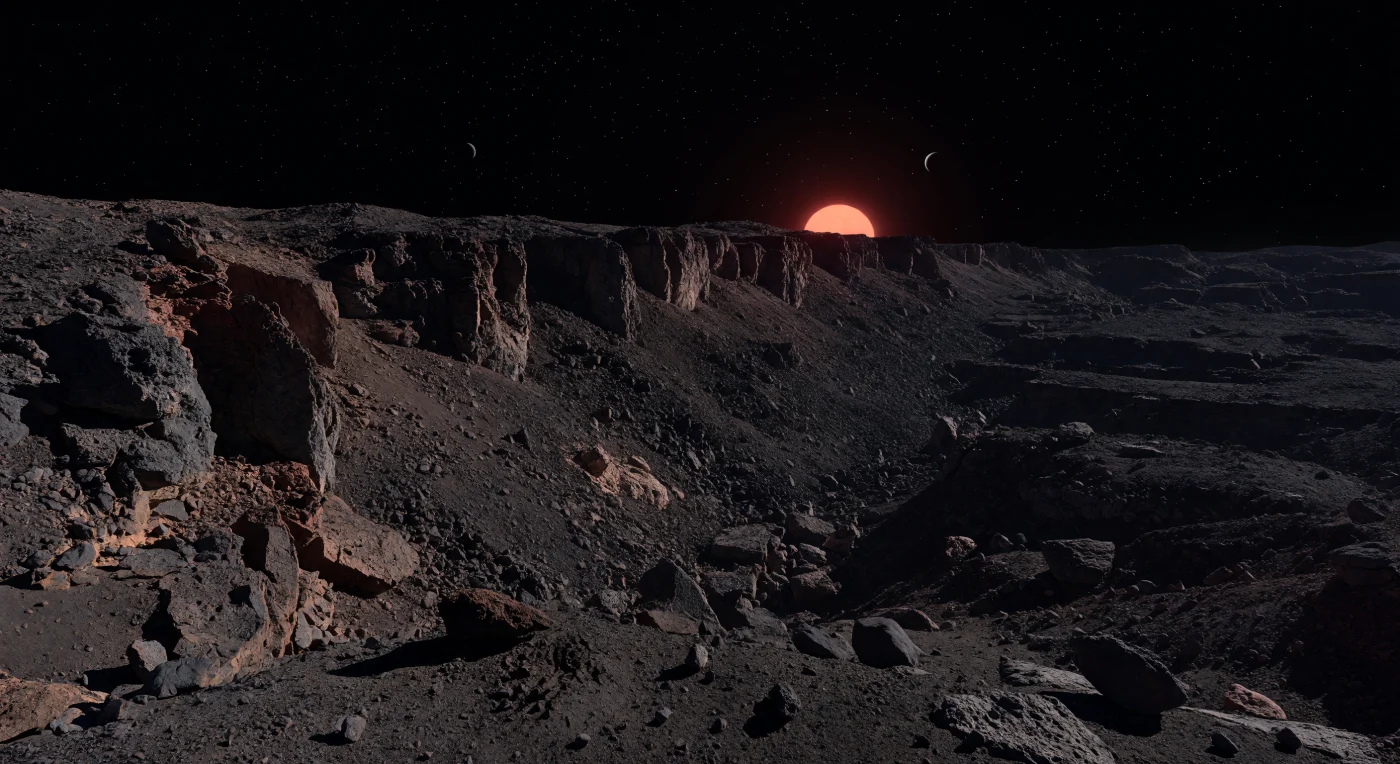
Along the permanent boundary between day and night, a colossal escarpment of fractured basaltic and ultramafic rock rises in broken tiers, its jagged cliffs and talus slopes scattered with angular black boulders, vesicular lava slabs, and impact-shattered ledges that descend into a lightless abyss. In the absence of any meaningful atmosphere, the sky remains perfectly black and crowded with sharp stars even as the immense red dwarf sits fixed on the horizon, half-submerged and casting a deep crimson-orange glow that ignites one face of every rock while the other falls into razor-edged darkness. The stark contrast reflects the conditions of a tidally locked, nearly airless world: no clouds, no haze, no wind-softened contours, only raw bedrock split by extreme thermal stress between the furnace of the dayside and the frozen black of the nightside. Standing here, the scale feels immense and unsettling—kilometers of shattered highlands fading both into maroon twilight and into star-filled void, with a neighboring planet hanging like a distant ember above the silent cliffs.
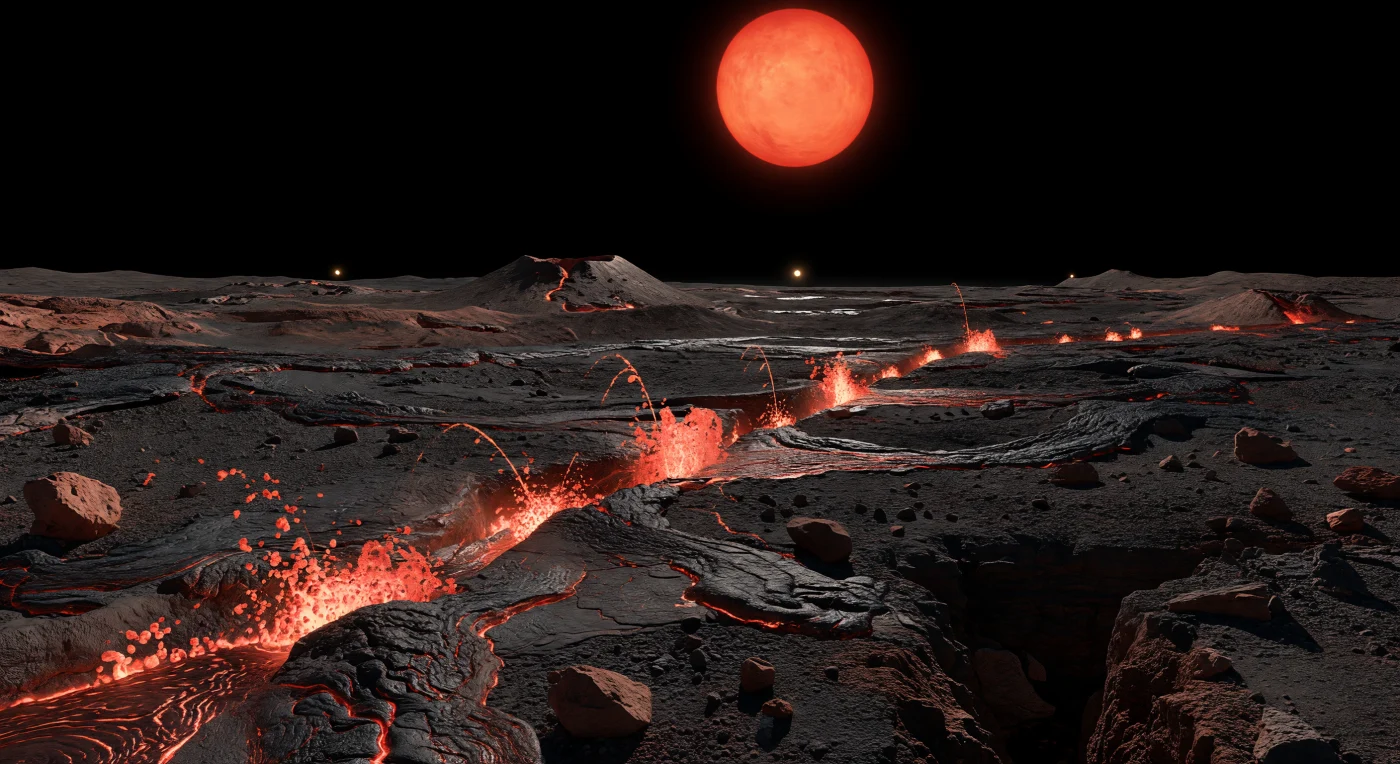
A jagged volcanic fissure slices across an immense plain of jet-black basalt, where glossy fresh lava wells up in low fountains and short bursts, building dark spatter ramparts and sending incandescent fragments along clean ballistic arcs through the airless black sky. Under the huge crimson-orange disk of the nearby red dwarf, the ground glows with a subdued copper-red sheen in the hottest cracks, while cooler lava crust, clinker, and scattered boulders remain matte charcoal, umber, and iron-black beneath razor-sharp shadows. With virtually no atmosphere to carry ash, steam, or haze, the eruption is stark and silent-looking: molten rock spreads in thin rivulets over older ropy and slabby flows, and the horizon stays perfectly clear, revealing low shield-like rises, collapsed lava channels, and impact-scarred flats stretching to enormous distance. The scene feels both volcanic and vacuum-bound, a place where basaltic volcanism unfolds in naked exposure to space on a tidally locked dayside of extreme heat and unsoftened light.
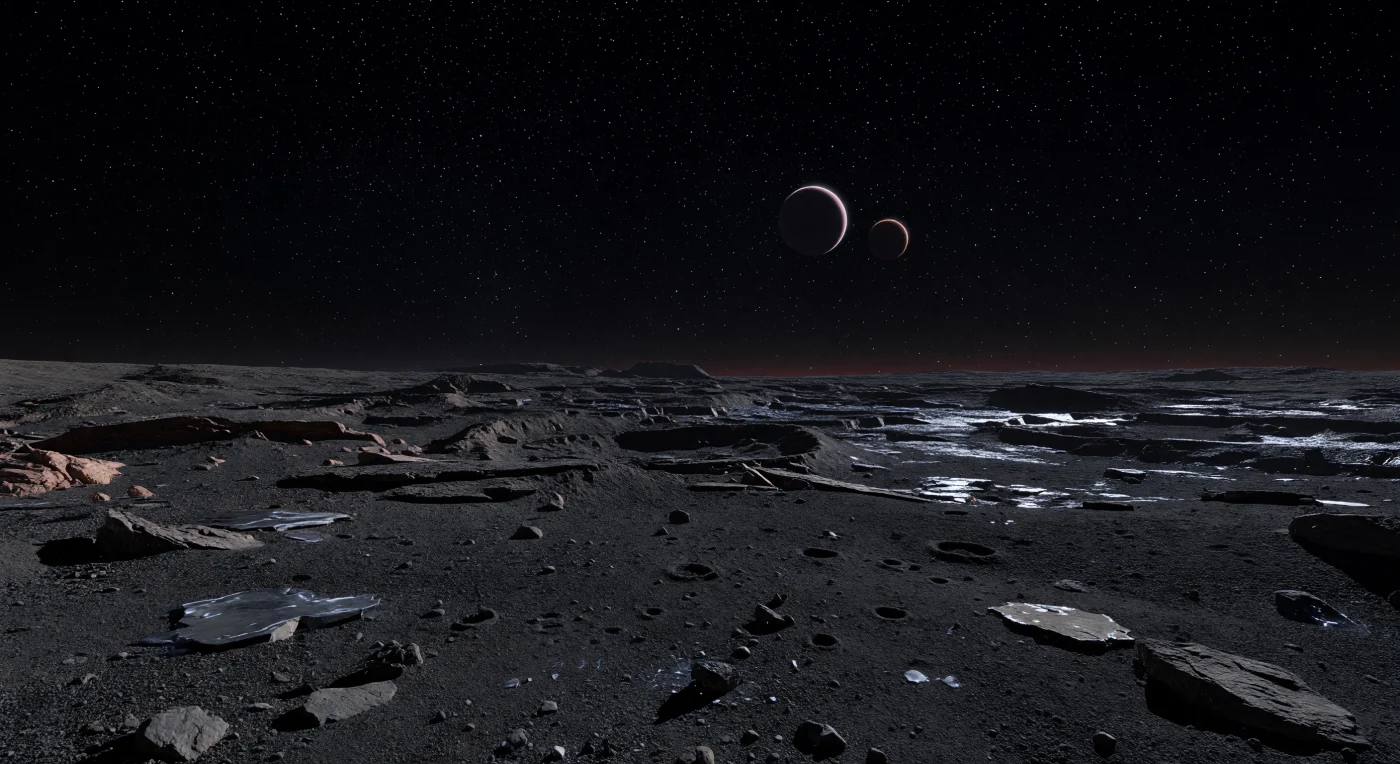
On this broad nightside plateau, the ground is a desolate pavement of black basaltic regolith, shattered slabs, glassy impact debris, and innumerable tiny craterlets, all etched with the crisp, unforgiving texture of a world exposed directly to space. With little to no atmosphere to soften the view, the sky is a perfect black vault crowded with sharp stars, while one or two neighboring planets loom overhead as bright crescent or gibbous disks, their reflected light laying a faint metallic sheen along rock edges and leaving shadows almost absolute. The surface tells the story of intense bombardment and thermal extremes: angular boulders, low crater rims, and scattered frost trapped only in the deepest permanently shadowed hollows hint at a tidally locked rocky planet whose nightside remains far colder than its scorched day hemisphere. Standing here would feel like standing on the edge of silence itself—an immense frozen volcanic plain under alien planetary lanterns, where scale is measured by distant crater fields and low mountains fading into the darkness.

At the edge of endless day, a shattered plain of charcoal-black basalt stretches toward a broken horizon, its angular plates, scattered boulders, and pockets of iron-stained dust picked out in stark crimson light from the enormous red dwarf hanging low and permanent in the black sky. With virtually no atmosphere to soften the scene, every rock casts a razor-edged shadow, and the ground reads as a dry, heavily irradiated volcanic crust—wrinkled, fractured, and pitted by old impacts, like an ancient Mercury-like surface locked forever to its star. Near the terminator-facing skyline, a ghostly, patchy sheen clings just above the horizon: not weather or cloud, but a tenuous exospheric glow, likely produced as energetic particles from the stellar outburst sputter atoms from the surface into a vanishingly thin veil. In that faint flarelit haze, with distant sibling worlds hanging as tiny disks above the dark uplands, the landscape feels immense, airless, and profoundly alien, a raw rocky face exposed directly to space.

Inside this permanently dark impact basin, the ground is a wasteland of nearly black regolith and shattered basaltic debris, where angular boulders, fractured ejecta blocks, and dull patches of glassy impact melt emerge only in the faintest ember-red reflections from neighboring worlds hanging above the horizon. With little or no atmosphere to soften the view, every edge is stark: low crater rims, talus slopes, overlapping secondary impacts, and jagged escarpments cut across the basin in razor-sharp shadow beneath a perfectly black sky. In the deepest hollows, the cold is severe enough that a few tenuous frost films may survive as pale veneers on rock faces, subtle traces of volatiles trapped in permanent darkness rather than broad sheets of ice. The result is a landscape of immense, silent scale—an airless crater interior frozen on the nightside, where ancient impacts, volcanic rock, and extreme temperature contrasts shape a scene that feels both geologically familiar and profoundly alien.

At the edge of eternal day, jagged mountain walls of black basaltic and ultramafic rock surge upward from vast aprons of shattered debris, their kilometer-high ridgelines glowing maroon along the crests while their opposite faces vanish into ink-dark shadow. The ground is a chaos of angular boulders, knife-edged scree, collapsed cliff blocks, and charcoal dust, a landscape shaped not by wind or water but by relentless impacts, tectonic fracturing, thermal stress, and the slow downslope creep of rock under near-Earth gravity on an almost airless world. Overhead, the sky is a pure black vacuum, so clear that faint stars remain visible beside the low, oversized red dwarf smoldering on the horizon, its copper-red light carving razor-sharp shadows across talus cones and broken lava-dark slabs. Standing here, the scale feels immense and severe: tiny foreground blocks give way to endless rubble fans and towering escarpments that recede into darkness, making the terminator seem less like a boundary and more like the rim of a silent planetary abyss.