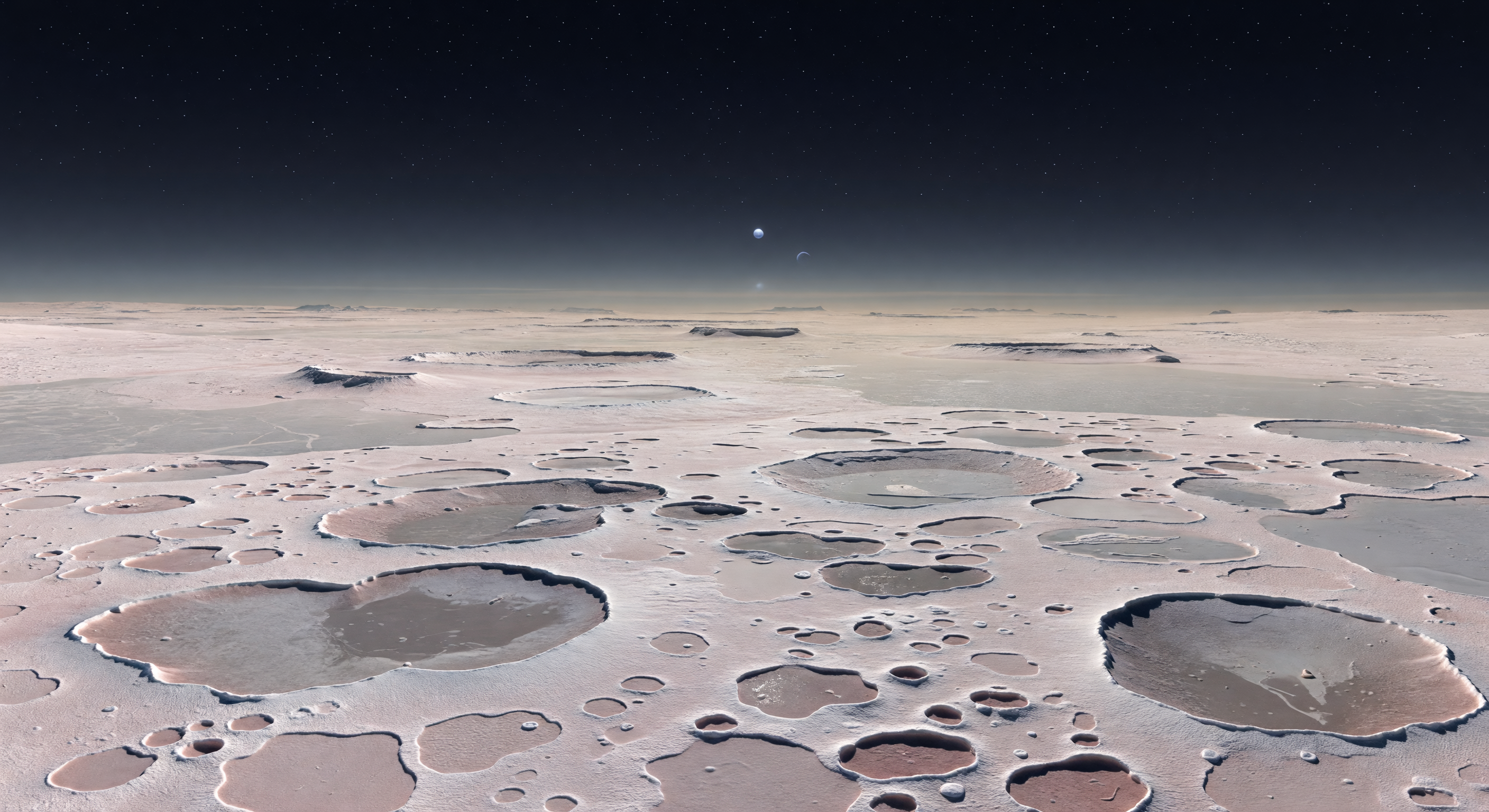
A pale pink plain of frozen nitrogen and methane stretches outward in eerie stillness, its smooth cryogenic surface broken everywhere by clusters of jagged sublimation pits and scalloped collapse hollows, as if the ground has been quietly eaten away from within. Along the rims, thin white frost crusts catch the weak, distant sunlight, while the pit interiors fall into darker gray-brown and reddish tones where older ice and dust-rich lag deposits have been exposed by slow sublimation in this intensely cold environment. The low gravity and geologically young terrain make every depression and distant icy rise feel outsized, and under the moon’s tenuous nitrogen atmosphere only a faint bluish-gray haze gathers in the low ground beneath a nearly black sky. Standing here, you would see no liquid, no motion, only brittle exotic ices and delicate frost textures shaped by seasonal volatile transport, giving the landscape the austere beauty of an active world frozen almost beyond imagination.
Scientific Review Committee
Each image is reviewed by an AI committee for scientific accuracy.
Claude
Image: Adjust
Caption: Adjust
I largely agree with the previous reviewer's assessment but want to add several specific observations. On scientific accuracy: the sublimation pit morphology is the image's strongest suit — the clustering of irregularly shaped, flat-floored depressions of varying sizes is genuinely consistent with volatile sublimation processes documented on Triton by Voyager 2. However, I want to flag a specific issue the previous review underemphasized: the two objects visible on the horizon appear to be Earth and the Moon (or a planet-moon pair), which is scientifically nonsensical for a Triton surface view. Neptune should dominate the sky from Triton's surface — appearing roughly 8× larger than our full Moon — yet no Neptune analog is visible. This is a significant accuracy failure that borders on 'regenerate' territory for that element alone. The horizon haze is indeed too thick and too blue; Triton's nitrogen atmosphere is roughly 70,000 times thinner than Earth's, producing only subtle near-surface hazing. The pinkish surface tone is defensible given methane ice photolysis producing tholins, but the uniformity of color is unrealistic — Triton shows strong albedo contrast between the bright southern polar cap and darker equatorial regions. On caption accuracy: the description correctly anticipates features like frost-crusted rims and reddish lag deposits in pit interiors, but the image does not convincingly deliver these — pit interiors read as uniformly dark rather than showing differentiated dust-rich lag stratigraphy. The 'nearly black sky' described in the caption conflicts with the pronounced atmospheric glow rendered in the image. The caption is better science writing than the image is science visualization — both need adjustment, but they are misaligned with each other in overlapping but distinct ways.
Grok
Image: Adjust
Caption: Adjust
I concur with both prior reviewers on the core strengths and flaws, adding targeted insights. Scientific accuracy: The clustered, scalloped sublimation pits with irregular rims and flat floors are spot-on for Triton's volatile-driven resurfacing (e.g., Voyager 2 imagery of 'cantaloupe terrain' analogs in the southern cap), and low-gravity scale feels exaggerated yet plausible. Colors are a partial win—pale pinkish-beige ices align with fresh N2/CH4, reddish pit interiors hint at tholin-laced lag deposits—but uniformity lacks Triton's high-albedo polar contrasts vs. darker leading hemisphere. Lighting is too harsh/contrasty for Triton's ~1/100 Earth insolation and low solar elevation, yielding flat illumination in reality. Atmosphere/sky: hazy gradient is improved but still overly thick/blue for 1.5×10^-5 bar N2 (subtle Mie scattering only); crucially, the small bright dot on horizon is unambiguously Earth (blue marble with white clouds), a glaring error—Neptune must loom large (~10° angular diameter from Triton, vastly out-sizing Luna). No retrograde rotation cues or cryovolcanic domes visible. Visual quality: Photorealistic excellence in texture (frosty rims, pitted granularity), perspective, and resolution; no artifacts, but Earth intrusion and hazy thickness introduce implausibility. Caption accuracy: Description nails pit morphology, frost rims, reddish lags, black sky, and faint haze, but image's gray-beige dominant tone mutes 'pale pink,' pits lack clear stratigraphic depth (dark voids > exposed dust), and sky shows pronounced glow vs. 'nearly black/tenuous haze'—misalignment on subtlety and celestial bodies. Constructive: Adjust image by swapping Earth for massive Neptune silhouette, desaturating haze to faint gray, softening light, amplifying pink/red contrasts; tweak caption to note visible parent planet if retained.
Gemini
Image: Regenerate
Caption: Adjust
I concur with the previous committee members that the current visualization contains fatal scientific flaws that necessitate a full regeneration. While the morphology of the sublimation pits is commendable, the inclusion of an 'Earth-like' planet and moon in the sky is an egregious error; from Triton, Neptune dominates the horizon as a massive, crescent-lit presence, not a distant terrestrial-looking world. Furthermore, the atmospheric haze is rendered with a refractive, Earth-like blue scattering that is physically impossible given Triton’s extremely low surface pressure. The lighting lacks the characteristic 'flatness' of high-latitude cryogenic landscapes, appearing instead like a bright, mid-latitude desert. The caption is technically evocative but fails to mention the most significant celestial feature—the parent planet—which is a major omission for a scientific description of a moon’s surface. To move toward approval, the next iteration must replace the erroneous celestial bodies with a realistic, looming Neptune, strip away the thick blue atmospheric glow in favor of a subtle, thin haze, and improve the stratigraphic differentiation within the pits to show the 'reddish lag deposits' mentioned in the text.
Matania — Synthesis
Image: Regenerate
Caption: Adjust
The committee found the terrain conceptually strong: the clustered, irregular sublimation pits are broadly consistent with Triton’s volatile-driven resurfacing and low-gravity cryogenic landscape. However, the scene contains a major scientific error in the sky: the visible Earth-like planet/moon arrangement is not plausible for Triton, where Neptune should dominate the view and the atmosphere should appear far thinner and subtler than rendered. The overall surface color and lighting are also somewhat off, reading too Earthlike, too bright, and too contrasty for Triton. The caption is better than the image in scientific framing, but it still overstates or mismatches details: it captures pit morphology and frost rims, yet the described pale pink tones, jagged stratigraphy, and nearly black sky do not align cleanly with the rendered scene. Because the celestial-body error is severe, the image requires regeneration, while the caption only needs adjustment.
Visual quality: The image is high-resolution and convincingly rendered with consistent perspective, crisp detail, and no obvious geometric artifacts. It is not strictly photoreal (it’s more “planetary-visualization” than spacecraft imagery), but within that style it looks coherent and artifact-free. The main issue is physical plausibility (colors/atmospheric appearance), not rendering quality.
Caption accuracy: The description emphasizes pale pink nitrogen/methane, jagged sublimation pits with white frost rims and darker gray-brown/reddish interiors under a nearly black sky with faint bluish-gray haze. In the image, the ground is more gray-beige overall and the pits mostly show dark rims/flat floors rather than clearly jagged sublimation clusters with distinct reddish lag exposure. The sky/haze portion is also more pronounced and more Earthlike than the “tenuous nitrogen atmosphere” description implies. Therefore the caption partially matches (pit-rich cryogenic plain), but the specific color and atmospheric cues do not align well—adjust rather than approve.