Scientific confidence: Low

From this low vantage, the ground stretches away as a maze of overlapping craters and subdued ridgelines, their ancient rims worn soft by immense age into a dark, charcoal-gray landscape of ice-rich regolith and impact-shattered blocks. The surface is coated in low-albedo, carbon-rich material that absorbs much of the feeble sunlight, leaving most of the terrain matte and somber, while occasional fresh fractures and a distant crater’s faint bright inner ring reveal cleaner water ice beneath the darkened skin. With no atmosphere to blur the view, a tiny hard-white Sun casts razor-edged shadows across hummocky plains, boulder fields, and slumped crater walls, while a pale cyan disk hangs low in a perfectly black sky. The result is a silent, airless highland plain that feels both frozen in time and immense in scale, preserving billions of years of impacts in crisp detail under weak but unforgiving light.
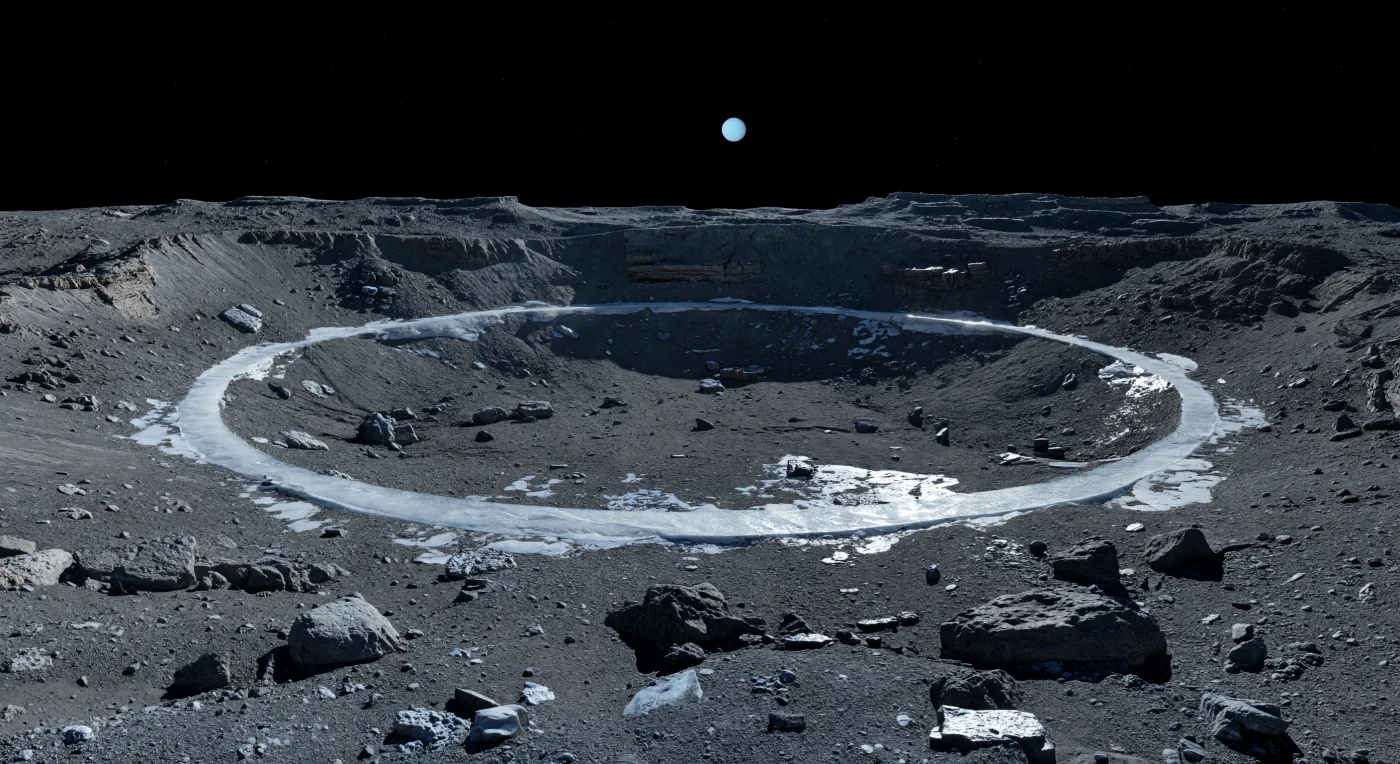
From the floor of this ancient crater, the landscape is a study in darkness and ice: jagged charcoal and steel-gray rubble stretches outward under a pure black sky, while a broad, ghostly arc of bluish-white ice gleams across the midground like a frozen ring laid into the crater’s interior. That bright annulus is thought to expose cleaner water ice than the surrounding terrain, which is heavily darkened by carbon-rich contaminants and radiation-processed surface materials, making the contrast especially stark on one of the most low-albedo icy worlds in the outer Solar System. In the airless vacuum, a tiny distant Sun casts hard, cold light and razor-sharp shadows over terraces, slump deposits, and softened crater walls, while low gravity and minimal erosion preserve the battered texture of overlapping impacts for immense spans of time. Above it all hangs Uranus as a pale cyan disk, larger than the Sun in this sky, turning the silent crater into an immense, lonely amphitheater of ancient ice and stone.

A long, low fault scarp cuts diagonally across a bleak charcoal plain, its modest cliff face catching the Sun’s glancing light and revealing a slightly brighter seam of fractured water ice and icy breccia amid the darker, ancient regolith. At your feet lie coarse impact-shattered blocks, frost-hardened rubble, and fine dark grains rich in carbonaceous material, while countless softened craters and overlapping rims stretch to the horizon, testimony to a surface shaped far more by impacts and deep internal fracturing than by any atmosphere, liquid, or erosion. In the weak, hard sunlight of the outer Solar System, every ledge and splinter throws an inky shadow across the vacuum-exposed ground, and the scarp’s kilometer-scale length slowly dwindles into rolling ejecta-textured terrain. Above it all hangs a perfectly black sky, star-sharp and airless, with distant pale Uranus suspended like a cold disk over a landscape so still and old it feels frozen not just in ice, but in time.

A sharp young crater interrupts the ancient charcoal-dark plain, its raised rim and splashed apron of frost-bright ejecta standing out starkly against regolith blackened by carbon-rich material and space weathering. Around your feet lie angular blocks, shattered crust fragments, and fine icy breccia, all preserved in uncanny stillness by feeble gravity and the complete absence of wind or air. The crater’s steep inner walls reveal cleaner subsurface water ice beneath the darker irradiated surface, while its floor drops into ink-black shadow under a tiny distant Sun that casts razor-edged light across the heavily cratered horizon. Above the silent landscape, the sky is utterly black, and if this hemisphere faces inward, a pale cyan disk hangs far overhead—vast compared with the Sun yet softly luminous—deepening the sense of standing on a frozen, airless relic from the early outer Solar System.
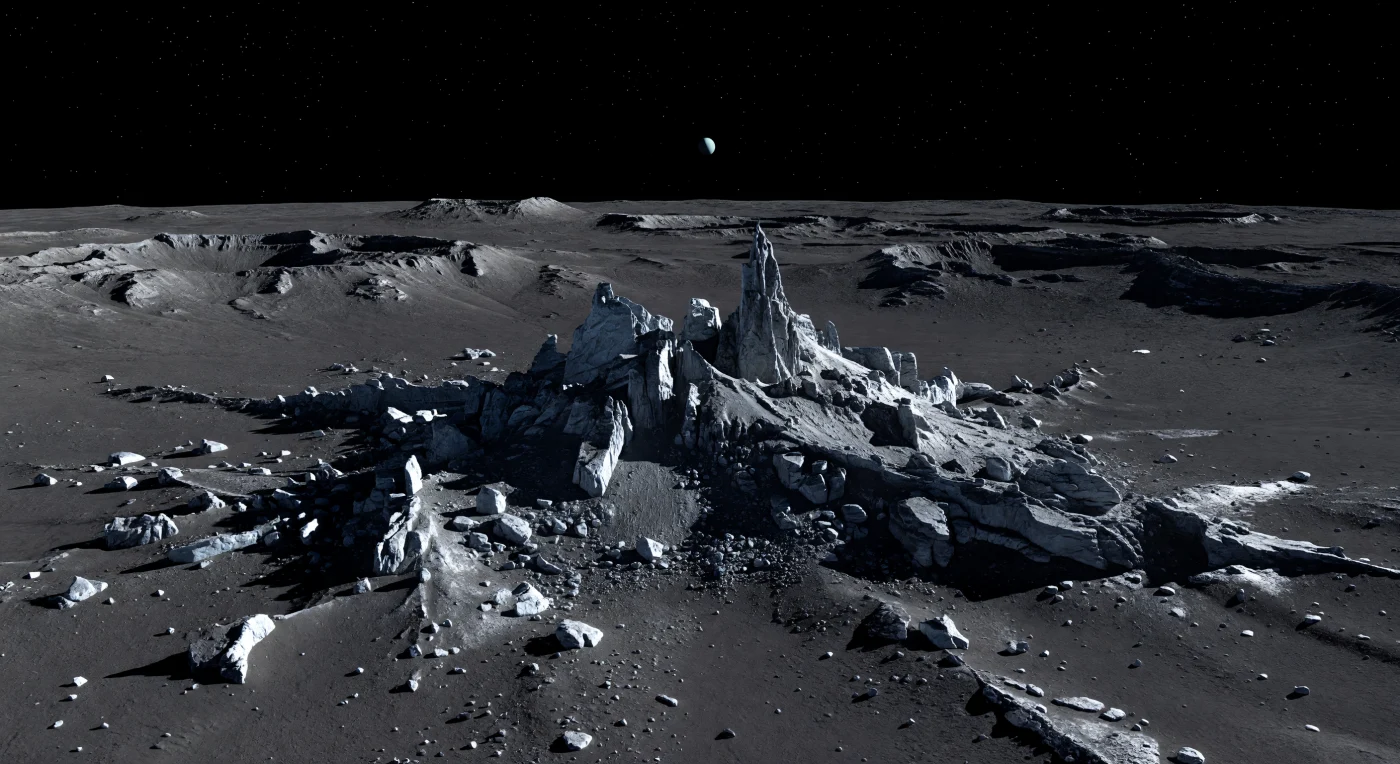
From the floor of this immense ancient crater, a shattered central peak massif rises in jagged cold-gray knobs and steep ice-rich spires above a plain of charcoal-dark debris, its fractured faces split between dazzling white highlights and pitch-black shadow under the hard, tiny Sun. The rock-like bedrock here is dominated by water ice mixed with dark carbon-rich material, while fresher uplifted blocks exposed by the impact appear slightly brighter, with frost-bright fracture edges, blocky talus aprons, scattered boulders, and fine regolith dust pooled in sheltered hollows. In the weak gravity, cliffs and precarious stacks of broken material stand unusually sharp, and beyond them the crater interior stretches toward distant, heavily cratered uplands and overlapping rims that speak to a surface ancient, battered, and only lightly modified over eons. Above it all hangs a perfectly black, airless sky—stars sharp and unwavering, and perhaps a small pale cyan disk on the horizon—making the silence, scale, and stark contrasts of this icy landscape feel almost unreal.
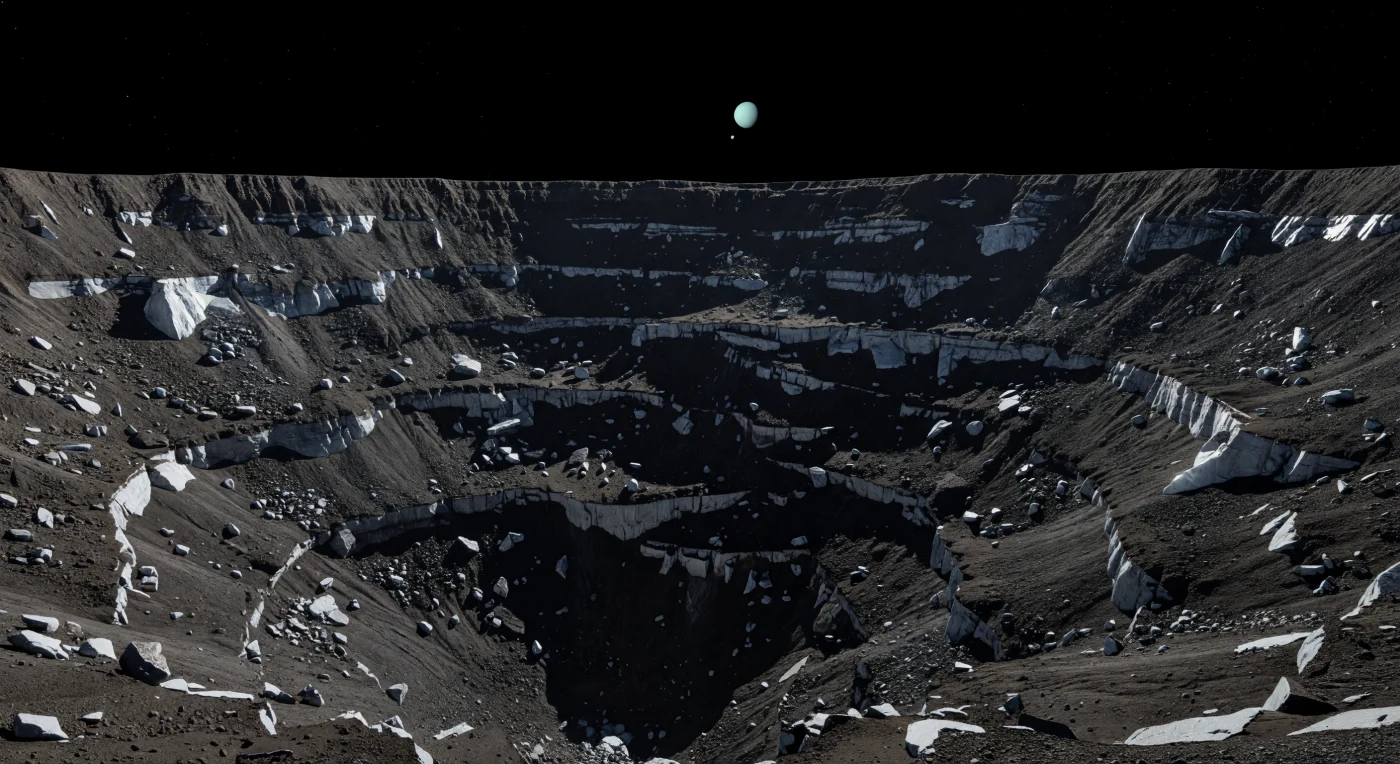
From the interior rim, the crater wall drops away in immense stepped terraces where whole slabs of crust have sagged and rotated downward, their broken arcuate scarps exposing pale water-ice beneath a surface darkened by carbon-rich material and long space weathering. Angular boulders, shattered icy regolith, and broad talus aprons spill down each bench in low gravity, while fine black dust gathers on the flatter ledges and small secondary craters pockmark the older slump blocks. In the cold, hard sunlight of the outer Solar System, every rim and fracture throws a razor-edged shadow, and the descent vanishes into a black interior abyss where only a few frost-bright streaks cling to the steepest, cold-trap faces. Above the stark charcoal landscape, the sky is airless and perfectly black, with a tiny distant Sun and the softly glowing cyan disk of Uranus hanging over a scene that feels both silent and colossal.
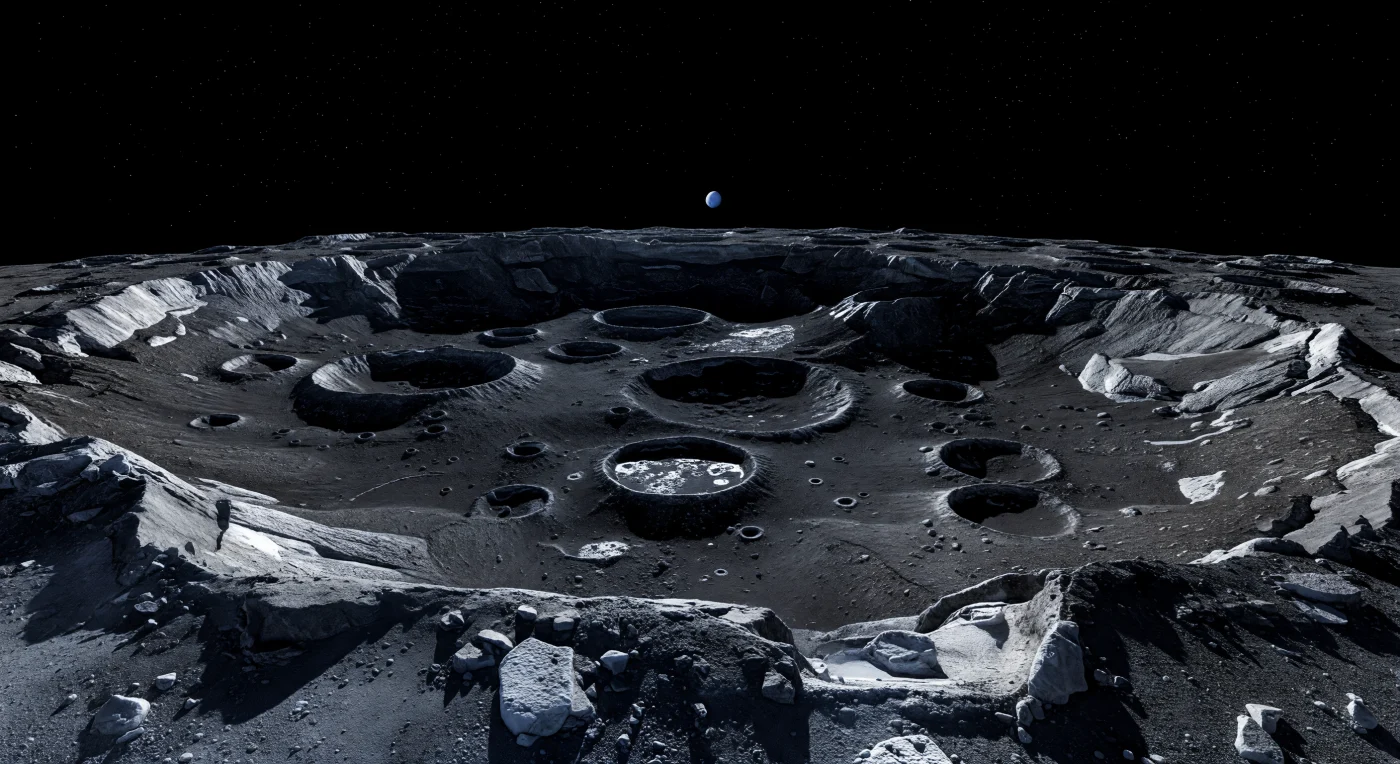
From this jagged crater rim at the day-night boundary, a desolate sweep of charcoal-dark ice and dusty regolith drops away into nested basins, softened ancient walls, and low ejecta hummocks that march toward a distinctly curved horizon. In the hard, low-angle sunlight, only the highest ridges and occasional cleaner ice exposures catch a cold silver-gray glow, while every hollow and crater floor falls into razor-edged blackness under an airless sky. The surface here is thought to be dominated by water ice darkened by carbon-rich non-ice material and billions of years of impact gardening, preserving one of the most ancient and heavily cratered landscapes in the outer Solar System. Above the stark terrain, a tiny white Sun and a small blue-green disk suspended in star-speckled blackness make the silence feel immense, as if you are standing on the rim of a frozen world where time, light, and geology move at almost unimaginable scales.
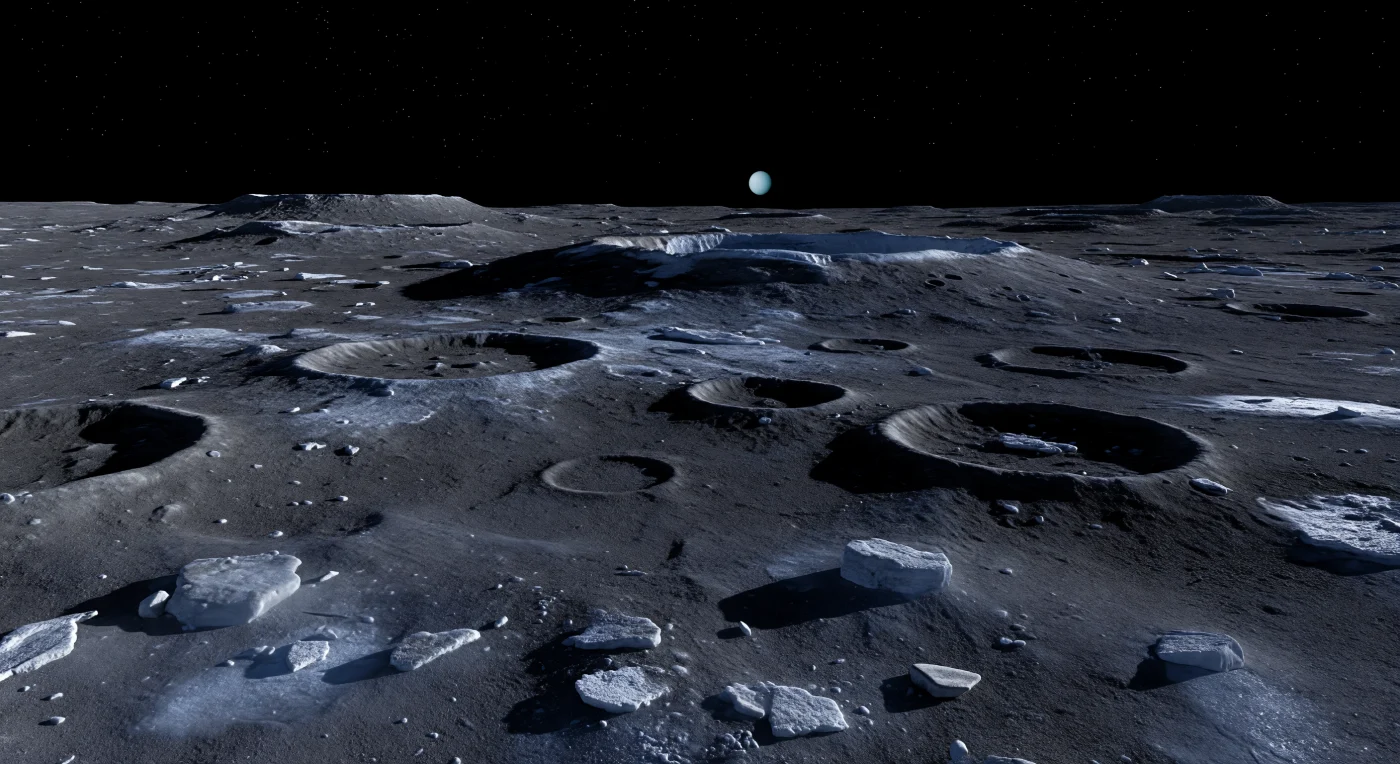
Under a Sun that barely clears the horizon, the polar plain stretches away as a dim expanse of charcoal and blue-gray ice, its ancient surface broken by softened crater rims, low hummocks, frost-dusted blocks, and drifts of dark impact dust pooled in shallow hollows. In the airless vacuum, there is no haze to soften the view, so every ridge and boulder casts a razor-black shadow that runs for kilometers across the ground, while distant cratered uplands remain unnaturally sharp against a perfectly black sky scattered with steady stars. The terrain is built from water-ice bedrock darkened by carbon-rich irradiated material and billions of years of micrometeoroid gardening, giving this battered landscape one of the lowest-reflectivity surfaces among icy moons. Far off, a large crater rim rises with a faint bright patch on its inner slope—an uncommon glimpse of cleaner, fresher ice exposed amid a world that seems frozen in perpetual twilight.

Under a sky of flawless black, the ancient surface stretches away in charcoal and steel-blue tones, its overlapping craters, low ejecta hummocks, and fractured icy outcrops picked out only by the cold cyan glow of the giant planet looming above the horizon. That planetshine reveals a world built largely of water ice darkened by carbon-rich, radiation-processed material and mantled with black regolith, so that only fresh fracture faces and a single distant crater with a conspicuously brighter inner floor catch and return a dirty white glimmer. In the airless stillness, shadows fall as pure ink inside craterlets, stars remain sharp and unwavering, and the low gravity lets battered basin rims rise with deceptively gentle relief yet remain visible across immense, crystal-clear distances. The result is a landscape that feels frozen outside time itself: geologically old, subdued, and nearly monochrome, illuminated not by a sun overhead but by the eerie reflected light of a vast cyan world.
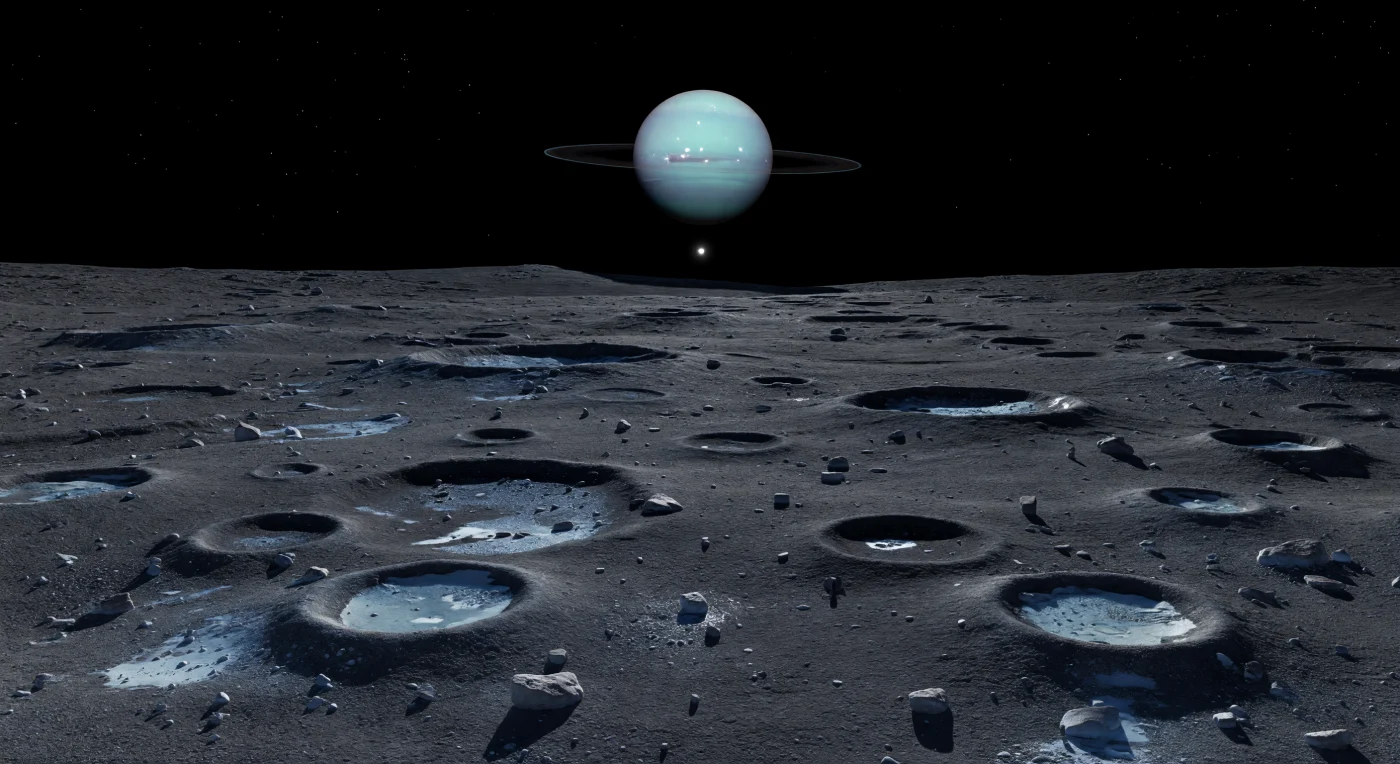
A dark, ancient plain rolls away in low hummocks and softened crater rims beneath a black sky, its charcoal regolith—likely a mix of water ice darkened by radiation processing and carbon-rich contaminant material—broken by chair-sized angular blocks and occasional brighter frost clinging to shaded crater walls. In the weak, distant sunlight, small craters stay sharply defined in the moon’s low gravity, with delicate raised rims and slightly steeper inner slopes, while broader overlapping depressions and subdued ejecta ridges hint at a surface that has endured impacts for immense spans of time with little internal resurfacing. Fixed above the horizon hangs an enormous pale cyan disk nearly fourteen degrees wide, crossed by a threadlike ring plane, casting a faint blue-green planetshine that seeps into the otherwise ink-black shadows. The result is a landscape of immense stillness and scale: airless, frozen, and geologically ancient, where the curved horizon feels close, yet the silence and the giant world overhead make the scene feel boundless.
