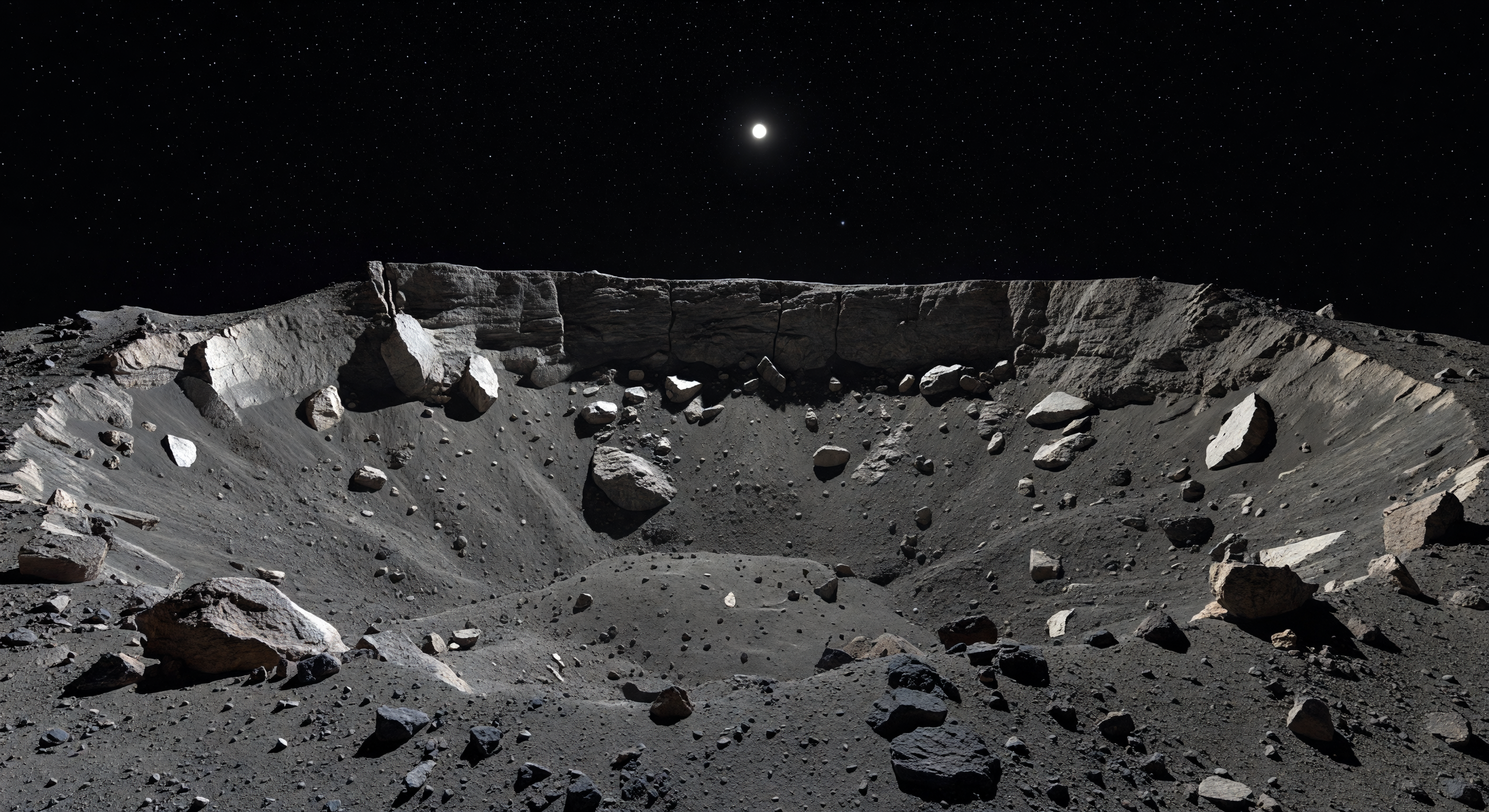
You stand within a crater whose interior wall appears caught in a silent landslide: broad stepped slump benches descend from fractured medium-gray basaltic crust, while overlapping fan-shaped talus aprons spread across the terrace in lobes of rubble, dust, and sharp-edged blocks. Fresh pale scarps and exposed bedrock mark where material has recently broken away, and detached megablocks—some the size of buildings—rest improbably on steep slopes, their precarious balance made possible by gravity only a few percent of Earth’s. The ground is a dry mosaic of charcoal-gray regolith, pebble-sized basalt fragments, scattered boulders, and small secondary impact pits, all lit by a smaller, fiercely bright Sun that casts razor-black shadows into narrow slots and under overhangs with no atmospheric softening at all. Above the close, subtly curved horizon, the sky is pure vacuum-black and crowded with hard, steady stars, making the crater feel both intimate and immense: a collapsed wound in the basaltic crust of an unfinished world.
Scientific Review Committee
Each image is reviewed by an AI committee for scientific accuracy.
Claude
Image: Adjust
Caption: Adjust
I largely agree with GPT's assessment but want to add several specific observations. On scientific accuracy: the airless environment is well-rendered—hard terminator shadows with zero penumbral softening, a vacuum-black sky, and a stellar-point Sun are all correct for Vesta. The gray basaltic regolith color is broadly consistent with HED meteorite compositions and Dawn mission imagery. However, I want to flag one issue GPT did not emphasize: the crater wall geometry. The far wall appears nearly vertical with what looks like horizontal stratification suggesting sedimentary layering. Vesta does show layered lithology in some scarps (e.g., Marcia crater's 'snowman' region), so this is not impossible, but the near-horizontal banding is somewhat exaggerated and reads more like sandstone canyon walls than fractured basaltic crust undergoing slump failure. True slump terraces on Vesta (as observed in Marcia and Cornelia craters by Dawn) show more irregular, rotated block morphology rather than clean horizontal benches. The megablocks present are convincing in number and distribution, but their placement on the crater floor rather than prominently on steep slopes slightly undercuts the caption's emphasis on 'precarious balance on steep slopes.' On visual quality: I agree the image is high-resolution and photorealistic with no obvious rendering artifacts. The regolith texture gradient from coarse rim blocks to finer floor material is geologically sensible. One subtle issue: the lighting on some boulders in the foreground left appears slightly inconsistent with the primary light source direction suggested by wall shadows, hinting at possible secondary fill lighting that would not exist in a vacuum. On caption accuracy: the description's invocation of 'fan-shaped talus aprons in lobes' and 'broad stepped slump benches' is the most significant mismatch—these organized morphological features are not clearly distinguishable in the image. The caption is well-written and evocative but is describing an idealized Vesta crater more precisely than the image actually depicts. Recommend adjusting the caption to de-emphasize the lobate apron and stepped bench language while retaining the core low-gravity, airless slump theme, and recommend minor image regeneration guidance to correct the overly horizontal wall banding toward more irregular fractured scarp morphology.
Grok
Image: Adjust
Caption: Adjust
I concur with both GPT and Claude's assessments, with some additional insights. Scientific accuracy: The airless environment is spot-on—razor-sharp shadows, vacuum-black sky densely packed with stars, pinpoint fiercely bright Sun (appropriately smaller angular size than on Earth), and correct lack of atmospheric scattering or haze. Regolith colors (charcoal-gray with basaltic tones) align well with Dawn mission FC/CAMVIS imagery of Vesta's Rheasilvia or Marcia craters, showing HED-like howardite/eucrite compositions. Low-gravity indicators like scattered large boulders and blocky debris are convincing. However, the slump terrace morphology falls short: Dawn-observed slumps (e.g., Cornelia crater) feature chaotic rotated blocks, headscarps, and irregular benches, not the image's overly clean, near-vertical walls with pronounced horizontal banding that evokes terrestrial sedimentary strata (e.g., Grand Canyon) rather than Vesta's fractured igneous crust. Talus aprons lack clear fan/lobate organization, appearing as generic rubble piles instead. Megablocks are present but mostly floor-scattered, not precariously perched on steep slopes as low-g (.025g) physics demands for the caption's drama. Minor lighting nit: foreground left boulders show faint fill consistent with subtle ambient occlusion or secondary bounce, implausible in pure vacuum/single-source illumination. Visual quality: Excellent photorealism—high-res textures, coherent perspective from interior viewpoint, subtle horizon curvature fitting Vesta's ~525km diameter, no glaring artifacts or aliasing. Regolith grain size progression (pebbles to boulders) and secondary pits are geologically sharp. Caption accuracy: Overly precise and evocative language ('broad stepped slump benches,' 'overlapping fan-shaped talus aprons in lobes,' 'detached megablocks...on steep slopes') describes an ideal Dawn-like slump (cf. Marcia's lobate flows) not fully realized here; image shows a steep fractured wall with rubble floor but misses organized slumping. Constructive recs: Image—regenerate with irregular rotated slump blocks, less horizontal banding, more prominent slope-perched megablocks, strict single-source shadows. Caption—tone down to 'steep fractured walls with slump debris and scattered megablocks across rubble-strewn floor' to match visuals while preserving Vesta essence.
Gemini
Image: Adjust
Caption: Adjust
I concur with the previous committee members. The image successfully captures the 'feel' of an airless, low-gravity environment, particularly through the use of high-contrast, razor-sharp shadows and the correct, star-dense vacuum sky. However, the geological representation of Vesta's crust is problematic. The image features distinct, near-horizontal sedimentary-like banding on the crater walls, which contradicts our knowledge of Vesta's igneous (basaltic) composition; Dawn imagery shows fractured, massive, or brecciated units rather than layered strata. Furthermore, the 'slump' mechanism is visually represented as a steep, almost cliff-like collapse rather than the characteristic rotated, chaotic block-slumping seen in large Vestan craters like Marcia. Regarding the caption, it is overly ambitious; it promises specific geomorphological features—namely 'fan-shaped talus aprons' and 'broad stepped benches'—that the AI failed to render with any clarity. To improve this, the image should be regenerated to replace the horizontal banding with irregular, fractured igneous faces and more distinct, discrete slump blocks. The caption should be simplified to describe a 'fractured crater wall with chaotic debris slopes and scattered megablocks' to better align with the actual visual output.
Matania — Synthesis
Image: Adjust
Caption: Adjust
The committee broadly agrees that the image convincingly evokes Vesta as an airless, low-gravity world: the black star field, hard-edged shadows, and rubble-strewn crater interior are scientifically plausible and visually strong. However, the geology is not rendered with enough fidelity to the requested Slump Terrace Interior. The wall morphology reads too much like a steep stratified escarpment, with near-horizontal banding that feels terrestrial and sedimentary, rather than the irregular fractured/brecciated rock and rotated slump blocks expected on Vesta. The talus is present but not clearly organized into lobate, stepped slump benches, and the megablocks are not emphasized as precariously perched on slopes. The caption is similarly over-specific relative to the image, describing distinct benches, fan-shaped talus aprons, and balanced megablocks that are not clearly visible. Overall: strong planetary atmosphere, but the landform details need better alignment with Vestan slump geomorphology.
Visual quality: The image is high resolution and photorealistic/physically plausible in appearance. I see no obvious rendering artifacts, geometry glitches, or inconsistent perspective. Terrain shading, crater wall texture, and debris size distribution are coherent. The star field and central bright light are visually convincing for a space environment.
Caption accuracy: The caption is more specific than what is clearly visible. It mentions stepped slump terraces and lobate fan-shaped talus aprons with fresh pale scarps and many precariously balanced megablocks. The image does show rubble and exposed bedrock, but the stepped bench morphology and distinct talus fans are not clearly identifiable, and the megablock emphasis is muted. I would adjust the caption to match what’s actually shown (steep crater wall with collapsed alcoves/overhangs and scattered boulder-rich regolith) while keeping the airless, low-gravity slump/talus theme.