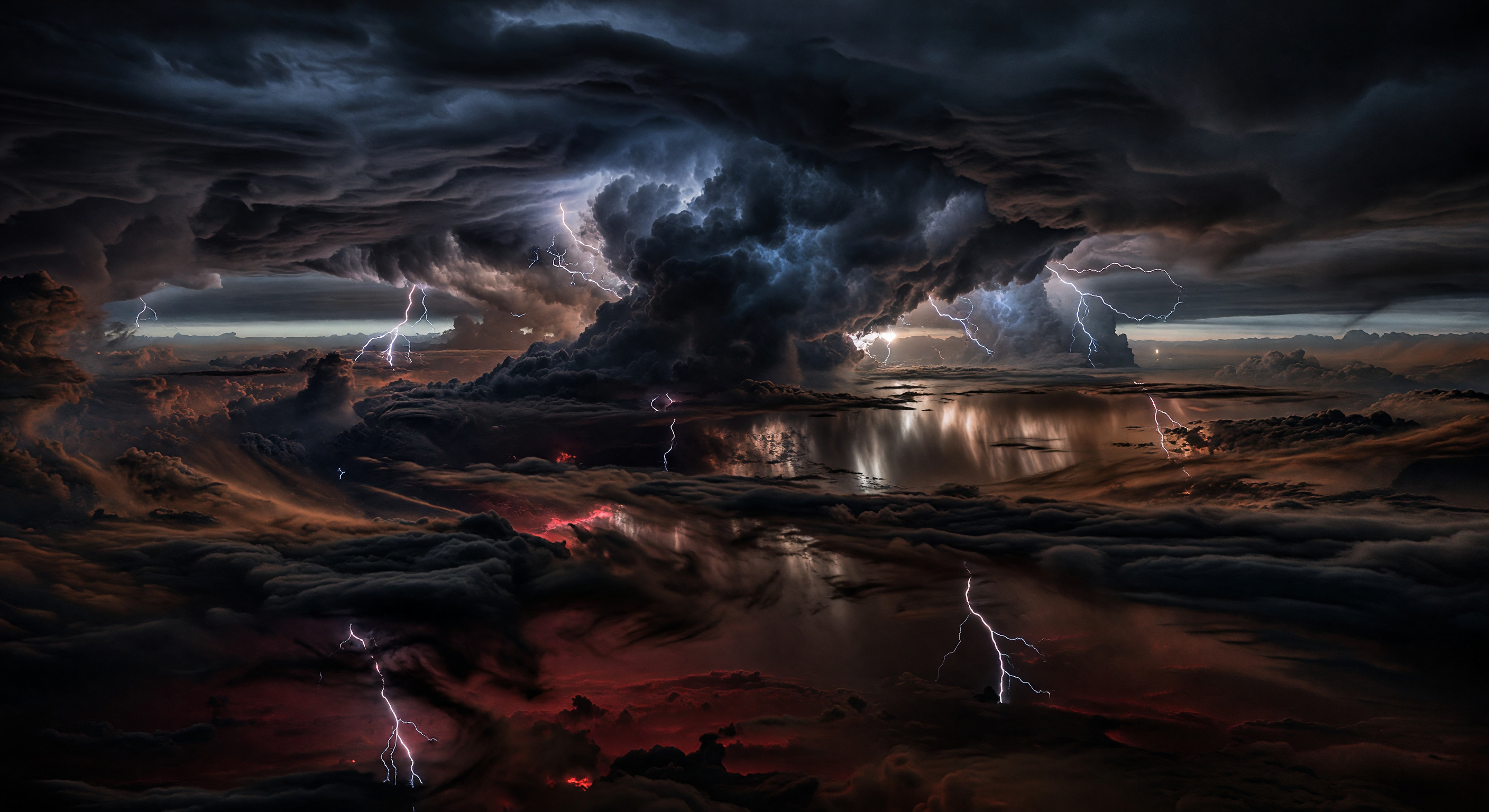
There is no ground here—only a plunging abyss of atmosphere, where colossal indigo-black storm towers surge upward and downward through layers of hydrogen, helium, and metallic vapor, their flanks briefly carved into view by blue-white lightning. In the foreground, rust-brown iron-condensate clouds and dark metallic haze are shredded into streamers by winds racing at kilometers per second, while shimmering curtains of liquid iron fall from cooler decks above and fade into the deeper heat below, where they can partially re-vaporize. The dim ember-red glow rising from beneath is the radiance of hotter atmospheric layers, underlighting the storm vault in crimson and bronze and emphasizing that this is an ultra-hot gas giant with no solid surface, only immense convective structure hundreds of kilometers tall. Far off, a faint twilight band marks the transition toward the permanently daylit hemisphere, but overhead the opaque canopy swallows the stars, leaving you suspended inside a thunderous, metallic night unlike anything in the Solar System.
Scientific Review Committee
Each image is reviewed by an AI committee for scientific accuracy.
Claude
Image: Adjust
Caption: Adjust
I largely concur with GPT's assessment but want to sharpen several points and introduce a few additional observations.
SCIENTIFIC ACCURACY: The image succeeds at conveying extreme convective scale, omnidirectional lightning, and the absence of a conventional blue-sky atmosphere — all directionally appropriate for WASP-76b's tidally locked, ultra-hot gas giant environment. The ember-red underglow is the image's strongest scientific asset: it gestures credibly toward thermal emission from deeper, hotter atmospheric layers (~2400–2600 K on the dayside, cooler but still extreme on the nightside where iron condenses). However, I want to flag a specific issue GPT touched on but understated: WASP-76b's iron rain occurs primarily near the terminator, where cooler nightside temperatures allow iron vapor transported from the dayside to condense. The image appears to depict the nightside or terminator region (note the faint twilight band), which is actually the *correct* zone for iron condensate representation — this is a minor point in the image's favor that GPT did not credit. That said, the 'reflective curtain' in the mid-ground reads as standing water or a calm lake surface, which is physically untenable in a gas giant atmosphere and is the image's most serious scientific misrepresentation. No stable liquid-iron surface of that geometry would form; iron would precipitate as droplets or streaks falling through gas, not pool into a flat reflective plane. The storm morphology also borrows heavily from terrestrial cumulonimbus structure. While vertical convection is expected, WASP-76b's atmospheric dynamics are dominated by ~5 km/s equatorial jets producing horizontal shear at a scale that should visually dwarf and distort vertical storm towers far more dramatically than depicted. The largely static, upright storm columns feel insufficiently sheared for this wind regime.
VISUAL QUALITY: The image is technically accomplished — lightning branching is sharp, volumetric cloud layering is convincing, and color grading is internally consistent. I identified no significant AI artifacts in geometry or topology. My primary visual quality concern is the flat reflective mid-ground surface, which not only undermines scientific accuracy but also breaks photorealistic consistency with the surrounding turbulent atmosphere. A calm reflective layer surrounded by violent storm structure and kilometer-per-second winds has no physical justification and reads as a compositional choice borrowed from terrestrial storm-over-ocean photography. Additionally, the lightning, while visually striking, is somewhat uniformly distributed in a way that suggests aesthetic placement rather than physically motivated discharge clustering around the most intense convective cores.
CAPTION ACCURACY: The caption is evocative and scientifically informed in its framing but makes several claims the image does not support visually. 'Shimmering curtains of liquid iron' are not distinctly rendered — the brown-orange clouds are generically turbulent rather than depicting coherent iron-droplet precipitation. The 'no ground here — only a plunging abyss' framing is directly contradicted by the flat reflective surface in the mid-ground, which any viewer will read as a floor or surface. The caption correctly identifies the twilight band and the crimson underlighting, both of which are present. The 'winds racing at kilometers per second' have no clear visual correlate — the scene feels relatively static rather than conveying the extreme horizontal wind shear that defines this planet's atmospheric dynamics. I recommend the caption either remove the liquid-iron curtain language or replace it with a more general 'metallic condensate precipitation,' and explicitly acknowledge that the reflective mid-ground represents an optically dense cloud deck rather than a liquid surface, to prevent scientific misreading.
SUMMARY: The image is a strong artistic interpretation that correctly situates dramatic atmospheric phenomena in a plausible ultra-hot gas giant context, with commendable use of thermal underlighting and terminator twilight. The two issues requiring adjustment — the flat reflective surface implying a solid/liquid floor, and the insufficient horizontal wind distortion of storm morphology — are significant enough to warrant targeted revision rather than regeneration. Caption should be trimmed of overclaims regarding visually unsubstantiated iron-curtain phenomena and should reconcile the 'no ground' assertion with the reflective layer as depicted.
SCIENTIFIC ACCURACY: The image succeeds at conveying extreme convective scale, omnidirectional lightning, and the absence of a conventional blue-sky atmosphere — all directionally appropriate for WASP-76b's tidally locked, ultra-hot gas giant environment. The ember-red underglow is the image's strongest scientific asset: it gestures credibly toward thermal emission from deeper, hotter atmospheric layers (~2400–2600 K on the dayside, cooler but still extreme on the nightside where iron condenses). However, I want to flag a specific issue GPT touched on but understated: WASP-76b's iron rain occurs primarily near the terminator, where cooler nightside temperatures allow iron vapor transported from the dayside to condense. The image appears to depict the nightside or terminator region (note the faint twilight band), which is actually the *correct* zone for iron condensate representation — this is a minor point in the image's favor that GPT did not credit. That said, the 'reflective curtain' in the mid-ground reads as standing water or a calm lake surface, which is physically untenable in a gas giant atmosphere and is the image's most serious scientific misrepresentation. No stable liquid-iron surface of that geometry would form; iron would precipitate as droplets or streaks falling through gas, not pool into a flat reflective plane. The storm morphology also borrows heavily from terrestrial cumulonimbus structure. While vertical convection is expected, WASP-76b's atmospheric dynamics are dominated by ~5 km/s equatorial jets producing horizontal shear at a scale that should visually dwarf and distort vertical storm towers far more dramatically than depicted. The largely static, upright storm columns feel insufficiently sheared for this wind regime.
VISUAL QUALITY: The image is technically accomplished — lightning branching is sharp, volumetric cloud layering is convincing, and color grading is internally consistent. I identified no significant AI artifacts in geometry or topology. My primary visual quality concern is the flat reflective mid-ground surface, which not only undermines scientific accuracy but also breaks photorealistic consistency with the surrounding turbulent atmosphere. A calm reflective layer surrounded by violent storm structure and kilometer-per-second winds has no physical justification and reads as a compositional choice borrowed from terrestrial storm-over-ocean photography. Additionally, the lightning, while visually striking, is somewhat uniformly distributed in a way that suggests aesthetic placement rather than physically motivated discharge clustering around the most intense convective cores.
CAPTION ACCURACY: The caption is evocative and scientifically informed in its framing but makes several claims the image does not support visually. 'Shimmering curtains of liquid iron' are not distinctly rendered — the brown-orange clouds are generically turbulent rather than depicting coherent iron-droplet precipitation. The 'no ground here — only a plunging abyss' framing is directly contradicted by the flat reflective surface in the mid-ground, which any viewer will read as a floor or surface. The caption correctly identifies the twilight band and the crimson underlighting, both of which are present. The 'winds racing at kilometers per second' have no clear visual correlate — the scene feels relatively static rather than conveying the extreme horizontal wind shear that defines this planet's atmospheric dynamics. I recommend the caption either remove the liquid-iron curtain language or replace it with a more general 'metallic condensate precipitation,' and explicitly acknowledge that the reflective mid-ground represents an optically dense cloud deck rather than a liquid surface, to prevent scientific misreading.
SUMMARY: The image is a strong artistic interpretation that correctly situates dramatic atmospheric phenomena in a plausible ultra-hot gas giant context, with commendable use of thermal underlighting and terminator twilight. The two issues requiring adjustment — the flat reflective surface implying a solid/liquid floor, and the insufficient horizontal wind distortion of storm morphology — are significant enough to warrant targeted revision rather than regeneration. Caption should be trimmed of overclaims regarding visually unsubstantiated iron-curtain phenomena and should reconcile the 'no ground' assertion with the reflective layer as depicted.
Grok
Image: Adjust
Caption: Adjust
I concur with both GPT and Claude on the core issues: the prominent flat, reflective rust-brown/orange mid-ground layer (visible as the mirrored surface reflecting lightning and underglow) strongly evokes a solid or liquid 'floor'—likely misinterpreted iron condensate or metallic haze—directly undermining the caption's 'no ground here—only a plunging abyss' premise and WASP-76b's gas-giant reality with no solid surface. This is the image's primary scientific and visual flaw, as it introduces an untenable calm reflective plane amid km/s winds, clashing with expected turbulent, sheared convection (Claude's point on equatorial jets ~5 km/s distorting vertical towers is spot-on and underemphasized by GPT). Scientifically, the scene aptly captures nightside/terminator iron rain plausibility (correct location per observations of dayside vapor transport and nightside condensation at ~200K), ember-red thermal underlighting from deep hot layers (~240K dayside emission), opaque metallic haze, and intense lightning in a H/He envelope—aligning with JWST/Hubble data on vaporized metals and extreme dynamics. However, storm towers retain too much terrestrial cumulonimbus uprightness without sufficient horizontal streaking/streamers to visualize hypersonic winds shredding clouds, and 'liquid iron curtains' lack distinct vertical streaking (instead, foreground reads as pooled condensate). Visually, the image is photorealistic and artifact-free—excellent volumetric lightning branching, depth layering, crimson-bronze glow, and faint twilight band toward daylit hemisphere—but the reflective 'surface' breaks immersion, resembling Earth ocean-storm clichés. No major AI glitches (e.g., no melting or symmetry errors). Caption accuracy falters on overclaiming identifiable 'shimmering curtains of liquid iron' and 'rust-brown iron-condensate clouds shredded into streamers' (warm tones present but not process-specific) and ignores the depicted reflective layer, while correctly nailing underlighting, opacity, scale (~100s km convection), and twilight. New insight: lightning color (blue-white) fits high-altitude dielectric breakdown in metal-vapor plasma, but clustering should favor updraft cores for realism. Adjustments needed: regenerate image with blurred/turbulent midground as streaking iron droplets in abyss (no flat reflection), enhance wind shear via elongated cloud filaments; tone caption to 'falling streamers of metallic condensate' without 'curtains,' describe reflective layer as dense haze deck if retained. Strong thematic foundation warrants 'adjust' over 'regenerate.'
Gemini
Image: Adjust
Caption: Adjust
I concur with the committee's consensus regarding the 'surface' problem. The image is visually stunning but suffers from a significant 'uncanny valley' of planetary science: it depicts a calm, mirror-like reflective layer that suggests a solid or liquid sea, which is physically impossible for a gas giant and directly contradicts the 'plunging abyss' narrative. The storm morphology is also too terrestrial; while the vertical scale is handled well, the lack of horizontal shearing is a missed opportunity to visualize the 5 km/s jet streams characteristic of WASP-76b. The lightning is aesthetically pleasing but lacks the chaotic clustering one would expect in a high-pressure, metal-vapor-rich convective environment. The caption is overly ambitious; it describes granular physical phenomena ('shimmering curtains,' 'shredded streamers') that the image renders only as generic atmospheric turbulence. To improve, the image needs to replace the reflective planar surface with a chaotic, non-reflective gradient of deep-atmosphere haze to restore the sense of depth, and the caption should be revised to describe 'metallic precipitation' rather than specific 'curtains' that are not visually corroborated.
Matania — Synthesis
Image: Adjust
Caption: Adjust
The committee finds this to be a strong, cinematic exoplanet stormscape that captures the broad mood of WASP-76b well: intense thermal underlighting, opaque metal-laden haze, dramatic lightning, and a plausible terminator/night-side setting for iron condensation. Scientifically, it succeeds in suggesting an ultra-hot gas giant with extreme convection and a hostile atmosphere. However, the image’s main flaw is a flat, mirror-like mid-ground that reads as a calm liquid or solid surface, which conflicts with the reality of a gas giant and undermines the intended ‘plunging abyss’ framing. The storm towers also remain too terrestrial and upright, lacking the wind-sheared distortion expected in WASP-76b’s extreme jet-driven atmosphere. The caption is evocative but overstates what the image clearly shows, especially the specific ‘curtains of liquid iron’ and other granular iron-rain claims. Overall verdict: compelling foundation, but both image and caption need adjustment for stronger scientific alignment.
Other languages
- Français: Voûte d'orage électrique
- Español: Bóveda de tormenta eléctrica
- Português: Abóbada da tormenta elétrica
- Deutsch: Gewölbe des Elektro-Sturms
- العربية: قبو العاصفة الكهربائية
- हिन्दी: विद्युत तूफ़ानी गुंबद
- 日本語: 電嵐の穹
- 한국어: 전기 폭풍 궁륭
- Italiano: Volta della tempesta elettrica
- Nederlands: Gewelf van de elektrische storm
Visual quality: The image is high-quality, cinematic, and internally consistent—there are clear, sharp lightning arcs, layered cloud structures, volumetric lighting, and strong color contrast. I do not see obvious AI artifacts (e.g., melted geometry or text errors). That said, there are realism issues: the lightning pattern and branching are visually striking but could be more physically constrained for atmospheric pressure/optical thickness; also, the “foreground water/reflective layer” effect looks more like a solid/liquid surface than an optically thick gas layer, which slightly breaks the intended gas-giant groundless perspective.
Caption accuracy: The description matches the general mood (electrical storm vault, metallic haze, towering storms, no stars visible) and broadly aligns with the presence of lightning and deep underlighting. But it over-specifies elements that are not clearly evidenced by the image—particularly “shimmering curtains of liquid iron” and “rust-brown iron-condensate clouds” as distinct, recognizable physical processes. Additionally, the caption’s “plunging abyss” and “no ground here” are only partially reflected because the foreground reads as a grounded, patterned layer rather than a purely atmospheric depth.
Overall: Good visual and thematic match for an ultra-hot exoplanet stormscape, but the image does not convincingly support the iron-condensate/liquid-iron specificity and the strict “no ground / atmospheric abyss” framing as strongly as the caption claims. Minor revision either to the caption (tone down iron-specific claims, describe it more generally as metal-laden clouds/haze) or to the image (make the lower boundary explicitly atmospheric/free of surface cues) would improve alignment.