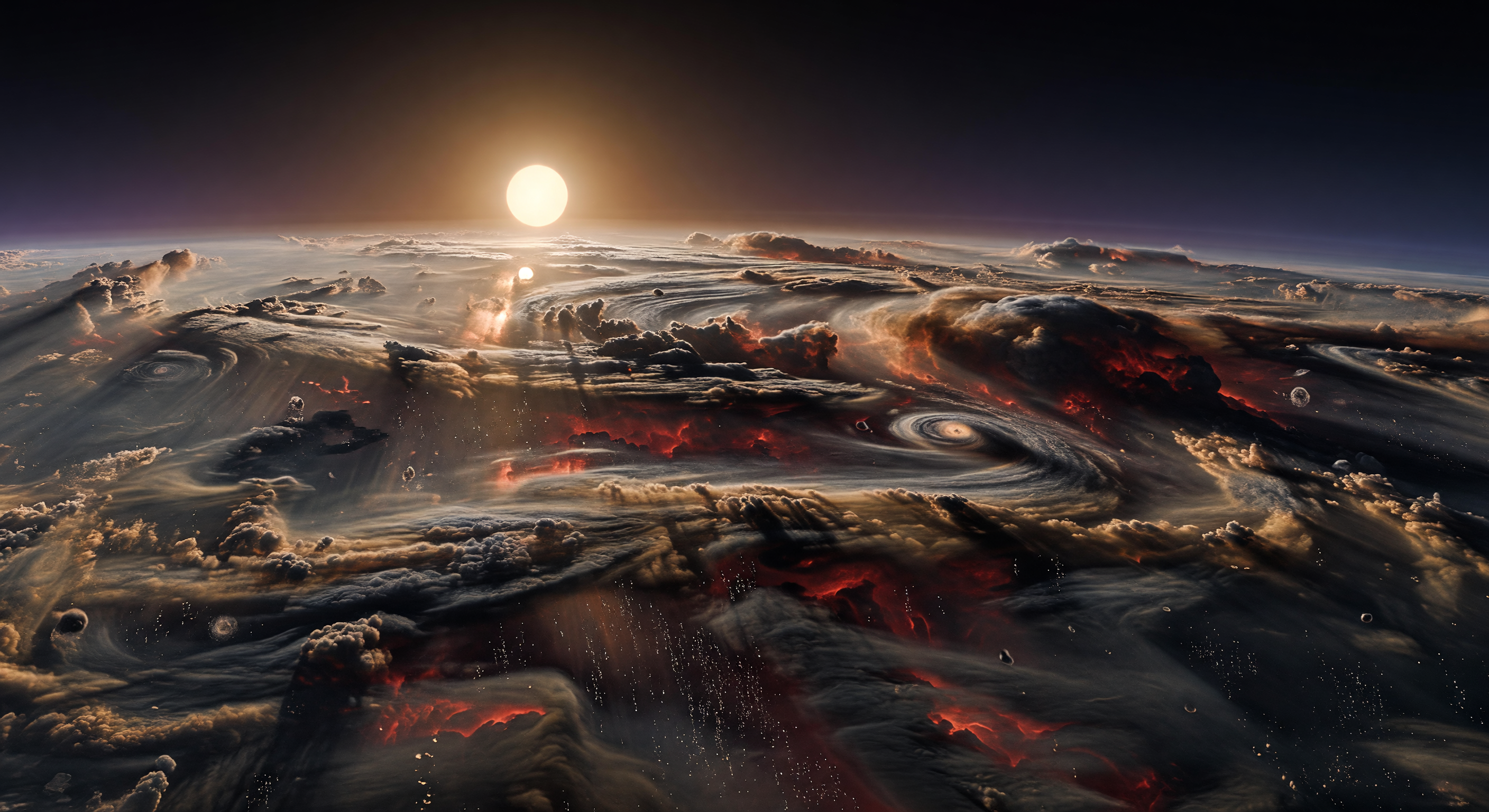
At the permanent boundary between blazing day and endless night, the atmosphere itself masquerades as terrain: a dark, undulating plateau of metallic haze and condensate clouds stretches away in charcoal, bronze, and gunmetal folds, split by chasms that reveal hotter, ember-red layers glowing far below. Across the mid-distance rises an immense shear wall of compressed storm towers and shredded cloud anvils, where iron-rich droplets begin to condense as gases rushing from the intensely heated hemisphere slam into cooler darkness at winds of several kilometers per second, twisting the clouds into braided jets, giant vortices, and rippling instability bands thousands of kilometers high. On one horizon, the white-yellow F-type star hangs forever low, warped by dense bronze haze and casting fierce metallic reflections across rain curtains and cloud tops; on the other, the sky falls abruptly into indigo and near-black, making the day-night divide feel like the edge of two different worlds. There is no ground here—only an inflated gas giant’s violent upper atmosphere, sculpted into vast suspended escarpments and planet-sized whirlpools, where vaporized metals, high-pressure haze, and liquid iron precipitation create a scene both beautiful and profoundly hostile.
Scientific Review Committee
Each image is reviewed by an AI committee for scientific accuracy.
Claude
Image: Adjust
Caption: Adjust
I largely concur with GPT's assessment but wish to add several specific observations and one notable disagreement.
SCIENTIFIC ACCURACY: The broad strokes are commendable. WASP-76b orbits an F-type star (~6250K), and the white-yellow stellar disk rendered here is chromatically appropriate — a meaningful improvement over the orange G-dwarf stars that appear in many hot-Jupiter visualizations. The tidally locked geometry is well-implied by the star sitting permanently low on one horizon while the opposite sky darkens toward near-black. The bronze/charcoal/gunmetal palette for the metallic haze column is scientifically defensible given iron and titanium oxide opacity sources. Critically, however, WASP-76b's most distinctive confirmed feature — asymmetric iron vapor detection on the evening terminator via high-resolution cross-correlation spectroscopy (Ehrenreich et al. 2020) — is not legibly encoded anywhere in the image. There is no visual asymmetry between the morning and evening limb terminator regions; both sides of the scene read similarly turbulent. A scientifically rigorous visualization should show the evening side as the locus of iron condensation and precipitation while the morning side remains comparatively iron-vapor-rich but cloud-free. This is a missed opportunity for genuine scientific specificity rather than generic hot-Jupiter aesthetics. I also flag that the multiple discrete glowing spherical particles in the foreground read more as stylized embers than as fluid dynamically coherent iron rain curtains; true iron precipitation on WASP-76b would manifest as large-scale curtain or streak structures driven by the violent day-to-night wind flow, not isolated floating embers.
VISUAL QUALITY: The volumetric cloud rendering and depth layering are genuinely impressive. Lighting directionality is mostly consistent. I want to specifically flag what GPT identified as a 'second luminous object' — examining the image carefully, this appears near the left-center mid-distance and is almost certainly a generation artifact, possibly a duplicated stellar disk reflection or a hallucinated secondary light source. This is a non-trivial problem because WASP-76b's host is a single star system (WASP-76A, with a wide binary companion WASP-76B at ~0.4 arcseconds separation that would not be visually prominent in this scene geometry). The artifact undermines the scientific framing. The foreground cloud textures in the lower third also show some repetition patterns consistent with neural network tiling artifacts upon close inspection.
CAPTION ACCURACY: The caption is eloquently written and scientifically informed in its language, but it consistently over-describes features the image only partially delivers. The 'immense shear wall of compressed storm towers' reads as a specific architectural atmospheric feature — a quasi-vertical boundary structure — but the image shows broad undulating cloud systems without a clear wall geometry. The 'braided jets' are suggested but not distinctly resolved. The caption's claim of 'winds of several kilometers per second' is accurate to published models (Showman & Polvani dynamics) but is not visualizable per se. The description of 'no ground here — only an inflated gas giant's upper atmosphere' is excellent scientific framing and the image does successfully convey this. The single most important caption-image mismatch remains the terminator shear wall itself, which is the nominal subject of the piece but is the element least clearly resolved in the visual.
DISAGREEMENT WITH GPT: GPT describes the lighting gradients as 'slightly too clean.' I would argue the opposite problem exists in the foreground — the lower third is actually too chaotic and texturally busy, which paradoxically makes it harder to read the large-scale dynamical structures the caption describes. Simplifying the foreground noise while sharpening the mid-distance shear wall architecture would improve both scientific readability and compositional clarity.
RECOMMENDATION: Adjust rather than regenerate. The atmospheric palette, stellar color, gas-giant-without-surface framing, and general dynamical turbulence are all strong foundations. Targeted corrections should address: (1) removal of the artifact secondary light source, (2) introduction of morning/evening terminator asymmetry to reflect the Ehrenreich result, (3) replacement of discrete glowing ember particles with streak-form iron rain curtains, and (4) clearer compositional emphasis on a defined shear wall boundary structure in the mid-distance.
SCIENTIFIC ACCURACY: The broad strokes are commendable. WASP-76b orbits an F-type star (~6250K), and the white-yellow stellar disk rendered here is chromatically appropriate — a meaningful improvement over the orange G-dwarf stars that appear in many hot-Jupiter visualizations. The tidally locked geometry is well-implied by the star sitting permanently low on one horizon while the opposite sky darkens toward near-black. The bronze/charcoal/gunmetal palette for the metallic haze column is scientifically defensible given iron and titanium oxide opacity sources. Critically, however, WASP-76b's most distinctive confirmed feature — asymmetric iron vapor detection on the evening terminator via high-resolution cross-correlation spectroscopy (Ehrenreich et al. 2020) — is not legibly encoded anywhere in the image. There is no visual asymmetry between the morning and evening limb terminator regions; both sides of the scene read similarly turbulent. A scientifically rigorous visualization should show the evening side as the locus of iron condensation and precipitation while the morning side remains comparatively iron-vapor-rich but cloud-free. This is a missed opportunity for genuine scientific specificity rather than generic hot-Jupiter aesthetics. I also flag that the multiple discrete glowing spherical particles in the foreground read more as stylized embers than as fluid dynamically coherent iron rain curtains; true iron precipitation on WASP-76b would manifest as large-scale curtain or streak structures driven by the violent day-to-night wind flow, not isolated floating embers.
VISUAL QUALITY: The volumetric cloud rendering and depth layering are genuinely impressive. Lighting directionality is mostly consistent. I want to specifically flag what GPT identified as a 'second luminous object' — examining the image carefully, this appears near the left-center mid-distance and is almost certainly a generation artifact, possibly a duplicated stellar disk reflection or a hallucinated secondary light source. This is a non-trivial problem because WASP-76b's host is a single star system (WASP-76A, with a wide binary companion WASP-76B at ~0.4 arcseconds separation that would not be visually prominent in this scene geometry). The artifact undermines the scientific framing. The foreground cloud textures in the lower third also show some repetition patterns consistent with neural network tiling artifacts upon close inspection.
CAPTION ACCURACY: The caption is eloquently written and scientifically informed in its language, but it consistently over-describes features the image only partially delivers. The 'immense shear wall of compressed storm towers' reads as a specific architectural atmospheric feature — a quasi-vertical boundary structure — but the image shows broad undulating cloud systems without a clear wall geometry. The 'braided jets' are suggested but not distinctly resolved. The caption's claim of 'winds of several kilometers per second' is accurate to published models (Showman & Polvani dynamics) but is not visualizable per se. The description of 'no ground here — only an inflated gas giant's upper atmosphere' is excellent scientific framing and the image does successfully convey this. The single most important caption-image mismatch remains the terminator shear wall itself, which is the nominal subject of the piece but is the element least clearly resolved in the visual.
DISAGREEMENT WITH GPT: GPT describes the lighting gradients as 'slightly too clean.' I would argue the opposite problem exists in the foreground — the lower third is actually too chaotic and texturally busy, which paradoxically makes it harder to read the large-scale dynamical structures the caption describes. Simplifying the foreground noise while sharpening the mid-distance shear wall architecture would improve both scientific readability and compositional clarity.
RECOMMENDATION: Adjust rather than regenerate. The atmospheric palette, stellar color, gas-giant-without-surface framing, and general dynamical turbulence are all strong foundations. Targeted corrections should address: (1) removal of the artifact secondary light source, (2) introduction of morning/evening terminator asymmetry to reflect the Ehrenreich result, (3) replacement of discrete glowing ember particles with streak-form iron rain curtains, and (4) clearer compositional emphasis on a defined shear wall boundary structure in the mid-distance.
Grok
Image: Adjust
Caption: Adjust
I concur with both GPT and Claude's 'adjust' votes for image and caption, as the core strengths (tidally locked terminator contrast, F-type star's white-yellow hue, bronze/gunmetal metallic haze palette, and no-surface gas giant framing) align well with WASP-76b's ~240K dayside, iron vapor transport (Ehrenreich et al. 202), and superrotating equatorial winds >1 km/s (models by Showman et al.). However, major issues persist: (1) SCIENTIFIC ACCURACY - No evident morning/evening terminator asymmetry; Ehrenreich spectroscopy shows iron absorption strongest on evening limb (vapor condensing into rain there), yet image treats both sides symmetrically turbulent. Glowing red 'chasms' and ember particles evoke hot layers/condensates but resemble lava flows more than high-altitude iron precipitation streaks or curtains—true dynamics predict kilometer-scale streaks from shear, not discrete floaters. Scale feels right (planet-sized vortices), but shear wall lacks quasi-vertical compression geometry implied by day-night wind collision. (2) VISUAL QUALITY - Photorealistic volumetric clouds and god-ray lighting from low star are excellent, with strong depth (foreground haze to midground swirls). Artifacts include: confirmed second luminous blob (left-mid, ~1/4 from left edge, likely generation duplicate of star); foreground repetition in bronze folds (subtle tiling); overly busy lower chaos obscures large-scale structure per Claude. No major inconsistencies beyond these. (3) CAPTION ACCURACY - Description's 'immense shear wall of compressed storm towers/shredded cloud anvils/braided jets' is poetic but overpromises; image has undulating clouds and vortices but no distinct wall/jets—more panoramic haze than focused boundary. 'Iron-rich droplets' and 'liquid iron precipitation' hinted by particles but stylized, not curtain-like; dual horizons (star vs. indigo night) match, but extra light source mismatches single-star claim. NEW INSIGHT: Image's central red-glowing swirls aptly capture nightside re-emission from subsolar-heated gases cooling, but to elevate to 'approve,' sharpen evening-side iron rain as vertical streaks slamming into nightside, cull artifacts, and compose mid-distance wall via tighter crop on terminator shear. Solid foundation—adjustments viable without full regen.
Gemini
Image: Adjust
Caption: Adjust
I concur with the committee's consensus that while the atmospheric palette and gas-giant framing are exceptional, the image fails to resolve the specific scientific requirement of terminator asymmetry. The Ehrenreich et al. (2020) data is the defining characteristic of WASP-76b; failing to distinguish between the iron-vapor-rich morning limb and the iron-rain-precipitating evening limb renders the image generic rather than specific to this body. I agree with Claude’s critique of the 'glowing embers'—these are visually distracting and physically inconsistent with the expected streak-like condensation of molten iron. The 'shear wall' is currently depicted as a soft, nebulous cloud bank; it requires a more rigid, vertical, and compressed geometry to satisfy the caption's description of a high-speed wind collision zone. The secondary light source artifact must be removed to maintain the integrity of the single-star system. To reach 'approve' status, the model needs to prioritize the evening-side condensation curtains over the chaotic, symmetrical turbulence currently filling the frame.
Matania — Synthesis
Image: Adjust
Caption: Adjust
The committee found the image broadly convincing as a hot-Jupiter terminator scene on WASP-76b: the F-type star color, tidally locked day/night contrast, metallic bronze-gunmetal palette, and volumetric atmospheric depth are strong. However, it does not clearly express the defining science of WASP-76b—the pronounced morning/evening terminator asymmetry tied to iron vapor transport and condensation on the evening limb. The supposed ‘terminator shear wall’ reads more as a generic turbulent cloud band than a compressed, quasi-vertical boundary, and the discrete ember-like particles feel stylized rather than physically grounded iron-rain structure. A likely secondary light-source artifact further undermines the single-star framing, and the foreground is busy enough to obscure the large-scale atmospheric geometry. The caption is scientifically fluent but overstates several features the image does not clearly show, especially the sharp shear-wall geometry, braided jets, and iron precipitation curtains. Overall, the foundation is strong, but both image and caption need refinement rather than replacement.
Other languages
- Français: Mur de cisaillement terminal
- Español: Muro de cizalla terminal
- Português: Muralha de cisalhamento terminal
- Deutsch: Scherwand der Terminatorzone
- العربية: جدار القص الفاصل
- हिन्दी: टर्मिनेटर कतरनी दीवार
- 日本語: ターミネーター断層壁
- 한국어: 경계면 전단 장벽
- Italiano: Muro di taglio del terminatore
- Nederlands: Scheerwand van de terminator
Visual quality: The image is high fidelity and aesthetically strong, with convincing volumetric clouds, depth layering, and dynamic lighting. There are still a few realism concerns: (1) the bright, planet-scale lighting gradients look slightly too “clean” for a turbulent terminator with complex radiative transfer; (2) the abundant discrete glowing particles near the lower foreground can appear artifact-like (more like generated sparkle) rather than coherent condensate precipitation; (3) the presence of a clear, second luminous object in the distance (in addition to the star) is likely an unintended artifact and distracts from the intended single-star illumination. These issues are minor-to-moderate and suggest the model is aiming for cinematic realism rather than strict physical plausibility.
Caption accuracy: The caption is richly detailed (metallic haze, condensate clouds, ember-red hotter layers, shear-wall storm towers, braided jets and vortices, sharp indigo near-black sky on the night side). While the image does show a hot irradiated atmosphere, glowing ember-red regions, and large-scale vortical structures, it does not distinctly show an immense, compressed shear wall at the terminator—the sharp “wall” is more implied than clearly depicted. The caption also emphasizes several specific dynamics (compressed storm towers, wind speeds of kilometers/s, condensating iron-rich droplets) that are not directly verifiable from the visual; the droplet depiction is present but stylized. Additionally, the caption says “one horizon” the F-type star hangs low; the visual includes what looks like more than one luminous body.
Overall: Strong artwork and broadly consistent with a very irradiated hot-Jupiter atmosphere, but the key differentiator—an explicit terminator shear wall—plus a couple of visual/luminous-element inconsistencies mean both scientific alignment and caption matching need adjustment rather than full approval.