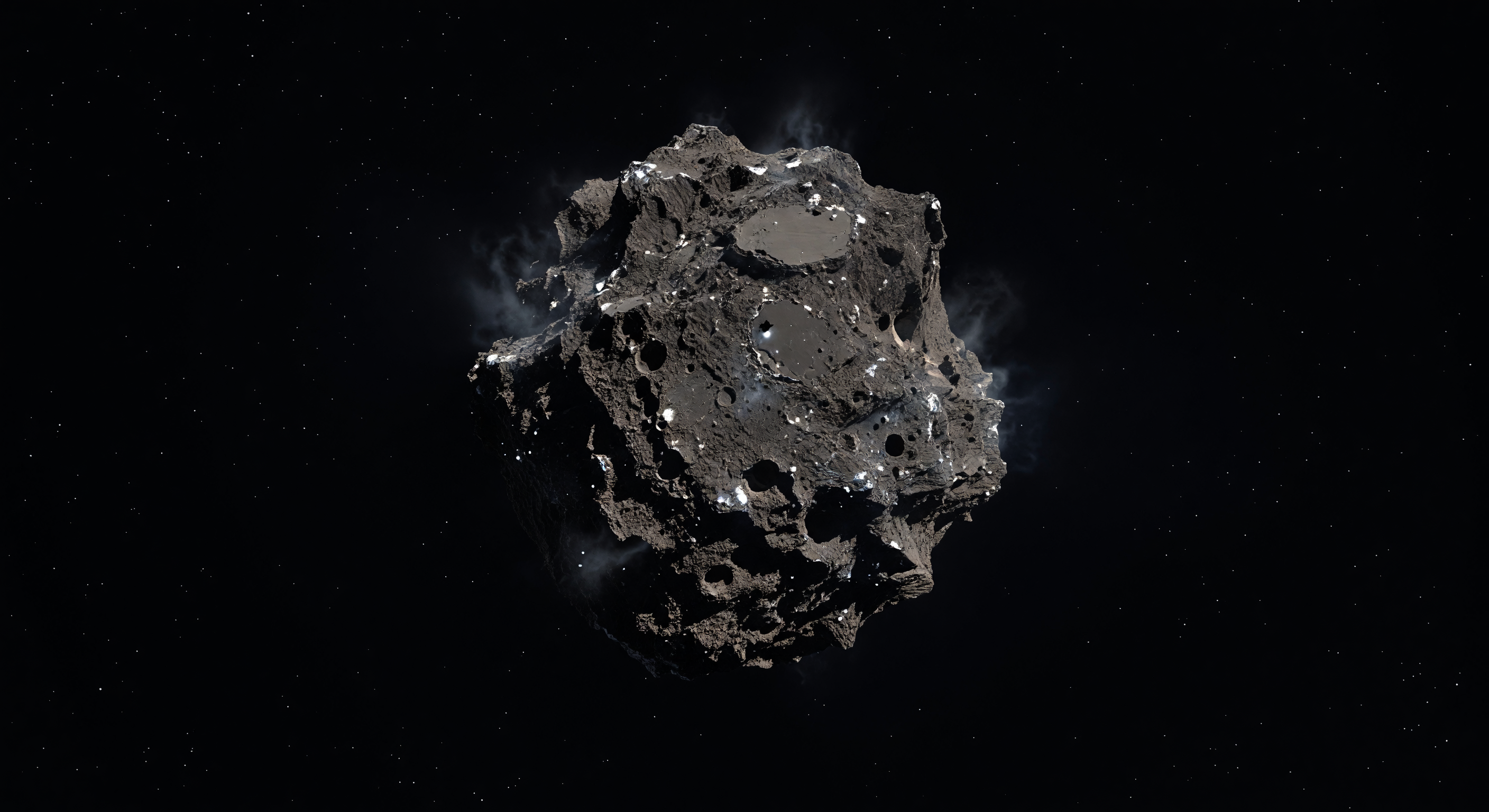
Scientific confidence: Medium

From this jagged rim, the land falls away into a kilometer-scale hollow so dark it seems to open directly into space, its floor almost entirely swallowed by shadow beneath an airless black sky. The ground around you is a brittle, ultra-dark crust of dust, organics, and ice-rich material—only about 4% reflective—broken into tooth-like pinnacles, sheer fractured cliffs, flat mesas, and precariously perched blocks that can survive on such steep slopes only because gravity here is extraordinarily weak. In the harsh sunlight, barely 40% as strong as at Earth, tiny patches of exposed dirty ice and frost glint from cracks and ledges while razor-edged shadows carve the terrain into stark black and white, and faint jets of gas and dust rise from sunlit fissures where buried volatiles are sublimating into vacuum. The nearby horizon curves away with surprising closeness, making these oversized escarpments and drifting grains feel both immense and fragile, as if you are standing on the crumbling skin of a tiny, active relic from the Solar System’s earliest days.
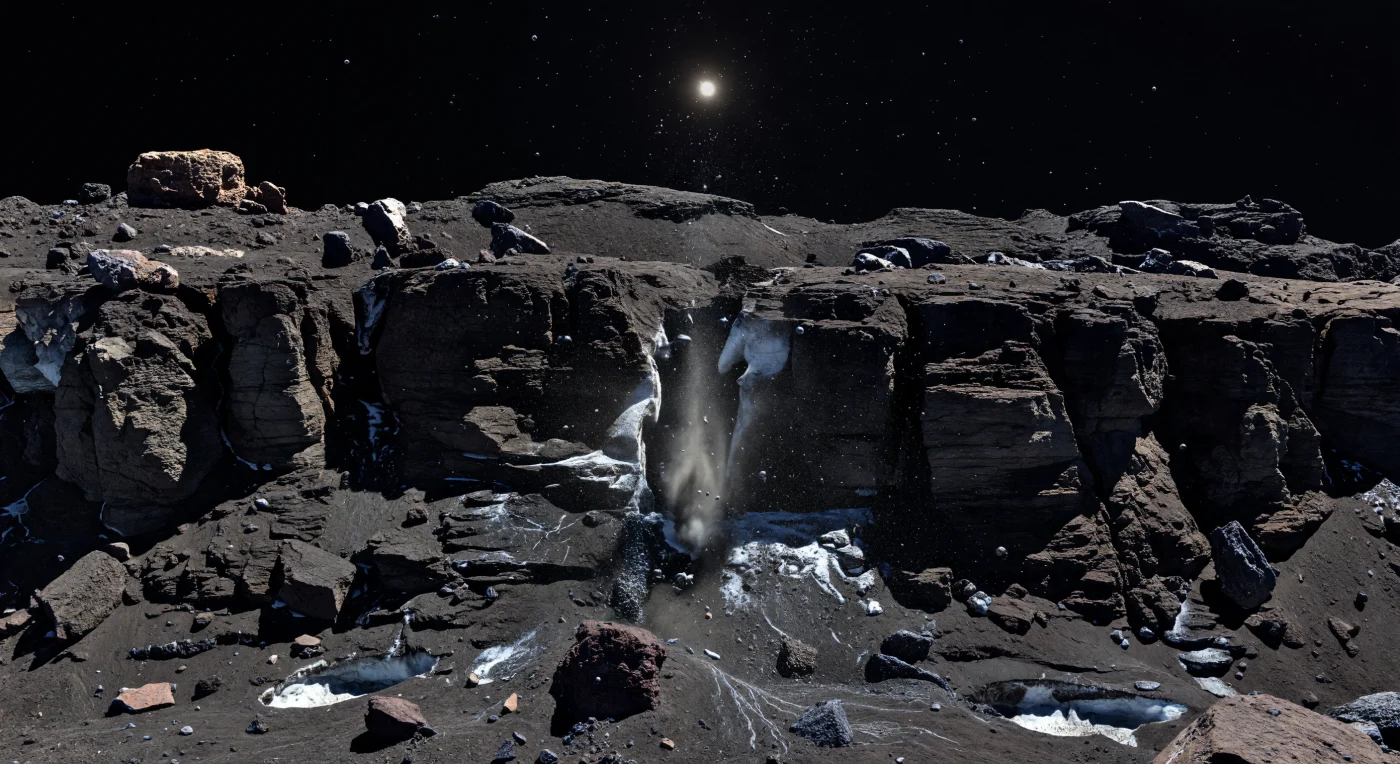
At the foot of a jagged, charcoal-dark cliff, the surface looks freshly broken and strangely fragile, its black-brown crust of dust, organics, and dirty ice split by deep fractures and strewn with angular blocks the size of furniture. Halfway up the wall, sunlight strikes a narrow crack and drives a tight, pale jet of sublimating gas and dust into the vacuum, lifting glittering grains and even pebble-sized fragments into slow, graceful arcs that linger in the comet’s almost nonexistent gravity. Thin bluish-white frost and exposed icy seams trace the vent and sheltered ledges, stark against the nucleus’s exceptionally dark, low-reflectivity surface, while hard sunlight casts knife-sharp shadows across mesas, pits, and overhangs that hint at a rugged world only a few kilometers across. Under a perfectly black sky with faint stars still visible, the scene feels silent, active, and uncannily alive—a raw landscape shaped not by wind or water, but by sunlight unlocking buried volatiles from a primitive crust.
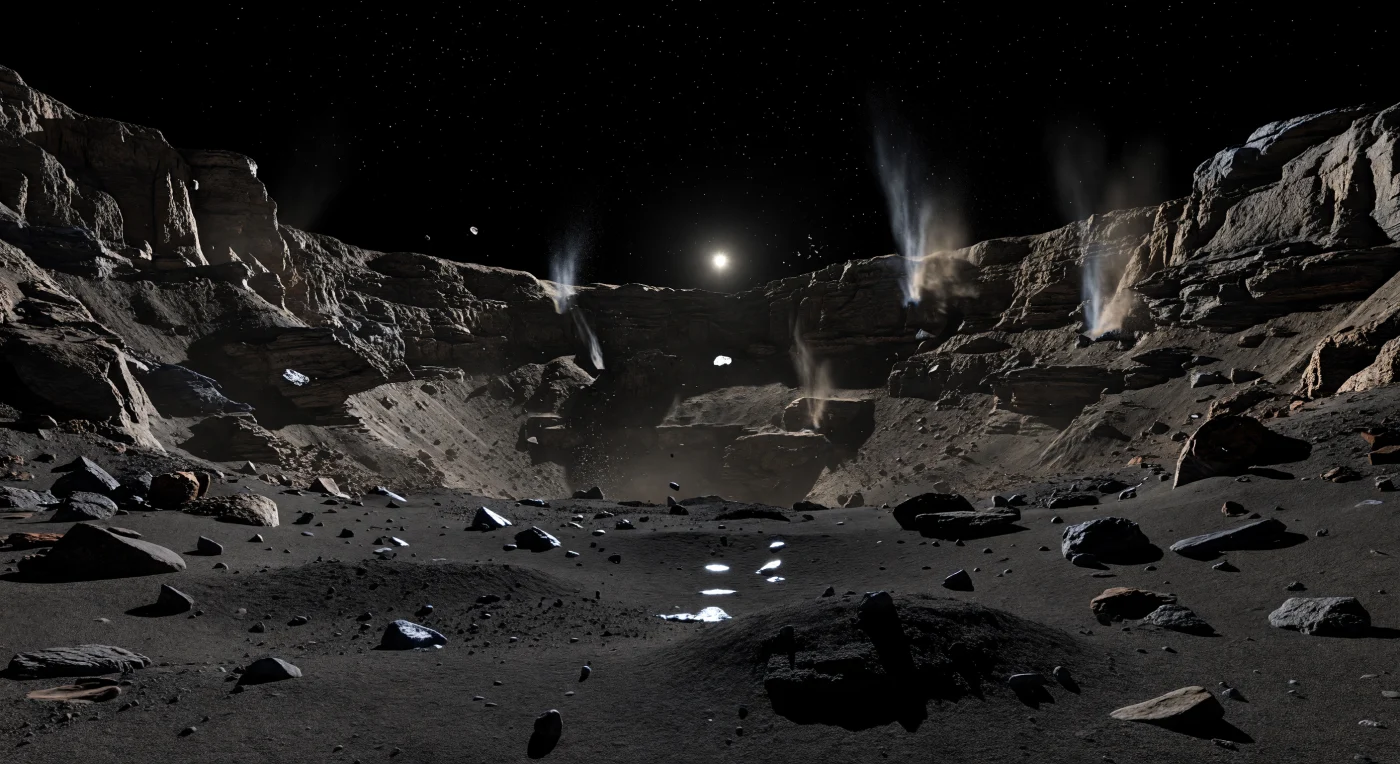
From the floor of this sheltered basin, the landscape appears as a gently rolling plain of ultra-dark fallback dust and compacted organic-rich crust, its charcoal-black surface broken by scattered angular cobbles, fractured boulders, and low hummocks that seem almost weightless in the feeble gravity. Around you, jagged walls rise hundreds of meters in abrupt tiers of consolidated dust and dirty ice, exposing ledges, alcoves, slump scars, and collapsed hollows that record repeated sublimation, fallback, and structural failure on a porous cometary nucleus only a few kilometers across. In the airless black above, stars remain sharp even beside a small, intense Sun, and every pebble throws a razor-edged shadow because there is no atmosphere to soften the light; only rare flecks of exposed ice flash pale white-blue from fresh fractures and shaded recesses. Near sunlit cracks high on the rim, narrow gas-and-dust jets may hiss upward into space, while fine grains drift and pebbles trace slow ballistic arcs, giving this silent hollow the uncanny feeling of a landscape both geologically active and almost suspended in time.
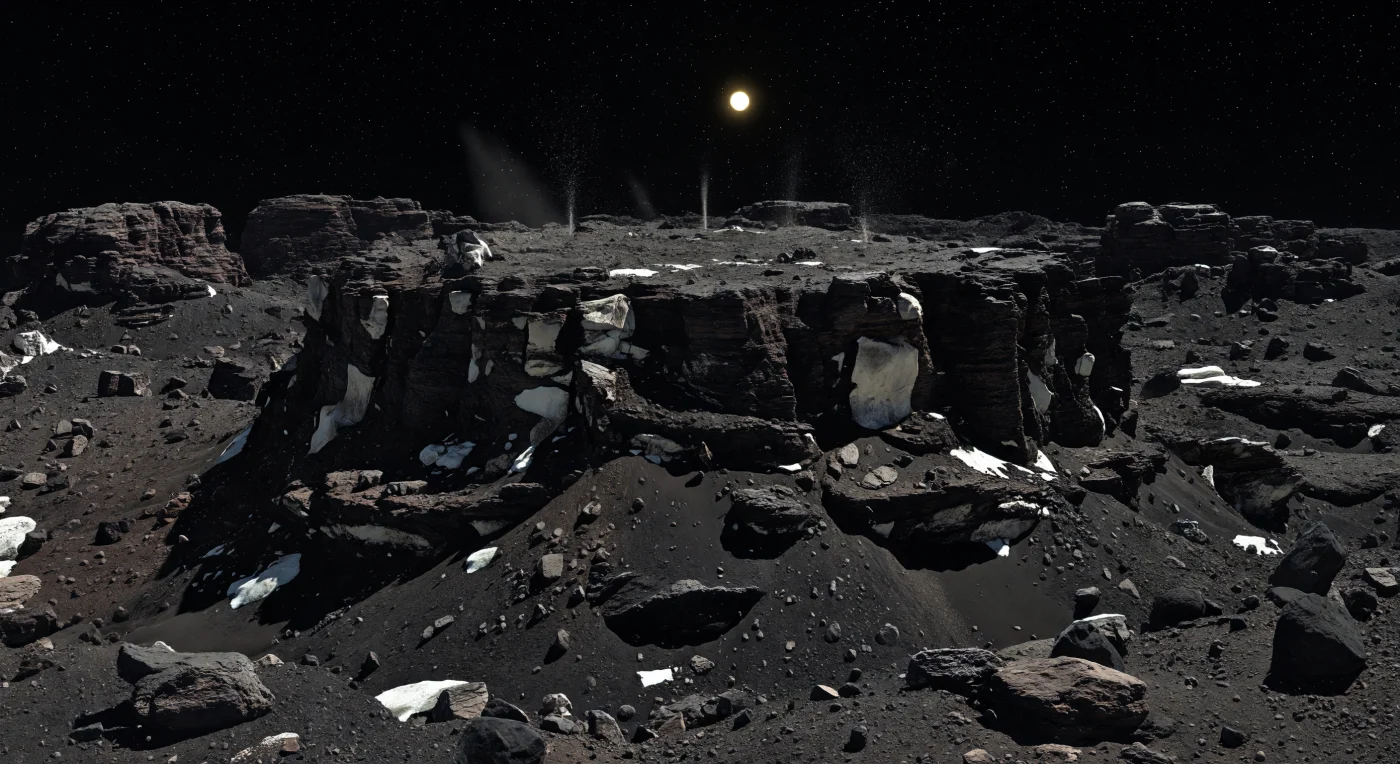
A flat-topped mesa of soot-black crust rises abruptly from a jumbled plain of angular boulders, brittle slabs, and powdery dark regolith, its near-vertical walls fractured into sharp ledges and broken faces where a few fresher scars reveal dirty gray-white ice mixed with dust. In this tiny world’s extraordinarily weak gravity, cliffs tens to perhaps a hundred meters high can stand almost impossibly steep, while talus lies loose at their base and even small grains hover or drift above the ground, nudged by outgassing and feeble falls. The surface is rich in dark carbon-bearing material, with muted brown undertones and occasional frost-bright patches in shadow, and near the rim a faint jet vents from a sunlit crack, where buried volatiles sublimate directly into vacuum and loft dust in a delicate arc. Above it all hangs a star-filled black sky and a smaller, hard white Sun, whose unfiltered light carves razor-sharp shadows across the mesa, making the landscape feel at once silent, fragile, and immense.

You stand among impossibly thin spires of nearly black cometary crust, their razor-edged faces rising tens to more than a hundred meters above a plain littered with shattered blocks, dark dust drifts, and a few startling patches of exposed ice that gleam blue-white in the hard sunlight. The surface is darker than charcoal because it is coated in organic-rich dust and refractory material with an albedo of only about 4 percent, while the weak gravity of this tiny, roughly 5-kilometer-wide nucleus allows steep cliffs, undercut towers, overhangs, and loose pebbles to persist in forms that would collapse on a larger world. Under a pure black sky, where stars remain visible even in daylight, the distant horizon curves away after only a few kilometers, making the landscape feel both miniature and vertiginous as long, knife-sharp shadows slice across the terrain. From shadowed fractures and pit walls, narrow jets of gas and dust rise in delicate fountains—the visible effect of buried ices sublimating in vacuum—reminding you that this stark forest of spires is not static rock, but an active relic of the early Solar System.
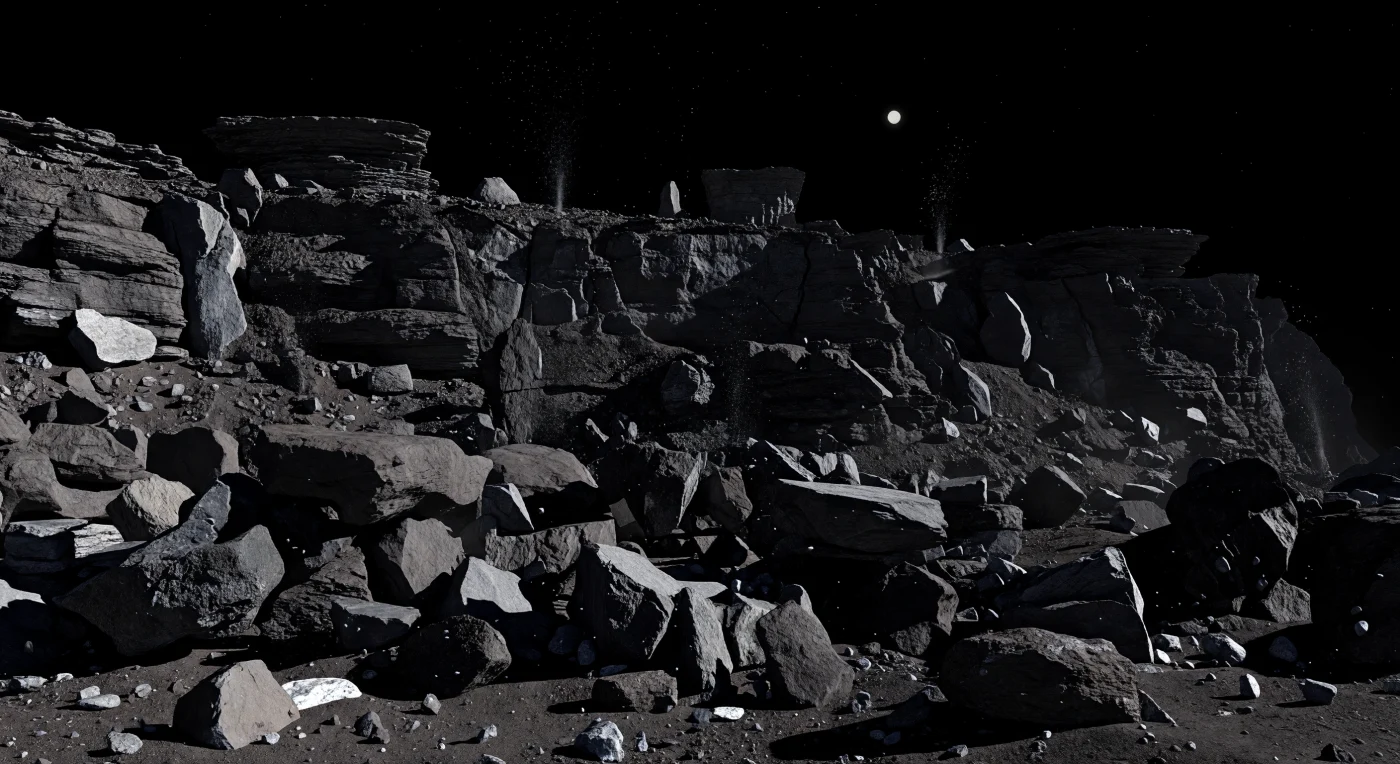
At the foot of a towering scarp, the ground is a jumbled apron of razor-edged blocks so dark they swallow the light, their freshly broken faces flashing cooler gray where the comet’s black, organic-rich crust has split open. In this almost nonexistent gravity, the rubble rests in improbable stacks and overhangs, with fine dark dust pooled in hollows, a few dirty ice patches hidden in permanent shade, and tiny grains drifting between the boulders as if the landscape itself is only loosely attached. Above, the near-vertical wall rises in fractured layers, collapsed niches, and jagged ledges, while faint jets of gas and dust leak from higher cracks—evidence that buried volatile ices are still sublimating under the Sun’s weak but harsh illumination. With no air to soften the scene, every edge is cut by stark side light and every shadow falls into absolute black, making this small, violent world feel immense, raw, and profoundly alien.

From this shattered summit, the ground is a patchwork of almost black crustal plates, angular cobbles, and charcoal-fine dust, broken here and there by cold white flashes of exposed ice. Beyond the knob, jagged ridges, flat-topped mesas, collapsed pits, and abrupt cliff bands fall away toward a dramatically curved horizon, making the comet’s tiny, roughly 5-kilometer nucleus feel startlingly small beneath a sky of absolute black. In the airless vacuum, sunlight arriving from 1.59 AU is still fierce but less intense than at Earth, and the Sun appears only about two-thirds as wide, carving razor-sharp shadows across dark organic-rich dust, dirty ice, and loosely bound debris shaped by microgravity and episodic outgassing. Far off, faint jets rise from illuminated scarps and pit walls, lofting dust in slow arcs above this primordial surface—a rugged remnant of the early Solar System, built from refractory material, ice, and ancient grains now exposed in an alien landscape of stark silence.

At ground level, the surface is a startling study in extremes: a crust darker than burnt coal, fractured into brittle ledges and rubble, suddenly broken by a fresh slump that reveals a bluish-white to pale gray patch of granular ice glinting in the Sun. Around it rise the nucleus’s signature landforms—steep cliffs, layered terraces, mesa-like blocks, sharp pinnacles, overhangs, and pit-rimmed hollows—made possible by gravity so feeble that dust grains and small fragments can lift off and drift in slow ballistic arcs. In the hard, airless light, razor-edged shadows slice across the charcoal terrain while faint wisps of gas and dust seep from the new exposure, a visible sign of sublimation as long-buried volatile ices warm and escape directly into vacuum. The scene feels both intimate and immense: a collapse scar only tens of meters wide, yet set within a jagged, miniature world of primordial ice, organics, and dust that has only recently been awakened by the Sun.

From the edge of this narrow chasm, the ground falls away into a darkness so complete that the trench floor nearly disappears, while only the upper rims and a few shattered ledges catch the weak, low Sun under a perfectly black sky. The surface is a brittle crust of carbon-rich dust, refractory organics, and dirty ice, broken into angular slabs, sharp boulders, and granular regolith that can rest on improbably steep slopes because gravity here is almost negligible. Along the deepest shaded recesses, thin bluish-white frost and exposed ice survive as cold-trap veneers, preserved in vacuum where there is no air to soften the light or redistribute heat, leaving shadows razor-edged and temperatures brutally divided between sunlit and dark terrain. Towering walls of fractured scarps, overhangs, and collapsed mesas reveal a small world that is nonetheless violently rugged, its freshly activated surface etched by sublimation and collapse into a landscape that feels both miniature and immense when you stand at its brink.

At ground level, this silent basin appears almost lightless: a matte plain of black-brown dust crust and granular regolith, split into plates and shallow fractures, strewn with porous boulders, and interrupted by faint frost gleaming from permanently shadowed hollows. Beyond it, steep mesas, razor-edged pinnacles, collapsed scarps, and deep pits rise with improbable sharpness, their exposed layers revealing a fragile mixture of dark refractory dust, organic-rich material, and buried ice preserved in the deep cold. In the comet’s vanishingly weak gravity, cliffs and overhangs can stand far steeper than they could on a larger world, while the lack of any atmosphere leaves every shadow perfectly black and every edge unnervingly crisp under a small, distant Sun. With no jets, no drifting dust, and no sound in the vacuum, the landscape feels suspended between activity and deep freeze, a frozen archive of primitive solar-system material resting beneath a star-filled black sky.