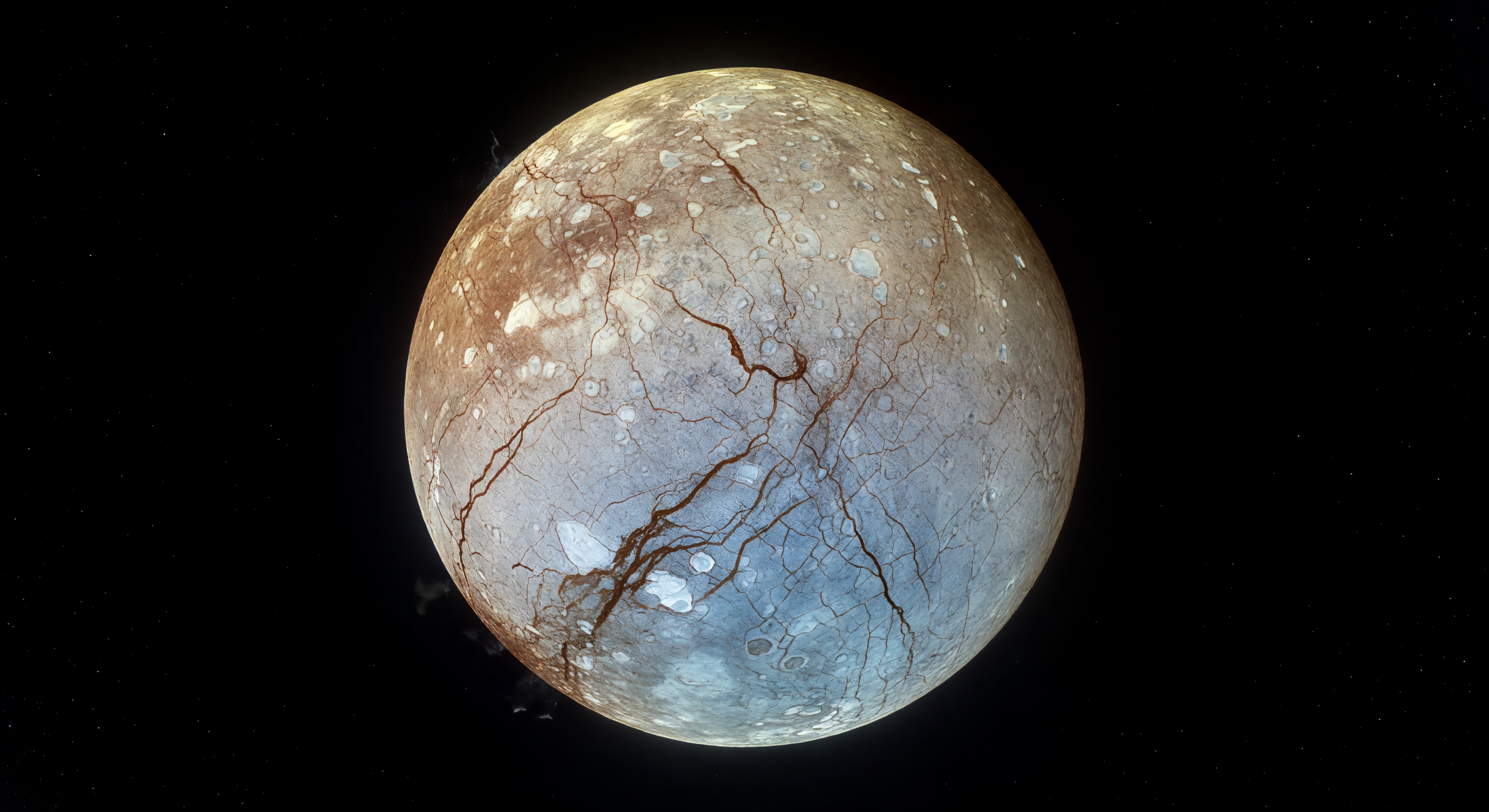
Scientific confidence: High
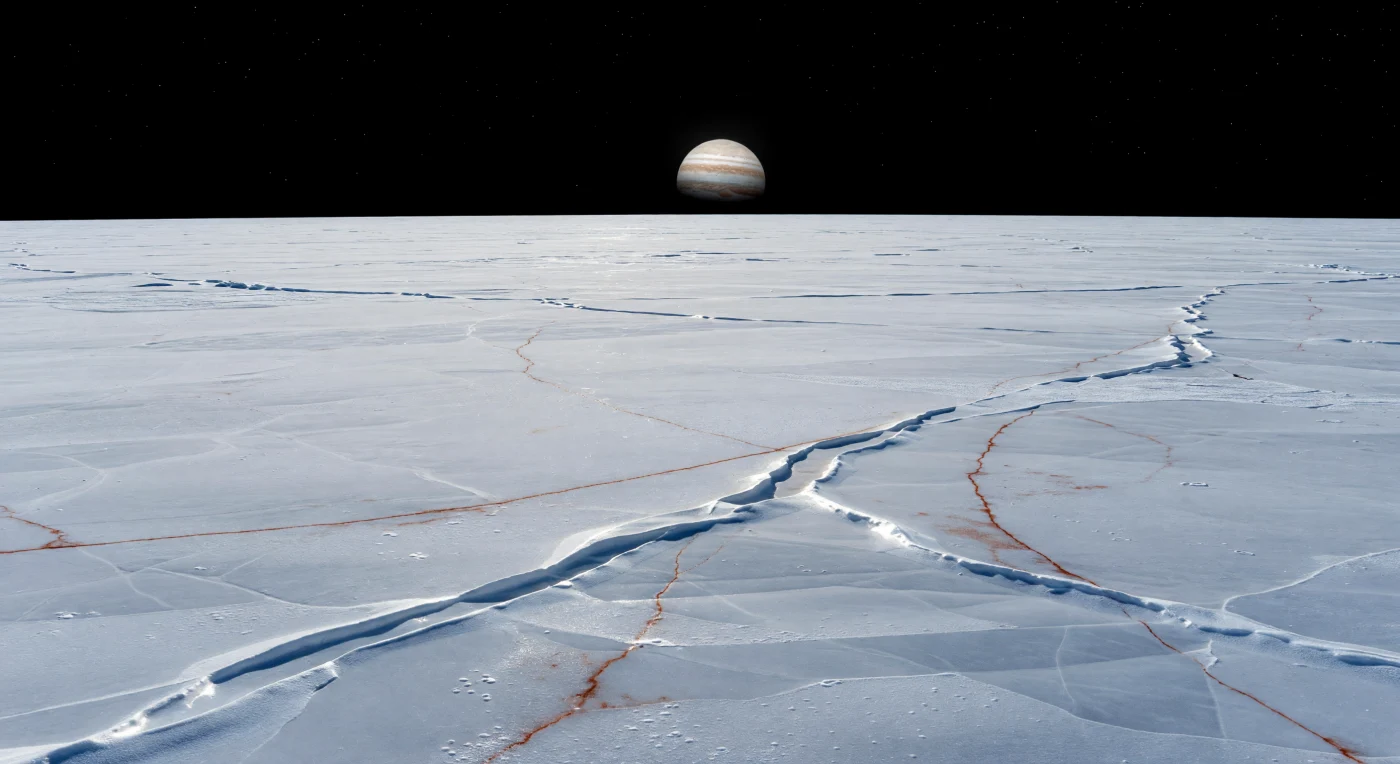
At your feet, hard glassy plates of bluish-white water ice are etched with polygonal cracks, frost textures, and tiny sublimation pits, while beyond them an immense, almost unnervingly smooth plain runs to a gently curved horizon under a pure black sky. Thin reddish-brown lineae and low double ridges cut diagonally across the pale surface, their rusty stains marking hydrated salts and radiation-processed non-ice material brought up along fractures in the icy shell. In the harsh noon sunlight—cast by a Sun much smaller than Earth’s—every crest throws a short, razor-sharp shadow, and the lack of air leaves even the farthest terrain stark and crystal clear. The landscape feels vast yet low and restrained, shaped not by wind or flowing water but by tidal flexing that cracks, shifts, and subtly rebuilds an ice crust hiding a deep saline ocean below.

At ground level, the landscape is a frozen wreckage of enormous water-ice plates—white to blue-white slabs tilted, rotated, and jammed together like shattered sea ice, their sharp edges casting long black shadows across narrow crevasses and uneven ridges. Between them lies a rough, sepia-brown chaos matrix of hummocky refrozen slush and brine-rich, salt-contaminated ice, material thought to have been churned upward and frozen again as tidal flexing fractured and mobilized the shell above a hidden global ocean. In the distance, the broken maze gives way to brighter fractured plains streaked with faint reddish lineae, while the gently curving horizon hints at the small size of this world and the immense scale of the disruption. Overhead, the sky is perfectly black and airless, the Sun a hard, distant point of light that makes the clean ice glitter coldly, and—if you stand on the Jupiter-facing side—the giant banded planet hangs huge above the horizon, turning the silence into something vast, hostile, and unforgettable.

You stand within a colossal ice corridor where twin ridges of fractured water ice tower tens to more than a hundred meters overhead, their frost-bright slabs, shattered plates, and knife-edged crests carved into stark relief by a low, distant Sun in a sky black with vacuum. Between them lies a broad trough of darker, rust-brown ice and dusty lag, colored by salts and sulfuric compounds altered by relentless bombardment from Jupiter’s radiation environment, while crevasses, pits, and refrozen-looking textures record a shell that has been stretched, split, and uplifted by powerful tidal flexing above a hidden global ocean. In the weak gravity, the landscape feels both immense and eerily still: razor-sharp shadows pool in every crack, smooth ice flashes with cold white glints, and the corridor runs onward toward a curved horizon lined with more ridges, lineae, and disrupted ice plains. Hanging low above it all, Jupiter looms as a giant banded disk, making the frozen silence feel not empty, but electrically charged with the geology of an active ocean world.

A vast pull-apart band cleaves the bright ice plain like a frozen spreading center, its darker interior filled with striated grooves, tilted rafts of broken crust, and jagged pressure-cracked margins stained rusty brown and umber by salts and radiation-altered surface chemistry. On either side, older water-ice terrain stretches away in cream-white and pale bluish tones, fractured into broad plates laced with thin reddish lineae, low double ridges, shallow troughs, and scattered pits, all rendered with startling clarity in the airless, near-black sky. The small, intense Sun casts hard-edged shadows across frost-granular ridges and exposed ice, while the low gravity helps preserve unusually sharp fracture faces and subtly steep relief. Standing here, you would feel the scale of an active icy shell being pulled apart over tens of kilometers, a brittle surface recording the slow rise, rupture, and freezing of material above a hidden global ocean.
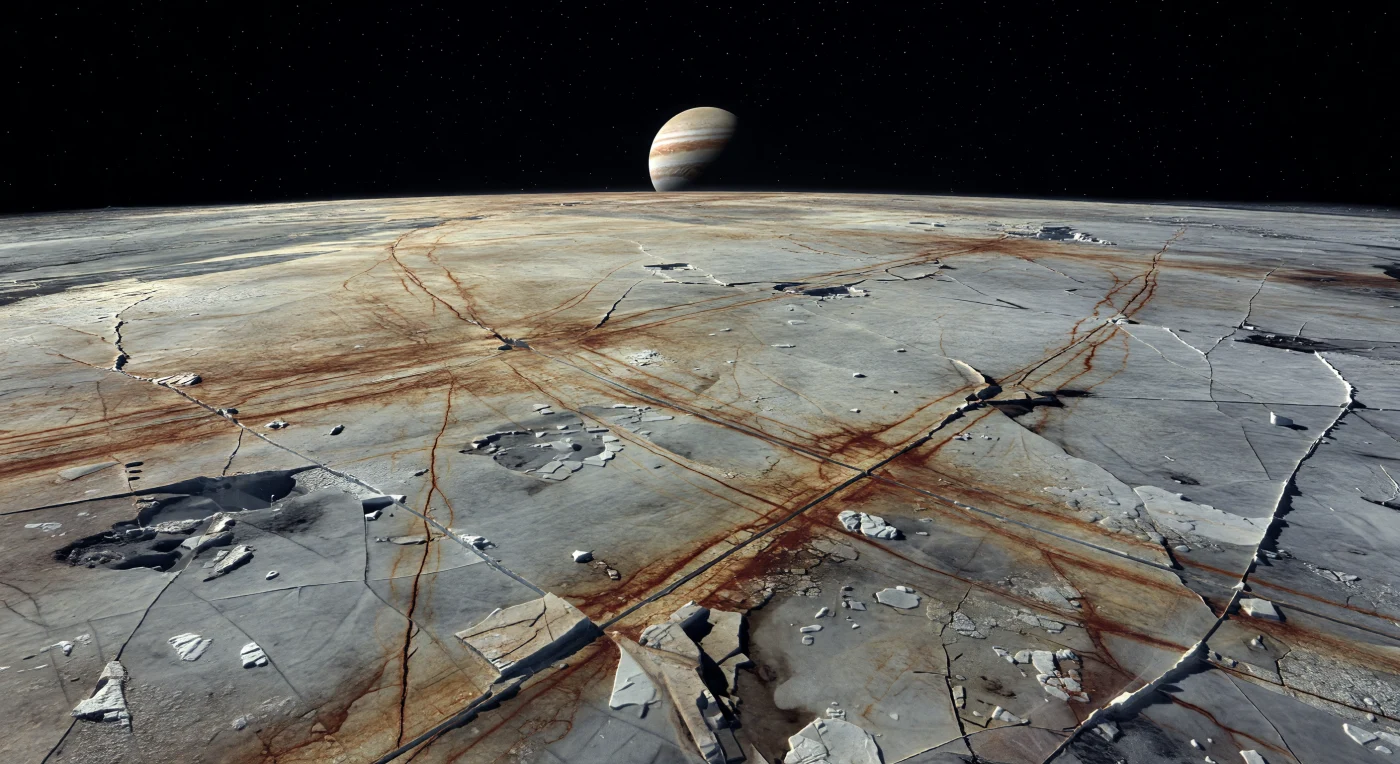
Across the horizon stretches a hard, gently rolling plain of gray-white water ice, its brittle crust slashed in every direction by intersecting ridges, twin fractures, and broad disrupted bands stained ochre, sepia, and rusty brown. These darker markings are the scars of intense radiation chemistry: energetic particles alter the ice and implant sulfur compounds, producing sulfuric-acid-rich materials that dirty and chemically weather the surface, especially along the more heavily bombarded terrain. Between the major lineae, the frozen ground breaks into angular plates, shallow troughs, low pressure ridges, pits, and small chaos-like patches where tilted blocks have partly refrozen into smoother ice, while fresh crack edges gleam brighter where cleaner water ice is newly exposed. Under a tiny, cold Sun and a black, airless sky, shadows fall ink-dark into the fractures and the distant curve of the horizon makes the entire landscape feel both starkly desolate and planetary in scale.

You stand on a shattered plain so bright it seems to glow, where fresh water-ice blasted out by a young impact lies in angular blocks, glittering frost-crusted slabs, and powdery ray deposits strewn across fractured crust. Ahead, a low but sharply raised rim arcs across the middle distance, beyond it dropping into a darker crater floor faintly stained tan to rust-brown by irradiated salts and other non-ice materials mixed into the ice. The foreground is split by reddish-brown lineae, shallow troughs, small ridges, fresh pits, and hummocky secondary-impact textures that reveal how recently this terrain was excavated and resurfaced. Under a small distant Sun, the airless black sky and near-vacuum make every shadow razor-edged and nearly pure black, while the broad, gently curving horizon and the immense planet hanging overhead emphasize the frozen, low-gravity vastness of this active icy world.
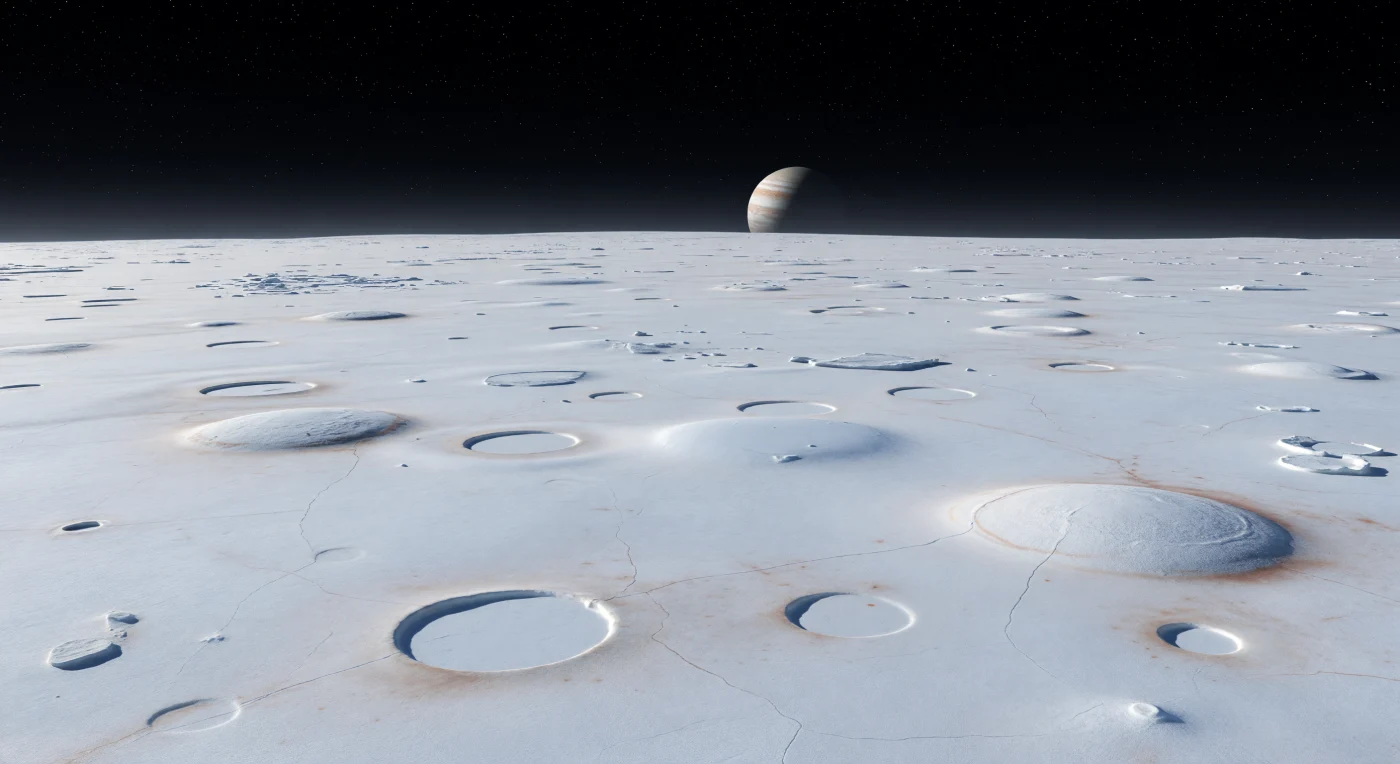
Across this broad icy plain, the ground seems haunted by giant overlapping discs—shallow pits, low domes, and barely perceptible swells several kilometers wide—emerging only where the low Sun catches their rims in blue-gray crescents and glints off the frost. The surface is a hard crust of ancient water ice, bright white to pale blue, dusted with fine frost and streaked with rusty tan radiolytic staining where salts and impurities have been altered by relentless bombardment from Jupiter’s magnetospheric particles. A few broken hummocks and disrupted plates hint that the ice shell here has been subtly mobilized from below, part of a landscape thought to record warm-ice upwellings, partial melt, or diapir-like deformation above a hidden saline ocean. Under the pure black sky of the near-vacuum exosphere, with stars sharp and the horizon gently curved by the small world’s size, the scene feels at once starkly silent and immense—as if you are standing on frozen skin stretched over an active interior.
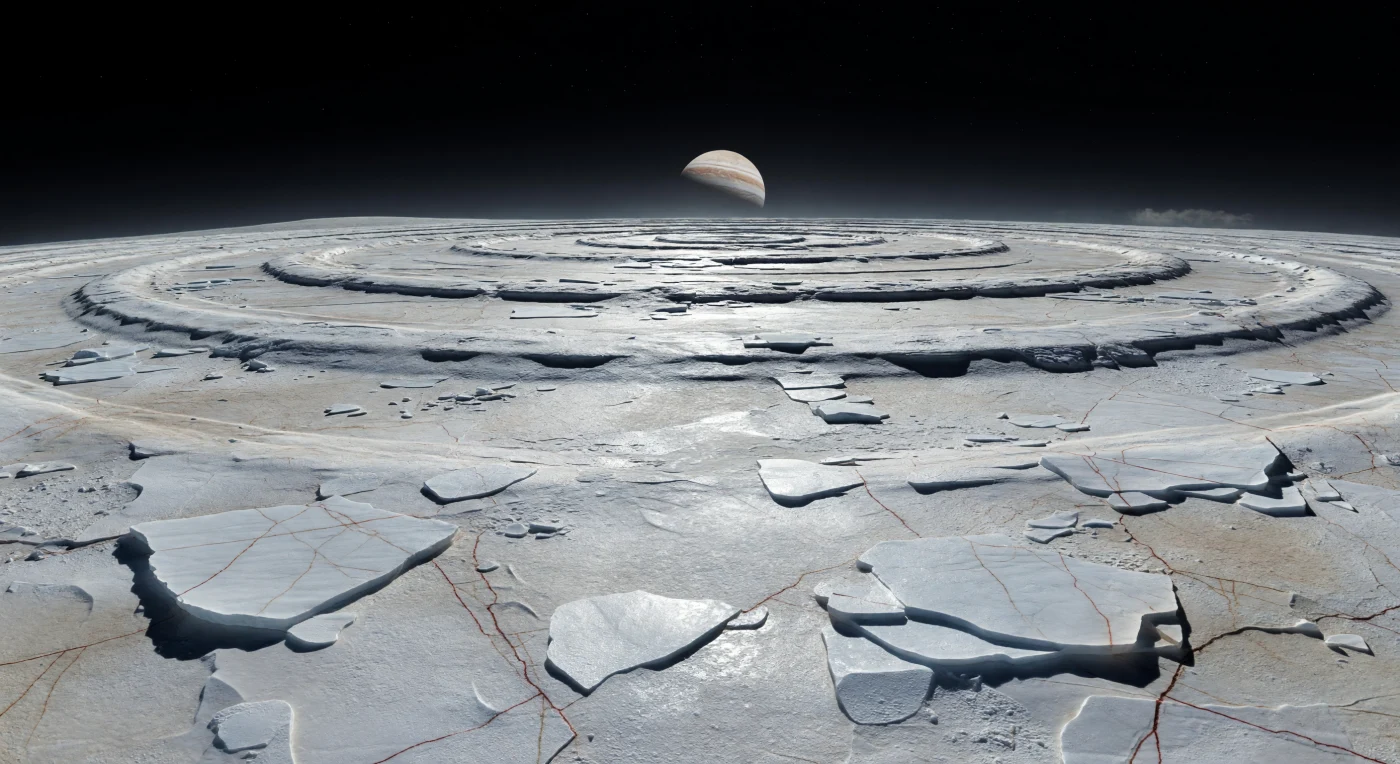
Low, sweeping arcs of ice rise and fall across the plain in vast concentric rings, their rounded ridges only modestly high yet stretching for kilometers toward a gently curved horizon that reveals the small size of this frozen world. Under a small, low Sun and a black, airless sky, hard water-ice regolith, broken plates, and bright frost glitter with sharp reflections, while razor-edged shadows pick out shallow troughs, hummocky crust, scattered angular blocks, and faint double ridges left by an ancient impact that fractured and reorganized the surface. Thin dark lineae and rusty-red to brown fracture fills trace the ice like stains in porcelain, likely marking salts and sulfur-bearing materials altered by intense radiation and tectonic disruption. The scene feels both stark and immense: a brittle shell of frozen ocean, silent and dry at the surface, yet shaped from below by a hidden sea and from above by relentless impacts and Jupiter’s tidal pull.
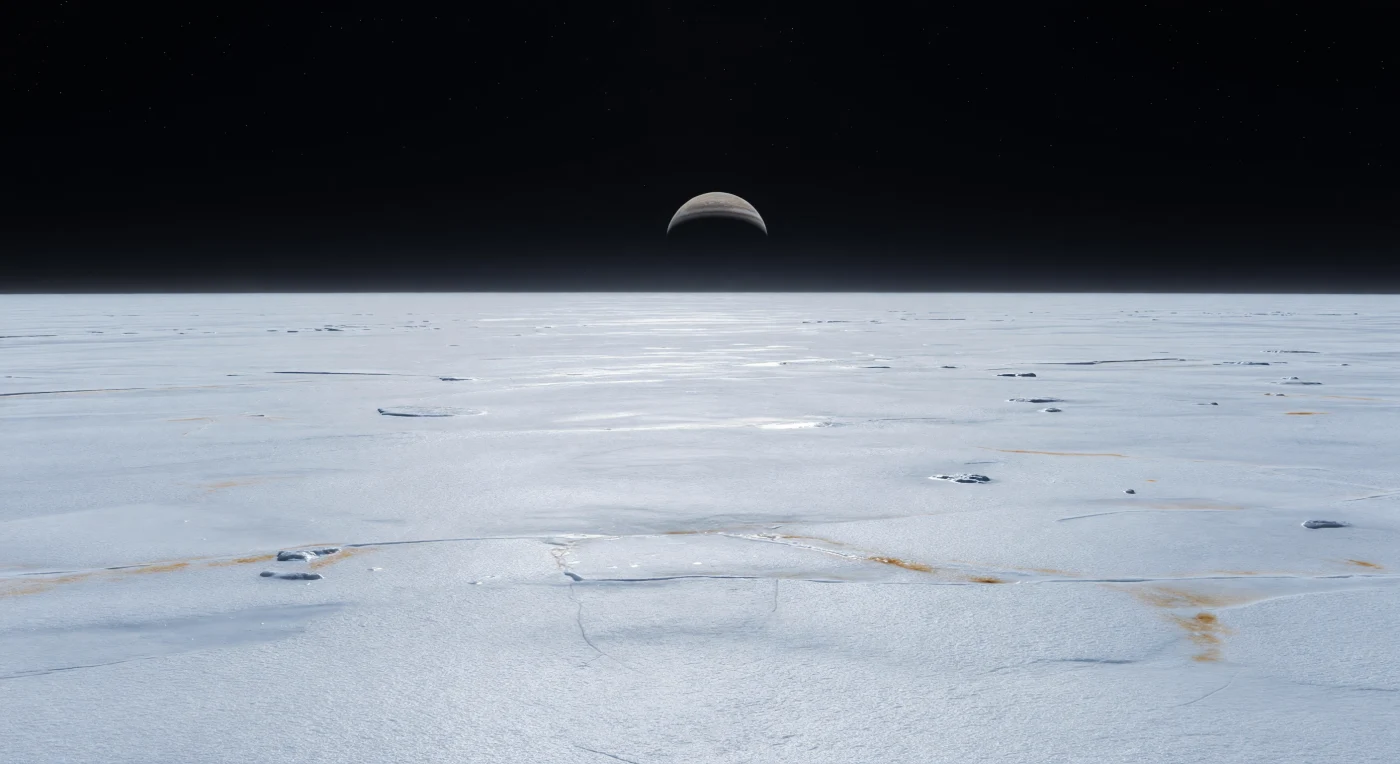
A vast plain of bright water ice stretches outward in almost unnerving perfection, its refrozen crust so smooth that only hairline fractures, shallow grooves, and a few barely perceptible swells break the surface before it meets a gently curving horizon. Under the hard, weak sunlight of an airless sky, the sintered frost flashes here and there with razor-bright reflections, while faint tan and rusty stains along some cracks hint at salts and sulfur compounds altered by intense radiation. This is geologically young terrain, resurfaced and frozen again over an active ice shell that conceals a global saline ocean below, with tidal flexing continually renewing parts of the crust even as the exposed surface remains bitterly cold and utterly dry. In the silence, with crisp black shadows at your feet and a giant banded world hanging low overhead, the tiny relief of each crack only makes the surrounding emptiness feel more immense.
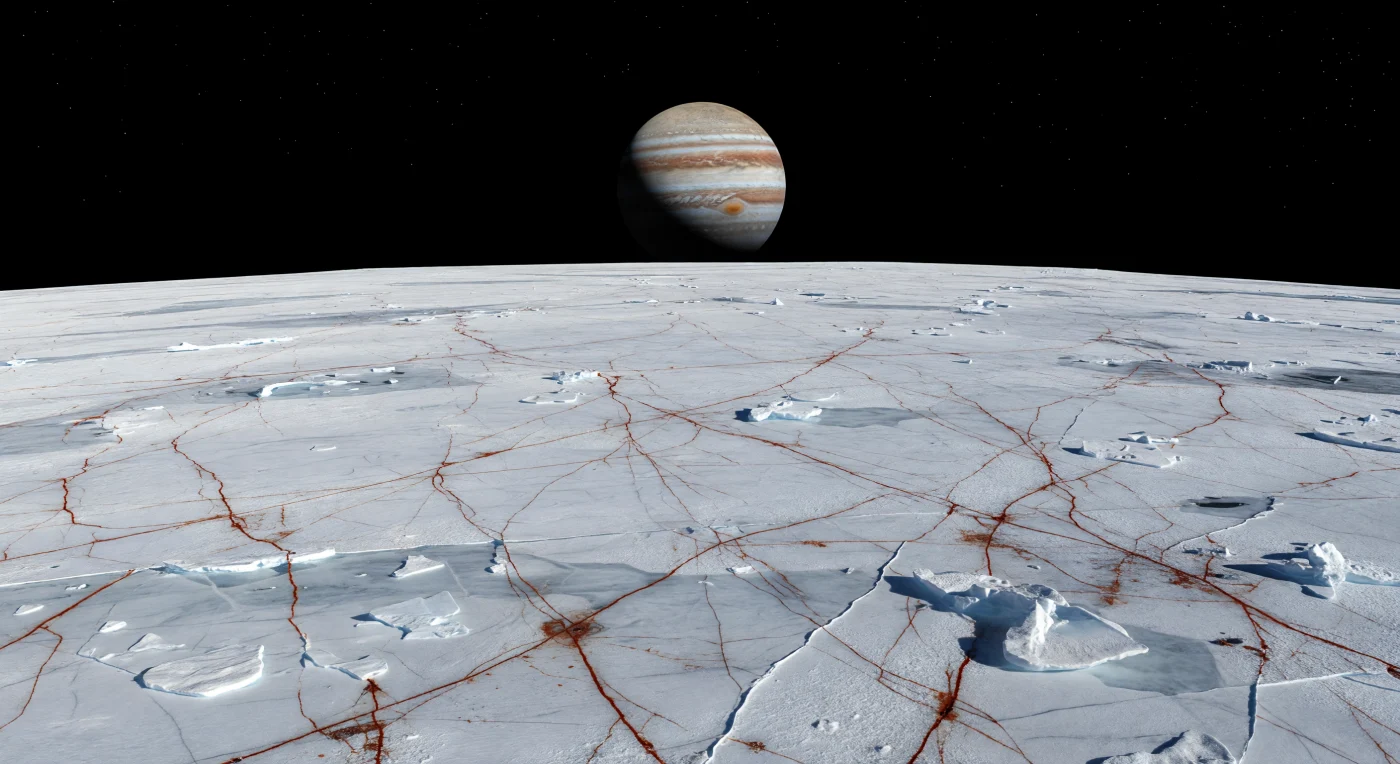
An immense, almost perfectly level plain of water ice stretches to a softly curved horizon, its white and pale blue crust split everywhere by rusty-red seams, double ridges, shallow troughs, and scattered patches of broken chaos terrain where slabs of ice have shifted and frozen back into place. Above this frozen expanse hangs Jupiter, enormous and nearly motionless in the black sky, its cream, tan, and brown cloud bands looming low overhead and casting a faint warm glow into the blue shadows cut by the small, hard Sun. The surface here is not snow or soil but a brittle shell of fractured ice, dusted with frost and stained along its cracks by salts and other non-ice materials brought up or altered by radiation, evidence of a geologically active crust flexed by powerful tides. Standing here, you would feel the stark scale of an ocean world turned inside out: a smooth globe of ice on the surface, a hidden saline sea below, and a giant planet dominating the silence above.

Under a black, star-crowded sky, the frozen plain glows faintly in Jupiter-shine, its silver-white ice and pale bluish frost cut by long reddish-brown fractures and twin ridges that run toward a gently curving horizon. At your feet, granular frost, translucent crust, and dark mineral-stained cracks reveal a surface made entirely of solid water ice, frozen brines, and salt-rich deposits, while low hummocky chaos terrain and scattered broken slabs hint at an ice shell repeatedly shattered and rearranged by powerful tidal flexing. Farther out, disrupted bands and shallow depressions fade into darkness, showing how a world that seems smooth from afar is actually a vast tectonic mosaic above a hidden global ocean. Overhead, the giant striped disk hanging in the sky casts cold silver-blue highlights and faint warm reflections across the ice, leaving shadows deep and razor-sharp in the near-vacuum and making the landscape feel both eerily still and immense beyond human scale.

At the polar horizon, a dazzling sheet of fine-grained water-ice frost stretches across a gently rolling plain, softening low scarps, shallow troughs, and buried pressure ridges into a landscape of almost blinding white and pale cyan sheen. Thin rusty-tan stains trace fractures and faint crosscutting lineae, where salts and other non-ice materials have been exposed and chemically altered by relentless irradiation, while angular ice blocks, crust plates, hummocks, and pits break the smoothness under razor-sharp, low-angle sunlight. With essentially no atmosphere to scatter light, the Sun hangs as a small hard disk just above the horizon, casting impossibly long shadows into blue-black pockets of permanent darkness and leaving the sky pure black even at day, with stars and the immense banded bulk of Jupiter suspended above the frozen plain. The slight curve of the horizon and the stark, airless clarity make the scene feel both intimate and immense, as if you are standing on the brittle skin of a hidden ocean in a silent vacuum at the edge of a world of ice.
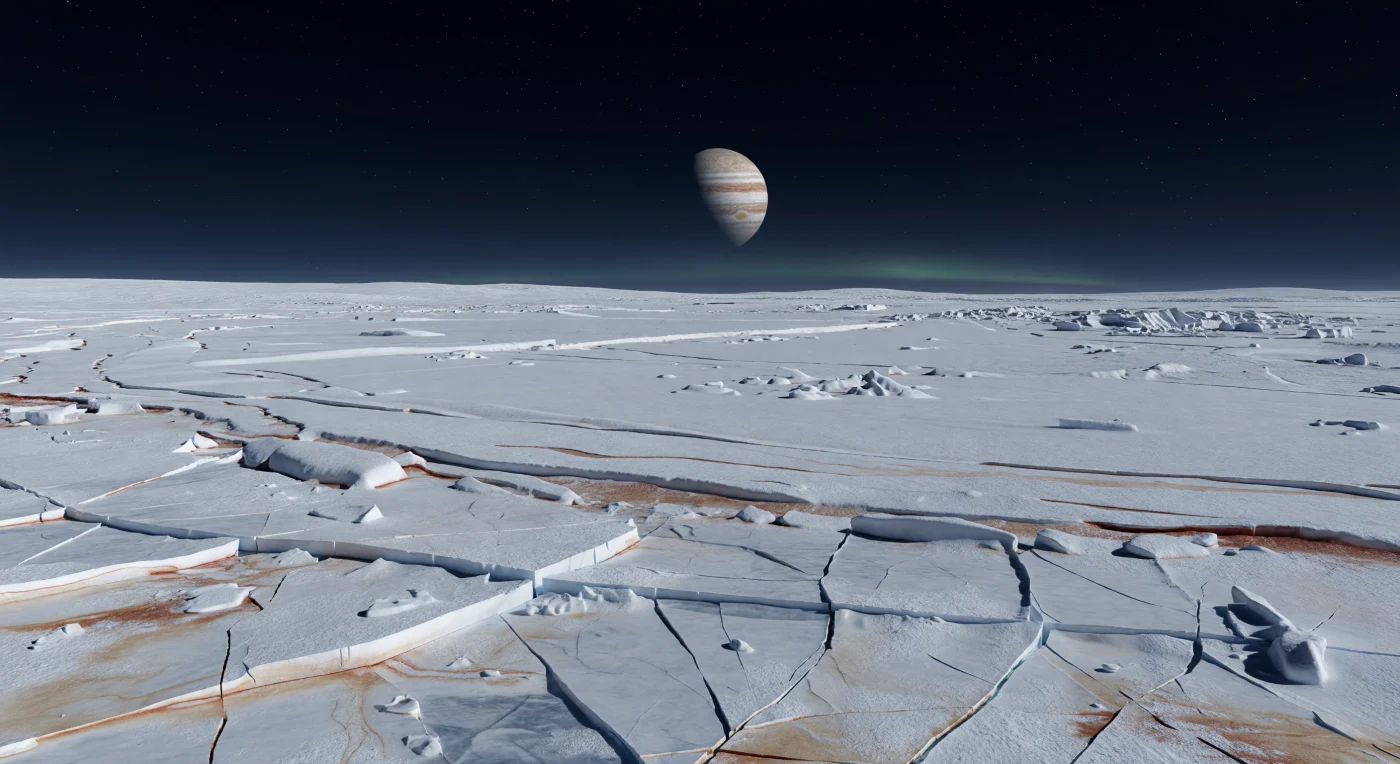
Under a star-crowded black sky, a vast plain of fractured water ice stretches to a gently curved horizon, its bluish-white and ivory crust broken into hard plates, rafted blocks, narrow dark lineae, and low double ridges dusted with fine frost. Rusty tan and reddish-brown stains trace the cracks where irradiated salts and sulfuric compounds have been altered by the intense particle environment, while distant chaos terrain forms a jumble of disrupted ice blocks hinting at a mobile shell above a hidden global ocean. Low above the horizon, the giant banded disk of Jupiter hangs as a muted cream-and-russet presence, providing only the faintest reflected light, so the landscape remains dim, cold, and almost soundless in the near-vacuum darkness. Along one stretch of the far limb, a ghostly bluish-green veil of oxygen aurora hovers just above the surface—far subtler than anything seen on Earth—an exospheric whisper shaped by the giant planet’s magnetosphere and too faint to brighten the frozen ground beneath your feet.

Under a total eclipse, the frozen plain drops into an eerie blue-gray twilight, lit only by faint Jupiter-shine and a scatter of hard, steady stars in a perfectly black sky where no atmosphere softens a single edge. At your feet, the surface is a crust of water ice glazed with crystalline frost and strewn with sharp ice fragments, while across the plain reddish-brown lineae—double ridges, fractures, and darker bands stained by salts and radiation-altered sulfur compounds—slice for kilometers through the luminous white crust. Nearby, hummocky chaos terrain rises in low jumbled mounds, where raft-like slabs of broken ice have tilted, shifted, and frozen into darker refrozen material, hinting at an active shell flexed by powerful tides above a hidden saline ocean. The low curved horizon, sparse craters, and immense dark bulk of Jupiter looming overhead make the landscape feel both starkly young and overwhelmingly vast, a silent world of solid ice, mineral-stained cracks, and shadow preserved in vacuum-sharp detail.
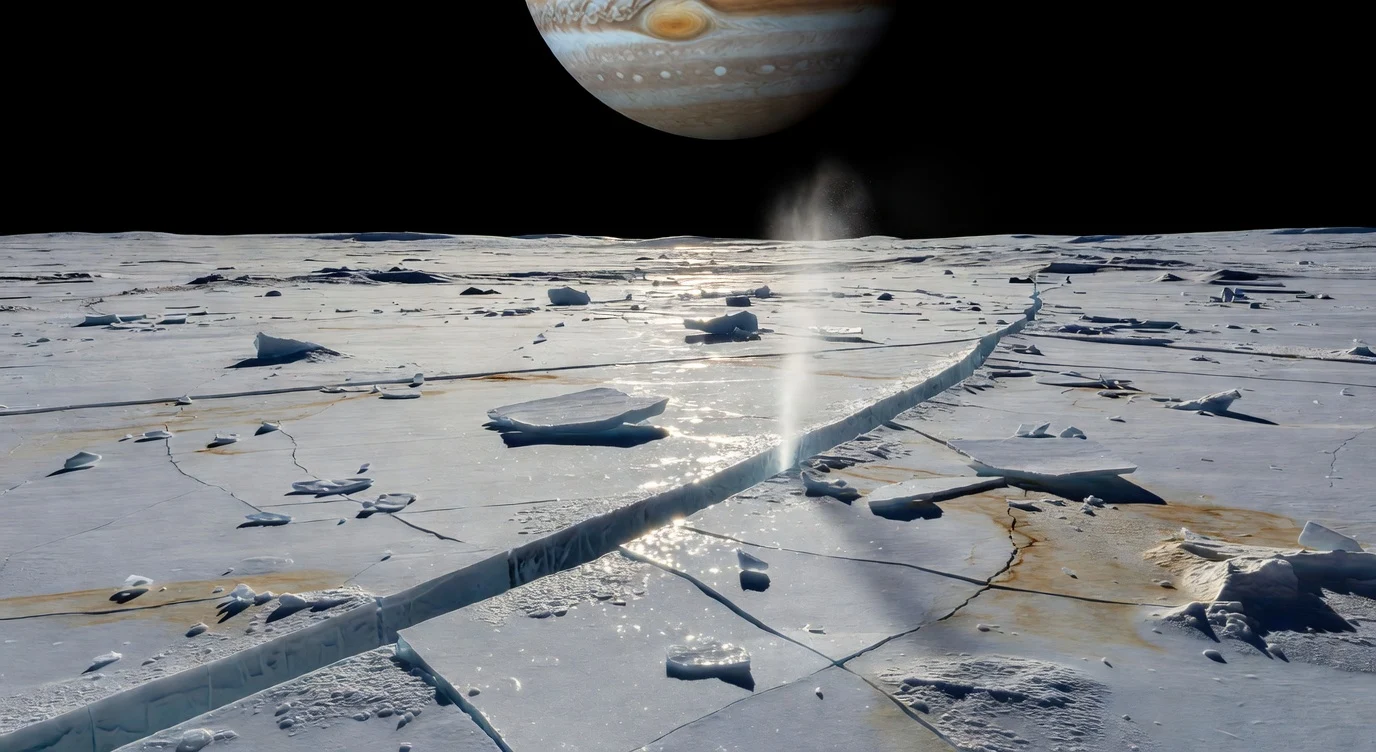
At your feet, a fresh fracture slices diagonally through the bright ice crust, its shadow-black interior bordered by sparkling aprons of newly condensed frost and surrounded by jagged slabs, low hummocks, and faint rust- and tan-colored stains left by salts and radiation-altered sulfur compounds. Beyond it stretches a smooth yet densely broken plain of water ice, etched with ridges, bands, pits, and patches of disrupted crust, while the gently curving horizon and low gravity make every sharp edge seem unnaturally crisp. In the airless darkness above, a narrow plume of water vapor and fine ice grains rises from the crack as a ghostly fan, visible only where the distant Sun catches its rim and turns it silver against space before it thins into vacuum. Overhead, Jupiter looms immense and banded, while the fissure below hints at the tidal flexing that fractures the ice shell and may connect this frozen surface to a hidden saline ocean far beneath.